


How Did Russia-Ukraine War Trigger a Food Crisis?

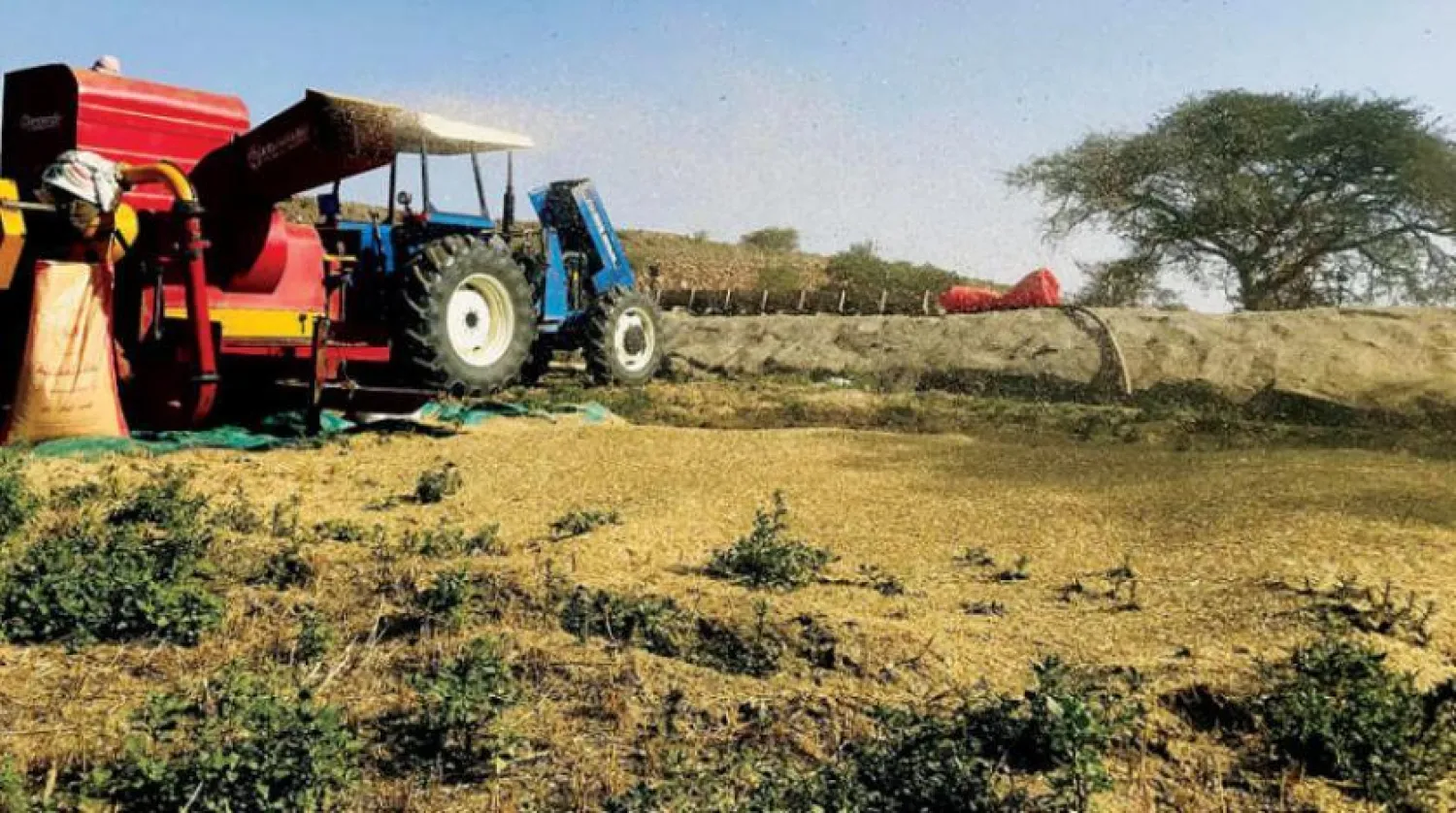
Arab countries could face a food shortage crisis if they do not address the existing challenges. (Asharq Al-Awsat)
TT

How Did Russia-Ukraine War Trigger a Food Crisis?

Arab countries could face a food shortage crisis if they do not address the existing challenges. (Asharq Al-Awsat)

Russian hostilities in Ukraine are preventing grain from leaving the “breadbasket of the world" and making food more expensive across the globe, threatening to worsen shortages, hunger and political instability in developing countries.

Together, Russia and Ukraine export nearly a third of the world’s wheat and barley, more than 70% of its sunflower oil, and are big suppliers of corn. Russia is the top global fertilizer producer, The Associated Press said.

World food prices were already climbing, and the war made things worse, preventing some 20 million tons of Ukrainian grain from getting to the Middle East, North Africa and parts of Asia.

Weeks of negotiations on safe corridors to get grain out of Ukraine's Black Sea ports have made little progress, with urgency rising as the summer harvest season arrives.

“This needs to happen in the next couple of months (or) it’s going to be horrific,’’ said Anna Nagurney, who studies crisis management at the University of Massachusetts Amherst and is on the board of the Kyiv School of Economics.

She says 400 million people worldwide rely on Ukrainian food supplies. The UN Food and Agriculture Organization projects that up to 181 million people in 41 countries could face food crisis or worse levels of hunger this year.

Here’s a look at the global food crisis:
WHAT'S THE SITUATION?
Typically, 90% of wheat and other grain from Ukraine's fields are shipped to world markets by sea but have been held up by Russian blockades of the Black Sea coast.

Some grain is being rerouted through Europe by rail, road and river, but the amount is a drop in the bucket compared with sea routes. The shipments also are backed up because Ukraine’s rail gauges don't match those of its neighbors to the west.

Ukraine’s deputy agriculture minister, Markian Dmytrasevych, asked European Union lawmakers for help exporting more grain, including expanding the use of a Romanian port on the Black Sea, building more cargo terminals on the Danube River and cutting red tape for freight crossing at the Polish border.

But that means food is even farther from those that need it.

“Now you have to go all the way around Europe to come back into the Mediterranean. It really has added an incredible amount of cost to Ukrainian grain,’’ said Joseph Glauber, senior research fellow at the International Food Policy Research Institute in Washington.

Ukraine has only been able to export 1.5 million to 2 million tons of grain a month since the war, down from more than 6 million tons, said Glauber, a former chief economist at the US Department of Agriculture.

Russian grain isn't getting out, either. Moscow argues that Western sanctions on its banking and shipping industries make it impossible for Russia to export food and fertilizer and are scaring off foreign shipping companies from carrying it.

Russian officials insist sanctions be lifted to get grain to global markets.

European Commission President Ursula von der Leyen and other Western leaders say, however, that sanctions don't touch food.

WHAT ARE THE SIDES SAYING?
Ukraine has accused Russia of shelling agricultural infrastructure, burning fields, stealing grain and trying to sell it to Syria after Lebanon and Egypt refused to buy it. Satellite images taken in late May by Maxar Technologies show Russian-flagged ships in a port in Crimea being loaded with grain and then days later docked in Syria with their hatches open.

Ukrainian President Volodymyr Zelensky says Russia has provoked a global food crisis. The West agrees, with officials like European Council President Charles Michel and US Secretary of State Antony Blinken saying Russia is weaponizing food.

Russia says exports can resume once Ukraine removes mines in the Black Sea and arriving ships can be checked for weapons.

Russian Foreign Minister Sergey Lavrov promised that Moscow would not “abuse” its naval advantage and would “take all necessary steps to ensure that the ships can leave there freely.”

Ukrainian and Western officials doubt the pledge. Turkish Foreign Minister Mevlut Cavusoglu said this week that it may be possible to create secure corridors without the need to clear sea mines because the location of the explosive devices are known.

But other questions would still remain, such as whether insurers would provide coverage for ships.

Dmytrasevych told the EU agriculture ministers this week that the only solution is defeating Russia and unblocking ports: “No other temporary measures, such as humanitarian corridors, will address the issue.”

HOW DID WE GET HERE?
Food prices were rising before the invasion, stemming from factors including bad weather and poor harvests cutting supplies, while global demand rebounded strongly from the COVID-19 pandemic.

Glauber cited poor wheat harvests last year in the United States and Canada and a drought that hurt soybean yields in Brazil. Also exacerbated by climate change, the Horn of Africa is facing one of its worst droughts in four decades, while a record-shattering heat wave in India in March reduced wheat yields.

That, along with soaring costs for fuel and fertilizer, has prevented other big grain-producing countries from filling in the gaps.

WHO’S HARDEST HIT?
Ukraine and Russia mainly export staples to developing countries that are most vulnerable to cost hikes and shortages.

Countries like Somalia, Libya, Lebanon, Egypt and Sudan are heavily reliant on wheat, corn and sunflower oil from the two warring nations.

“The burden is being shouldered by the very poor," Glauber said. “That’s a humanitarian crisis, no question.’’

Beside the threat of hunger, spiraling food prices risk political instability in such countries. They were one of the causes of the Arab Spring, and there are worries of a repeat.

The governments of developing countries must either let food prices rise or subsidize costs, Glauber said. A moderately prosperous country like Egypt, the world's top wheat importer, can afford to absorb higher food costs, he said.

“For poor countries like Yemen or countries in the Horn of Africa — they’re really going to need humanitarian aid," he said.

Starvation and famine are stalking that part of Africa. Prices for staples like wheat and cooking oil in some cases are more than doubling, while millions of livestock that families use for milk and meat have died. In Sudan and Yemen, the Russia-Ukraine conflict came on top of years of domestic crises.

UNICEF warned about an “explosion of child deaths” if the world focuses only on the war in Ukraine and doesn’t act. UN agencies estimated that more than 200,000 people in Somalia face “catastrophic hunger and starvation,” roughly 18 million Sudanese could experience acute hunger by September and 19 million Yemenis face food insecurity this year.

Wheat prices have risen in some of those countries by as much as 750%.

“Generally, everything has become expensive. Be it water, be it food, it’s almost becoming quite impossible,” Justus Liku, a food security adviser with the aid group CARE, said after visiting Somalia recently.

Liku said a vendor selling cooked food had “no vegetables or animal products. No milk, no meat. The shopkeeper was telling us she’s just there for the sake of being there."

In Lebanon, bakeries that used to have many types of flat bread now only sell basic white pita bread to conserve flour.

WHAT'S BEING DONE?
For weeks, UN Secretary-General Antonio Guterres has been trying to secure an agreement to unblock Russian exports of grain and fertilizer and allow Ukraine to ship commodities from the key port of Odesa. But progress has been slow.

A vast amount of grain is stuck in Ukrainian silos or on farms in the meantime.
And there's more coming — Ukraine’s harvest of winter wheat is getting underway soon, putting more stress on storage facilities even as some fields are likely to go unharvested and because of the fighting.

Serhiy Hrebtsov can’t sell the mountain of grain at his farm in the Donbas region because transport links have been cut off. Scarce buyers mean prices are so low that farming is unsustainable.

“There are some options to sell, but it is like just throwing it away,” he said.

US President Joe Biden says he’s working with European partners on a plan to build temporary silos on Ukraine's borders, including with Poland, a solution that would also address the different rail gauges between Ukraine and Europe.

The idea is that grain can be transferred into the silos, and then “into cars in Europe and get it out to the ocean and get it across the world. But it’s taking time," he said in a speech Tuesday.

Dmytrasevych said Ukraine’s grain storage capacity has been reduced by 15 million to 60 million tons after Russian troops destroyed silos or occupied sites in the south and east.

WHAT’S COSTING MORE?
World production of wheat, rice and other grains is expected to reach 2.78 billion tons in 2022, down 16 million tons from the previous year — the first decline in four years, the UN Food and Agriculture Organization said.

Wheat prices are up 45% in the first three months of the year compared with the previous year, according to the FAO's wheat price index. Vegetable oil has jumped 41%, while sugar, meat, milk and fish prices also have risen by double digits.

The increases are fueling faster inflation worldwide, making groceries more expensive and raising costs for restaurant owners, who have been forced to increase prices.

Some countries are reacting by trying to protect domestic supplies. India has restricted sugar and wheat exports, while Malaysia halted exports of live chickens, alarming Singapore, which gets a third of its poultry from its neighbor.

The International Food Policy Research Institute says if food shortages grow more acute as the war drags on, that could lead to more export restrictions that further push up prices.

Another threat is scarce and costly fertilizer, meaning fields could be less productive as farmers skimp, said Steve Mathews of Gro Intelligence, an agriculture data and analytics company.

There are especially big shortfalls of two of the main chemicals in fertilizer, of which Russia is a big supplier.

“If we continue to have the shortage of potassium and phosphate that we have right now, we will see falling yields," Mathews said. “No question about it in the coming years."


What Does Trump Want in Iran? 

An anti-US mural on a building in Tehran, Iran, January 24, 2026. Majid Asgaripour/WANA (West Asia News Agency) via Reuters
TT

What Does Trump Want in Iran? 

An anti-US mural on a building in Tehran, Iran, January 24, 2026. Majid Asgaripour/WANA (West Asia News Agency) via Reuters

President Donald Trump's threats to attack Iran provide little detail on what the long-term US goal would be in the event of a sustained or even brief conflict.

Trump sent warships and dozens of fighter planes to the Middle East and has several options to choose from that could destabilize the region.

Will Trump order surgical strikes targeting Iran's Revolutionary Guard Corps, the backbone of the clerical regime in power, try to take out its missile program -- as Israel wants him to do -- or even try to force regime change in Tehran?

Iran has threatened severe reprisal if it is attacked.

- What are the options? -

Trump said Thursday he would decide in 10 or 15 days whether to order strikes on Iran if no nuclear deal is reached.

The news outlet Axios has reported that Trump was presented with an array of military options that include a direct attack on Iran's supreme leader, Ali Khamenei.

Trump has said many times he prefers a diplomatic route leading to an agreement that addresses not only Iran's nuclear program but also its ballistic missile capability and its support for armed groups such as Hezbollah and Hamas. Iran has said no to making such concessions.

The United States and Iran recently held two rounds of indirect talks, in Oman and Switzerland. They have not brought the two sides' position closer, with talks set to resume Thursday in Switzerland.

Trump is "surprised" that Iran has not "capitulated" given the massive US military buildup, his envoy Steve Witkoff has said.

"The Trump administration most likely aims for a limited conflict that reshapes the balance of power without trapping it in a quagmire," said Alex Vatanka, an analyst at the Middle East Institute in Washington.

Vatanka said Iran is now expecting "a short, high-impact military campaign that would cripple Iran's missile infrastructure, undermine its deterrent, and reset the balance of power after the 12-day war with Israel in June 2025."

- What is the justification? -

Trump has insisted US forces destroyed Iran's nuclear program in attacks targeting uranium enrichment facilities.

Things changed with the January protest movement in Iran that security forces put down with huge loss of life.

Trump threatened several times to intervene to "help" the Iranian people, but did not act.

Trump boasts often of having brought peace to the Middle East, citing the oft-violated ceasefire he engineered in Gaza between Hamas and Israel.

And he has argued that regime change in Iran would strengthen what he calls a dynamic toward peace in the region.

But opposition Democrats are worried that Trump is leading America into a violent mess and demanding that he consult Congress, the only body in the United States with the authority to declare war.

- US firepower in the region? -

The US military now has 13 warships stationed in the Middle East: the aircraft carrier USS Abraham Lincoln, which arrived late last month, nine destroyers and three frigates.

More warships are on the way. The world's largest vessel, the US aircraft carrier USS Gerald Ford, was photographed sailing through the Strait of Gibraltar to enter the Mediterranean on Friday.

Besides the many planes parked on the aircraft carriers, the United States has sent a powerful force of dozens of warplanes to the Middle East, and tens of thousands of US troops are stationed across the Middle East.

These are potential targets for attack by Iran.

- To what end? -

Richard Haas, the former president of the Council on Foreign Relations, said it is not clear what impact a conflict of any duration and scale would have on Iran's government.

"It could just as easily strengthen it as weaken it. And it is impossible to know what would succeed this regime if it were to fall," Haas wrote recently on Substack.

Secretary of State Marco Rubio told a Senate hearing late last month that no one really knows what will happen if Iran's Supreme leader falls "other than the hope that there would be some ability to have somebody within their systems that you could work towards a similar transition."

Mona Yacoubian, of the Center for Strategic and International Studies, recently told AFP that Iran is much more complex than Venezuela, which the United States attacked January 3 as it captured its leader Nicolas Maduro.

She said Iran has more diffuse centers of power and a "decapitation strike" could end up "really unleashing a mess inside of Iran."


Saudi Arabia Revives Centuries of Heritage in Founding Day Celebrations

The Riyadh Municipality decorates the capital's roads and squares with more than 5,000 aesthetic illuminations in celebration of Founding Day (SPA)
TT

Saudi Arabia Revives Centuries of Heritage in Founding Day Celebrations

The Riyadh Municipality decorates the capital's roads and squares with more than 5,000 aesthetic illuminations in celebration of Founding Day (SPA)

As streets across Saudi cities were adorned in green and traditional attire, a series of major cultural and entertainment events were under way on Sunday across the Kingdom to mark Founding Day. Riyadh and cities nationwide were transformed into cultural and tourism destinations, attracting thousands of citizens, residents, and visitors who came to witness the legacy and impact of the epic nation-building journey that shaped the history of the Arabian Peninsula.

This year’s Founding Day coincided with the nights of the holy month of Ramadan, giving the celebrations a distinct national and cultural character, with evening events held in a Ramadan atmosphere. Cities across Saudi Arabia commemorated Founding Day by expressing pride in the state’s deep-rooted origins, its historical depth, and the enduring bond between citizens and their leaders since the establishment of the First Saudi State three centuries ago.

Academic sessions on the history of the Saudi state (Diriyah Development Authority)

Diriyah...The Beating Heart of History

Historic Diriyah took center stage in the celebrations, as the At-Turaif district, listed as a UNESCO World Heritage Site, hosted a range of distinctive events organized by the Diriyah Gate Development Authority.

Founding Day activities in At-Turaif brought visitors closer to history through immersive experiences set in the birthplace of the Saudi state. At the At-Turaif Majlis, children were introduced to the stories of Diriyah through dedicated workshops, while storyteller Nawaf Al-Huwaimil captivated audiences with rich historical narratives delivered in a distinctive style.

In the “Misyan Sessions,” Dr. Faisal Al-Amer led in-depth academic discussions on Diriyah’s legacy and the expansion of the Saudi state. The program also included Arabian horse displays and specialized Founding Day guided tours along a historical route highlighting leadership, community partnership, and collective contribution during the founding era.

Saudi regions decorated in celebration of Founding Day (SPA)

The Capital...Where Modernity Meets Heritage

In the heart of Riyadh, the Qasr Al-Hukm district and Al-Adl Square hosted national events under the patronage of the Royal Commission for Riyadh City. Activities included the “Mikhayal Hal Al-Awja” exhibition, which showcased the stages of state formation using contemporary visual techniques.

Prince of Hail sponsors the region’s education sector celebration of Founding Day (SPA).

The Riyadh Municipality decorated streets and major roads to mark Founding Day, installing more than 5,000 decorative light features across key routes, squares, and public spaces. The initiative enhanced the visibility of the occasion across neighborhoods, creating a cohesive visual identity that reflects pride in the Kingdom’s history and underscores the significance of Founding Day.

Street decorations conveyed a deep sense of belonging and pride, as light blended with national identity across the capital. Roads and squares became living canvases of national pride, marking 299 years of building and achievement and expressing loyalty to the leadership and the nation’s enduring journey.

Saudi regions decorated in celebration of Founding Day (SPA)

The municipality also continued its Founding Day activities in parks and public squares, reinforcing the occasion’s presence in communal spaces, strengthening pride in historical roots, and encouraging community engagement across Riyadh

Celebrations across the Kingdom

Celebrations were not limited to the capital. Festivities took place across 13 regions of Saudi Arabia as the country marked Founding Day for the fifth time since King Salman issued a royal order designating February 22 each year as Founding Day.

In Jeddah, a multi-day program was launched, featuring decorations across main roads, squares, gates, and parks throughout the city. Prince Majed Park hosted on-the-ground events on February 22, including falconry and horse displays, handicrafts, children’s activities, drawing, and henna.

The celebrations reflected the historical depth of Founding Day and reinforced pride in national identity.

In the Tabuk region, Founding Day was marked through 23 national, cultural, and heritage events across cities and governorates, with participation from government and private entities. The activities highlighted the historical significance of the occasion and strengthened values of belonging and pride in Saudi identity.


The Saudi Riyal: Tracing Three Centuries from Diriyah’s Markets to Global Financial Icon

The Saudi riyal serves as a living record of three centuries of progress, representing not merely a unit of value but a document of the nation’s journey and renaissance. (SPA)
TT

The Saudi Riyal: Tracing Three Centuries from Diriyah’s Markets to Global Financial Icon

The Saudi riyal serves as a living record of three centuries of progress, representing not merely a unit of value but a document of the nation’s journey and renaissance. (SPA)

The history of the Saudi riyal is deeply intertwined with the evolution of the Saudi state, evolving from its early days as a fluctuating medium of exchange to its modern, regulated form through significant political, social, and economic transformations, reported the Saudi Press Agency on Saturday.

A comprehensive overview of this trajectory begins with the diverse currencies of the First Saudi State, passes through the regulatory milestones of the unification era, and culminates in today’s sophisticated monetary structure.

First Saudi State: Vibrant markets and multiple currencies

With the establishment of the First Saudi State in the mid-12th century AH (mid-18th century CE), the Arabian Peninsula lacked a unified monetary system, and a variety of currencies circulated, driven by trade across a vast geography.

According to the historical guide for Founding Day published by the King Abdulaziz Foundation for Research and Archives (Darah), First Saudi State founder Imam Muhammad bin Saud bin Muhammad bin Muqrin focused on building a robust economic foundation by securing financial resources and encouraging trade between Diriyah and other regions. Consequently, markets in Diriyah and Najd flourished, attracting merchants who traded in gold, silver, and barter.

As noted in Dr. Abdullah Al-Saleh Al-Uthaimin’s "History of the Kingdom of Saudi Arabia," popular currencies included the Austrian silver Maria Theresa thaler, locally known as Al-Riyal Al-Fransi (literally the French riyal), which became a staple due to its consistent purity and weight.

According to Dr. Mohammed Al-Manshat’s "Organizations of the First Saudi State," Diriyah’s markets reached a peak of prosperity during the reign of Imam Saud bin Abdulaziz. Political and security stability allowed merchants to move freely, facilitating smooth and reliable financial transactions.

The history of the Saudi riyal is deeply intertwined with the evolution of the Saudi state. (SPA)

Regional diversity and variety of coins

Monetary patterns varied by region. In Najd, denominations such as Al-Jadeeda, Al-Khurda, Al-Muhammadiya, and Al-Mushakhas were used according to market needs. Al-Khurda served as the smallest unit, while Al-Jadeeda was used for everyday transactions.

In Al-Ahsa, an agriculturally vital hub, a local currency called Al-Tawila, a bent copper bar combined with silver, was commonly used. Meanwhile, the Hijaz experienced a high degree of currency diversification, as Makkah and Madinah welcomed pilgrims carrying various coins from across the Muslim world.

The reign of King Abdulaziz: Foundations of organization

The entry of King Abdulaziz bin Abdulrahman Al Saud into Riyadh in 1319 AH (1902) marked a pivotal economic turning point. Initially, he maintained the existing currencies to preserve market stability while gradually introducing a unified currency.

According to the Saudi Central Bank (SAMA), an early significant step was counterstamping circulating coins with the word "Najd" to indicate official adoption. After the unification of the Hijaz and Najd in 1343 AH (1925), the word "Hijaz" was added to reflect the expanding political unity.

By 1343 AH, monetary reform shifted from stamping to minting. SAMA records show the issuance of the first Saudi copper coins in half- and quarter-qirsh denominations, bearing King Abdulaziz’s name and the mint location, Umm Al-Qura. These were the first legal-tender coins of the Saudi state.

In 1346 AH (1927), King Abdulaziz abolished all foreign circulating currencies and introduced the first pure Saudi silver riyal. To support this, he issued a royal decree - published in the Umm Al-Qura gazette - outlining the state’s new monetary policies. After the formal unification of the Kingdom in 1351 AH (1932), the riyal became the official currency. By 1354 AH (1935), a new silver riyal bearing the name "Kingdom of Saudi Arabia" was issued, symbolizing national unity and stability.

Saudi Arabian Monetary Agency: Regulation and supervision

To manage the expansion of economic activity, King Abdulaziz issued two royal decrees in 1371 AH (1952) establishing the Saudi Arabian Monetary Agency (SAMA), now the Saudi Central Bank. SAMA was tasked with regulating currency issuance, maintaining its value, and supervising the banking system. It began operations in 1372 AH (1953), focusing on introducing the Saudi gold pound and completing the minting of the silver riyal.

With the establishment of the First Saudi State in the mid-18th century CE, the Arabian Peninsula lacked a unified monetary system. (SPA)

Pilgrim receipts and paper currency

Recognizing that heavy coins were becoming impractical for a modernizing economy and burdensome for pilgrims, King Abdulaziz sought a more efficient solution. This led to the introduction of "pilgrim receipts" by SAMA in 1372 AH (1953). Initially issued in 10-riyal denominations, these receipts were printed in Arabic, Persian, English, Urdu, Turkish, and Malay.

Though intended as a temporary convenience to be exchanged for silver, the receipts quickly gained the trust of merchants, citizens, and pilgrims alike. This success led SAMA to issue five-riyal notes in 1373 AH (1954) and one-riyal notes in 1375 AH (1956).

The public’s preference for these receipts over heavy coins paved the way for a permanent transition to paper currency. In 1381 AH (1961), the first official paper issue of the Saudi riyal was released during the reign of King Saud bin Abdulaziz, featuring enhanced security and depictions of historical landmarks.

The sixth issue: Trust and security

The sixth issue of the Saudi currency was released in 1438 AH (2016) under the reign of Custodian of the Two Holy Mosques King Salman bin Abdulaziz Al Saud, bearing the slogan "Trust and Security." This series incorporated the latest global technologies and security standards for both paper and metal denominations.

Furthermore, the adoption of the official Saudi Riyal Symbol on February 20, 2025, reinforced the Kingdom’s financial and national identity. The symbol’s design, inspired by Arabic calligraphy, reflects pride in the cultural heritage that defines the nation.

From the barter systems of Diriyah to the internationally recognized symbol of today, the Saudi riyal serves as a living record of three centuries of progress, representing not merely a unit of value but a document of the nation’s journey and renaissance.