

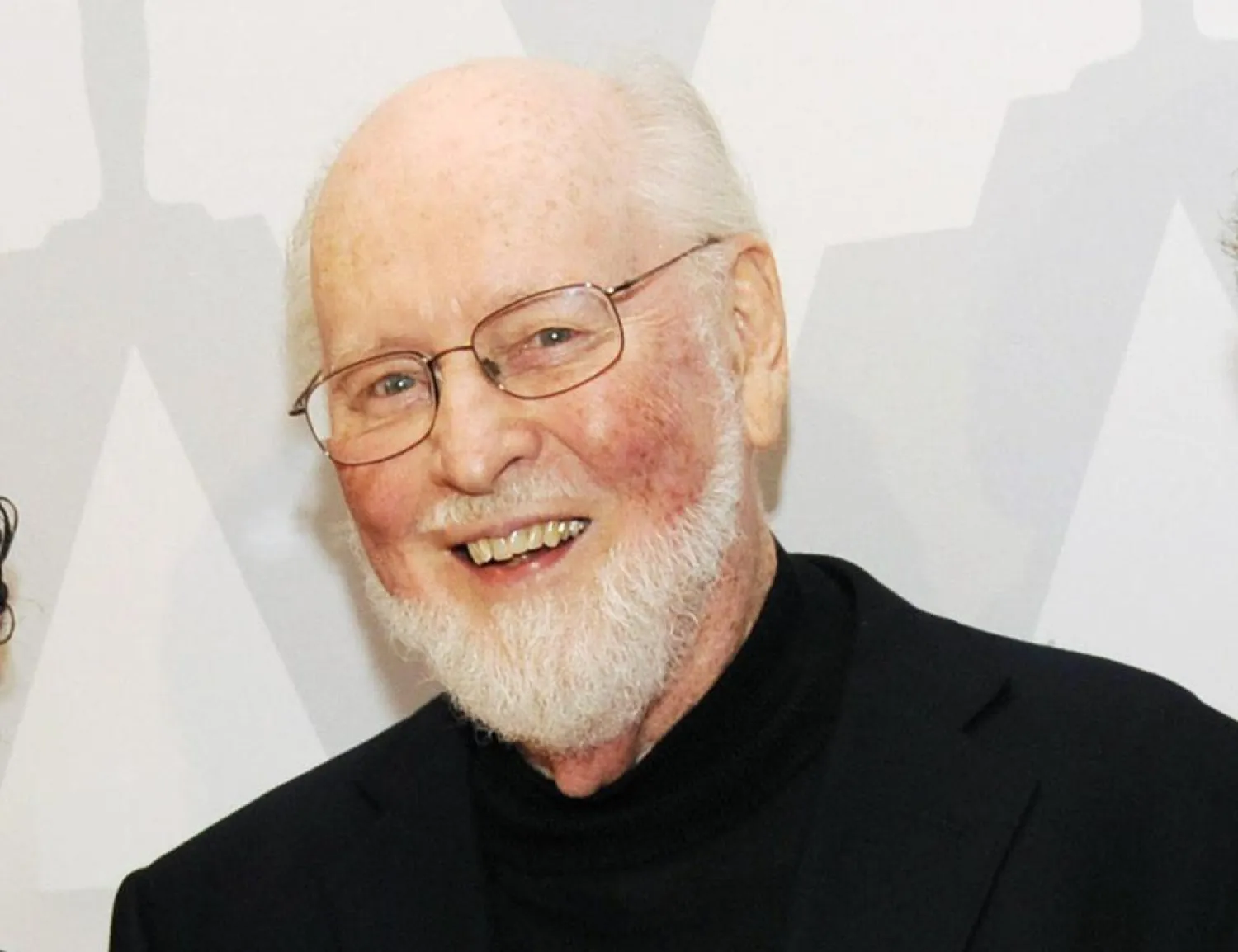

John Williams, 90, Steps Away from Film, but Not Music

Composer John Williams poses at the Academy of Motion Picture Arts and Sciences event "Behind the Score: The Art of the Film Composer" in Los Angeles on July 21, 2014. (AP)
TT

John Williams, 90, Steps Away from Film, but Not Music

Composer John Williams poses at the Academy of Motion Picture Arts and Sciences event "Behind the Score: The Art of the Film Composer" in Los Angeles on July 21, 2014. (AP)

After more than six decades of making bicycles soar, sending panicked swimmers to the shore and other spellbinding close encounters, John Williams is putting the final notes on what may be his last film score.

“At the moment I’m working on ‘Indiana Jones 5,’ which Harrison Ford — who’s quite a bit younger than I am — I think has announced will be his last film,” Williams says. “So, I thought: If Harrison can do it, then perhaps I can, also.”

Ford, for the record, hasn’t said that publicly. And Williams, who turned 90 in February, isn’t absolutely certain he’s ready to, either.

“I don’t want to be seen as categorically eliminating any activity,” Williams says with a chuckle, speaking by phone from his home in Los Angeles. “I can’t play tennis, but I like to be able to believe that maybe one day I will.”

Right now, though, there are other ways Williams wants to be spending his time. A “Star Wars” film demands six months of work, which he notes, “at this point in life is a long commitment to me.” Instead, Williams is devoting himself to composing concert music, including a piano concerto he’s writing for Emanuel Ax.

This spring, Williams and cellist Yo-Yo Ma released the album “A Gathering of Friends,” recorded with the New York Philharmonic, Pablo Sáinz-Villegas and Jessica Zhou. It’s a radiant collection of cello concertos and new arrangements from the scores of “Schindler’s List,” “Lincoln” and “Munich,” including the sublime “A Prayer for Peace.”

Turning 90 — an event that the Kennedy Center and Tanglewood are celebrating this summer with birthday concerts — has caused Williams to reflect on his accomplishments, his remaining ambitions and what a lifetime of music has meant to him.

“It’s given me the ability to breathe, the ability to live and understand that there’s more to corporal life,” Williams says. “Without being religious, which I’m not especially, there is a spiritual life, an artistic life, a realm that’s above the mundanities of everyday realities. Music can raise one’s thinking to the level of poetry. We can reflect on how necessary music has been for humanity. I always like to speculate that music is older than language, that we were probably beating drums and blowing on reeds before we could speak. So it’s an essential part of our humanity.

“It’s given me my life.”

And, in turn, Williams has provided the soundtrack to the lives of countless others through more than 100 film scores, among them “Star Wars,”“Jurassic Park,” “Jaws,” “Close Encounters of the Third Kind,” “E.T.,” “Indiana Jones,”“Superman,” “Schindler’s List” and “ Harry Potter.”

“He’s lived through the better part of a century, and his music encompasses all of the events and changes of those times,” says Ma, a longtime friend. “He is one of the great American voices.”

It’s an amount of accomplishment that’s hard to quantify. Five Oscars and 52 Academy Award nominations, a number bested only by Walt Disney, is one measurement. But even that hardly hints at the cultural power of his music. A billion people might be able to instantly hum Williams’ two-note ostinato from “Jaws” or “The Imperial March” from “Star Wars.”

“I’m told that the music is played all over the world. What could be more rewarding than that?” says Williams. “But I have to say it seems unreal. I can only see what’s in front of me at the piano right at this moment, and do my best with that.”

Williams has a warm, humble, courteous manner despite his stature. He began an interview by offering: “Let me see if I can give you anything that might be useful.” All those indelible, perfectly constructed themes, he believes, are the product less of divine inspiration than daily hard work. Williams does most of his work sitting for hours at a time at his Steinway, composing in pencil.

“It’s like cutting a stone at your desk,” he says. “My younger colleagues are much faster than I am because they have electronic equipment and computers and synthesizers and so on.”

When Williams began (his first feature film score was 1958′s “Daddy-O”), the cinematic tradition of grand, orchestral scores was beginning to lose out to pop soundtracks. Now, many are gravitating toward synthesized music for film. Increasingly, Williams has the aura of a venerated old master who bridges distant eras of film and music.

“Recording with the New York Philharmonic, the whole orchestra to a person were awestruck by this gentleman at now 90 who hears everything, is unfailingly kind, gentle, polite. People just wanted to play for him,” says Ma. “They were floored by the musicianship of this man.”

This late chapter in Williams’ career is in some ways a chance to place his mammoth legacy not just in connection with cinema but among the classical legends. Williams, who led the Boston Pops from 1980 to 1993, has conducted the Berlin, Vienna and New York philharmonics, among others. In the world’s elite orchestras, Williams’ compositions have passed into canon.

“A purist may say that music represented in film is not absolute music. Well, that may be true,” says Williams. “But some of the greatest music ever written has been narrative. Certainly in opera. Film offers that opportunity — not often but occasionally it does. And in a rewarding way musically. Occasionally we get lucky and we find one.”

Williams’ enduring partnership with Steven Spielberg has, of course, helped the composer’s odds. Spielberg, who first sought out a lunch with Williams in 1972 after being captivated by his score to “The Reivers,” has called him “the single most significant contributor to my success as a filmmaker.”

“Without John Williams, bikes don’t really fly,” Spielberg said when the AFI honored Williams in 2016.

They remain irrevocably linked. Their offices on the Universal lot are just steps from one another. Along with “Indiana Jones,” Williams recently scored Spielberg’s upcoming semi-autobiographical drama about growing up in Arizona, “The Fabelmans.” The two movies make it 30 films together for Spielberg and Williams.

“It’s been 50 years now. Maybe we’re starting on the next 50,” says Williams with a laugh. “Whatever our connections will be, whether it’s music or working with him or just being with him, I think we will always be together. We’re great, close friends who have shared many years together. It’s the kind of relationship where neither one of us would ever say no to the other.”

In Spielberg’s films and others, Williams has carved out enough perfectly condensed melodies to rival the Beatles. Spielberg once described his five-note “Communication Motif” from “Close Encounters” as “a doorbell.”

“Simple little themes that speak clearly and without obfuscation are very hard to find and very hard to do,” says Williams. “They really are the result of a lot of work. It’s almost like chiseling. Move one note, change a rhythmic emphasis or the direction of an interval and so on. A simple tune can be done in dozens of ways. If you find one that, it seems like you discovered something that wanted to be uncovered.”

One thing you won’t hear from Williams is a grand pronouncement about his own legacy. He’s much more comfortable talking like a technician who tinkers until a gleaming gem falls out.

“My own personality is such that I look at what I’ve done — I’m quite pleased and proud of a lot of it — but like most of us, we always wish we might have done better,” he says.

“We live with examples like Beethoven and Bach before us, monumental achievements people have made in music, and can feel very humbled. But I also feel very fortunate. I’ve had wonderful opportunities, particularly in film where a composer can have an audience of not millions of people, but billions of people.”

Williams has a number of concerts planned for the rest of the year, including performances in Los Angeles, Singapore and Lisbon. But while Williams may be stepping away from film, he remains enchanted by cinema, and the ability of sound and image, when combined, to achieve liftoff.

“I’d love to be around in 100 years to see what people are doing with film and sound and spatial, aural and visual effects. It has a tremendous future, I think,” says Williams. “I can sense great possibility and great future in the atmospherics of the whole experience. I’d love to come back and see and hear it all.”



‘Godfather’ and ‘Apocalypse Now’ Actor Robert Duvall Dead at 95 

Actor Robert Duvall arrives at the 72nd Golden Globe Awards in Beverly Hills, California January 11, 2015. (Reuters)
TT

‘Godfather’ and ‘Apocalypse Now’ Actor Robert Duvall Dead at 95 

Actor Robert Duvall arrives at the 72nd Golden Globe Awards in Beverly Hills, California January 11, 2015. (Reuters)

Robert Duvall, who played the smooth mafia lawyer in "The Godfather" and stole the show with his depiction of a surfing-crazed colonel in "Apocalypse Now," has died at the age of 95, his wife said Monday.

His death Sunday was confirmed by his wife Luciana Duvall.

"Yesterday we said goodbye to my beloved husband, cherished friend, and one of the greatest actors of our time. Bob passed away peacefully at home," she wrote.

Blunt-talking, prolific and glitz-averse, Duvall won an Oscar for best actor and was nominated six other times. Over his six decades-long career, he shone in both lead and supporting roles, and eventually became a director. He kept acting in his 90s.

"To the world, he was an Academy Award-winning actor, a director, a storyteller. To me, he was simply everything," Luciana Duvall said. "His passion for his craft was matched only by his deep love for characters, a great meal, and holding court."

Duvall won his Academy Award in 1983 for playing a washed-up country singer in "Tender Mercies."

But his most memorable characters also included the soft-spoken, loyal mob consigliere Tom Hagen in the first two installments of "The Godfather" and the maniacal Lieutenant Colonel William Kilgore in Francis Ford Coppola's 1979 Vietnam War epic "Apocalypse Now."

"It was an honor to have worked with Robert Duvall," Oscar winner Al Pacino, who acted alongside Duvall in "The Godfather" films, said in a statement.

"He was a born actor as they say, his connection with it, his understanding and his phenomenal gift will always be remembered. I will miss him."

As Colonel Kilgore, Duvall earned an Oscar nomination and became a bona fide star after years playing lesser roles, in a performance where he utters what is now one of cinema's most famous lines.

"I love the smell of napalm in the morning," his war-loving character -- bare chested, cocky and sporting a big black cowboy hat -- muses as low-flying US warplanes bomb a beachfront tree line where he wants to go surfing.

That character was originally created to be even more over the top -- his name was at first supposed to be Colonel Carnage -- but Duvall had it toned down, demonstrating his meticulous approach to acting.

"I did my homework," Duvall told veteran talk show host Larry King in 2015. "I did my research."

Cinema giant Francis Ford Coppola -- who directed Duvall in "Apocalypse Now" and "The Godfather" -- called his loss "a blow."

"Such a great actor and such an essential part of American Zoetrope from its beginning," Coppola said in a statement on Instagram.

- A 'vast career' -

Duvall was sort of a late bloomer in Hollywood -- he was already 31 when he delivered his breakout performance as the mysterious recluse Boo Radley in the 1962 film adaptation of Harper Lee's novel "To Kill a Mockingbird."

He would go on to play myriad roles -- a bullying corporate executive in "Network" (1976), a Marine officer who treats his family like soldiers in "The Great Santini" (1979), and then his star turn in "Tender Mercies."

Duvall often said his favorite role, however, was one he played in a 1989 TV mini-series -- the grizzled, wise-cracking Texas Ranger-turned-cowboy Augustus McCrae in "Lonesome Dove," based on the novel by Larry McMurtry.

British actress Jane Seymour, who worked with Duvall on the 1995 film "The Stars Fell on Henrietta," took to Instagram to share a heartfelt tribute to the star.

"We were able to share in his love of barbecue and even a little tango," Seymour captioned a photo of herself with Duvall. "Those moments off camera were just as memorable as the work itself."

US actor Alec Baldwin made a short video tribute to Duvall, speaking about the star's "vast career."

"When he did 'To Kill A Mockingbird' he just destroyed you with his performance of Boo Radley, he used not a single word of dialogue, not a single word, and he just shatters you," Baldwin said.

Film critic Elaine Mancini once described Duvall as "the most technically proficient, the most versatile, and the most convincing actor on the screen in the United States."


Songwriter Billy Steinberg Dies at 75

Grammy-winning songwriter Billy Steinberg (L) was behind several top hits of the 1980s and 1990s including Madonna's 'Like A Virgin'. Paul A. Hebert / GETTY IMAGES NORTH AMERICA/AFP/File
TT

Songwriter Billy Steinberg Dies at 75

Grammy-winning songwriter Billy Steinberg (L) was behind several top hits of the 1980s and 1990s including Madonna's 'Like A Virgin'. Paul A. Hebert / GETTY IMAGES NORTH AMERICA/AFP/File

Award-winning US songwriter Billy Steinberg, who wrote several top hit songs including Madonna's "Like a Virgin," died Monday at age 75, according to media reports.

Steinberg wrote some of the biggest pop hits of the 1980s and 1990s and was behind songs performed by singers from Whitney Houston and Celine Dion to Madonna and Cyndi Lauper.

He died following a battle with cancer, his attorney told the Los Angeles Times and BBC News.

"Billy Steinberg's life was a testament to the enduring power of a well-written song -- and to the idea that honesty, when set to music, can outlive us all," his family said in a statement to the outlets.

Steinberg was born in 1950 and grew up in Palm Springs, California, where his family had a table grape business. He attended Bard College in New York and soon began his career in songwriting.

He helped write five number one singles on the Billboard Hot 100 list. Among those was "Like a Virgin," co-written with Tom Kelly, which spent six consecutive weeks at the top of the charts.

Steinberg won a Grammy Award in 1997 for his work on Celine Dion's "Falling Into You."

He was inducted into the Songwriters Hall of Fame in 2011.


'Train Dreams,' 'The Secret Agent' Nab Spirit Wins to Boost Oscars Campaigns

'Train Dreams' director Clint Bentley speaks to the audience after his film grabbed best feature at the Film Independent Spirit Awards, as it continues its best picture Oscars campaign. KEVIN WINTER / GETTY IMAGES NORTH AMERICA/AFP
TT

'Train Dreams,' 'The Secret Agent' Nab Spirit Wins to Boost Oscars Campaigns

'Train Dreams' director Clint Bentley speaks to the audience after his film grabbed best feature at the Film Independent Spirit Awards, as it continues its best picture Oscars campaign. KEVIN WINTER / GETTY IMAGES NORTH AMERICA/AFP

Period drama "Train Dreams" took home the Spirit Awards win for best feature Sunday, as both it and "The Secret Agent" gathered momentum ahead of the Academy Awards.

"The Secret Agent" notched best international film as its team hopes to win in the same category at the Oscars next month.

The annual Film Independent Spirit Awards ceremony only celebrates movies made for less than $30 million.

"Train Dreams," director Clint Bentley's adaptation of the Denis Johnson novella, follows a railroad worker and the transformation of the American northwest across the 20th century.

The film won three of its four categories, also grabbing wins for best director and best cinematography. The movie's lead, Joel Edgerton, however, did not take home best actor, which went to Rose Byrne for "If I Had Legs I'd Kick You."

"Train Dreams" producer Teddy Schwarzman told AFP the film "is a singular journey, but it hopefully helps bring people together to understand all that life entails: love, friendship, loss, grief, healing and hope."

"Train Dreams" will compete for best picture at the Oscars, among other honors.

Big win for Brazil

After "The Secret Agent" nabbed best international film, director Kleber Mendonca Filho hailed the win as one that hopefully "gives more visibility to Brazilian cinema."

The film follows a former academic pursued by hitmen amid the political turmoil of Brazil under military rule.

It prevailed Sunday over contenders including rave-themed road trip movie "Sirat," which will compete alongside "The Secret Agent" for best international feature film at the Oscars, capping Hollywood's awards season.

"The Secret Agent" will also be up for best picture, best actor and best casting.

Brazil's "I'm Still Here" won best international feature at the Oscars last year.

Other Spirit winners on Sunday included "Lurker," for best first screenplay and best first feature film.

"Sorry, Honey" nabbed best screenplay and "The Perfect Neighbor" scored best documentary.

The Academy Awards will be presented on March 15.