


G-7 Set to Back Pursuing Russian Oil Price Cap, Tariff Hikes

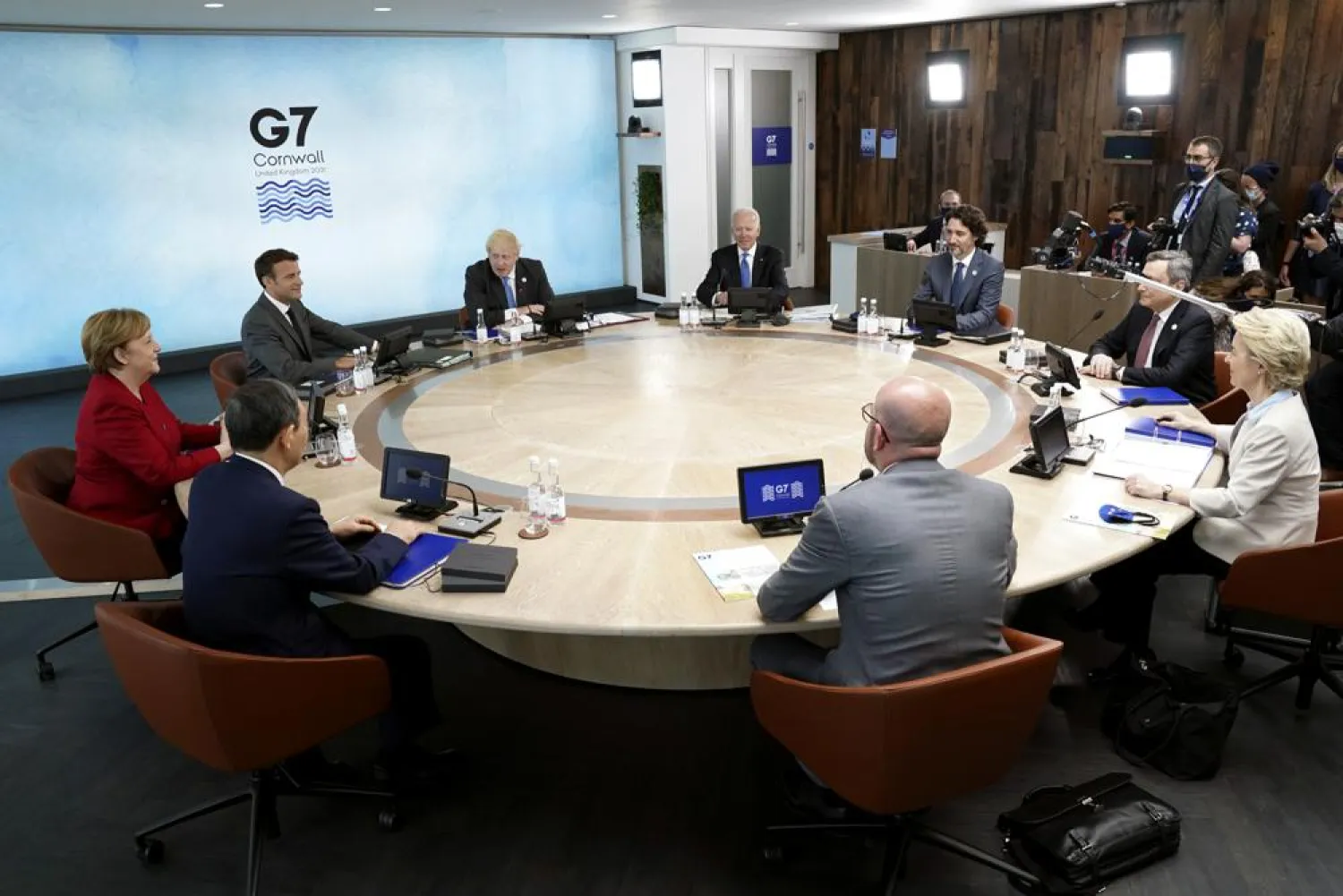
Clockwise from left, German Chancellor Angela Merkel and French President Emmanuel Macron, British Prime Minister Boris Johnson, U.S. President Joe Biden, Canadian Prime Minister Justin Trudeau, Italy's Prime Minister Mario Draghi, European Commission President Ursula von der Leyen, European Council President Charles Michel, and Japan's Prime Minister Yoshihide Suga sit around a table during the G-7 summit at the Carbis Bay Hotel in Carbis Bay, St. Ives, Cornwall, England, Friday, June 11, 2021. (Kevin Lamarque/Pool via AP)
TT

G-7 Set to Back Pursuing Russian Oil Price Cap, Tariff Hikes

Clockwise from left, German Chancellor Angela Merkel and French President Emmanuel Macron, British Prime Minister Boris Johnson, U.S. President Joe Biden, Canadian Prime Minister Justin Trudeau, Italy's Prime Minister Mario Draghi, European Commission President Ursula von der Leyen, European Council President Charles Michel, and Japan's Prime Minister Yoshihide Suga sit around a table during the G-7 summit at the Carbis Bay Hotel in Carbis Bay, St. Ives, Cornwall, England, Friday, June 11, 2021. (Kevin Lamarque/Pool via AP)

The Group of Seven economic powers are set to commit themselves to supporting Ukraine for the long haul, with the US preparing to announce the purchase of an advanced surface-to-air missile system for Kyiv. Leaders are also set to announce an agreement to pursue a price cap on Russian oil, raise tariffs on Russian goods and impose new sanctions on hundreds of officials and entities supporting the four month long war.

Leaders were finalizing the deal to seek a price cap during their three-day summit in the German Alps, where they conferred by video link with Ukrainian President Volodymyr Zelenskyy. The details of how a price cap would work, as well as its impact on the Russian economy, were to be resolved by the G-7 finance ministers in the coming weeks and months, according to a senior administration official spoke on the condition of anonymity to preview the announcements from the G-7 leaders’ summit.

The largest democratic economies will also commit to raising tariffs on Russian imports to their countries, with the US announcing new tariffs on 570 categories of goods, as well as use of sanctions to target Russia’s defense supply chains that support its effort to rearm during the war, The Associated Press said.

Biden is set to announce that the US is providing an advanced surface-to-air missile system to Ukraine, as well as additional artillery support, according to a person familiar with the matter, in the latest assistance meant to help the country defend against Russia’s bloody invasion.

The US is purchasing NASAMS, a Norwegian-developed anti-aircraft system, to provide medium- to long-range defense, according to the person, who spoke on the condition of anonymity. NASAMS is the same system used by the US to protect the sensitive airspace around the White House and US Capitol in Washington.

Additional aid includes more ammunition for Ukrainian artillery, as well as counter-battery radars, to support its efforts against the Russian assault in the Donbas, the person said. Biden is also announcing a $7.5 billion commitment to help Ukraine's government meet its expenses, as part of a drawdown of the $40 billion military and economic aid package he signed into law last month.

The G-7 leaders began Monday's session of their three-day summit with a focus on Ukraine. Later, they will be joined by the leaders of five democratic emerging economies — India, Indonesia, South Africa, Senegal and Argentina — for a discussion on climate change, energy and other issues.

The war in Ukraine was already at the forefront of the G-7 leaders' minds as they opened their summit at the secluded Schloss Elmau luxury hotel on Sunday — just as Russian missiles hit the Ukrainian capital of Kyiv for the first time in weeks.

Biden said Sunday that Russian President Vladimir Putin "has been counting on, from the beginning, that somehow NATO and the G-7 would splinter, but we haven’t and we’re not going to.” Britain’s Boris Johnson warned the leaders not to give in to “fatigue.”

Biden hopes to use his trip to Europe to proclaim the unity of the coalition pressing to punish Russia for its invasion of Ukraine as much as he is urging allies to do even more — seeking to counter doubts about its endurance as the war grinds into its fifth month.

The summit's host, German Chancellor Olaf Scholz, said last week that he wants to discuss the outlines of a “Marshall plan for Ukraine” with his G-7 counterparts, referring to the US-sponsored plan that helped revive European economies after World War II.

With the war still in progress and destruction mounting by the day, it's unlikely to be a detailed plan at this stage. Scholz has said that “rebuilding Ukraine will be a task for generations.”

The G-7 already is committed to help finance Ukraine's immediate needs. Finance ministers from the group last month agreed to provide $19.8 billion in economic aid to help Kyiv keep basic services functioning and prevent tight finances from hindering its defense against Russian forces.

A senior US administration official, speaking on condition of anonymity to discuss private conversations between the G-7 leaders, said the US and Europe are aligned in their aims for a negotiated end to the conflict, even if their roles sometimes appear different.

Scholz and French President Emmanuel Macron have tried to facilitate that through active conversations with Russian President Vladimir Putin and Zelenskyy, while also supplying weapons to Ukraine. The US has largely cut off significant talks with Russia and aims to bolster Ukraine’s battlefield capacity as much as possible so that its eventual position at the negotiating table is stronger.

The endurance of the tough sanctions on Russia may ultimately come down to whether the G-7 and other leaders can identify ways to ease energy supply issues and skyrocketing prices once winter hits, as they seek to disengage from Russian sources of fuel.

The G-7 meeting is sandwiched between a European Union summit last week that agreed to give Ukraine the status of a candidate for membership — kicking off a process that is likely to take years with no guarantee of success — and a summit of NATO leaders starting Tuesday in Madrid.

The leaders of the G-7 — the US, Germany, France, the UK, Italy, Canada and Japan — may hope to make some progress in bringing their counterparts from their five guest countries closer to Western views on sanctions against Russia.

Scholz also is eager to win over such countries for his idea of a “climate club” for nations that want to speed ahead when it comes to tackling the issue.



Karachi Building Collapse after Blast Kills 16

Rescue workers and people gather at the site of a residential compound following a suspected gas leakage blast in Karachi, Pakistan, 19 February 2026. EPA/REHAN KHAN
TT

Karachi Building Collapse after Blast Kills 16

Rescue workers and people gather at the site of a residential compound following a suspected gas leakage blast in Karachi, Pakistan, 19 February 2026. EPA/REHAN KHAN

A building collapse caused by an explosion in Pakistan's southern megacity of Karachi killed at least 16 people on Thursday, including children, officials said.

More than a dozen people were injured in the incident in the Soldier Bazaar neighborhood of Karachi at around 4:00 am, when Muslim families start preparing Sehri, the pre-sunrise meal eaten during Ramadan.


Australian Police Investigate Threatening Letter to Country's Largest Mosque

FILE PHOTO: A security guard stands outside the Lakemba Imam Ali bin Abi Talib Mosque as people arrive for Friday prayers in Sydney, Australia, December 19, 2025. REUTERS/Hollie Adams/File Photo
TT

Australian Police Investigate Threatening Letter to Country's Largest Mosque

FILE PHOTO: A security guard stands outside the Lakemba Imam Ali bin Abi Talib Mosque as people arrive for Friday prayers in Sydney, Australia, December 19, 2025. REUTERS/Hollie Adams/File Photo

Australian police said on Thursday they had launched an investigation after a threatening letter was sent to the country’s largest mosque, the third such incident in the lead-up to the Muslim fasting month of Ramadan.

The letter sent to Lakemba Mosque in Sydney’s west on Wednesday contained a drawing of a pig and a threat to kill the "Muslim race", local media reported. Police said they had taken the letter for forensic testing, and would continue to patrol ‌religious sites including ‌the mosque, as well as community events.

The latest letter ‌comes ⁠weeks after a ⁠similar message was mailed to the mosque, depicting Muslim people inside a mosque on fire.

Police have also arrested and charged a 70-year-old man in connection with a third threatening letter sent to Lakemba Mosque's staff in January.

The Lebanese Muslim Association, which runs the mosque, told the Australian Broadcasting Corp (ABC) it had written to the government to request more funding for additional security guards and ⁠CCTV cameras.

Some 5,000 people are expected to attend ‌the mosque each night during Ramadan. More ‌than 60% of residents in the suburb of Lakemba identify as Muslim, according to ‌the Australian Bureau of Statistics.

Bilal El-Hayek, mayor of Canterbury-Bankstown council, where Lakemba ‌is located, said the community was feeling "very anxious".

"I've heard first-hand from people saying that they won't be sending their kids to practice this Ramadan because they're very concerned about things that might happen in local mosques," AFP quoted him as saying.

Prime Minister Anthony Albanese ‌condemned the recent string of threats.

"It is outrageous that people just going about commemorating their faith, particularly during the ⁠holy month ⁠for Muslims of Ramadan, are subject to this sort of intimidation," he told ABC radio.

"I have said repeatedly we need to turn down the temperature of political discourse in this country, and we certainly need to do that."

Anti-Muslim sentiment has been growing in Australia since the war in Gaza War in late 2023, according to a recent report commissioned by the government.

The Islamophobia Register Australia has also documented a 740% rise in reports following the Bondi mass shooting on December 14, where authorities allege two gunmen inspired by ISIS killed 15 people attending a Jewish holiday celebration.

"There's been a massive increase post-Bondi," Mayor El-Hayek said. "Without a doubt, this is the worst I have ever seen it. There's a lot of tension out there."


Russia's Lavrov Warns against Any New US Strike on Iran

FILE PHOTO: Russia's Foreign Minister Sergei Lavrov speaks during an annual press conference in Moscow, Russia, January 14, 2025. REUTERS/Evgenia Novozhenina/File Photo
TT

Russia's Lavrov Warns against Any New US Strike on Iran

FILE PHOTO: Russia's Foreign Minister Sergei Lavrov speaks during an annual press conference in Moscow, Russia, January 14, 2025. REUTERS/Evgenia Novozhenina/File Photo

Russian Foreign Minister Sergei Lavrov, in ‌an interview made public on Wednesday, said that any new US strike on Iran would have serious consequences and called for restraint to find a solution to enable Iran to pursue a peaceful nuclear program.

Lavrov's interview with Saudi Arabia's Al-Arabiya television was aired a day after US and Iranian negotiators held indirect talks in Geneva to head off a new mounting crisis between Washington and Tehran, Reuters said.

"The consequences are not good. There have already been strikes on Iran on ‌nuclear sites ‌under the control of the International Atomic ‌Energy ⁠Agency. From what ⁠we can judge there were real risks of a nuclear incident," Lavrov said in the interview, which was posted on his ministry's website.

"I am carefully watching reactions in the region from Arab countries, Gulf monarchies. No one wants an increase in tension. Everyone understands this is playing with fire."

Boosting ⁠tensions, he said, could undo the ‌positive steps of recent years, including ‌improved relations between Iran and nearby countries, notably Saudi Arabia.

A senior ‌US official told Reuters on Wednesday that Iran was ‌expected to submit a written proposal on how to resolve its standoff with the United States after the talks in Geneva.

US national security advisers met in the White House on Wednesday and ‌were told all US military forces deployed to the region should be in place ⁠by mid-March, ⁠the official said.

The United States wants Iran to give up its nuclear program, and Iran has adamantly refused and denied it is trying to develop an atomic weapon.

Lavrov said Arab countries were sending signals to Washington "clearly calling for restraint and a search for an agreement that will not infringe on Iran's lawful rights and ... guarantee that Iran has a purely peaceful nuclear enrichment program".

Russia, he said, remained in close, regular contact with Iran's leaders "and we have no reason to doubt that Iran sincerely wants to resolve this problem on the basis of observing the Nuclear Non-Proliferation Treaty".