

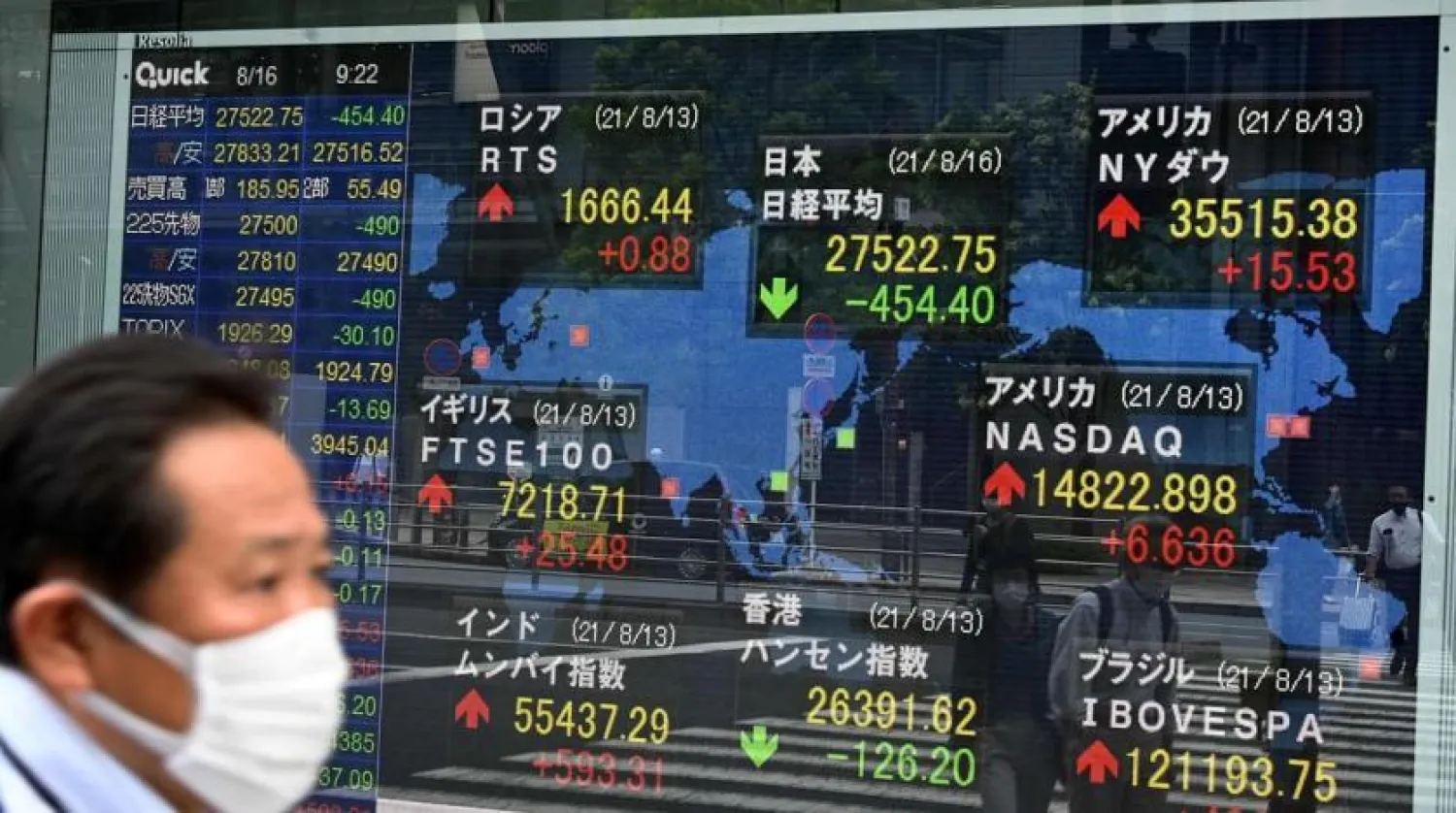

Asian Markets' Rally Fizzles as Rates, Inflation Fears Return

A pedestrian walks past a stock indicator displaying the Nikkei 225 of the Tokyo Stock Exchange (C, top) and other world stock markets in Tokyo on 16 August 2021. AFP
TT

Asian Markets' Rally Fizzles as Rates, Inflation Fears Return

A pedestrian walks past a stock indicator displaying the Nikkei 225 of the Tokyo Stock Exchange (C, top) and other world stock markets in Tokyo on 16 August 2021. AFP

Asian markets mostly fell Tuesday as investors struggled to maintain a recent rally while weighing central banks' inflation-fighting rate hikes and the possibility of a recession.

Renewed concerns about thinning supplies and rising demand also helped push oil even higher, after enjoying a big bounce Monday, said AFP.

Shares rallied last week as the prospect of a contraction saw traders lower their bets on how long finance chiefs will tighten monetary policy, with some commentators eyeing possible cuts at the back end of 2023.

But the global advance fizzled Monday in New York, and on Tuesday, Asian investors ran out of puff.

Meanwhile, analysts said there was a worry on trading floors that the upcoming earnings season could see a lot of firms lower their forecasts for the year ahead.

"There is a clear lack of conviction by investors, with light trading volumes favoring the notion of an exhausted market with big declines set to be recorded this quarter, notwithstanding the outsized gains logged last week," said National Australia Bank's Rodrigo Catril.

Hong Kong was among the big losers, with tech firms reversing the previous day's surge, while there were also losses in Shanghai, Tokyo, Seoul, Singapore, Taipei, Jakarta and Wellington.

Sydney and Manila bucked the trend.

Another pledge by the central People's Bank of China to provide support to the world's number two economy had little impact on sentiment.

Still, some commentators remain relatively upbeat as the second half of the year approaches.

Market strategist Louis Navelier said in a note: "While it's sobering that the first half of the year is the worst since 1970, history also says that when the first half of the year is down at least 15 percent the second half of the year is up every single time with an average return of 24 percent."

And Ben Laidler, a global markets strategist at eToro, added that a lot of the expected economic weakness had been largely factored in by dealers.

"Much is already discounted by markets, which may be in 'bad news is good news' mode, as a slowdown cools inflation and interest rate fears," he said.

"A 'less bad' gradual easing of inflation risks is possible, as is a slowdown -- not recession -- driving a 'U-shaped' rebound. The focus for investors is on cheap and defensive assets while managing rising risks."

Oil prices jumped, building on a rally that has seen Brent and WTI pile on more than eight percent since Wednesday. Both main contracts had fallen heavily earlier in the month on recession worries.

The gains have come on the back of a pick-up in demand from China as it gradually emerges from lockdowns, while supply fears have been raised by political crises in producers Libya and Ecuador.

- Key figures at around 0230 GMT -
Tokyo - Nikkei 225: DOWN 0.2 percent at 26,830.69 (break)

Hong Kong - Hang Seng Index: DOWN 0.8 percent at 22,046.66

Shanghai - Composite: DOWN 0.4 percent at 3,366.48

West Texas Intermediate: UP 1.1 percent at $110.72 per barrel

Brent North Sea crude: UP 1.1 percent at $116.39 per barrel

Dollar/yen: DOWN at 135.25 yen from 135.48 yen on Monday

Euro/dollar: DOWN at $1.0575 from $1.0583

Pound/dollar: DOWN at $1.2263 from $1.2268

Euro/pound: DOWN at 86.22 pence from 86.24 pence

New York - Dow: DOWN 0.2 percent at 31,438.26 (close)

London - FTSE 100: UP 0.7 percent at 7,258.32 (close)


US Stocks Fall as Iran Angst Lifts Oil Prices

A screen displays a stock chart at a work station on the floor of the New York Stock Exchange (NYSE) in New York City, US, April 6, 2022. REUTERS/Brendan McDermid
TT

US Stocks Fall as Iran Angst Lifts Oil Prices

A screen displays a stock chart at a work station on the floor of the New York Stock Exchange (NYSE) in New York City, US, April 6, 2022. REUTERS/Brendan McDermid

Wall Street stocks retreated early Thursday as worries over US-Iran tensions lifted oil prices while markets digested mixed results from Walmart.

US oil futures rose to a six-month high as Iran's atomic energy chief Mohammad Eslami said no country can deprive the Islamic republic of its right to nuclear enrichment, after US President Donald Trump again hinted at military action following talks in Geneva.

"We'd call this an undercurrent of concern that is bubbling up in oil prices," Briefing.com analyst Patrick O'Hare said of the "geopolitical angst."

About 10 minutes into trading, the Dow Jones Industrial Average was down 0.6 percent at 49,379.46, AFP reported.

The broad-based S&P 500 fell 0.5 percent to 6,849.35, while the tech-rich Nasdaq Composite Index declined 0.6 percent to 22,621.38.

Among individual companies, Walmart rose 1.7 percent after reporting solid results but offering forecasts that missed analyst expectations.

Shares of the retail giant initially fell, but pushed higher after Walmart executives talked up artificial intelligence investments on a conference call with analysts.

The US trade deficit in goods expanded to a new record in 2025, government data showed, despite sweeping tariffs that Trump imposed during his first year back in the White House.


Gold Advances on US–Iran Tensions as Markets Weigh Fed Policy Path

UK gold bars and gold Sovereign coins are displayed at Baird & Co in Hatton Garden in London, Britain, October 8, 2025. REUTERS/Hiba Kola/File Photo
TT

Gold Advances on US–Iran Tensions as Markets Weigh Fed Policy Path

UK gold bars and gold Sovereign coins are displayed at Baird & Co in Hatton Garden in London, Britain, October 8, 2025. REUTERS/Hiba Kola/File Photo

Gold prices extended gains on Thursday after rising more than 2% in the previous session, as lingering tensions between the United States and Iran prompted a flight to safety, while investors evaluated the Federal Reserve's monetary policy path.

Spot gold rose 0.2% to $4,989.09 per ounce by 1227 GMT. US gold futures for April delivery held steady at $5,008.60.

"Geopolitical concerns are front and centre with reports that, if the US were to take military action against Iran, it could go on for several weeks," said Jamie Dutta, market analyst at Nemo.money, Reuters reported.

Some progress was made during Iran talks this week in Geneva but distance remained on some issues, the White House said on Wednesday.

FED LARGELY UNITED

Top US national security advisers met in the White House Situation Room on Wednesday to discuss Iran and were told all US military forces deployed to the region should be in place by mid-March.

Meanwhile, the Fed's January minutes showed it largely united on holding interest rates steady, but divided over what comes next, with "several" open to rate hikes if inflation remains elevated, while others were inclined to support further cuts if inflation recedes.

The weekly jobless claims data, due later in the day, and Friday's Personal Consumption Expenditures report, the Fed’s preferred inflation gauge, will provide further clues on the central bank's policy trajectory.

Markets currently expect this year's first interest rate cut to be in June, according to CME's FedWatch Tool.

Non-yielding bullion tends to do well in low-interest-rate environments.

Spot silver rose 0.9% to $77.87 per ounce after climbing more than 5% on Wednesday.

Silver is "supported by tight supply and low COMEX stock levels ahead of the delivery period of the March contract. However, given the extent of the historic correction earlier this month, silver is not back on safer ground until it trades back above $86," said Ole Hansen, head of commodity strategy at Saxo Bank.

Spot platinum fell 0.6% to $2,059.55 per ounce, while palladium lost 1.7% to $1,686.47.


Oil Prices Extend Gains on Concerns of Potential US-Iran Conflict

FILE PHOTO: The Phillips 66 Lake Charles Refinery is pictured in West Lake, Louisiana, US, June 12, 2018. REUTERS/Jonathan Bachman/File Photo
TT

Oil Prices Extend Gains on Concerns of Potential US-Iran Conflict

FILE PHOTO: The Phillips 66 Lake Charles Refinery is pictured in West Lake, Louisiana, US, June 12, 2018. REUTERS/Jonathan Bachman/File Photo

Oil prices rose on Thursday as the US and Iran attempted to ease a standoff in talks over Tehran's nuclear program while both sides heightened military activity in the key oil-producing region.

Brent futures climbed 23 cents, or 0.3% to $70.58 a barrel by 0735 GMT, while US West Texas Intermediate (WTI) crude gained 25 cents, or 0.4%, to trade at $65.44 a barrel.

Both benchmarks settled more than 4% higher on Wednesday, posting their highest settlements since January 30, as traders priced in the risk of supply disruptions in the event of ‌a conflict.

"Oil prices are ‌rallying as the market becomes increasingly concerned over the potential ‌for ⁠imminent US action ⁠against Iran," said ING analysts in a Thursday note.

Iranian state media reported the country had shut down the Strait of Hormuz for a few hours on Tuesday, without making clear whether the waterway had fully reopened. About 20% ⁠of the world's oil supply passes through the waterway.

"Tensions between Washington ‌and Tehran remain high, but the prevailing view ‌is that full-scale armed conflict is unlikely, prompting a wait-and-see approach," said Hiroyuki Kikukawa, chief strategist of ‌Nissan Securities Investment, a unit of Nissan Securities.

"US President Donald Trump does not ‌want a sharp rise in crude prices, and even if military action occurs, it would likely be limited to short-term air strikes," Kikukawa added.

A degree of progress was made during Iran talks in Geneva this week but distance remained on some issues, the White House said on Wednesday, ‌adding that it expected Tehran to come back with more details in a couple of weeks.

Iran issued a notice to ⁠airmen (NOTAM) that ⁠it plans rocket launches in areas across its south on Thursday from 0330 GMT to 1330 GMT, according to the US Federal Aviation Administration website.

At the same time, the US has deployed warships near Iran, with US Vice President JD Vance saying Washington was weighing whether to continue diplomatic engagement with Tehran or pursue "another option".

Meanwhile, two days of peace talks in Geneva between Ukraine and Russia ended on Wednesday without a breakthrough, with Ukrainian President Volodymyr Zelenskiy accusing Moscow of stalling US-mediated efforts to end the four-year-old war.

US crude and gasoline and distillate inventories fell last week, market sources said, citing American Petroleum Institute figures on Wednesday, contrary to expectations in a Reuters poll that crude stocks would rise by 2.1 million barrels in the week to February 13.

Official US oil inventory reports from the Energy Information Administration are due on Thursday.
