


Memoirs of Late Prime Minister Saeb Salam (Part 2): The Americans Secured Arafat’s Protection as He Left Beirut

Saeb Salam with Yasser Arafat.
TT

Memoirs of Late Prime Minister Saeb Salam (Part 2): The Americans Secured Arafat’s Protection as He Left Beirut

Saeb Salam with Yasser Arafat.

The second episode of the memoirs of late Lebanese Prime Minister Saeb Salam talks about the Israeli invasion in the summer of 1982, where Salam says that under the bombardment and raids, he felt as if “the gates of hell were wide open.”

Salam reviewed the contacts he made with the late Palestinian President Yasser Arafat and Palestinian resistance officials, who used to live in Beirut, most notably: Abu Iyad, Abu Jihad, and Hani al-Hassan, as well as the Lebanese figures who played a role at that stage, especially President Elias Sarkis and Bashir Gemayel, who was leading the Lebanese Forces, then elected President of the Republic and assassinated before taking office.

The memoirs are issued in three parts by Hachette Antoine publishing house, and will be available in Lebanon starting June 28 and on the Antoine Online website.

The Israeli bombing of Beirut

Salam recounted that on the night of June 22, 1982, as Israel was intensely bombarding the capital, he decided to meet with the “Palestinian resistance.”

The next day, “Abu Ammar (Yasser Arafat), who had come to my house when the Islamic Gathering was in session, spoke to me in an irrational way. He said: “I am encircled, I will strike in all directions… In the north, the south, the elderly, the children, the women, Jounieh, the whole country, everyone, the Israelis. ... We will not die like this, we will not die.”

Salam continued: “I tried so hard to talk to him, to calm him down; but he wouldn’t listen. Then I tried again, saying: “[Then-US Envoy to Lebanon] Ambassador Philippe Habib is seriously seeking to stop the Israeli advancement.” He replied: “They will take the airport, they will transport the tanks by helicopter, they will crawl on us and we will not die, we will fight!””

Salam said that several days passed while he repeated, even to foreign newspapers and correspondents who flocked to Beirut, that the Palestinians fought gloriously and that they had the right to die only as fighters…

The late premier said that he insisted with Habib that the Lebanese army should go to Beirut, after agreeing with the Palestinians.

“Without an agreement with the Palestinians, the army cannot go down and ensure that there will not be a clash with the militants, especially the Palestinians. Abu Ammar refused this, and demanded that the Israeli army withdraw beyond 7 kilometers” from Beirut, he explained.

Salam recounted that one evening, he received a phone call from Habib, who said that he had obtained US confirmation that [then-Israeli Defense Minister Ariel] Sharon had agreed not to enter the Beirut airport, provided that the Palestinians stop their attacks.

“I was making these endeavors out of my concern for the Palestinian cause… I have taken from Habib guarantees that they will not allow attacking the Palestinians if the Lebanese army was in Beirut, nor would accept their humiliation or slaughter as he said, and I, in turn, conveyed these assurances as requested by America,” he wrote.

The threats of Yasser Arafat

Salam recounted in his memoirs that Yasser Arafat insisted on his stance, after having “emptied all his crazy and meaningless words… that he would destroy and strike east, south and north...”

He said that thousands of Beirut residents were forced to leave the city towards the north and the east, while others remained “at the mercy of Sharon’s bombs.”

“The month of Ramadan began while we were still under this situation… I was constantly imploring the world, news agencies and newspapers... I strived every hour with the ministers, with the ambassadors, with the ‘Islamic Gathering’… shouted that the Israelis wanted to eliminate the ‘Palestinian resistance’ once and for all…”

Salam continued: “I had to call the President of the Republic twice, and I spoke to him in a harsh tone, saying: “You are sitting in Baabda, but your capital is at the mercy of the Israelis every hour, and they may destroy it… I also spoke to the Grand Mufti and asked him to broadcast a statement on television, to the peoples of the world and the heads of friendly and brotherly countries...”

Talks with Bashir Gemayel

The late prime minister recounted in his memoirs: “I received the foreign correspondents at the Commodore Hotel… Germans, Italians, English, Americans and French, from BBC, AP, UP, New York Times, Le Monde and Der Spiegel... I was explaining to them the situation and developments... I believed that I was fulfilling my patriotic and national duty… as the Palestinian resistance could not be crushed under the feet of the Israeli invader.”

He stressed that he was repeating this stance “to our Maronite brothers, and to Bashir Gemayel in particular.”

Salam noted that while he maintained a good relationship with Bashir Gemayel, the latter’s attitude changed when the Israelis entered Lebanon.

Addressing Gemayel, Salam said: “Bashir, you know that my heart is open to you and my hands are outstretched… For the sake of Lebanon, we must cooperate… But today, I feel that you are shortsighted. If the Israelis achieve their goal and humiliate the resistance, you will be inflicted with great harm. And if they gain all of that and destroy Beirut and the Muslims… you will be at the mercy of the Israelis, and you will be the biggest losers.”

As for Arafat, Salam said that he would always come to him a few minutes after the Iftar, to sit for hours, arguing with him, without changing his stance.

The late premier pointed to an article by Michel Abou Jaoudeh, published in An-Nahar newspaper, which described Saeb Salam as the “president of the Republic of Beirut.”

The article emphasized that any solution to the Beirut issue should begin with solving the Lebanese problem, then the whole Middle East file.

“But if Beirut is destroyed or besieged, all of Lebanon will be gone, and there will be no peace in the region,” the article read, as translated from Arabic.

“Abou Jaoudeh’s view converged with mine,” Salam wrote.

He added: “In this context, I maintained continuous contacts with Habib and the resistance, especially after the leaders of the resistance wrote and signed a report that they were going to leave Beirut.”

The day the Palestinians left

“I remember that it was Monday, August 30, 1982, when Abu Ammar visited the Prime Minister, and from there went to the port…

“We entered the ship, where a meeting took place, attended by President Al-Wazzan, representing His Excellency the President of the Republic, and Rene Moawad. Abu Ammar gave a moving speech, then presented a message to Al-Wazzan, and a medal to Beirut in the name of the General Commander of the Organization... He called it, ‘the Beirut Resilience Medal.’

“I was quite satisfied with this farewell; because in fact, it allowed Abu Ammar and the Palestinian resistance, to leave with dignity. What caught everyone’s attention was that the Americans, although they refused to recognize the Palestinian organization, were guarding the roads from the commercial center to the port, on both sides, just as they guarded Abu Ammar with their battleships in the sea. So, this is an indirect acknowledgment, as the Greek ship was under the protection of the American and French fleet,” Salam wrote in his memoirs.



Lebanon Says Two Killed in Israeli Strike on Palestinian Refugee Camp

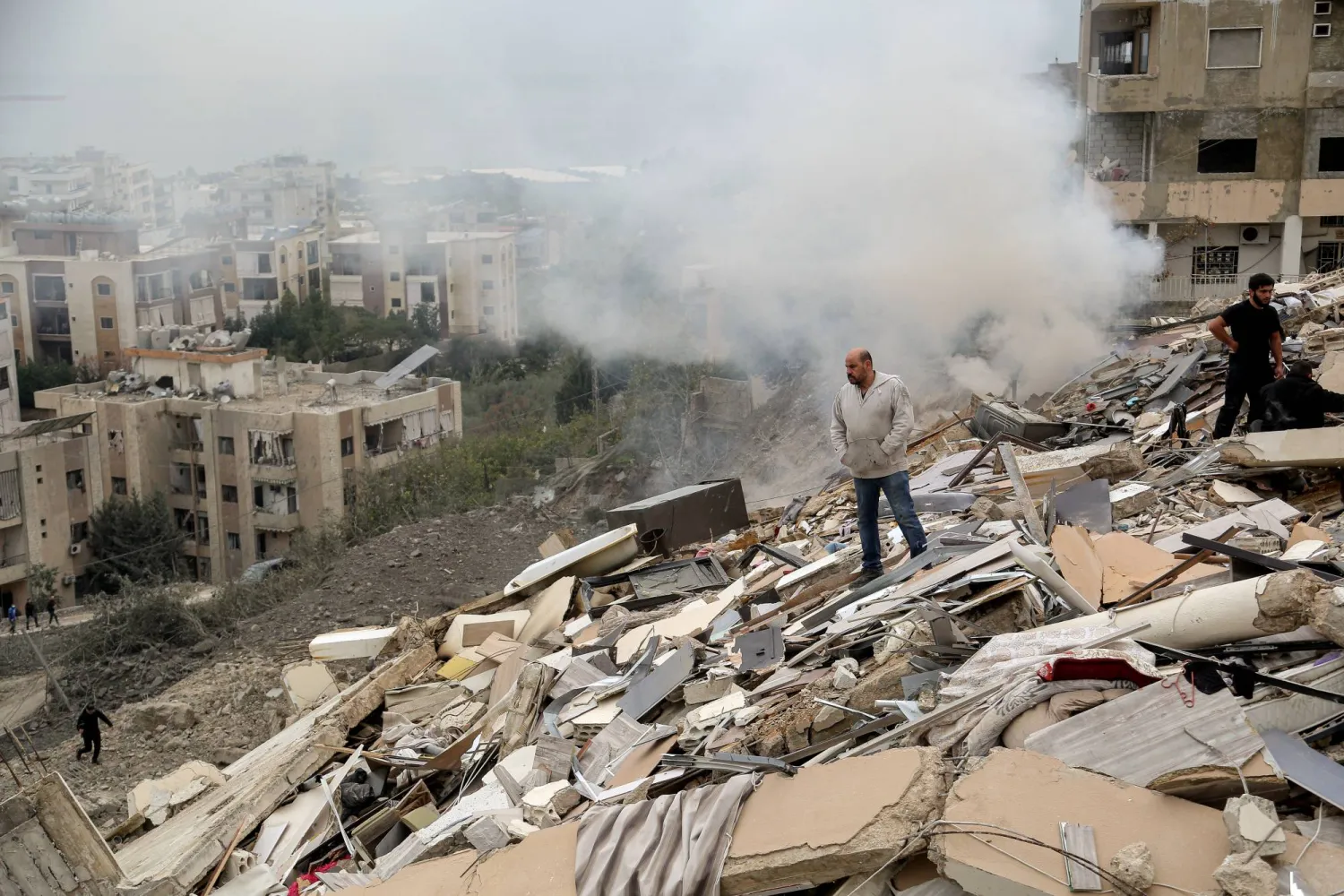
22 January 2026, Lebanon, Qnarit: People inspect the damage of a building that was destroyed by an Israeli air raid on the southern Lebanese village of Qnarit. (dpa)
TT

Lebanon Says Two Killed in Israeli Strike on Palestinian Refugee Camp

22 January 2026, Lebanon, Qnarit: People inspect the damage of a building that was destroyed by an Israeli air raid on the southern Lebanese village of Qnarit. (dpa)

Lebanon said an Israeli strike on the country's largest Palestinian refugee camp killed two people on Friday, with Israel's army saying it had targeted the Palestinian group Hamas. 

The official National News Agency said "an Israeli drone" targeted a neighborhood of the Ain al-Hilweh camp, which is located on the outskirts of the southern city of Sidon. 

Lebanon's health ministry said two people were killed in the raid. The NNA had earlier reported one dead and an unspecified number of wounded. 

An AFP correspondent saw smoke rising from a building in the densely populated camp as ambulances headed to the scene. 

The Israeli army said in a statement that its forces "struck a Hamas command center from which terrorists operated", calling activity there "a violation of the ceasefire understandings between Israel and Lebanon" and a threat to Israel. 

The Israeli military "is operating against the entrenchment" of the Palestinian group in Lebanon and will "continue to act decisively against Hamas terrorists wherever they operate", it added. 

Israel has kept up regular strikes on Lebanon despite a November 2024 ceasefire that sought to halt more than a year of hostilities with Hezbollah. 

Israel has also struck targets belonging to Hezbollah's Palestinian ally Hamas, including in a raid on Ain al-Hilweh last November that killed 13 people. 

The UN rights office had said 11 children were killed in that strike, which Israel said targeted a Hamas training compound, though the group denied it had military installations in Palestinian camps in Lebanon. 

In October 2023, Hezbollah began launching rockets at Israel in support of Hamas at the outset of the Gaza war, triggering hostilities that culminated in two months of all-out war between Israel and the Iran-backed Lebanese group. 

On Sunday, Lebanon said an Israeli strike near the Syrian border in the country's east killed four people, as Israel said it targeted operatives from Palestinian group Islamic Jihad. 


UN Says It Risks Halting Somalia Aid Due to Funding Cuts 

A Somali trader marks watermelons for sale at an open-air grocery market as Muslims start the fasting month of Ramadan, the holiest month in the Islamic calendar, within Bakara market in Mogadishu, Somalia, February 18, 2026. (Reuters)
TT

UN Says It Risks Halting Somalia Aid Due to Funding Cuts 

A Somali trader marks watermelons for sale at an open-air grocery market as Muslims start the fasting month of Ramadan, the holiest month in the Islamic calendar, within Bakara market in Mogadishu, Somalia, February 18, 2026. (Reuters)

The UN's World Food Program (WFP) warned Friday it would have to stop humanitarian assistance in Somalia by April if it did not receive new funding.

The Rome-based agency said it had already been forced to reduce the number of people receiving emergency food assistance from 2.2 million in early 2025 to just over 600,000 today.

"Without immediate funding, WFP will be forced to halt humanitarian assistance by April," it said in a statement.

In early January, the United States suspended aid to Somalia over reports of theft and government interference, following the destruction of a US-funded WFP warehouse in the capital Mogadishu's port.

The US announced a resumption of WFP food distribution on January 29.

However, all UN agencies have warned of serious funding shortfalls since Washington began slashing aid across the world following President Donald Trump's return to the White House last year.

"The situation is deteriorating at an alarming rate," said Ross Smith, WFP Director of Emergency Preparedness and Response, in Friday's statement.

"Families have lost everything, and many are already being pushed to the brink. Without immediate emergency food support, conditions will worsen quickly.

"We are at the cusp of a decisive moment; without urgent action, we may be unable to reach the most vulnerable in time, most of them women and children."

Some 4.4 million people in Somalia are facing crisis-levels of food insecurity, according to the WFP, the largest humanitarian agency in the country.

The Horn of Africa country has been plagued by conflict and also suffered two consecutive failed rainy seasons.


Hamas Says Path for Gaza Must Begin with End to ‘Aggression’ 

Makeshift tents of displaced Palestinian families among the ruins of their homes at sunset during the holy month of Ramadan in Jabaliya northern Gaza Strip on, 19 February 2026. (EPA)
TT

Hamas Says Path for Gaza Must Begin with End to ‘Aggression’ 

Makeshift tents of displaced Palestinian families among the ruins of their homes at sunset during the holy month of Ramadan in Jabaliya northern Gaza Strip on, 19 February 2026. (EPA)

Discussions on Gaza's future must begin with a total halt to Israeli "aggression", the Palestinian movement Hamas said after US President Donald Trump's Board of Peace met for the first time.

"Any political process or any arrangement under discussion concerning the Gaza Strip and the future of our Palestinian people must start with the total halt of aggression, the lifting of the blockade, and the guarantee of our people's legitimate national rights, first and foremost their right to freedom and self-determination," Hamas said in a statement Thursday.

Trump's board met for its inaugural session in Washington on Thursday, with a number of countries pledging money and personnel to rebuild the Palestinian territory, more than four months into a fragile ceasefire between Israel and Hamas.

Israeli Prime Minister Benjamin Netanyahu has insisted however that Hamas must disarm before any reconstruction begins.

"We agreed with our ally the US that there will be no reconstruction of Gaza before the demilitarization of Gaza," Netanyahu said.

The Israeli leader did not attend the Washington meeting but was represented by his foreign minister Gideon Saar.

Trump said several countries had pledged more than seven billion dollars to rebuild the territory.

Muslim-majority Indonesia will take a deputy commander role in a nascent International Stabilization Force, the unit's American chief Major General Jasper Jeffers said.

Trump, whose plan for Gaza was endorsed by the UN Security Council in November, also said five countries had committed to providing troops, including Morocco, Kazakhstan, Kosovo and Albania.