


Israel’s Spies Have Hit Iran Hard. In Tehran, Some Big Names Paid the Price.

Before he was removed from his post last week, Hossein Taeb presided over a vast and feared intelligence apparatus in Iran. Credit: Hamed Malekpour/Agence France-Presse, via Tasnim News/Afp Via Getty Images
TT

Israel’s Spies Have Hit Iran Hard. In Tehran, Some Big Names Paid the Price.

Before he was removed from his post last week, Hossein Taeb presided over a vast and feared intelligence apparatus in Iran. Credit: Hamed Malekpour/Agence France-Presse, via Tasnim News/Afp Via Getty Images

For more than a decade, he was a feared presence in Iran, presiding over a vast intelligence apparatus. He crushed domestic dissent and political rivals, and expanded covert operations beyond Iran’s borders to target dissidents and enemies abroad.

Hossein Taeb, a 59-year-old cleric and chief of intelligence for the powerful Islamic Revolutionary Guards Corps, seemed untouchable.

That was until he was abruptly removed from his position last week, a casualty of a relentless campaign by Israel to undermine Iran’s security by targeting its officials and military sites, according to officials and analysts in both countries.

A botched Iranian effort to target Israeli citizens in Turkey, which caused an embarrassing diplomatic crisis with Ankara, a regional ally of Tehran, eventually tipped the balance, according to Israeli intelligence officials briefed on the Iranian plot who requested anonymity to discuss sensitive operations and intelligence topics.

The removal of Taeb was an acknowledgment by Tehran that confronting the threat from Israel required new leadership and a reset of strategies and protocols, according to Mohammad Ali Abtahi, a reformist former vice president of Iran and cleric who was ousted by conservatives in 2009 but has maintained close ties to top officials.

“The security breaches inside Iran and the vast scope of operations by Israel have really undermined our most powerful intelligence organization,” Abtahi said by telephone from Tehran. “The strength of our security has always been the bedrock of the Islamic Republic and it has been damaged in the past year.”

Calls to purge Taeb appeared amid a growing climate of mistrust within the Iranian leadership after a senior commander in the Revolutionary Guards, Brig. Gen. Ali Nasiri, was secretly arrested on allegations of spying for Israel, according to a person with close ties to top officials in the Revolutionary Guards and another with knowledge of the arrest. They and other Iranian officials quoted in this article requested anonymity because they were not authorized to speak on the record about internal discussions.

General Nasiri’s detention came two months after several dozen employees of the Ministry of Defense’s missile development program were arrested on suspicion of leaking classified military information, including design blueprints of missiles, to Israel, according to an Iranian official familiar with the raid.
During the past year, Israel has intensified the scope and frequency of its attacks inside Iran, including on the nuclear and military sites that Taeb’s organization was responsible for protecting.

One of the Israeli officials said that part of the strategy entailed exposing failures by the Revolutionary Guards in their covert war with Israel in the hope that it would create conflict between political leaders and the defense and intelligence establishment.

Israel’s spy network has infiltrated deep into the rank and file of Iran’s security circles, Iranian officials have acknowledged, with Iran’s former minister of intelligence warning last year that officials should fear for their lives, according to Iranian media reports.

Israeli agents have carried out assassinations with remote-controlled robots and in drive-by shootings, flown drones into sensitive missile and nuclear facilities, and kidnapped and interrogated an agent of the Revolutionary Guards inside Iran. Tehran also suspects that Israel killed two of its scientists in May.

Taeb was appointed the head of the Revolutionary Guards’ intelligence organization in 2009 after nationwide unrest over disputed presidential elections. He had previously served as the chief of the Basij, a plainclothes militia notorious for attacking and sometimes killing protesters.

Taeb enforced systematic crackdowns with a brutality that elevated the intelligence organization from an obscure security unit to the most feared spying operation in the country.

Taeb, a trusted ally of Iran’s supreme leader, Ali Khamenei, placed opposition leaders under house arrest, dismantled many civil society groups, arrested activists and dual nationals and kidnapped dissidents in neighboring countries. In at least one incident, one of the dissidents was executed after being forcibly returned to Iran. In a video praising Taeb released by the Revolutionary Guards this week, those actions were cited among other “accomplishments.”

More recently, Taeb had been under pressure to root out Israel’s network of spies in Iran and to strike back, according to an adviser to the government and another person affiliated with the Revolutionary Guards.

General Nasiri, who was arrested in June, served as a senior commander in the Revolutionary Guards’ Protection of Information Unit, tasked with oversight and supervision of the organization’s work.

His arrest, combined with the repeated attacks by Israel, rattled the leadership in Tehran, according to the Iranian officials with knowledge of the situation. Some began quietly calling for Taeb to resign or be removed, the officials said.

Taeb requested one more year in his post to rectify the security breaches, the person affiliated with the Guards said.

Then came the plot to target Israelis in Turkey.

On June 18, an Israeli intelligence official, who spoke on condition of anonymity to disclose the intelligence data, said that Mossad believed Iran was planning attacks against Israeli tourists and citizens.

The Israeli Counter-Terrorism Headquarters raised its alert for Turkey to the highest level and told all Israelis in Istanbul to lock themselves in their hotel rooms.

The intelligence official said that Israel had informed Turkey and shared information showing that Taeb was behind the plot, which it said was in retaliation for the killing in May of Col. Sayad Khodayee, the deputy commander of another covert Revolutionary Guards unit.

Saeed Khatibzadeh, spokesman for the Iranian Foreign Ministry, said last week that Israel’s allegations that Tehran had planned to attack Israelis in Turkey were “ridiculous” and “a precooked scenario to damage the relationship of two Muslim countries.”

Turkey arrested five Iranians and three Turkish nationals suspected of having been involved in the plot, seizing two pistols, two silencers and documents and digital material containing the identities and addresses of individuals said to be on the target list, Turkish news media reported.

Bennett, the Israeli prime minister, said last week that “cooperation is taking place at all levels” with Turkey and had yielded results. The Turkish foreign minister, Mevlut Cavusoglu, at a news conference on Thursday with Yair Lapid, his Israeli counterpart, said that Turkey would not tolerate “score-settling” and “terror attacks” on its soil.

The crisis threatened to push Turkey, a key regional ally for Tehran, closer to the Israeli camp. The Iranian foreign minister, Hossein Amir-Abdollahian, was in Turkey on Monday for a meeting with President Recep Tayyip Erdogan and Cavusoglu to discuss the crisis.

Some conservative lawmakers in Iran have told news outlets that the replacement of Taeb was nothing out of the ordinary and that his term had simply come to an end. But one tweeted that Taeb’s removal was one of the most significant in the history of Iran.

Taeb was replaced by Gen. Mohammad Kazemi, the current head of the Revolutionary Guard Protection of Information Unit. Mr. Taeb has been moved to an advisory role to the commander in chief of the Revolutionary Guards and not to Ayatollah Khamenei, which would have been more typical for one of the ayatollah’s close confidants.

On Saturday, Iran also replaced the head of a Revolutionary Guards unit that provides security for Ayatollah Khamenei and his family, and on Monday, a new head for the Guards’ Protection Information Unit was announced. More reshuffling of senior commanders is expected, analysts say.

The New York Times
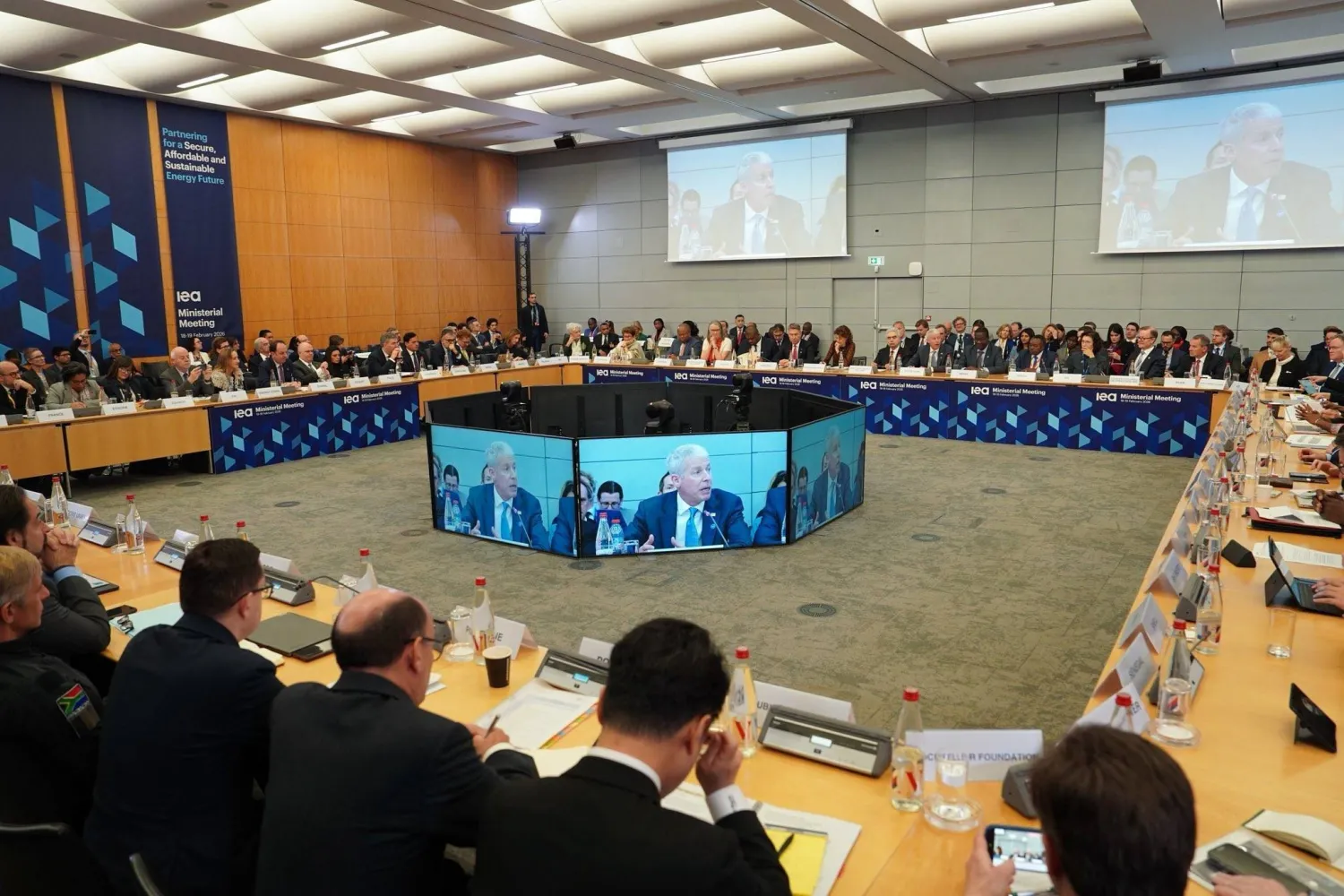


US Renews Threat to Leave IEA

US Energy Secretary Chris Wright speaks at an IEA ministerial meeting in Paris (X)
TT

US Renews Threat to Leave IEA

US Energy Secretary Chris Wright speaks at an IEA ministerial meeting in Paris (X)

US Energy Secretary Chris Wright renewed his threat Thursday to pull out of the International Energy Agency, saying Washington would press the organization to abandon a net-zero agenda “in the next year or so.”

Speaking on the last day of an IEA ministerial meeting in Paris, Wright said the 52-year-old agency should return to its founding mission of ensuring energy security.

“The US will use all the pressure we have to get the IEA to eventually, in the next year or so, move away from this agenda,” Wright said in a news conference.

“But if the IEA is not able to bring itself back to focusing on the mission of energy honesty, energy access and energy security, then sadly we would become an ex-member of the IEA,” he added.

Meaning of Wright’s Warning

A US exit means a deep cut to IEA’s budget undermining the agency’s global influence.

Washington is not just a member of the agency but its largest funder. It alone contributes to 25% of the IEA core budget (equivalent to between $25 and $30 million annually) and therefore its exit would “dry up” a quarter of the agency’s financial resources.

Also, Washington is the world's largest oil and gas producer, meaning the US exit will affect the agency's reports and their credibility in markets.

The IEA was created to coordinate responses to major disruptions of supplies after the 1973 oil crisis. But in recent years, it became the main advocate of green transition policies, which the US considers as “politicized.”

The IEA produces monthly reports on oil demand and supply as well as annual world energy outlooks that include data on the growth of solar and wind energy, among other analyses.

Wright praised IEA Executive Director Fatih Birol for reinserting in November 2025’s annual outlook a Current Policies Scenario in which oil and gas demand would grow in the next decades. That scenario had been dropped for the past five years.

But the report still included a scenario where the world reaches net zero emissions by mid-century.

Birol’s current four-year term ends in 2027, but Wright demurred when asked who he would like to head the IEA, which has over 30 member nations.

“We remain today undecided or neutral on who the leadership is. We care about the mission much more than the individual leaders,” the US energy chief said.

If Birol can make the agency “get out the politics and get out the anti-energy part of it, that's great by us,” said Wright, who first warned last year that the US could leave the IEA if it did not reform.

For his part, Birol insisted that the Paris-based agency was “data-driven.” He said, “We are a non-political organization.”

The IEA was created “to focus on energy security,” Wright said on Wednesday at a ministerial meeting of the agency in Paris.

“That mission is beyond critical and I'm here to plead to all the members (of the IEA) that we need to keep the focus of the IEA on this absolutely life-changing, world-changing mission of energy security,” he said.

The Energy Secretary said he wanted to get support from “all the nations in this noble organization to work with us, to push the IEA to drop the climate. That's political stuff.”

His comments come just a day after he publicly threatened to quit the organization unless it abandoned its focus on the energy transition— a call that several countries rejected, including the UK, Austria and France.


Trump Warns of 'Bad Things' if Iran Doesn't Make a Deal, as Second US Carrier Nears Mideast

The US Navy's Nimitz-class aircraft carrier USS Abraham Lincoln leads its strike group during a photo exercise in the Arabian Sea, February 6, 2026.  US Navy/Mass Communication Specialist 1st Class Jesse Monford/Handout via REUTERS
The US Navy's Nimitz-class aircraft carrier USS Abraham Lincoln leads its strike group during a photo exercise in the Arabian Sea, February 6, 2026. US Navy/Mass Communication Specialist 1st Class Jesse Monford/Handout via REUTERS
TT

Trump Warns of 'Bad Things' if Iran Doesn't Make a Deal, as Second US Carrier Nears Mideast

The US Navy's Nimitz-class aircraft carrier USS Abraham Lincoln leads its strike group during a photo exercise in the Arabian Sea, February 6, 2026.  US Navy/Mass Communication Specialist 1st Class Jesse Monford/Handout via REUTERS
The US Navy's Nimitz-class aircraft carrier USS Abraham Lincoln leads its strike group during a photo exercise in the Arabian Sea, February 6, 2026. US Navy/Mass Communication Specialist 1st Class Jesse Monford/Handout via REUTERS

Iran held annual military drills with Russia on Thursday as a second American aircraft carrier drew closer to the Middle East, with both the United States and Iran signaling they are prepared for war if talks on Tehran's nuclear program fizzle out.

President Donald Trump said Thursday he believes 10 to 15 days is “enough time” for Iran to reach a deal. But the talks have been deadlocked for years, and Iran has refused to discuss wider US and Israeli demands that it scales back its missile program and sever ties to armed groups. Indirect talks held in recent weeks made little visible progress, and one or both sides could be buying time for final war preparations.

Iran’s theocracy is more vulnerable than ever following 12 days of Israeli and US strikes on its nuclear sites and military last year, as well as mass protests in January that were violently suppressed.

In a letter to the UN Security Council on Thursday, Amir Saeid Iravani, the Iranian ambassador to the UN, said that while Iran does not seek “tension or war and will not initiate a war,” any US aggression will be responded to “decisively and proportionately.”

“In such circumstances, all bases, facilities, and assets of the hostile force in the region would constitute legitimate targets in the context of Iran’s defensive response,” Iravani said.

Earlier this week, Iran conducted a drill that involved live-fire in the Strait of Hormuz, the narrow opening of the Arabian Gulf through which a fifth of the world's traded oil passes.

Tensions are also rising inside Iran, as mourners hold ceremonies honoring slain protesters 40 days after their killing by security forces. Some gatherings have seen anti-government chants despite threats from authorities.

Trump again threatens Iran

The movements of additional American warships and airplanes, with the USS Gerald R. Ford aircraft carrier near the mouth of the Mediterranean Sea, don't guarantee a US strike on Iran — but they bolster Trump's ability to carry out one should he choose to do so.

He has so far held off on striking Iran after setting red lines over the killing of peaceful protesters and mass executions, while reengaging in nuclear talks that were disrupted by the war in June.

Iran has agreed to draw up a written proposal to address US concerns raised during this week’s indirect nuclear talks in Geneva, according to a senior US official who was not authorized to comment publicly and spoke on the condition of anonymity.

The official said top national security officials gathered Wednesday to discuss Iran, and were briefed that the “full forces” needed to carry out potential military action are expected to be in place by mid-March. The official did not provide a timeline for when Iran is expected to deliver its written response.

“It’s proven to be, over the years, not easy to make a meaningful deal with Iran, and we have to make a meaningful deal. Otherwise, bad things happen,” Trump said Thursday.

With the US military presence in the region mounting, one senior regional government official said he has stressed to Iranian officials in private conversations that Trump has proven that his rhetoric should be taken at face value and that he’s serious about his threat to carry out a strike if Iran doesn’t offer adequate concessions.

The official, who spoke on the condition of anonymity to discuss delicate diplomatic conversations, said he has advised the Iranians to look to how Trump has dealt with other international issues and draw lessons on how it should move forward.

The official added that he’s made to case to the Trump administration it could draw concessions from Iran in the near-term if it focuses on nuclear issues and leaves the push on Tehran to scale back its ballistic missile program and support for proxy group for later.

The official also said that Trump ordering a limited strike aimed at pressuring Iran could backfire and lead to Supreme Leader Ali Khamenei withdrawing Iran from the talks.

Growing international concern Polish Prime Minister Donald Tusk urged his nation's citizens to immediately leave Iran as “within a few, a dozen, or even a few dozen hours, the possibility of evacuation will be out of the question.” He did not elaborate, and the Polish Embassy in Tehran did not appear to be drawing down its staff.

The German military said that it had moved “a mid-two digit number of non-mission critical personnel” out of a base in northern Iraq because of the current situation in the region and in line with its partners’ actions. It said that some troops remain to help keep the multinational camp running in Irbil, where they train Iraqi forces.

Iran holds drill with Russia Iranian forces and Russian sailors conducted the annual drills in the Gulf of Oman and the Indian Ocean aimed at “upgrading operational coordination as well as exchange of military experiences,” Iran's state-run IRNA news agency reported.

Footage released by Iran showed members of the paramilitary Revolutionary Guard's naval special forces board a vessel in the exercise. Those forces are believed to have been used in the past to seize vessels in key international waterways.

Iran also issued a rocket-fire warning to pilots in the region, suggesting it planned to launch anti-ship missiles in the exercise.

Meanwhile, tracking data showed the Ford off the coast of Morocco in the Atlantic Ocean midday Wednesday, meaning the carrier could transit through Gibraltar and potentially station in the eastern Mediterranean with its supporting guided-missile destroyers.

It would likely take more than a week for the Ford to be off the coast of Iran.

Netanyahu warns Iran Israel is making its own preparations for possible Iranian missile strikes in response to any US action.

“We are prepared for any scenario,” Israeli Prime Minister Benjamin Netanyahu said Thursday, adding that if Iran attacks Israel, “they will experience a response they cannot even imagine.”

Netanyahu, who met with Trump last week, has long pushed for tougher US action against Iran and says any deal should not only end its nuclear program but curb its missile arsenal and force it to cut ties with militant groups like Hamas and Hezbollah.

Iran has said the current talks should only focus on its nuclear program, and that it hasn't been enriching uranium since the US and Israeli strikes last summer. Trump said at the time that the strikes had “obliterated” Iran's nuclear sites, but the exact damage is unknown as Tehran has barred international inspectors.

Iran has always insisted its nuclear program is peaceful. The US and others suspect it is aimed at eventually developing weapons. Israel is widely believed to have nuclear weapons but has neither confirmed nor denied that.


US Pays $160 Million of More than $4 Billion Owed to UN

US President Donald Trump during the Board of Peace meeting at the Donald J. Trump US Institute of Peace in Washington, USA, 19 February 2026. EPA/ALESSANDRO DI MEO
TT

US Pays $160 Million of More than $4 Billion Owed to UN

US President Donald Trump during the Board of Peace meeting at the Donald J. Trump US Institute of Peace in Washington, USA, 19 February 2026. EPA/ALESSANDRO DI MEO

The United States has paid about $160 million of the more than $4 billion it owes to the UN, a United Nations spokesperson said on Thursday as President Donald Trump hosted the first meeting of his "Board of Peace" initiative that experts say could undermine the United Nations.

"Last week, we received about $160 million from the United States as a partial payment of its past dues for the UN regular budget," the UN spokesperson said ‌in a ‌statement.

Trump said during his comments at the opening "Board of Peace" ‌meeting ⁠that Washington would ⁠give the United Nations money to strengthen it.

The US is the biggest contributor to the UN budget, but under the Trump administration it has refused to make mandatory payments to regular and peacekeeping budgets, and slashed voluntary funding to UN agencies with their own budgets.

Washington has withdrawn from dozens of UN agencies.

UN officials say the US owed $2.19 billion to the regular UN budget as of the start ⁠of February, more than 95% of the total owed by ‌countries globally. The US also owes another $2.4 billion ‌for current and past peacekeeping missions and $43.6 million for UN tribunals.

"We're going to help ‌them (UN) money-wise, and we're going to make sure the United Nations is viable," ‌Trump said.

"I think the United Nations has great potential, really great potential. It has not lived up to (that) potential."

Countries, including major powers of the Global South and key US allies in the West, have been reluctant to join Trump's "Board of Peace" where ‌Trump himself is the chair. Many experts have said such an initiative undermines the United Nations.

Trump launched the board ⁠last month ⁠and proposed it late last year as part of his plan to end Israel's war in Gaza.

A UN Security Council resolution recognized the board late last year through 2027, limiting its scope to Gaza, the Palestinian territory it was meant to oversee following Israel's devastating more than two-year assault. Under Trump's plan to end Israel's war in Gaza, the board was meant to oversee Gaza's temporary governance. Trump subsequently said the board will tackle global conflicts and look beyond Gaza as well.

UN experts say that Trump's oversight of a board to supervise a foreign territory's affairs resembles a colonial structure and criticized the board for not having Palestinian representation. There was no UN representative at the "Board of Peace" meeting on Thursday.
