


Zhou Feared F1 Car Would Catch Fire with Him Trapped Inside

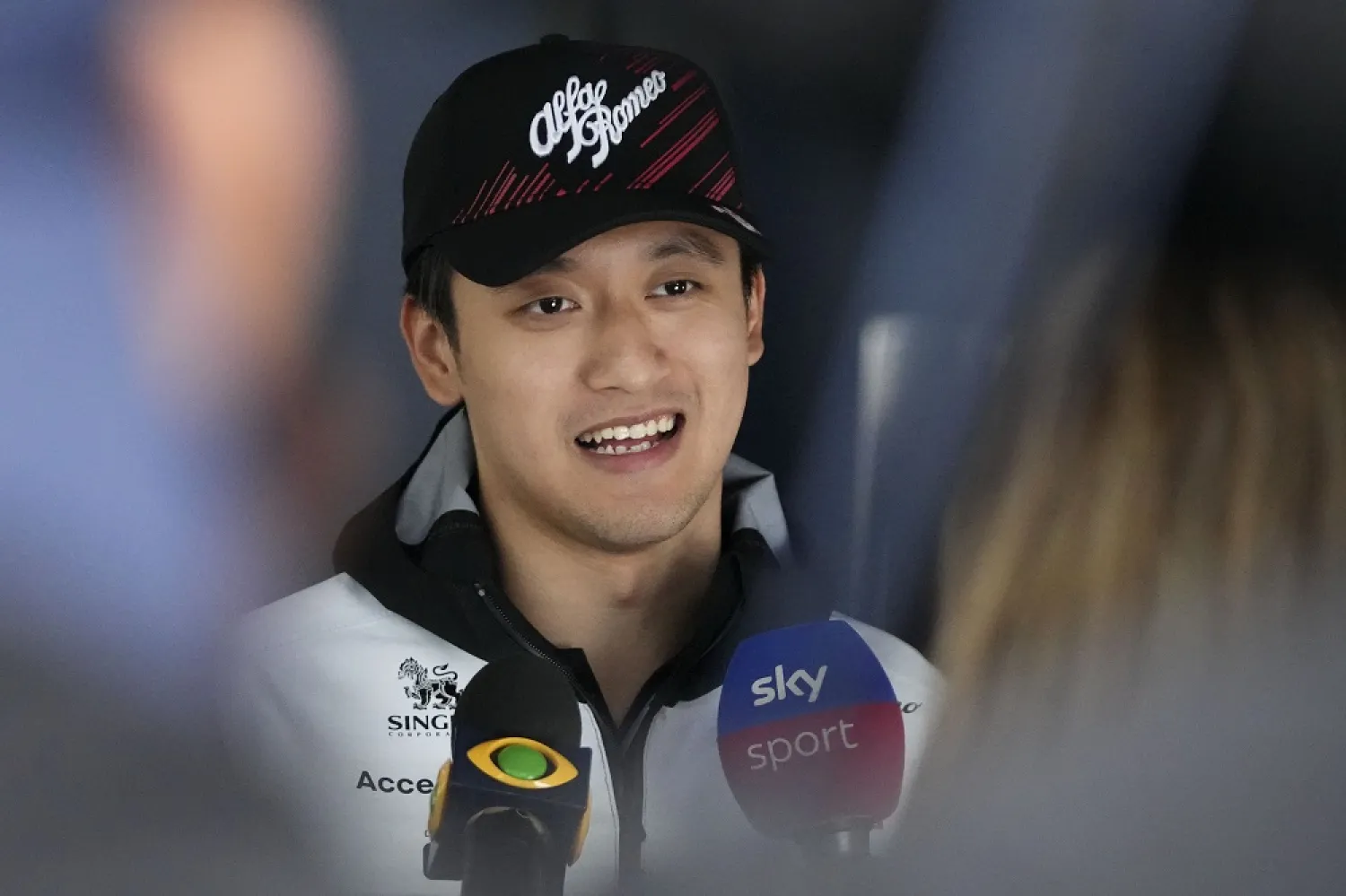
Alfa Romeo driver Zhou Guanyu of China answers to questions of journalists during interviews ahead of the Austrian Formula One Grand Prix at the Red Bull Ring racetrack in Spielberg, Thursday, July 7, 2022. (AP)
TT

Zhou Feared F1 Car Would Catch Fire with Him Trapped Inside

Alfa Romeo driver Zhou Guanyu of China answers to questions of journalists during interviews ahead of the Austrian Formula One Grand Prix at the Red Bull Ring racetrack in Spielberg, Thursday, July 7, 2022. (AP)

Trapped upside down inside his mangled car, Zhou Guanyu felt something leaking. He wasn't sure what it was, but the Formula One driver knew that it potentially raised the risk of his car exploding in flames and him being stuck inside.

"I didn’t know where I was because I was upside down, and the next thing I felt was some leaking. I was not sure if it was from my body or from the car," he said. "I knew if a fire started it would be difficult to get out, so I switched my engine off and then everything was fine."

Zhou, a 23-year-old Chinese driver for Alfa Romeo, on Thursday matter-of-factly explained his agonizing wait to be freed from his car following a terrifying first-lap crash at last Sunday's British Grand Prix. The car was wedged between fencing and a tire barrier at the first corner and rescue crews struggled to reach him in such an unusual position.

With thoughts of fire racing through his mind, Zhou said he also held his head to stop it bumping against the side, but didn’t know much else about his position.

The crash at Silverstone brought the race to an immediate halt after the car flipped and slid upside-down across the gravel and over a tire wall into the retaining fence. The car was skidding on the halo, a frontal cockpit protection device, with Zhou's helmet frighteningly close to the track surface. Then it went airborne.

Zhou still can’t explain how he walked away with minor bruising.

"I had a little bit of bruising but it was all fine after one day. I don’t know how I walked out with such little impact on my body," Zhou said ahead of this weekend's Austrian GP in Spielberg.

"It’s nice to be back here and especially not having such a long time. So you don’t think about what happened, with the questions, you just go straight into preparation ... If you had a summer break just after that it would be terrible, you would be thinking about the crash repeatedly."

He processed the incident out of his mind remarkably fast.

"I was happy mentally just having one day off and then went back to checking my physical condition. For me it wasn’t a concern," he said. "Obviously there’s times you do something and you need a bit of mental help, but this time I didn’t feel it was needed."

Zhou was looking forward to Friday's sprint race qualifying at the Red Bull Ring.

"No fears. I was able to take it quite calmly apart from not looking too much at the pictures, because that car was in a bad state," he said. "What I remember is that I had a massive hit and flipped over, traveling at a very constant speed, quite fast into the gravel ... It was only when I was facing downwards that I realized I was going to the barrier."

Remarkably, Zhou was still lucid enough to analyze how best to protect himself: "I tried to release the steering wheel myself and then get into a very low position. Make sure I’m quite solid inside myself, waiting for the final impact."

Zhou again praised the halo protective device, which was added to F1 cars in 2018.

"I felt quite lucky looking back," he said. "I don’t know how I survived, but then looking back obviously I saw the halo saved me for that."

The race, won by Ferrari's Carlos Sainz Jr., was quickly red flagged. George Russell sprinted from his Mercedes to the tire barrier to check on Zhou.

"It was really sporting of him. Shows the huge respect of the drivers," Zhou said. "Even though he wasn’t the one causing the incident. He called me after."

Russell, who appeared to be hit from behind at the start and was knocked into Zhou, recalled his first glimpse of Zhou.

"It was him trapped in there, literally not being able to get out of the car," Russell said Thursday. "When you've got a tire wall effectively on top of your head, blocking your exit, hanging upside down, it's just a horrible situation to be in."

Russell thinks improvements can be made to ensure a driver is removed more quickly from the car.

"From every disaster there's an opportunity to improve as a sport, or whatever it may be," he said. "Clearly things could have been positioned a bit differently to have given him that exit."

Race rules prevented Russell from taking the restart because his car was towed back, harsh because he'd rushed out to check on Zhou. He said Mercedes understood his "natural reaction" to a "horrific incident."

IndyCar driver Callum Illot, who praised Russell's actions, recalled when he helped him during a kart crash. Russell explained how he'd been similarly helped.

"I rolled my car in 2008. I was trapped under," he said. "I was actually burning my arm because the exhaust was stuck on top of me. This other driver stopped to lift the car off me and help me out of there."

The halo device on the cars was once very divisive in F1. While four-time F1 champion Sebastian Vettel was an early vocal advocate of it, seven-time F1 champion Lewis Hamilton was among its critics.

Not anymore, not after last Sunday and last September, when Max Verstappen's Red Bull car landed on top of his at the Italian GP.

"The (governing body) FIA have done an incredible job to improve safety. I also want to acknowledge the late, great (race director) Charlie (Whiting), who was really fundamental in getting us this halo, " Hamilton said.

"It saved my life last year, it saved several drivers' lives. Whilst we were weren't always supportive of it initially because of how it looked, I remember (Whiting) telling us it was 17% improvement in safety, and we couldn't ignore that."

Alex Albon of Williams was flung into the pit wall last Sunday after being struck by Vettel from behind as drivers tried to avoid the incident involving Zhou. Williams was helicoptered to hospital and discharged that evening.

"I feel fine, a little bit sore Monday," Albon said Thursday. "It all happened very quickly. I felt I was hitting the wall and then it was like a pinball reaction."



Shakhtar Boss Pays Ukrainian Racer $200,000 After Games Disqualification

Ukrainian President Volodymyr Zelenskiy holds helmet as he meets with a Ukrainian skeleton racer Vladyslav Heraskevych , who was disqualified from the Olympic skeleton competition over his "helmet of remembrance" depicting athletes killed since Russia's invasion and his father and coach, Mykhailo Heraskevych, amid Russia's attack on Ukraine, in Munich, Germany February 13, 2026. (Ukrainian Presidential Press Service/Handout via Reuters)
TT

Shakhtar Boss Pays Ukrainian Racer $200,000 After Games Disqualification

Ukrainian President Volodymyr Zelenskiy holds helmet as he meets with a Ukrainian skeleton racer Vladyslav Heraskevych , who was disqualified from the Olympic skeleton competition over his "helmet of remembrance" depicting athletes killed since Russia's invasion and his father and coach, Mykhailo Heraskevych, amid Russia's attack on Ukraine, in Munich, Germany February 13, 2026. (Ukrainian Presidential Press Service/Handout via Reuters)

The owner of ‌Ukrainian football club Shakhtar Donetsk has donated more than $200,000 to skeleton racer Vladyslav Heraskevych after the athlete was disqualified from the Milano Cortina Winter Games before competing over the use of a helmet depicting Ukrainian athletes killed in the war with Russia, the club said on Tuesday.

The 27-year-old Heraskevych was disqualified last week when the International Bobsleigh and Skeleton Federation jury ruled that imagery on the helmet — depicting athletes killed since Russia invaded Ukraine in 2022 — breached rules on athletes' expression at ‌the Games.

He ‌then lost an appeal at the Court ‌of ⁠Arbitration for Sport hours ⁠before the final two runs of his competition, having missed the first two runs due to his disqualification.

Heraskevych had been allowed to train with the helmet that displayed the faces of 24 dead Ukrainian athletes for several days in Cortina d'Ampezzo where the sliding center is, but the International Olympic Committee then ⁠warned him a day before his competition ‌started that he could not wear ‌it there.

“Vlad Heraskevych was denied the opportunity to compete for victory ‌at the Olympic Games, yet he returns to Ukraine a ‌true winner," Shakhtar President Rinat Akhmetov said in a club statement.

"The respect and pride he has earned among Ukrainians through his actions are the highest reward. At the same time, I want him to ‌have enough energy and resources to continue his sporting career, as well as to fight ⁠for truth, freedom ⁠and the remembrance of those who gave their lives for Ukraine," he said.

The amount is equal to the prize money Ukraine pays athletes who win a gold medal at the Games.

The case dominated headlines early on at the Olympics, with IOC President Kirsty Coventry meeting Heraskevych on Thursday morning at the sliding venue in a failed last-minute attempt to broker a compromise.

The IOC suggested he wear a black armband and display the helmet before and after the race, but said using it in competition breached rules on keeping politics off fields of play. Heraskevych also earned praise from Ukraine President Volodymyr Zelenskiy.


Speed Skating-Italy Clinch Shock Men’s Team Pursuit Gold, Canada Successfully Defend Women’s Title

 Team Italy with Davide Ghiotto, Andrea Giovannini, Michele Malfatti, celebrate winning the gold medal on the podium of the men's team pursuit speed skating race at the 2026 Winter Olympics, in Milan, Italy, Tuesday, Feb. 17, 2026. (AP)
Team Italy with Davide Ghiotto, Andrea Giovannini, Michele Malfatti, celebrate winning the gold medal on the podium of the men's team pursuit speed skating race at the 2026 Winter Olympics, in Milan, Italy, Tuesday, Feb. 17, 2026. (AP)
TT

Speed Skating-Italy Clinch Shock Men’s Team Pursuit Gold, Canada Successfully Defend Women’s Title

 Team Italy with Davide Ghiotto, Andrea Giovannini, Michele Malfatti, celebrate winning the gold medal on the podium of the men's team pursuit speed skating race at the 2026 Winter Olympics, in Milan, Italy, Tuesday, Feb. 17, 2026. (AP)
Team Italy with Davide Ghiotto, Andrea Giovannini, Michele Malfatti, celebrate winning the gold medal on the podium of the men's team pursuit speed skating race at the 2026 Winter Olympics, in Milan, Italy, Tuesday, Feb. 17, 2026. (AP)

An inspired Italy delighted the home crowd with a stunning victory in the Olympic men's team pursuit final as

Canada's Ivanie Blondin, Valerie Maltais and Isabelle Weidemann delivered another seamless performance to beat the Netherlands in the women's event and retain their title ‌on Tuesday.

Italy's ‌men upset the US who ‌arrived ⁠at the Games ⁠as world champions and gold medal favorites.

Spurred on by double Olympic champion Francesca Lollobrigida, the Italian team of Davide Ghiotto, Andrea Giovannini and Michele Malfatti electrified a frenzied arena as they stormed ⁠to a time of three ‌minutes 39.20 seconds - ‌a commanding 4.51 seconds clear of the ‌Americans with China taking bronze.

The roar inside ‌the venue as Italy powered home was thunderous as the crowd rose to their feet, cheering the host nation to one ‌of their most special golds of a highly successful Games.

Canada's women ⁠crossed ⁠the line 0.96 seconds ahead of the Netherlands, stopping the clock at two minutes 55.81 seconds, and

Japan rounded out the women's podium by beating the US in the Final B.

It was only Canada's third gold medal of the Games, following Mikael Kingsbury's win in men's dual moguls and Megan Oldham's victory in women's freeski big air.


Lindsey Vonn Back in US Following Crash in Olympic Downhill 

Milano Cortina 2026 Olympics - Alpine Skiing - Women's Downhill 3rd Official Training - Tofane Alpine Skiing Centre, Belluno, Italy - February 07, 2026. Lindsey Vonn of United States in action during training. (Reuters)
TT

Lindsey Vonn Back in US Following Crash in Olympic Downhill 

Milano Cortina 2026 Olympics - Alpine Skiing - Women's Downhill 3rd Official Training - Tofane Alpine Skiing Centre, Belluno, Italy - February 07, 2026. Lindsey Vonn of United States in action during training. (Reuters)

Lindsey Vonn is back home in the US following a week of treatment at a hospital in Italy after breaking her left leg in the Olympic downhill at the Milan Cortina Games.

“Haven’t stood on my feet in over a week... been in a hospital bed immobile since my race. And although I’m not yet able to stand, being back on home soil feels amazing,” Vonn posted on X with an American flag emoji. “Huge thank you to everyone in Italy for taking good care of me.”

The 41-year-old Vonn suffered a complex tibia fracture that has already been operated on multiple times following her Feb. 8 crash. She has said she'll need more surgery in the US.

Nine days before her fall in Cortina d'Ampezzo, Italy, Vonn ruptured the ACL in her left knee in another crash in Switzerland.

Even before then, all eyes had been on her as the feel-good story heading into the Olympics for her comeback after nearly six years of retirement.