


Biden Greeted as Old Friend in Israel at Start of Middle East Tour

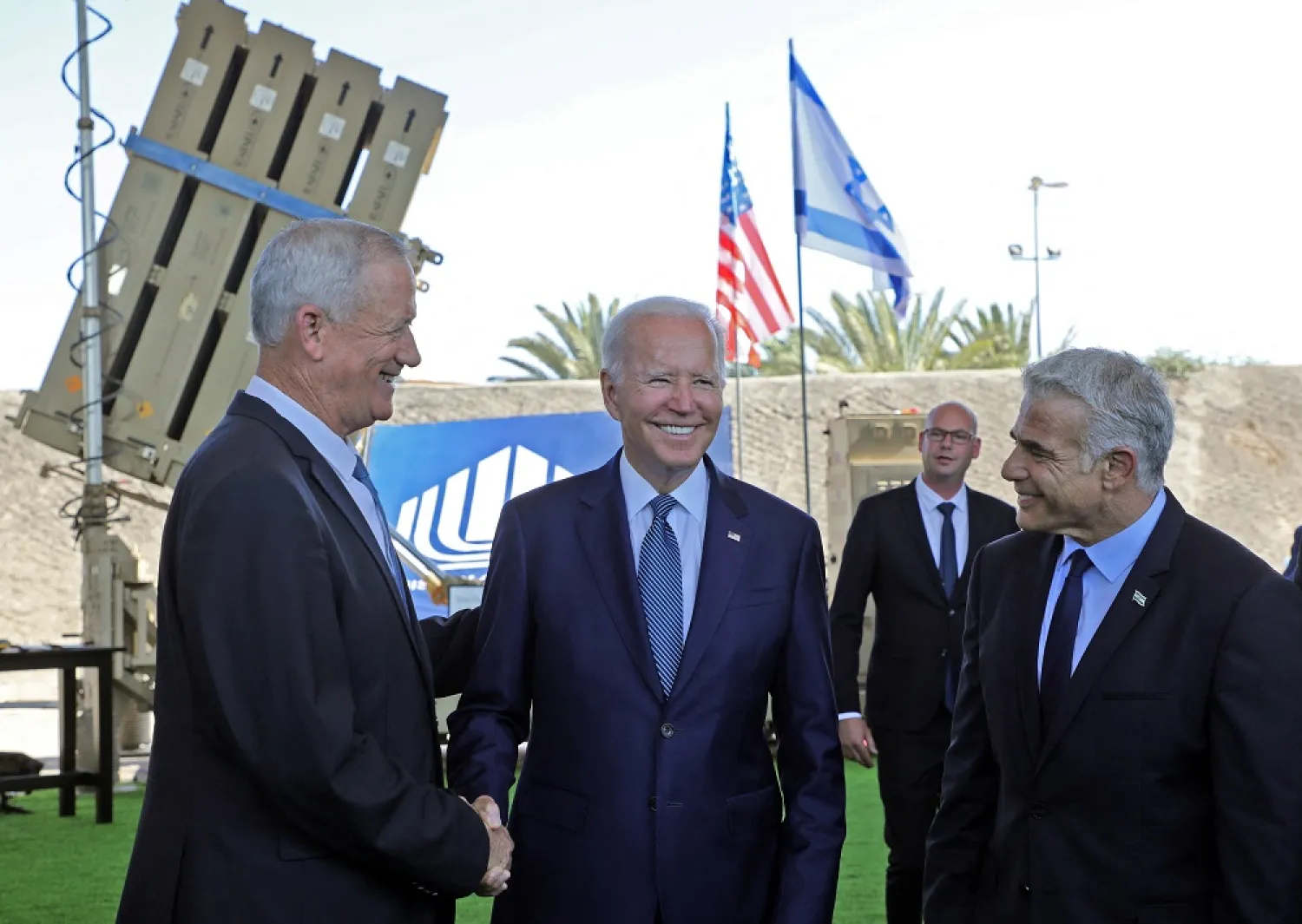
US President Joe Biden, Israeli caretaker Prime Minister Yair Lapid and Israeli Defense Minister Benny Gantz stand in front of Israel's Iron Dome defense system, during a tour at Ben Gurion Airport, in Lod, near Tel Aviv, Israel, July 13, 2022. (Reuters)
TT

Biden Greeted as Old Friend in Israel at Start of Middle East Tour

US President Joe Biden, Israeli caretaker Prime Minister Yair Lapid and Israeli Defense Minister Benny Gantz stand in front of Israel's Iron Dome defense system, during a tour at Ben Gurion Airport, in Lod, near Tel Aviv, Israel, July 13, 2022. (Reuters)

US President Joe Biden arrived on Wednesday in Israel, which embraced him as an old friend on the first leg of a high-stakes trip dominated by tensions with Iran.

Landing at Ben Gurion Airport, whose tarmac he first trod in 1973 as a senator, Biden bumped fists with Israeli Prime Minister Yair Lapid and President Isaac Herzog and, in a speech, described the connection between the two nations as "bone-deep".

"You do not need to be a Jew to be a Zionist," Biden added, voicing support for the ideology behind Israel's foundation on lands with ancient Jewish roots, and which is deeply resented by many Palestinians.

Biden also reiterated US desire for negotiations, stalled since 2014, to create a Palestinian state on Israeli-occupied territory, calling this two state solution "the best hope" for both peoples.

Biden's first visit to Israel as president is his tenth of a long political career. Israel has stepped carefully around disputes with Washington over Iranian nuclear diplomacy and long-stalled Palestinian statehood negotiations.

"Your relationship with Israel has always been personal," Lapid said in a speech, calling Biden "one of the best friends Israel has ever known".

Biden will spend two days in Jerusalem before meeting Palestinian President Mahmoud Abbas on Friday in the occupied West Bank.

He will then fly directly from Israel to Jeddah, Saudi Arabia for talks with Saudi officials and to attend a summit of Gulf allies.

In a similar vein, Herzog played on Biden's first name, deeming him "both a visionary and a leader" like the biblical Joseph. Biden was "truly amongst family" in Israel, Herzog said.

Biden's trip aims to promote regional stability, deepen Israel's integration in the region and counter Iranian influence and aggression by Russia and China.

US National Security Adviser Jake Sullivan reiterated Washington's desire for the reopening of a Jerusalem consulate shut down by the former US administration of President Donald Trump. The consulate had served the Palestinians, who want East Jerusalem as capital of a future state.

"Obviously that requires engagement with the Israeli government," Sullivan told reporters aboard Air Force 1. Israel deems all of Jerusalem its capital - a status not recognized abroad - and does not consent to the consulate reopening.

Wasel Abu Youssef, a member of the umbrella Palestine Liberation Organization (PLO), said he saw nothing new from Biden on Palestinian issues.

"Biden’s visit aims to integrate the occupation state in the Arab region and build a new alliance against Iran. When it comes to the promises President Biden made during his electoral campaign and early in office, we don’t see any practical formula to reflect that on the ground,” he added.

Saudi visit

Biden, under pressure at home to bring down soaring gasoline prices that have damaged his standing in public opinion polls, is expected to press Gulf allies to expand oil production.

He said details about a price cap on oil from Russia were still being worked out with European partners and said signs of a deepening relationship between Russia and Iran should be seen as a threat.

A centerpiece of Biden's visit will be talks in Jeddah where he will attend a Gulf summit that will also include the leaders of Jordan and Iraq.

Biden's talks with Abbas will be the first between a US president and a Palestinian leader since the Obama administration. The Palestinians boycotted the Trump administration over a peace plan they saw as biased against them.

Tensions are high between Israel and the Palestinians over the killing of Palestinian-American journalist Shireen Abu Akleh in May during an Israeli army raid in the West Bank.

Palestinians say she was killed by Israeli troops deliberately; Israel denies this. Washington has concluded she was killed by a bullet from the direction of an Israeli position but it has no evidence it was intentional.

Her family had accused the Biden administration of providing impunity for Israel over her killing, and asked to meet Biden during his trip to the region this week. US Secretary of State Antony Blinken had spoken with the family, Sullivan said, and invited them to a meeting.

The Palestinians, while appreciating the resumption of ties under Biden, want him to make good on pledges to reopen the Jerusalem consulate.

They also want the United States to remove the PLO from the US list of terrorist organizations, block changes to rules for worship at Jerusalem sites revered by Muslims and Jews, and curb Jewish settlement expansion in the West Bank.

Israeli officials said Biden's visit would work towards what they called a Jerusalem Declaration on the US-Israel Strategic Partnership.

One official said the joint declaration "takes a very clear and united stand against Iran, its nuclear program and its aggression across the region and commits both countries to using all elements of their national power against the Iranian nuclear threat."

Biden is likely to face questions from Israel and from Gulf states such as Saudi Arabia and the United Arab Emirates about the wisdom of his attempts to revive a nuclear deal with Iran that was abandoned by his predecessor Trump.

At Ben Gurion Airport, Biden received a briefing on Israel's US-supported Iron Dome defense system and a new laser-enabled system called Iron Beam. He will also pay his respects at Yad Vashem, Israel's memorial to Holocaust victims in World War Two.

Israel has been jolted by internal political strife with previous prime minister Naftali Bennett's coalition collapsing in June.

This has left Lapid as caretaker prime minister until a new election in November, the fifth in less than four years. He and Biden will give a joint news conference on Thursday.

Biden will also meet past prime minister Benjamin Netanyahu, now the opposition leader. Netanyahu was a close ally of Trump and a critic of the Obama administration when Biden served as vice president.



Oil Tanker Hijacked off Yemen, Diverted Towards Somalia

Oil tanker (file photo – Reuters)
TT

Oil Tanker Hijacked off Yemen, Diverted Towards Somalia

Oil tanker (file photo – Reuters)

An oil tanker was hijacked on Saturday off the coast of Yemen in the Gulf of Aden and taken toward Somalia, the Yemeni coast guard said.

According to the agency, the tanker EUREKA was seized off Shabwa province by unknown individuals who "boarded, took control of it, then steered it... in the direction of the Somali coast".

It also said that the tanker has been located, and efforts are under way to track it and take the necessary measures in an attempt to recover it and ensure the safety of its crew, whose number and nationalities were not specified.


Lebanese Divisions over Approach to US Pressure for Aoun–Netanyahu Meeting

A poster depicting the portrait of Lebanon's President Joseph Aoun that reads "The decision-maker, the protector of Lebanon, Lebanon first...The State always. We are with you" hangs at the entrance of a tunnel on a street in Beirut (Photo by Joseph EID / AFP)
TT

Lebanese Divisions over Approach to US Pressure for Aoun–Netanyahu Meeting

A poster depicting the portrait of Lebanon's President Joseph Aoun that reads "The decision-maker, the protector of Lebanon, Lebanon first...The State always. We are with you" hangs at the entrance of a tunnel on a street in Beirut (Photo by Joseph EID / AFP)

Lebanese political forces are split between those supporting direct negotiations with Israel to end the ongoing war in the south and those opposing them, placing the Lebanese president in a difficult position amid internal divisions that could affect the course of the state. There are warnings that pursuing any option without consensus could have repercussions for unity and internal stability.

In a statement notable for both its timing and content, the US Embassy in Beirut on Thursday called for direct engagement between Lebanon and Israel, saying a direct meeting between Aoun and Netanyahu, mediated by the US president, could give Lebanon an opportunity to obtain tangible guarantees regarding full sovereignty, territorial integrity, secure borders, humanitarian support and reconstruction, and the full restoration of the Lebanese state’s authority over every inch of its territory, guaranteed by the United States.

Hezbollah–Amal alliance

It was not surprising that the “Shiite duo” (Hezbollah and the Amal Movement) fully opposes such a meeting, viewing it as contrary to the path of direct negotiations underway between Lebanon and Israel.

Sources close to the two parties told Asharq Al-Awsat: “There is absolutely no support for this meeting, and a scene like this cannot be accepted. It is true that US pressure is very clear, but there is also Lebanon’s interest and the position of Arab states, which advised the president not to move toward such a meeting and instead to seek, through negotiations, a security arrangement similar to the 1949 armistice agreement, even if with some amendments.”

The sources added that “President Aoun is caught between US pressure on one hand and Arab pressure on the other, and must decide where Lebanon’s interest lies and define its position, role, and future in the region.”

A woman walks past a billboard supporting Lebanese President Joseph Aoun - EPA/WAEL HAMZEH

Progressive Socialist Party

The position of the Progressive Socialist Party, expressed by MP Dr. Bilal Abdallah, is not far from that of the “duo.” Abdallah considers that “the meeting is premature, and there are many stages that must be completed before it can take place, most notably consolidating the ceasefire, halting attacks, Israeli withdrawal, and reaching a security agreement based on international agreements (a revised armistice agreement), after which each step can be addressed in due course.”

He stressed the need to respect “the Arab and international ceiling and avoid preempting developments or skipping stages, as the repercussions would be negative for national interest and internal unity.”

Lebanese President Joseph Aoun speaks with Egypt's President Abdel Fattah el-Sisi on the day of a summit of the European Union and regional partners' leaders in Nicosia (Lefkosia), Cyprus, April 24, 2026. REUTERS/Yves Herman

Lebanese Forces and Kataeb position

By contrast, the Lebanese Forces and Kataeb parties take a different approach. MP Ghada Ayoub of the “Strong Republic” bloc (Lebanese Forces) said her party supports “the negotiating initiative undertaken by Aoun, which falls within the core powers of the president,” leaving it to him to assess its course, including the timing of any meeting or even a potential handshake with Benjamin Netanyahu, whether it should take place now or come as the culmination of negotiations.

She told Asharq Al-Awsat: “We support the president in what he sees as appropriate to save Lebanon and extricate it from this predicament, which has imposed a heavy cost as a result of Hezbollah’s decision to draw Israel into Lebanon. Today it realizes it is unable to remove it, and that the only party capable of doing so is the United States. We saw how President Donald Trump was able to impose a ceasefire on Benjamin Netanyahu despite his team’s insistence on continuing the war.”

Ayoub stressed that “any negotiating track will be tied to clear conditions where the US position intersects with that of the Lebanese government, foremost among them disarmament, preventing Lebanese territory from being used as a launchpad for military operations against Israel, and banning the party’s security and military activities.”

Sources in the Kataeb Party, while confirming significant US pressure to arrange an Aoun–Netanyahu meeting, said such a step requires “historic courage,” adding that “what matters in the end is the outcome, which should be a roadmap for peace.”


Asharq Al-Awsat Reveals Contents of Hamas and Factions’ Response to Mediators’ Amendments and Mladenov

Palestinians take part in a protest against the limited access to medical spare parts and batteries for deaf and hearing-impaired individuals in the Gaza Strip, as they gather in Gaza City, Saturday, May 2, 2026. (AP Photo/Abdel Kareem Hana)
TT

Asharq Al-Awsat Reveals Contents of Hamas and Factions’ Response to Mediators’ Amendments and Mladenov

Palestinians take part in a protest against the limited access to medical spare parts and batteries for deaf and hearing-impaired individuals in the Gaza Strip, as they gather in Gaza City, Saturday, May 2, 2026. (AP Photo/Abdel Kareem Hana)

Hamas and Palestinian factions submitted their response at dawn on Saturday to the mediators and the High Representative for Gaza at the Peace Council, Nickolay Mladenov, regarding the amendments paper presented to the factions, which had previously submitted their initial response to the “roadmap” presented on April 19.

The response by Hamas and the Palestinian factions included amendments to some of the points contained in Mladenov’s paper, which Asharq Al-Awsat had disclosed on Friday. These included acceptance by Hamas and the factions of a text acceptable to all parties within the framework of US President Donald Trump’s plan, commitment to what was agreed in Sharm el-Sheikh in full, and acceptance of the recently presented roadmap as a basis for entering negotiations to reach an agreement quickly.

It also stipulated that the issue of weapons be addressed in accordance with Trump’s plan and UN Security Council Resolution 2803, and that both continue to be implemented in a way that ensures Palestinians obtain self-determination and establish a sovereign state.

FILE - Board member Nickolay Mladenov speaks after the signing of a Board of Peace charter during the Annual Meeting of the World Economic Forum in Davos, Switzerland, Thursday, Jan. 22, 2026. (AP Photo/Evan Vucci, file)

The response by Hamas and the factions, as revealed by Asharq Al-Awsat, to Mladenov’s amendments expressed appreciation for the mediators’ efforts to reach a text acceptable to all parties within the framework of Trump’s plan, and called for Israel’s full and immediate commitment to the obligations of this text as stipulated in the Sharm el-Sheikh agreement, according to an agreed timetable.

It also included approval of the recently submitted roadmap as a basis for entering serious negotiations on its contents, and its implementation after reaching an acceptable agreement as soon as possible, in a way that ensures a ceasefire between the two sides, an end to the humanitarian crisis in the Gaza Strip, full withdrawal from the Strip, reconstruction, the entry of international forces, addressing the issue of weapons, and transferring governance of the Strip to the national committee with full powers.

It further stressed that the issue of weapons would be handled in connection with the political rights of the Palestinian people, within a national framework, and in the context of establishing the necessary security arrangements as a basis for guaranteeing security for both sides. It added that mediators and all parties should work to achieve the objective stated in Trump’s plan of establishing a sovereign Palestinian state and securing the Palestinian people’s right to self-determination.

A senior Hamas source told Asharq Al-Awsat that the movement submitted this response on behalf of the Palestinian factions after taking into account observations presented by some factions, noting that there are substantive remarks on Mladenov’s amended paper.

The source indicated that Hamas leadership senses a degree of discomfort among the mediators regarding the submitted response after changes were made to it. This was confirmed by another source from a Palestinian faction whose representatives met Egyptian mediators, who expressed surprise at the manner of the response. Two sources from Palestinian factions represented by delegations in Cairo said that Hamas’s response showed divergence from what some factions had proposed.

A Palestinian child participates in a protest against the shortage of medical equipment and hearing aid batteries for deaf and hearing-impaired individuals in Gaza City on Saturday (AP)

According to the sources, some points of contention relate to the factions’ recommendation for immediate and full implementation of the first phase, as set out in the roadmap, paving the way for the administrative committee to assume its role, and establishing a clear timetable to follow up and monitor implementation of the phase’s provisions in a simultaneous and balanced manner between the parties. This was not addressed by Hamas, particularly regarding simultaneity and balance.

The factions’ remarks stressed that the issue of weapons should be addressed within a political horizon for the Palestinian people in the context of ensuring the success of Trump’s plan and the objectives of the roadmap, and that factions should work to complete this track in a way that enables Palestinians to achieve self-determination and establish their independent state in accordance with international legitimacy resolutions.

Asharq Al-Awsat learned that after receiving the Hamas and factions’ response, Mladenov left the Egyptian capital, Cairo. The Hamas delegation may also leave Cairo to participate in completing the election of the head of its political bureau, while contacts and meetings are expected to continue in the coming days.