SDF Announces General Mobilization in Anticipation of Turkish Attack

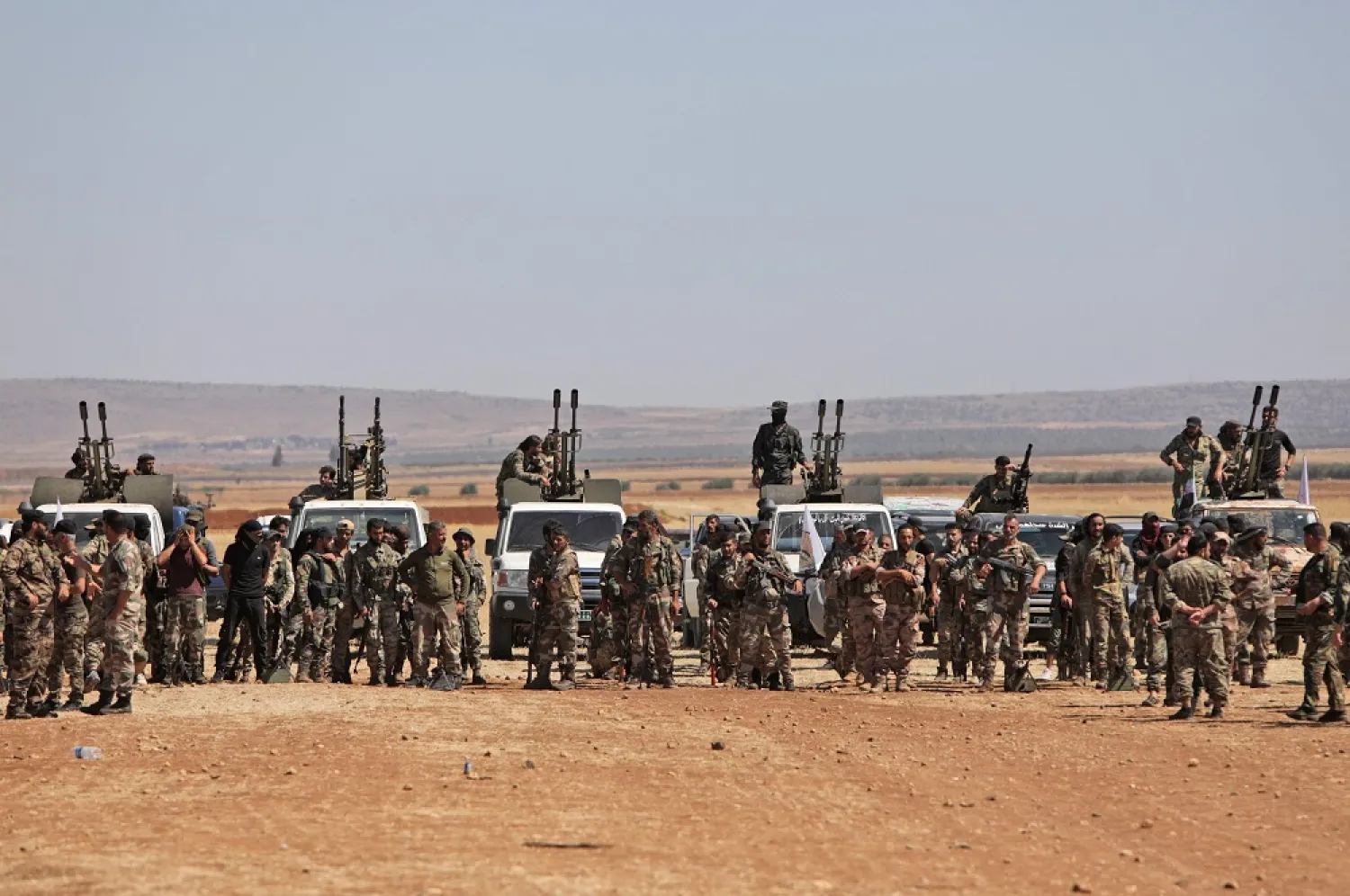
Turkey-backed Syrian fighters gather along the frontlines opposite Kurdish forces near the town of Dadat north of Manbij in Syria's northern Aleppo province, on July 5, 2022. (AFP)
TT

SDF Announces General Mobilization in Anticipation of Turkish Attack

Turkey-backed Syrian fighters gather along the frontlines opposite Kurdish forces near the town of Dadat north of Manbij in Syria's northern Aleppo province, on July 5, 2022. (AFP)

The military councils of the Syrian Democratic Forces (SDF) declared Monday general mobilization in areas under their control in northeastern Syria.

They also announced sending military reinforcements near the borders with Turkey as Ankara continues to threaten to wage a new offensive in the region.

The Syrian Observatory for Human Rights reported the arrival of new regime reinforcements to the frontlines in the Manbij countryside, east of Aleppo.

Several buses loaded with regime and Russian forces arrived at frontlines on Monday.

Pro-Turkish National Army factions in the Manbij countryside also took up positions.

The regime forces have recently reinforced their positions in Ain Issa and the M4 international highway.

The reinforcements comprised buses transporting 250 soldiers, five tanks and heavy weapons.

The area witnesses almost daily clashes between the warring parties.

Separately, masses of US soldiers roamed the Tal Tamr countryside, northwest of al-Hasakah governorate, under the protection of SDF patrols.

The International Coalition Forces and SDF carried out a new round of military drills using live ammunition at the coalition base in al-Shaddadi town, south of al-Hasakah.

A convoy of military aid, comprised of 50 trucks, also arrived at the base. It included weapons, logistic equipment, armored vehicles and water and fuel tanks.

A day earlier, 80 trucks carrying reinforcements arrived at Coalition bases in al-Hasakah and the Deir Ezzor province.


Israeli Airstrike Destroys Bridge on Litani River in South Lebanon

Smoke and flames rise after an Israeli strike targeting the Qasmiyeh bridge near Tyre, in southern Lebanon, 22 March 2026. (EPA)
TT

Israeli Airstrike Destroys Bridge on Litani River in South Lebanon

Smoke and flames rise after an Israeli strike targeting the Qasmiyeh bridge near Tyre, in southern Lebanon, 22 March 2026. (EPA)

An Israeli airstrike destroyed on Monday another bridge on the Litai River in southern Lebanon.

The strike on the bridge in the southern village of Qaaqaaiyet al-Jisr cut a main link between the southern city of Nabatieh and al-Hujair valley region farther south.

The state-run National News Agency gave no further details.

On Sunday, Israel struck the Qasmiyeh bridge near the southern port city of Tyre.

Lebanese President Joseph Aoun called Israel’s new targeting of bridges in the south “a prelude to a ground invasion.”

The Israeli military announced Sunday it was expanding its ground campaign against Hezbollah in Lebanon, warning of a lengthy operation, after Beirut condemned what it called Israel's flagrant violations of Lebanese sovereignty.

Israeli forces were ordered earlier Sunday to destroy bridges they said were used by the Iran-backed group Hezbollah to cross the Litani River.

"The operation against the Hezbollah terrorist organization has only begun... This is a prolonged operation," Lieutenant General Eyal Zamir said in a statement.

"We are now preparing to advance the targeted ground operations and strikes according to an organized plan," he added.

In a separate statement Sunday, military spokesman Brigadier General Effie Defrin said the expansion of the ground operation would begin within the coming week.

Lebanon was pulled into the Middle East war when Hezbollah began firing rockets into Israel on March 2 to avenge the killing of Iran's supreme leader Ali Khamenei in an Israeli-US strike.

Lebanon's health ministry said four people were killed on Sunday in two strikes in the south, while authorities have reported 1,029 dead in three weeks of conflict and more than one million displaced.

Israeli Defense Minister Israel Katz said he and Israeli Prime Minister Benjamin Netanyahu had instructed the military "to immediately destroy all the bridges over the Litani River that are used for terrorist activity, in order to prevent Hezbollah terrorists and weapons from moving south".

The Litani River runs around 30 kilometers (20 miles) north of the Israeli border.

Earlier this week, Israel attacked two bridges spanning the Litani, also alleging they were being used by Hezbollah.

Katz said the military was also instructed to "accelerate the demolition of Lebanese houses in the contact villages in order to thwart threats to Israeli communities".


First Israeli Civilian Killed in Lebanon Border War Was Hit by Israeli Fire

Smoke rises after an Israeli strike, following an escalation between Hezbollah and Israel amid the US-Israeli conflict with Iran, as seen from Marjayoun, Lebanon, March 22, 2026. REUTERS/Karamallah Daher
TT

First Israeli Civilian Killed in Lebanon Border War Was Hit by Israeli Fire

Smoke rises after an Israeli strike, following an escalation between Hezbollah and Israel amid the US-Israeli conflict with Iran, as seen from Marjayoun, Lebanon, March 22, 2026. REUTERS/Karamallah Daher

Israel said on Monday its own forces had misfired artillery that killed an Israeli farmer near the Lebanese frontier, the first Israeli civilian killed in a border conflict being waged in parallel with the war in Iran.

Ofer Moskovitz, 60, an avocado farmer in the town of Misgav Am, had spoken with Reuters just last week and said he was worried about the fighting at the border.

In a ⁠statement, Major General ⁠Rafi Milo, who heads the military's northern command, said: "Moskovitz was killed by our own forces’ fire during an operation whose entire purpose was to protect them."

The military had initially blamed cross-border fire from Lebanon when it first reported the incident on Sunday.

Israel has ⁠launched a major ground assault and air campaign into Lebanon to root out Hezbollah, a powerful Iran-backed militia, which fired into Israel in support of Tehran two days after the start of the Israeli-US air attacks on Iran.

Lebanese authorities say more than a thousand people have been killed and more than a million driven from their homes in Lebanon. The death of Moskovitz was the first reported in Israel. The ⁠military ⁠says two Israeli soldiers have been killed in combat.

"Every five minutes you can hear the bombs," Moskovitz told Reuters last week.

The military's statement said troops had opened fire to support soldiers operating in southern Lebanon, but "severe issues and operational errors" had taken place.

"The artillery fire was carried out at an incorrect angle and did not follow required protocols," it said. "As a result, five artillery shells were fired at the Misgav Am ridge instead of toward the enemy target."


Iraqi PM Says Accelerating Withdrawal of Anti-ISIS Coalition Forces

13 January 2023, Berlin: Iraqi Prime Minister Mohammed Shia al-Sudani speaks during a press conference. (dpa)
TT

Iraqi PM Says Accelerating Withdrawal of Anti-ISIS Coalition Forces

13 January 2023, Berlin: Iraqi Prime Minister Mohammed Shia al-Sudani speaks during a press conference. (dpa)

Iraqi Prime Minister Mohammed Shia al-Sudani said he would accelerate the dismantling of a US-led international anti-ISIS coalition, in an interview with an Italian newspaper published Monday.

The prime minister's comments come as the country finds itself unwillingly drawn into the conflict in the Middle East, which began with Israeli and US strikes on Iran on February 28.

Pro-Iran armed groups have claimed responsibility for near-daily attacks on US interests in Iraq and across the region, while strikes have also targeted these groups.

The end of the international anti-ISIS coalition's mission was initially planned for September 2026 in Iraq, with the drawdown launching in 2024.

The end of the mission was intended to pave the way for bilateral security partnerships with member countries of the alliance, formed in 2014 to fight the extremist ISIS group.

"With our allies we have now decided to bring forward the end of the international coalition, which was supposed to continue until September 2026," Sudani told Italian newspaper Corriere Della Sera.

"Once there are no more foreign military contingents on Iraqi soil, it will be easier to break up the armed factions," he said, referring to pro-Iran groups in the country.

The presence of foreign troops -- particularly American advisers -- is a long-running point of contention between the government and the pro-Iran armed factions.

Baghdad has demanded a monopoly on weapons and called for the dismantling of the groups' arsenals, which the factions justify by pointing to the presence of foreign soldiers.

Both the government and the coalition insist the coalition deploys military advisers -- who provide expertise and support, aiming to prevent a resurgence of ISIS -- to Iraq at the invitation of the authorities.

These advisers are currently only deployed in northern Iraqi Kurdistan and were scheduled to remain there until September 2026.

In January, the first phase of the coalition withdrawal agreement was completed, with personnel leaving the Iraqi military bases.

The coalition is also in the process of withdrawing from neighboring Syria, where it also deployed, having recently handed over its bases to Syrian government forces.