


Egypt Seeks to Reduce, Capture and Store Carbon

Egyptian Petroleum Minister Tarek El Molla and Environment Minister Yasmine Fouad during talks on Tuesday, July 26,2022. (Asharq Al-Awsat)
TT

Egypt Seeks to Reduce, Capture and Store Carbon

Egyptian Petroleum Minister Tarek El Molla and Environment Minister Yasmine Fouad during talks on Tuesday, July 26,2022. (Asharq Al-Awsat)

Egyptian Petroleum Minister Tarek El Molla and Environment Minister Yasmine Fouad met on Tuesday to discuss preparations for the COP27 Climate Summit, which will be held in the Red Sea resort of Sharm El-Sheikh in November.

They discussed organizing a number of events related to environmental sustainability, carbon reduction, capture and storage in the energy, oil and gas sectors.

In a press statement following the meeting, Molla said his ministry, in coordination with the Environment Ministry, will organize the Decarbonization Day during upcoming summit.

It aims to underline the policies and initiatives implemented by the companies operating in the oil and gas industry in the country to reduce carbon emissions, as part of their commitment to contribute to sustainable development and support global efforts to address climate change.

He pointed out that international companies will present advanced technologies that help achieve optimal results, as well as the best practices and models applied for the carbon reduction, capture and storage process.

He affirmed that technology, human capacity-building efforts and ways to provide financial support will be among the topics tackled, given their vital role in advancing efforts to reduce carbon emissions.

The two ministers reviewed final draft of the activities and discussions that will be held during the event, as well as the ongoing preparations between the working teams from both ministries.

Discussions also tackled preparations for the Energy Day, which will be held in coordination between the two ministries.

Yasmine, for her part, referred to the tasks entrusted to the Petroleum Ministry to determine the topics that will be discussed on that day, in preparation for submitting them to the Supreme Committee COP27 Climate Summit.
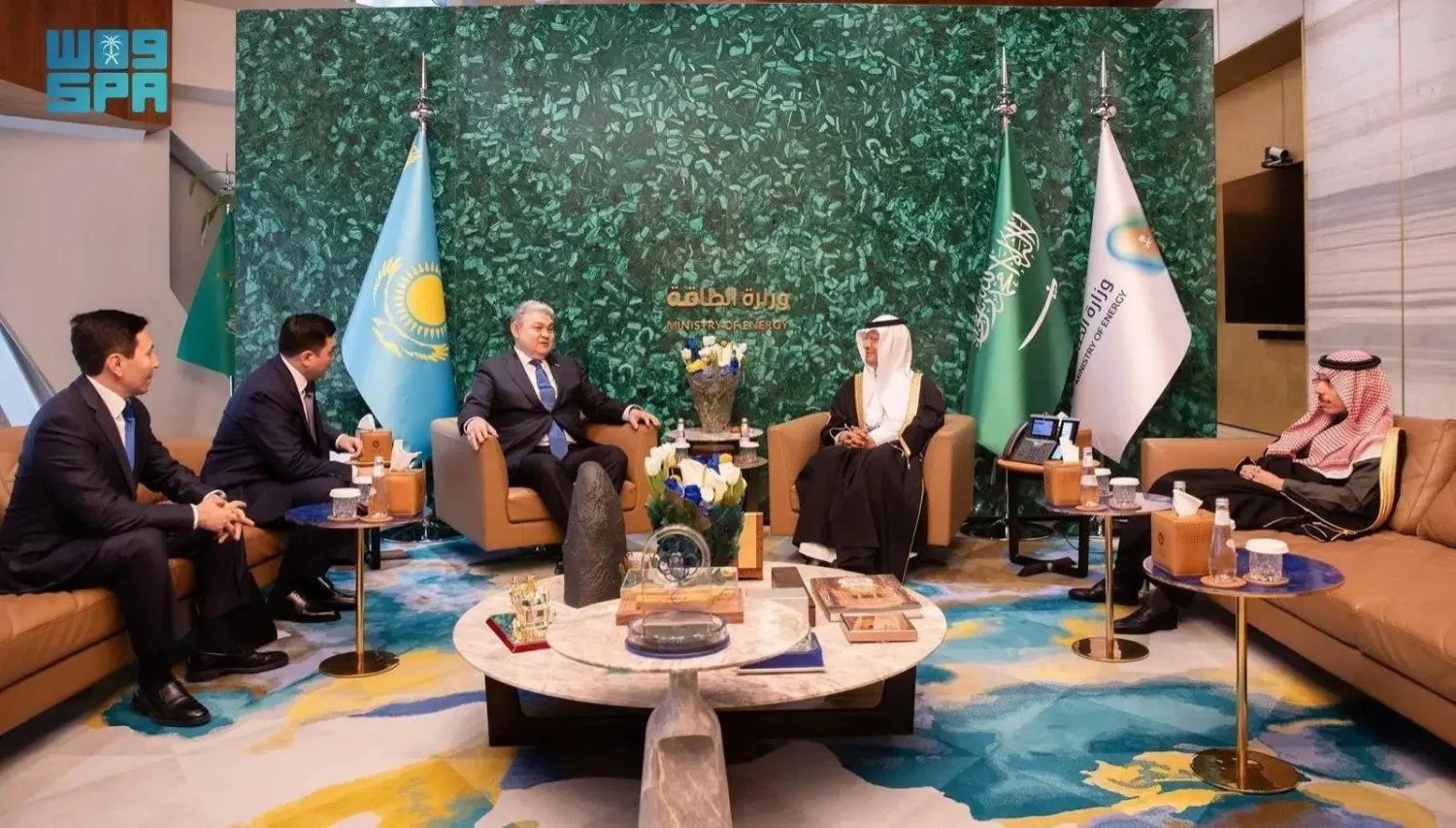



Saudi Arabia, Kazakhstan Agree to Establish Coordination Council

Saudi Minister of Energy Prince Abdulaziz bin Salman bin Abdulaziz receives Kazakhstan’s Foreign Minister Yermek Kosherbayev in Riyadh. (SPA)
TT

Saudi Arabia, Kazakhstan Agree to Establish Coordination Council

Saudi Minister of Energy Prince Abdulaziz bin Salman bin Abdulaziz receives Kazakhstan’s Foreign Minister Yermek Kosherbayev in Riyadh. (SPA)

Saudi Arabia and Kazakhstan agreed to establish a Saudi-Kazakh Coordination Council, reported the Saudi Press Agency on Tuesday.

Saudi Minister of Energy Prince Abdulaziz bin Salman bin Abdulaziz received in Riyadh Kazakhstan’s Foreign Minister Yermek Kosherbayev. Saudi FM Prince Faisal bin Farhan bin Abdullah and Minister of Energy of Kazakhstan Yerlan Akkenzhenov also attended the meeting.

The talks tackled the establishment of the coordination council, which will be chaired by the Saudi minister of energy and Kazakhstan’s foreign minister. The council reflects the two countries’ commitment to strengthening cooperation and expanding their bilateral partnership.

Prince Abdulaziz and Kosherbayev signed an agreement on the establishment of the council, which aims to boost coordination and consultation between the two countries and develop frameworks for cooperation across various sectors of mutual interest, elevating bilateral relations to broader levels.

Prince Abdulaziz and Kosherbayev discussed relations between their countries and ways to develop them further, especially in the energy field. They tackled opportunities for cooperation and investment in renewable energy and energy storage systems and discussed oil market developments.


Saudi-Qatari Partnership Paves Way for Logistics Corridors to Boost Regional Trade Efficiency 

The MoU was signed by Mawani President Eng. Suliman Almazroua and CEO of Qatar Ports Management Company Captain Abdullah Mohammed Al-Khanji. (QNA)
TT

Saudi-Qatari Partnership Paves Way for Logistics Corridors to Boost Regional Trade Efficiency 

The MoU was signed by Mawani President Eng. Suliman Almazroua and CEO of Qatar Ports Management Company Captain Abdullah Mohammed Al-Khanji. (QNA)

The Saudi Ports Authority (Mawani) and Qatar Ports Management Company signed on Tuesday a memorandum of understanding (MoU) aimed at boosting maritime and logistics cooperation between the two sides.

The agreement will contribute to the development of the ports sector, raising operational efficiency, and supporting regional and international trade flows.

The MoU was signed by Mawani President Eng. Suliman Almazroua and CEO of Qatar Ports Management Company Captain Abdullah Mohammed Al-Khanji. Qatari Ambassador to Saudi Arabia Bandar bin Mohammed Al Attiyah attended the signing ceremony.

The agreement reflects Saudi Arabia and Qatar’s commitment to building effective partnerships, exchanging expertise, establishing an organized framework for cooperation management, and developing joint investment opportunities in line with Saudi Vision 2030 and Qatar National Vision 2030.

The MoU outlines eight key areas of cooperation, including the exchange of best practices in port management and operations, and the study of opportunities for direct maritime and land connectivity between the ports of both countries to enhance trade flow efficiency.

It includes collaboration in logistics services, exploring the establishment of joint maritime corridors serving bilateral and regional trade, and assessing the feasibility of creating shared regional distribution centers.

In the fields of digital transformation and artificial intelligence, the two sides agreed to deepen cooperation on developing smart systems, data governance, and the unified maritime window, thereby boosting operational efficiency and keeping pace with technological advancements in the maritime sector.

The MoU places strong emphasis on maritime safety and environmental protection, including exchanging expertise in combating marine pollution and emergency response; developing joint maritime emergency plans; establishing an emergency communication line between the two countries; and cooperating to ensure compliance with international conventions, conduct joint exercises, and develop risk monitoring systems.

The cooperation also covers human capital development through joint training programs and field-exchange of expertise, as well as academic and research collaboration in maritime transport and logistics.

In terms of joint investment, both sides will study local and global investment opportunities in ports and related services and coordinate with the private sector to support these initiatives.

The MoU further includes cooperation in cruise tourism through enhanced maritime connectivity and joint promotion of Gulf cruise routes, as well as international and regional representation by coordinating positions in international maritime organizations and supporting joint initiatives, notably “Green Ports” and “Safe Sea Corridors.”

The agreement reflects the commitment of Mawani and Qatar Ports Management Company to advancing the ports sector and boosting its role as a key driver of trade and economic growth, contributing to Gulf integration and enhancing regional competitiveness in maritime and marine services.


Golden Halal Logo Launched at Makkah Halal Forum  

The Makkah Halal Forum 2026 was held from February 14 to 16. (SPA)
TT

Golden Halal Logo Launched at Makkah Halal Forum  

The Makkah Halal Forum 2026 was held from February 14 to 16. (SPA)

The Makkah Halal Forum 2026, which concluded on Monday, marked a pivotal milestone in the development of Saudi Arabia's halal industry, ushering in a new phase of structured institutional action.

This shift moves the sector beyond theoretical discourse toward a fully integrated implementation framework. It cements the Kingdom’s global leadership in halal and boosts the credibility of Saudi products in international markets.

The forum that began on February 14 witnessed the launch of a package of strategic enablers reflecting the maturity of the Saudi experience in the sector. Chief among them was the introduction of the Halal Academy as a specialized knowledge and training arm dedicated to building professional expertise and raising standards across the entire value chain.

The event also saw the unveiling of the Golden Halal logo, a high-level accreditation mark designed to provide global markets with a unified benchmark of trust, underscoring the Kingdom’s commitment to the highest standards of quality and compliance.

These initiatives signal a strategic shift that goes beyond the traditional concept of religious oversight. Instead, they frame halal as a comprehensive industrial and economic system that integrates Sharia compliance with high quality standards, advanced governance, and digital traceability. The approach is expected to boost the competitiveness of Saudi exports and facilitate their entry into global markets.

National success stories highlight the tangible impact of this transformation. CEO and founder of Roya Factory for Food Products Rasha Al Sanea noted that Saudi accreditation has evolved into a comprehensive quality certification that provides companies with a clear competitive edge abroad.

She noted that obtaining certification involves a rigorous process, including assessments of facility safety, manufacturing quality, and compliance with global standards ahead of final audits. These measures strengthen product reliability and boost readiness for international expansion.

The presence of international delegations and trade missions in Makkah on the sidelines of the forum helped accelerate expansion opportunities and open direct export channels to several markets, she added.

Pairing the Saudi Made logo with accredited halal marks, foremost among them the Golden Halal logo, enhances global consumer confidence and gives Saudi products a strong presence across diverse cultures and markets, she stressed.