


Sadr’s Followers Set Up for Long Sit-in at Iraq Parliament

Supporters of Iraqi Shiite cleric Moqtada al-Sadr protest inside the parliament building in Baghdad on July 30, 2022. Thaier Al-Sudani, Reuters
TT

Sadr’s Followers Set Up for Long Sit-in at Iraq Parliament

Supporters of Iraqi Shiite cleric Moqtada al-Sadr protest inside the parliament building in Baghdad on July 30, 2022. Thaier Al-Sudani, Reuters

With mattresses strewn about, food trucked in and protesters playacting as lawmakers, hundreds of followers of influential Shiite cleric Moqtada al-Sadr were camped out Sunday inside the Iraqi parliament after toppling security walls around the building and storming in the previous day.

The protesters pledged to hold an open-ended sit-in to derail efforts by their rivals from Iran-backed political groups to form the country's next government. Their demands are lofty: early elections, constitutional amendments and the ouster of Sadr's opponents.

The developments have catapulted Iraq's politics to center stage, plunging the country deeper into a political crisis as a power struggle unfolds between the two major Shiite groups.

Sadr has not visited the scene but egged his loyalists on, tweeting on Sunday that the sit-in was “a great opportunity to radically challenge the political system, the constitution, and the elections.” He called on all Iraqis to join the “revolution," an indication the sit-in will likely become a drawn-out event.

On Sunday, the sit-in appeared more of a joyous celebration than a political protest — Sadr's followers were dancing, praying and chanting slogans inside the parliament, in praise of their leader. In between, they took naps on mattresses lining the grand halls.

It was a scene starkly different from the one on Saturday, when protesters used ropes and chains to topple concrete walls around the heavily fortified Green Zone in Baghdad, then flooded into the assembly building. It was the second such breach last week, but this time they did not disperse peacefully.

Iraqi security forces fired tear gas and stun grenades at first, to try to repel the demonstrators. The Ministry of Health said about 125 people were injured in the violence — 100 protesters and 25 members of the security forces. Within a few hours, the police backed off, leaving the parliament to the protesters.

The takeover of the parliament showed Sadr was using his large grassroots following as a pressure tactic against his rivals in the Coordination Framework — an alliance of Shiite parties backed by Iran and led by former Prime Minister Nouri al-Maliki — after his party was not able to form a government despite having won the largest number of seats in the federal elections held last October.

Neither side appears willing to concede and Sadr seems intent on derailing government formation efforts by the Iran-backed groups.

But there were red-lines — the road to the judicial council building nearby was closed, with heavy security presence around it. Breaching the building would amount to a coup, and Sadr had ordered his followers to steer clear of it.

The protesters appeared prepared for the long-haul — or at least an extended sit-in.

Tuk-tuks, a mainstay of transportation in the impoverished Baghdad suburb of Sadr City from where the cleric derives much of his following, shuttled demonstrators to and from the parliament for a fee of 1,000 Iraqi dinars, or 60 cents.

Coolers were set up and water bottles were passed around. A child handed out sweets while teenagers sold juice from sacks. A few women — a minority in the male-dominated demonstration — swept the floors.

Outside, garbage from food packages and other trash littered the street leading up to the parliament gate while trucks brought in giant cauldrons of steaming rice and beans to feed the protesters. Signs nearby read: “Revolution Restaurant”

Sadr’s portraits hung everywhere. Many protesters smoked, tossing cigarette butts on the floor, and cigarette smoke filled the assembly.

A young man, Samir Aziz Abbas sold popsicles. “I am here to make a living,” he said, wiping the sweat from his brow.

One protester, Haidar Jameel assumed the seat of Parliament Speaker Mohammed al-Halbousi — among the most powerful political figures in Iraq — and from it, looked on at his rowdy fellow demonstrators. After Sadr's followers took over the parliament, Halbousi suspended future sessions until further notice.

“We will not back down until our demands are met,” Jameel declared.

Sadr's support base consists largely of impoverished Iraqis living in the slums of Baghdad, attracted by calls against corruption. But Sadr is also an establishment figure, with many civil servants appointed by his party throughout the state apparatus.

By choosing to stage his protest ahead of the Shiite Islam's holy day of Ashura, Sadr capitalized on a moment when religious fervor runs high — protesters performed religious rituals inside the parliament. At midday, an imam led a prayer in the central lobby.

Iraqis typically march in the thousands to commemorate the day in the city of Karbala and emotions run high in the days leading up to it.

Sadr's messaging to his followers is imbued with references to the pilgrimage, said Marsin Alshamary, a post–doctoral fellow at the Brookings Institution.

For the protesters, most of them young men, the sit-in offers a chance to come close to the seat of power in a system that has long neglected them. Before, they would not have been able to enter the heavily fortified zone without permission.

When Meethak Muhi took his turn to sit in the seat of the deputy speaker of parliament, he tied himself to the chair with a scarf.

“The parliament, it's finished,” he shouted.
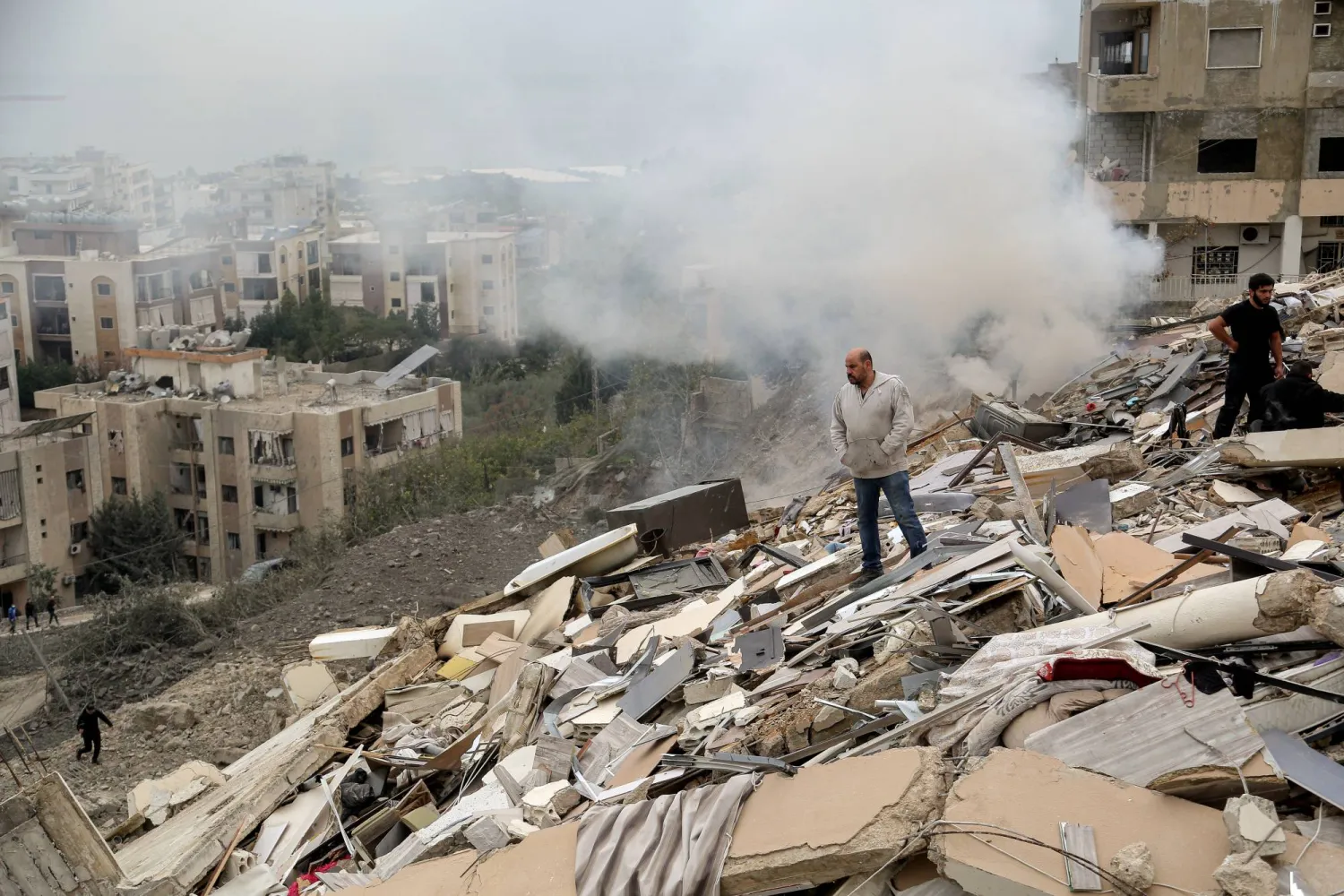


Lebanon Says Two Killed in Israeli Strike on Palestinian Refugee Camp

22 January 2026, Lebanon, Qnarit: People inspect the damage of a building that was destroyed by an Israeli air raid on the southern Lebanese village of Qnarit. (dpa)
TT

Lebanon Says Two Killed in Israeli Strike on Palestinian Refugee Camp

22 January 2026, Lebanon, Qnarit: People inspect the damage of a building that was destroyed by an Israeli air raid on the southern Lebanese village of Qnarit. (dpa)

Lebanon said an Israeli strike on the country's largest Palestinian refugee camp killed two people on Friday, with Israel's army saying it had targeted the Palestinian group Hamas. 

The official National News Agency said "an Israeli drone" targeted a neighborhood of the Ain al-Hilweh camp, which is located on the outskirts of the southern city of Sidon. 

Lebanon's health ministry said two people were killed in the raid. The NNA had earlier reported one dead and an unspecified number of wounded. 

An AFP correspondent saw smoke rising from a building in the densely populated camp as ambulances headed to the scene. 

The Israeli army said in a statement that its forces "struck a Hamas command center from which terrorists operated", calling activity there "a violation of the ceasefire understandings between Israel and Lebanon" and a threat to Israel. 

The Israeli military "is operating against the entrenchment" of the Palestinian group in Lebanon and will "continue to act decisively against Hamas terrorists wherever they operate", it added. 

Israel has kept up regular strikes on Lebanon despite a November 2024 ceasefire that sought to halt more than a year of hostilities with Hezbollah. 

Israel has also struck targets belonging to Hezbollah's Palestinian ally Hamas, including in a raid on Ain al-Hilweh last November that killed 13 people. 

The UN rights office had said 11 children were killed in that strike, which Israel said targeted a Hamas training compound, though the group denied it had military installations in Palestinian camps in Lebanon. 

In October 2023, Hezbollah began launching rockets at Israel in support of Hamas at the outset of the Gaza war, triggering hostilities that culminated in two months of all-out war between Israel and the Iran-backed Lebanese group. 

On Sunday, Lebanon said an Israeli strike near the Syrian border in the country's east killed four people, as Israel said it targeted operatives from Palestinian group Islamic Jihad. 


UN Says It Risks Halting Somalia Aid Due to Funding Cuts 

A Somali trader marks watermelons for sale at an open-air grocery market as Muslims start the fasting month of Ramadan, the holiest month in the Islamic calendar, within Bakara market in Mogadishu, Somalia, February 18, 2026. (Reuters)
TT

UN Says It Risks Halting Somalia Aid Due to Funding Cuts 

A Somali trader marks watermelons for sale at an open-air grocery market as Muslims start the fasting month of Ramadan, the holiest month in the Islamic calendar, within Bakara market in Mogadishu, Somalia, February 18, 2026. (Reuters)

The UN's World Food Program (WFP) warned Friday it would have to stop humanitarian assistance in Somalia by April if it did not receive new funding.

The Rome-based agency said it had already been forced to reduce the number of people receiving emergency food assistance from 2.2 million in early 2025 to just over 600,000 today.

"Without immediate funding, WFP will be forced to halt humanitarian assistance by April," it said in a statement.

In early January, the United States suspended aid to Somalia over reports of theft and government interference, following the destruction of a US-funded WFP warehouse in the capital Mogadishu's port.

The US announced a resumption of WFP food distribution on January 29.

However, all UN agencies have warned of serious funding shortfalls since Washington began slashing aid across the world following President Donald Trump's return to the White House last year.

"The situation is deteriorating at an alarming rate," said Ross Smith, WFP Director of Emergency Preparedness and Response, in Friday's statement.

"Families have lost everything, and many are already being pushed to the brink. Without immediate emergency food support, conditions will worsen quickly.

"We are at the cusp of a decisive moment; without urgent action, we may be unable to reach the most vulnerable in time, most of them women and children."

Some 4.4 million people in Somalia are facing crisis-levels of food insecurity, according to the WFP, the largest humanitarian agency in the country.

The Horn of Africa country has been plagued by conflict and also suffered two consecutive failed rainy seasons.


Hamas Says Path for Gaza Must Begin with End to ‘Aggression’ 

Makeshift tents of displaced Palestinian families among the ruins of their homes at sunset during the holy month of Ramadan in Jabaliya northern Gaza Strip on, 19 February 2026. (EPA)
TT

Hamas Says Path for Gaza Must Begin with End to ‘Aggression’ 

Makeshift tents of displaced Palestinian families among the ruins of their homes at sunset during the holy month of Ramadan in Jabaliya northern Gaza Strip on, 19 February 2026. (EPA)

Discussions on Gaza's future must begin with a total halt to Israeli "aggression", the Palestinian movement Hamas said after US President Donald Trump's Board of Peace met for the first time.

"Any political process or any arrangement under discussion concerning the Gaza Strip and the future of our Palestinian people must start with the total halt of aggression, the lifting of the blockade, and the guarantee of our people's legitimate national rights, first and foremost their right to freedom and self-determination," Hamas said in a statement Thursday.

Trump's board met for its inaugural session in Washington on Thursday, with a number of countries pledging money and personnel to rebuild the Palestinian territory, more than four months into a fragile ceasefire between Israel and Hamas.

Israeli Prime Minister Benjamin Netanyahu has insisted however that Hamas must disarm before any reconstruction begins.

"We agreed with our ally the US that there will be no reconstruction of Gaza before the demilitarization of Gaza," Netanyahu said.

The Israeli leader did not attend the Washington meeting but was represented by his foreign minister Gideon Saar.

Trump said several countries had pledged more than seven billion dollars to rebuild the territory.

Muslim-majority Indonesia will take a deputy commander role in a nascent International Stabilization Force, the unit's American chief Major General Jasper Jeffers said.

Trump, whose plan for Gaza was endorsed by the UN Security Council in November, also said five countries had committed to providing troops, including Morocco, Kazakhstan, Kosovo and Albania.
