

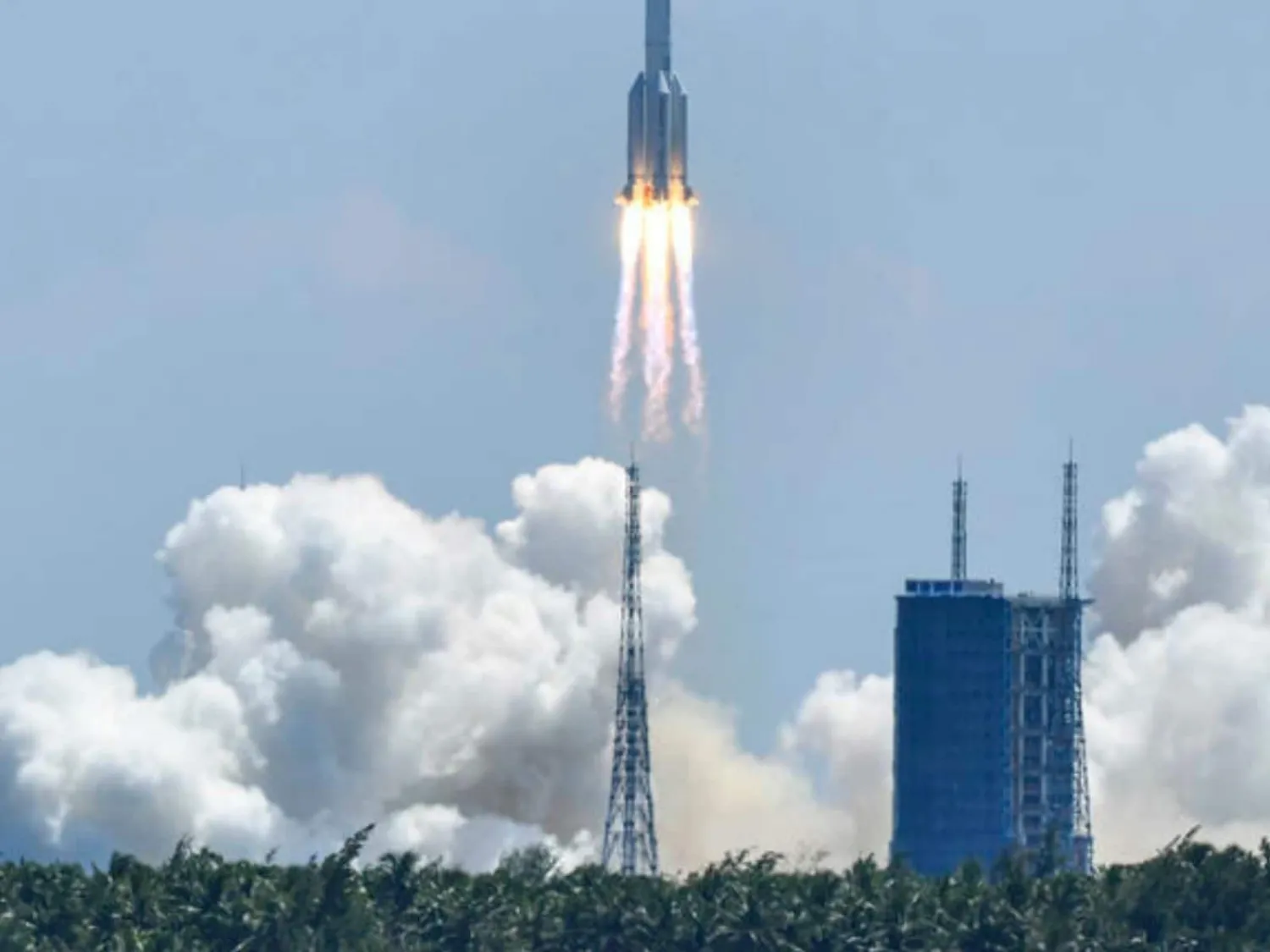

Chinese Booster Rocket Makes Uncontrolled Return to Earth

Chinese Booster Rocket. (Image: AFP)
TT

Chinese Booster Rocket Makes Uncontrolled Return to Earth

Chinese Booster Rocket. (Image: AFP)

A Chinese booster rocket made an uncontrolled return to Earth on Saturday, leading US officials to chide Beijing for not sharing information about the potentially hazardous object's descent.

US Space Command "can confirm the People's Republic of China (PRC) Long March 5B (CZ-5B) re-entered over the Indian Ocean at approx 10:45 am MDT on 7/30," the US military unit said on Twitter.

"We refer you to the #PRC for further details on the reentry’s technical aspects such as potential debris dispersal+ impact location," it said.

In a statement posted to its official WeChat profile, the China Manned Space Agency later gave coordinates for an impact area in the Sulu Sea, about 35 miles (57 kilometers) off the east coast of the Philippines' Palawan Island, AFP said.

"Most of its devices were ablated and destroyed during re-entry," the agency said of the booster rocket, which was used last Sunday to launch the second of three modules China needed to complete its new Tiangong space station.

Malaysia's space agency said it detected rocket debris burning up on re-entry before falling in the Sulu Sea northeast of the island of Borneo.

"The debris of the rocket caught fire while entering the Earth's airspace and the movement of the burning debris also crossed Malaysian airspace and could be detected in several areas including crossing the airspace around the state of Sarawak," it said.

- NASA criticism -
NASA administrator Bill Nelson criticized Beijing on Twitter, saying the failure to share details of the rocket's descent was irresponsible and risky.

"All spacefaring nations should follow established best practices, and do their part to share this type of information in advance," Nelson wrote, "to allow reliable predictions of potential debris impact risk, especially for heavy-lift vehicles, like the Long March 5B, which carry a significant risk of loss of life and property."

He added: "Doing so is critical to the responsible use of space and to ensure the safety of people here on Earth".

The Tiangong space station is one of the crown jewels of Beijing's ambitious space program, which has landed robotic rovers on Mars and the Moon, and made China only the third nation to put humans in orbit.

The new module, propelled by the Long March 5B, successfully docked with Tiangong's core module on Monday and the three astronauts who had been living in the main compartment since June successfully entered the new lab.

When China launched its first Tiangong module in April 2021, there was a similar frenzy around the possibility of damage caused by an unpredictable booster reentry.

Objects generate immense amounts of heat and friction when they enter the atmosphere, which can cause them to burn up and disintegrate. But larger ones such as the Long March-5B may not be destroyed entirely.

In 2020, debris from another Chinese rocket fell on villages in the Ivory Coast, causing structural damage but no injuries or deaths.

China has poured billions of dollars into space flight and exploration as it seeks to build a program that reflects its stature as a rising global power.



Thieves Drill into a German Bank Vault and Steal Tens of Millions of Euros Worth of Property

 Police officers stand in front of the savings bank branch in the Buer district in Gelsenkirchen, Germany, Tuesday, Dec. 30, 2025 following a break-in into the bank's vault. (Christoph Reichwein/dpa via AP)
Police officers stand in front of the savings bank branch in the Buer district in Gelsenkirchen, Germany, Tuesday, Dec. 30, 2025 following a break-in into the bank's vault. (Christoph Reichwein/dpa via AP)
TT

Thieves Drill into a German Bank Vault and Steal Tens of Millions of Euros Worth of Property

 Police officers stand in front of the savings bank branch in the Buer district in Gelsenkirchen, Germany, Tuesday, Dec. 30, 2025 following a break-in into the bank's vault. (Christoph Reichwein/dpa via AP)
Police officers stand in front of the savings bank branch in the Buer district in Gelsenkirchen, Germany, Tuesday, Dec. 30, 2025 following a break-in into the bank's vault. (Christoph Reichwein/dpa via AP)

Thieves stole tens of millions of euros worth of property from safety deposit boxes inside a German bank vault that they drilled into Monday during the holiday lull, police said.

Some 2,700 bank customers were affected by the theft in Gelsenkirchen, police and the Sparkasse bank said.

Thomas Nowaczyk, a police spokesperson, said investigators believe the theft was worth between 10 and 90 million euros ($11.7 to 105.7 million).

German news agency dpa reported that the theft could be one of Germany's largest heists.

The bank remained closed Tuesday, when some 200 people showed up demanding to get inside, dpa reported.

A fire alarm summoned police officers and firefighters to the bank branch shortly before 4 a.m. Monday. They found a hole in the wall and the vault ransacked. Police believe a large drill was used to break through the vault's basement wall.

Witnesses told investigators they saw several men carrying large bags in a nearby parking garage over the weekend. Video footage from the garage shows masked people inside a stolen vehicle early Monday, police said.

Gelsenkirchen is about 192 kilometers (119 miles) northwest of Frankfurt.


The Year's First Meteor Shower and Supermoon Clash in January Skies

People look up to the sky from an observatory near the village of Avren, Bulgaria, Aug. 12, 2009. (AP Photo/Petar Petrov, File)
TT

The Year's First Meteor Shower and Supermoon Clash in January Skies

People look up to the sky from an observatory near the village of Avren, Bulgaria, Aug. 12, 2009. (AP Photo/Petar Petrov, File)

The year's first supermoon and meteor shower will sync up in January skies, but the light from one may dim the other.

The Quadrantid meteor shower peaks Friday night into Saturday morning, according to the American Meteor Society. In dark skies during the peak, skygazers typically see around 25 meteors per hour, but this time they'll likely glimpse less than 10 per hour due to light from Saturday's supermoon, The AP news reported.

“The biggest enemy of enjoying a meteor shower is the full moon,” said Mike Shanahan, planetarium director at Liberty Science Center in New Jersey.

Meteor showers happen when speedy space rocks collide with Earth’s atmosphere, burning up and leaving fiery tails in their wake — the end of a “shooting star.” A handful of meteors are visible on any given night, but predictable showers appear annually when Earth passes through dense streams of cosmic debris.

Supermoons occur when a full moon is closer to Earth in its orbit. That makes it appear up to 14% bigger and 30% brighter than the faintest moon of the year, according to NASA. That difference can be tough to notice with the naked eye.

Supermoons, like all full moons, are visible in clear skies everywhere that it's night. The Quadrantids, on the other hand, can be seen mainly from the Northern Hemisphere. Both can be glimpsed without any special equipment.

To spot the Quadrantids, venture out in the early evening away from city lights and watch for fireballs before the moon crashes the party, said Jacque Benitez with the Morrison Planetarium at the California Academy of Sciences. Skygazers can also try looking during early dawn hours on Sunday.

Wait for your eyes to get used to the darkness, and don’t look at your phone. The space rocks will look like fast-moving white dots and appear over the whole sky.

Meteor showers are named for the constellation where the fireballs appear to come from. The Quadrantids — space debris from the asteroid 2003 EH1 — are named for a constellation that's no longer recognized.

The next major meteor shower, called the Lyrids, is slotted for April.

Supermoons happen a few times a year and come in groups, taking advantage of the sweet spot in the moon’s elliptical orbit. Saturday night’s event ends a four-month streak that started in October. There won't be another supermoon until the end of 2026.


New Maritime Theater in Jazan to Host the City's Festival Opening

The site also includes various amenities, such as shopping zones, kiosks for dining, an art gallery - SPA
TT

New Maritime Theater in Jazan to Host the City's Festival Opening

The site also includes various amenities, such as shopping zones, kiosks for dining, an art gallery - SPA

The Jazan city theater on the southern corniche will host the opening ceremony of the Jazan Festival 2026 on Friday. This event will take place at a 35-square-kilometer site that features the Kingdom's largest maritime theater, SPA reported.

The theater accommodates more than 10,000 spectators and features five VIP areas. To ensure a smooth experience, the venue offers parking for over 9,000 vehicles, providing easy access during peak times.

Built specifically for the festival, the stage meets stringent safety and technical standards, providing a high-quality audiovisual experience against the stunning backdrop of the Red Sea.

The site also includes various amenities, such as shopping zones, kiosks for dining, an art gallery, a play area for children, a bird garden, and a regional museum, showcasing the region's history and culture.

This temporary maritime theater aims to provide a cohesive experience, integrating entertainment, culture, shopping, and services in one location, further establishing Jazan as a year-round destination for tourism and entertainment.