

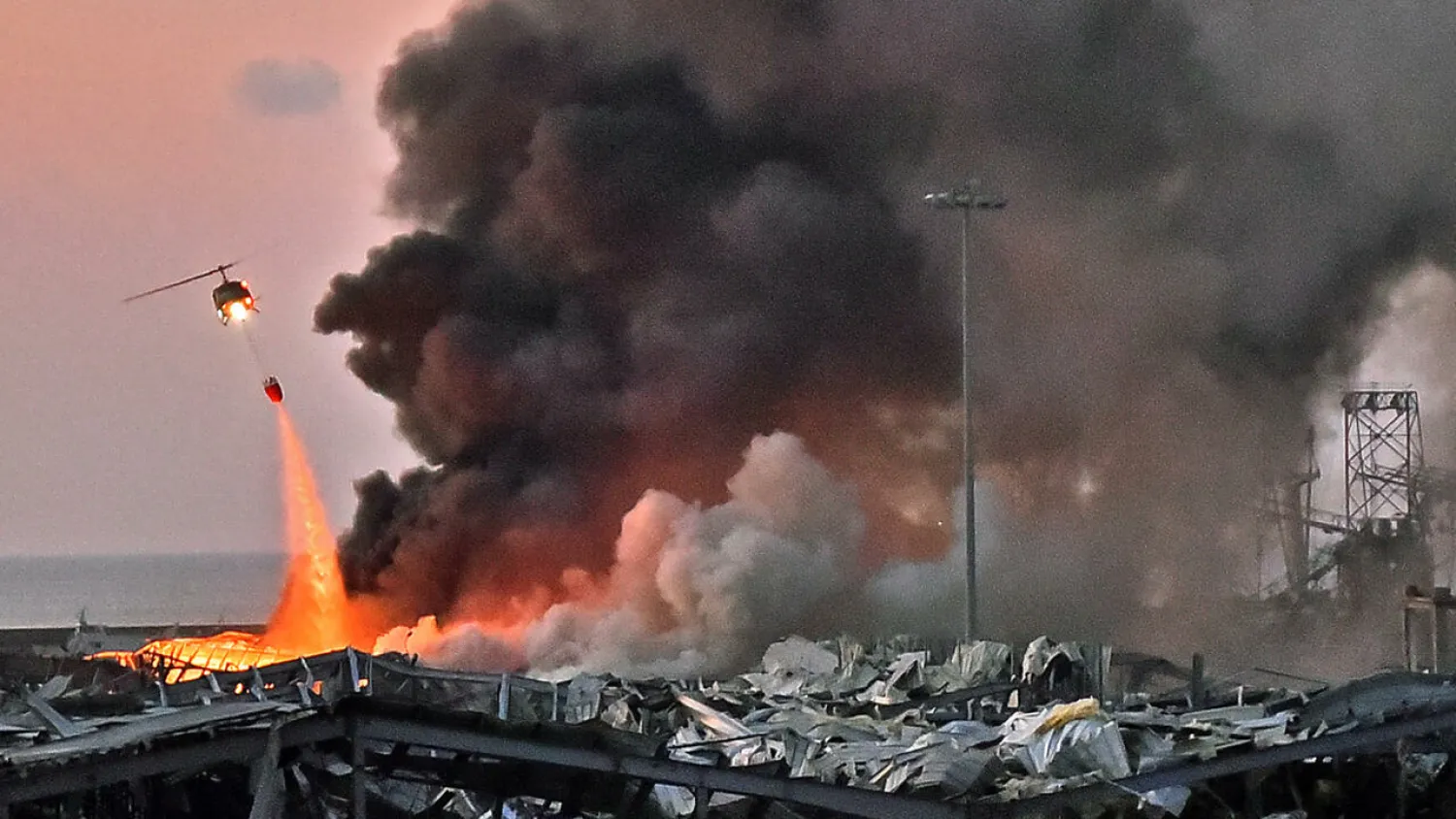

Two Years After Beirut Mega-blast, Lebanon Hits New Lows

The port explosion further scarred the crisis-tested population and accelerated a massive exodus that recalls the flight during the 1975-1990 civil war STR AFP
TT

Two Years After Beirut Mega-blast, Lebanon Hits New Lows

The port explosion further scarred the crisis-tested population and accelerated a massive exodus that recalls the flight during the 1975-1990 civil war STR AFP

Crisis-hit Lebanon marks two years Thursday since a massive explosion ripped through Beirut, with victims' relatives planning protest marches as they keep demanding truth and justice.

The portside blast of haphazardly stored ammonium nitrate, one of the biggest non-nuclear explosions ever, killed more than 200 people, wounded thousands more and decimated vast areas of the capital.

Yet an investigation into the cause has been stalled amid political interference and no state official has yet been held accountable over the August 4, 2020 tragedy.

Several heavily damaged grain silos that became a grim symbol of the disaster collapsed last week, and more are dangerously close to coming down, experts warn.

"I hope that seeing the silos fall will give people the will to fight for justice, to battle with us," said Tatiana Hasrouty, who lost her father in the blast.

Politicians "are doing everything in their power to stop the investigation" into the explosion of the fertilizer, she said, AFP reported.

The mega-blast was a nightmarish moment in the chaotic history of Lebanon, which is mired in its worst-ever economic crisis marked by blackouts, runaway inflation and widespread despair.

When protesters in three separate marches starting from 1200 GMT Thursday later converge at the port, they will smell the smoke wafting from the silos where fermenting grain is smoldering in the blistering summer heat.

The enormous explosion two years ago was felt as far away as Cyprus and sowed the kind of devastation normally caused by wars and natural disasters.

It further scarred the crisis-tested population and accelerated a massive exodus that recalls the flight during the 1975-1990 civil war.

Lebanon's ruling class, accused of misrule, graft and gross negligence, has however clung firmly to power even as the people endure shortages of fuel, medicine and clean water.

"This ruling class is killing us every day," Hasrouty said. "If we did not die in the blast, we are dying of hunger, from a lack of basic human rights."

Power cuts last up to 23 hours a day, streets are dark at night and traffic lights out of service, leaving some districts illuminated mainly by the silo fires.

Lara Khatchikian, 51, whose apartment was badly hit two years ago, has watched the blazes, calling the sight "a nightmare".

"My neighbors and I were stressed all the time," she said. "I have felt fear, we couldn't sleep. It takes superhuman strength to live when you are constantly reminded of the blast."

The government in April ordered the silos' demolition -- but this has been suspended, partially because of objections from victims' relatives who want them preserved as a memorial.

French civil engineer Emmanuel Durand, who monitors the silos, has warned that the danger of a further partial collapse "has never been so high" and could come "at any time".

Meanwhile, the probe is also at risk of falling apart, as officials have curtailed the work of the lead investigator Tarek Bitar with a series of lawsuits.

A judicial official close to the investigations said judge Bitar's work had been paused since December 23.

Victims' families are divided, with some accusing Bitar of bias and others regarding him as their only hope.

Amnesty International, Human Rights Watch and other groups Wednesday relaunched an appeal to the United Nations to send a fact-finding mission.

They jointly declared that "it is now, more than ever, clear that the domestic investigation cannot deliver justice".




Hezbollah Chief Accuses Lebanese Authorities of Working ‘in the Interest of What Israel Wants’

Hezbollah leader Naim Qassem
TT

Hezbollah Chief Accuses Lebanese Authorities of Working ‘in the Interest of What Israel Wants’

Hezbollah leader Naim Qassem

Hezbollah leader Naim Qassem on Sunday said moves to disarm the group in Lebanon are an "Israeli-American plan,” accusing Israel of failing to abide by a ceasefire agreement sealed last year.

Under heavy US pressure and fears of expanded Israeli strikes, the Lebanese military is expected to complete Hezbollah's disarmament south of the Litani River -- located about 30 kilometers from the border with Israel -- by the end of the year.

It will then tackle disarming the Iran-backed movement in the rest of the country.

"Disarmament is an Israeli-American plan," Qassem said.

"To demand exclusive arms control while Israel is committing aggression and America is imposing its will on Lebanon, stripping it of its power, means that you are not working in Lebanon's interest, but rather in the interest of what Israel wants."

Despite a November 2024 ceasefire that was supposed to end more than a year of hostilities between Israel and Hezbollah, Israel has kept up strikes on Lebanon and has maintained troops in five areas it deems strategic.

According to the agreement, Hezbollah was required to pull its forces north of the Litani River and have its military infrastructure in the vacated area dismantled.

Israel has questioned the Lebanese military's effectiveness and has accused Hezbollah of rearming, while the group itself has rejected calls to surrender its weapons.

"The deployment of the Lebanese army south of the Litani River was required only if Israel had adhered to its commitments... to halting the aggression, withdrawing, releasing prisoners, and having reconstruction commence," Qassem said in a televised address.

"With the Israeli enemy not implementing any of the steps of the agreement... Lebanon is no longer required to take any action on any level before the Israelis commit to what they are obligated to do."

Lebanese army chief Rodolphe Haykal told a military meeting on Tuesday "the army is in the process of finishing the first phase of its plan.”

He said the army is carefully planning "for the subsequent phases" of disarmament.


Israel Army Ends Crackdown on West Bank Town after Attack

Smoke rises following an explosion detonated by the Israeli army, which said it was destroying buildings used by Palestinian militants in the West Bank Jenin refugee camp, Sunday, February 2, 2025. © Majdi Mohammed, AP
TT

Israel Army Ends Crackdown on West Bank Town after Attack

Smoke rises following an explosion detonated by the Israeli army, which said it was destroying buildings used by Palestinian militants in the West Bank Jenin refugee camp, Sunday, February 2, 2025. © Majdi Mohammed, AP

The Israeli military said on Sunday it had ended its operation in a town in the occupied West Bank that it had sealed off after a Palestinian from the area killed two Israelis.

Around 50 residents of Qabatiya were briefly detained during the two-day operation, the official Palestinian news agency Wafa reported, quoting the town's mayor Ahmed Zakarneh.

The attacker's father and two brothers remained in custody, it added.

The military launched the operation on Friday, shortly after a 34-year-old Palestinian fatally stabbed an 18-year-old Israeli woman and ran over a man in his sixties with his vehicle.

When contacted by AFP on Sunday morning, the military confirmed the end of its operation in the area.

Defense Minister Israel Katz previously said the army had completely sealed off the town.

Wafa also reported that Israeli troops had withdrawn from Qabatiya, near the city of Jenin.

Zakarneh said the town had been in a state of "total paralysis" during the military activity.

Israeli army bulldozers tore up pavement on several streets and erected roadblocks to halt traffic, he said, adding that around 50 houses were searched.

Wafa reported that a school had been turned into a detention and interrogation center.

AFPTV footage filmed on Saturday showed Israeli soldiers carrying automatic rifles and patrolling the streets, where several armoured vehicles were deployed.

Shops were closed, though men and children were seen walking through the village.

On Sunday, the Israeli army said it had sealed off the assailant's home and was finalising "the procedures required for its demolition".

Israeli authorities argue that demolishing the homes of Palestinians who carry out attacks against Israelis has a deterrent effect.

Critics, however, condemn the practice as collective punishment that leaves families homeless.


Arab League Council Holds Extraordinary Session on Latest Developments in Somalia

A general view shows the opening session of the meeting of Arab foreign ministers at the Arab League Headquarters (Reuters)
TT

Arab League Council Holds Extraordinary Session on Latest Developments in Somalia

A general view shows the opening session of the meeting of Arab foreign ministers at the Arab League Headquarters (Reuters)

At the request of the Federal Republic of Somalia and with the support of Arab League member states, the Arab League Council on Sunday began its extraordinary session at the league’s General Secretariat, at the level of permanent representatives and under the chairmanship of the United Arab Emirates, to discuss developments regarding the Israeli occupation authorities’ declaration on mutual recognition with the Somaliland region.

The Kingdom’s delegation to the meeting was headed by its Permanent Representative to the Arab League Ambassador Abdulaziz bin Abdullah Al-Matar, SPA reported.

The meeting is discussing ways to strengthen the unified Arab position in addressing this step, to affirm full solidarity with Somalia, and to support its legitimate institutions in a manner that contributes to preserving security and stability in the region.

The meeting also aims to reaffirm the Arab League’s categorical rejection of any unilateral measures or decisions that could undermine Somalia’s sovereignty and territorial integrity, and to emphasize commitment to the principles of international law and the relevant resolutions of the Arab League and the African Union.