


UN Watchdog Warns of 'Grave' Crisis amid Violence near Ukraine Nuclear Plant

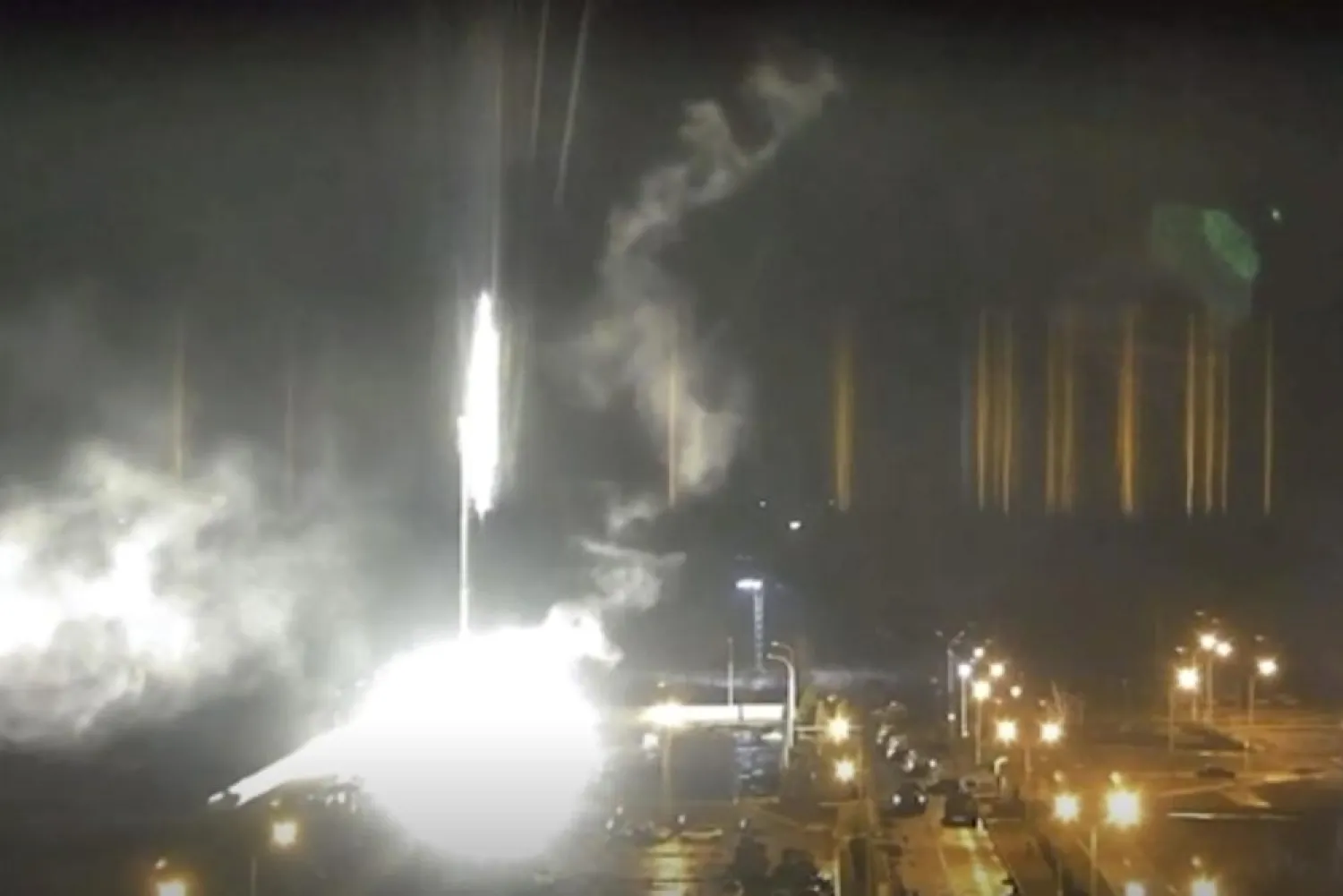
This image made from a video released by Zaporizhzhia nuclear power plant shows bright flaring object landing in grounds of the nuclear plant in Enerhodar, Ukraine Friday, March 4, 2022. Russian forces shelled Europe’s largest nuclear plant early Friday, sparking a fire as they pressed their attack on a crucial energy-producing Ukrainian city and gained ground in their bid to cut off the country from the sea. (Zaporizhzhia nuclear power plant via AP)
TT

UN Watchdog Warns of 'Grave' Crisis amid Violence near Ukraine Nuclear Plant

This image made from a video released by Zaporizhzhia nuclear power plant shows bright flaring object landing in grounds of the nuclear plant in Enerhodar, Ukraine Friday, March 4, 2022. Russian forces shelled Europe’s largest nuclear plant early Friday, sparking a fire as they pressed their attack on a crucial energy-producing Ukrainian city and gained ground in their bid to cut off the country from the sea. (Zaporizhzhia nuclear power plant via AP)

The head of the UN nuclear watchdog warned an emergency Security Council meeting on Thursday of the "grave" crisis unfolding at the Zaporizhzhia nuclear power plant in Ukraine, as Moscow and Kyiv traded accusations of new shelling near the facility.

"This is a serious hour, a grave hour," Rafael Grossi, chief of the International Atomic Energy Agency, told the Security Council, adding that the IAEA must urgently be allowed to conduct a mission to Zaporizhzhia.

And in Kyiv, Ukrainian President Volodymyr Zelensky accused Moscow of "nuclear blackmail" as he urged the international community "to react immediately to chase out the occupiers from Zaporizhzhia," said AFP.

"Only the Russians' full withdrawal... would guarantee nuclear safety for all of Europe," Zelensky said in a video address to the nation.

Moscow and Kyiv on Thursday accused each other of new shelling near the Zaporizhzhia nuclear power plant, a dangerous escalation five months into the war.

Both sides said there were five rocket strikes near a radioactive material storage area at the plant, Europe's biggest nuclear facility which has been a focus of renewed fighting in recent days.

Ukraine's nuclear agency Energoatom said later there had been fresh Russian shelling near one of the plant's six reactors that had caused "extensive smoke" and "several radiation sensors are damaged".

Vladimir Rogov, a member of the Moscow-installed regional administration, said Ukrainian forces had "once again struck" the plant.

The Ukrainian plant is under the control of Russian troops, and Ukraine has accused Moscow of basing hundreds of soldiers and storing arms there.

- 'Cannot wait any longer' -
In New York, Security Council members all supported calls for an urgent IAEA mission to Ukraine -- but there was no consensus over who was to blame for the attacks and who should be responsible for facilitating the mission.

Bonnie Jenkins, the US State Department's undersecretary for arms control and international security, said the visit "cannot wait any longer" but added that only a full withdrawal of Russian troops from Ukraine would keep the nuclear plant safe.

"This would allow for Ukraine to restore the impeccable safety, security, and safeguards performance it upheld for decades at the facility."

But Russia's UN ambassador Vasily Nebenzya put the blame for the attacks around Zaporizhzhia squarely on Ukrainian forces.

"We call on states that support the Kyiv regime to bring their proxies into check to compel them to immediately and once and for all stop attacks on Zaporizhzhia nuclear power to ensure the safe conditions for the conduct of the IAEA mission," Nebenzya told the Council.

Earlier Thursday Washington also backed calls to establish a demilitarized zone around the plant.

- 'State sponsor of terrorism' -
The Soviet-era plant in southern Ukraine was captured by Russian troops at the beginning of March -- shortly after Moscow launched its invasion of its neighbor -- and has remained on the frontline since then.

Ukrainian President Volodymyr Zelensky has warned Russia could cause an incident "even more catastrophic than Chernobyl" -- a reference to the nuclear disaster in then-Soviet Ukraine in 1986.

"Russia has turned the nuclear station into a battlefield," he said earlier Thursday, addressing a Ukraine donors conference in Copenhagen by video link.

He called for stronger sanctions against Russia, saying it was a "terrorist state" -- on the same day that Latvian MPs adopted a resolution calling Russia a "state sponsor of terrorism".

The statement said Russia's actions in Ukraine constituted "targeted genocide against the Ukrainian people."

Ukrainian Foreign Minister Dmytro Kuleba hailed it as a "timely move" and urged other countries to follow suit, while Russian foreign ministry spokeswoman Maria Zakharova called it "xenophobia".

Latvia has also urged all EU countries to ban tourist visas for Russian citizens and said the measure should be extended to Belarusians because of the Belarusian regime's support for the invasion.

- 'We hope for the best' -
The war meanwhile rumbled on in eastern Ukraine, where Russia-backed separatists have been fighting against Ukrainian forces since 2014.

In the bombed-out town of Soledar, the few residents left are living in underground shelters.

"We hope for the best, but every day it turns out worse and worse," said Svitlana Klymenko, 62, as the relentless shelling continued outside.

Another man living in the shelter, 59-year-old Oleg Makeev said: "You can't cook anything normally here, you can't wash yourself. How am I supposed to feel?"



Türkiye Says Greece-Chevron Activity off Crete Unlawful 

A Chevron gas station sign is pictured at one of their retain gas stations in Cardiff, California October 9, 2013. REUTERS/Mike Blake/File Photo
TT

Türkiye Says Greece-Chevron Activity off Crete Unlawful 

A Chevron gas station sign is pictured at one of their retain gas stations in Cardiff, California October 9, 2013. REUTERS/Mike Blake/File Photo

Türkiye said on Thursday it opposed Greece's "unilateral activities" in energy fields south of Crete with a consortium led by US major Chevron as a violation of international law and good neighbourly relations.

Athens responded that its policies abide international law.

The Chevron-led consortium signed exclusive lease agreements on Monday to look for natural gas off southern Greece, expanding US presence in the eastern Mediterranean.

"We oppose this unlawful activity, which is being attempted in violation of the 2019 Memorandum of Understanding on Maritime Jurisdiction between Libya and our country," the Turkish Defense Ministry said at a press briefing.

It said the activity, while not directly impacting Türkiye's continental shelf, also violated Libya's maritime jurisdiction that was declared to the United Nations in May last year.

"We continue to provide the necessary support to the Libyan authorities to take action against these unilateral and unlawful activities by Greece," the ministry said.

A 2019 agreement signed by Türkiye and Libya set out maritime boundaries in the Mediterranean Sea. It was rejected by Greece as it ignored the presence of the Greek island of Crete between the coasts of Türkiye and Libya. The Chevron deal doubles the amount of Greek maritime acreage available for exploration and is the second in months involving a US energy major, as the European Union seeks to phase out supplies from Russia and the US seeks to replace them.

Asked about the Turkish objections later on Thursday, Greek government spokesman Pavlos Marinakis told a press briefing that Athens followed an "active policy" and "exercises its rights in accordance with international law and respects international law steadfastly - and I think no one questions that, period."

There was no immediate comment from Chevron.

Neighbors and NATO members Türkiye and Greece have been at odds over a range of issues for decades, primarily maritime boundaries and rights in the Aegean, an area widely believed to hold energy resources and with key implications for airspace and military activity.

A 2023 declaration on friendly relations prompted a thaw between the sides and leaders have voiced a desire to address remaining issues.


Andrew Mountbatten-Windsor Arrested on Suspicion of Misconduct in Public Office

FILE - Britain’s Andrew Mountbatten-Windsor, formerly known as Prince Andrew, looks round as he leaves after attending the Easter Matins Service at St. George's Chapel, Windsor Castle, England, April 20, 2025. (AP Photo/Kirsty Wigglesworth, File)
TT

Andrew Mountbatten-Windsor Arrested on Suspicion of Misconduct in Public Office

FILE - Britain’s Andrew Mountbatten-Windsor, formerly known as Prince Andrew, looks round as he leaves after attending the Easter Matins Service at St. George's Chapel, Windsor Castle, England, April 20, 2025. (AP Photo/Kirsty Wigglesworth, File)

UK police arrested Andrew Mountbatten-Windsor on Thursday on suspicion of misconduct in public office.

The Thames Valley Police, an agency that covers areas west of London, including Mountbatten-Windsor’s former home, said it was “assessing” reports that the former Prince Andrew sent trade reports to convicted sex offender Jeffrey Epstein in 2010. The assessment followed the release of millions of pages of documents connected to a US investigation of Epstein.

The police force did not name Mountbatten-Windsor, as is normal under UK law. But when asked if he had been arrested, the force pointed to a statement saying that they had arrested a man in his 60s. Mountbatten-Windsor is 66.

“Following a thorough assessment, we have now opened an investigation into this allegation of misconduct in public office,’’ the statement said. “It is important that we protect the integrity and objectivity of our investigation as we work with our partners to investigate this alleged offence."

“We understand the significant public interest in this case, and we will provide updates at the appropriate time,” the statement added.

Pictures circulated online appearing to show unmarked police cars at Wood Farm on the Sandringham Estate in Norfolk, with plainclothes officers appearing to gather outside the home of Mountbatten-Windsor.


Georgia Arrests Two Foreigners Trying to Purchase Uranium

FILE PHOTO: A block with the symbol, atomic number and mass number of Uranium (U) element, in this illustration taken January 21, 2026. REUTERS/Dado Ruvic/Illustration/File Photo
TT

Georgia Arrests Two Foreigners Trying to Purchase Uranium

FILE PHOTO: A block with the symbol, atomic number and mass number of Uranium (U) element, in this illustration taken January 21, 2026. REUTERS/Dado Ruvic/Illustration/File Photo

Georgia has ‌detained two people who attempted to purchase $3 million worth of uranium and a cache of a radioactive isotope found in nuclear weapons testing programs, the national security service said on Thursday.

Two foreign nationals from unspecified countries were arrested in the city of Kutaisi, the State Security Service said in a statement.

"They were planning to ‌illegally purchase ‌nuclear material uranium and radioactive ‌substance ⁠Cesium 137 for $3 ⁠million and illegally transport it to the territory of another country," Reuters quoted it as saying.

It said other foreigners had been arriving in Georgia in recent weeks with the aim of purchasing and transporting the nuclear and ⁠radioactive materials, without elaborating further.

The ‌statement did ‌not specify the quantity of materials the individuals were ‌attempting to procure. There were ‌no details on the substances' origin or potential destination.

Cesium 137 is a radioactive isotope present primarily in the aftermath of nuclear weapons testing ‌and nuclear power plant accidents such as the Chernobyl disaster in ⁠then-Soviet ⁠Ukraine in 1986.

The security of nuclear materials was one of the biggest concerns after the 1991 fall of the Soviet Union, of which Georgia was part. There have been several serious incidents involving the illicit trade in nuclear materials in Georgia over recent decades.

Most recently, three Chinese citizens were arrested in the capital Tbilisi for attempting to purchase two kilograms of "nuclear material" uranium.