Yemeni Women Praise Appointment of First Female Supreme Court Judge

Judge Sabah al-Alwani taking the oath before the President of the Yemeni Leadership Council in Aden (Saba News)
TT

Yemeni Women Praise Appointment of First Female Supreme Court Judge

Judge Sabah al-Alwani taking the oath before the President of the Yemeni Leadership Council in Aden (Saba News)

The decision of the Presidential Leadership Council in Yemen to appoint Judge Sabah al-Alwani as the first woman in the Supreme Judicial Council, the highest judicial authority in the country, was highly praised by Yemeni female activists.

They saw the appointment as a fair representation for the females in the judiciary, which men have monopolized for decades.

Member of the National Commission to Investigate Alleged Violations to Human Rights (NCIAVHR), Ishraq al-Maqtari, said the appointment of the first woman since 1990 to this position in the judiciary is a win for all Arab women.

Maqtari, a friend of Alwani, noted that females are rarely represented in Supreme Judicial Councils in the Arab world.

She told Asharq Al-Awsat that despite the decline in female officials in various state institutions, especially in ministerial and diplomatic positions, the appointment of Alwani is a kind of rehabilitation and victory for women.

She regrets the "discriminatory" policies towards women, which made the appointment a surprise and was seen as "a great achievement."

Yemen signed the Convention on the Elimination of All Forms of Discrimination Against Women (CEDAW) and is committed to many reports, including the periodic report submitted a year ago before the Rights Council to empower women by at least 30 percent, said Maqtari.

However, she notes that the decision significantly impacted women working hard to reach top positions.

Regarding her working experience with Judge Alwani, Maqtari recalled that they had been working together since mid-2016, saying she is "an accomplished woman, capable of working in prosecution. She had a direct field role with citizens, perhaps in all of Aden directorates' prosecution offices."

Alwani is "a strong woman with much legal experience," said Maqtari, adding that the judge is "one of the women who will provide a strong and leading role."

Maqtari believes that Alwani will be an essential addition to the Council, and her appointment will benefit the citizens.

Yemeni feminist leader and member of the Consultation and Reconciliation Commission, Rasha Jarhum, believes that Alwani's appointment is an improvement in women's representation.

It is a transition from national commitments to practical steps in implementation.

Jarhum told Asharq Al-Awsat that the feminist movement presented proposals to improve female representation at all state levels, from the local to the central authority, and in all social, security, military and diplomatic sectors.

The proposal includes raising the women's quota in the government to 13 ministers, with the importance of observing gender equality. Any leadership position headed by a man should have a female deputy and vice versa.

Sabah Ahmed Saleh al-Alwani was elected head of the executive office of the Southern Judges Club in 2013. She worked as a judge in the Appeals Prosecution Office of Aden governorate.

In 2017, Alwani was appointed by a presidential decision as a member of the National Commission to Investigate Alleged Violations of Human Rights.

Between 2018 and 2019, she refuted widely circulated rumors about the torture of detainees in Bir Ahmed prison after she led a field investigation committee.

She concluded that they were prisoners of war and were not subjected to any torture.


Lebanon President Calls Israeli Bridge Strikes 'Prelude to Ground Invasion'

Lebanese President Joseph Aoun (AFP)
TT

Lebanon President Calls Israeli Bridge Strikes 'Prelude to Ground Invasion'

Lebanese President Joseph Aoun (AFP)

Lebanese President Joseph Aoun on Sunday slammed Israeli strikes on bridges and other infrastructure in the country's south, calling such attacks a "prelude to a ground invasion".

Aoun "condemned Israel's targeting and destruction of infrastructure and vital facilities in southern Lebanon, particularly the Qasmiyeh bridge over the Litani River and other bridges", a presidency statement said, AFP reported.

"These attacks represent a dangerous escalation and flagrant violation of Lebanon's sovereignty, and are considered a prelude to a ground invasion," Aoun said, hours after Israel's defense minister said the army had been ordered to destroy more bridges allegedly being used by Hezbollah.


Ceasefire Efforts Enter an 'Open-Ended Pause,' Unsettling Lebanese

Lebanese President Joseph Aoun holding talks with Parliament Speaker Nabih Berri (File - National News Agency)
TT

Ceasefire Efforts Enter an 'Open-Ended Pause,' Unsettling Lebanese

Lebanese President Joseph Aoun holding talks with Parliament Speaker Nabih Berri (File - National News Agency)

Lebanese-US efforts to secure a ceasefire have entered a prolonged “open-ended pause,” with no clear indication of when it might end, while the decisive factor remains tied to developments on the ground as the war between Hezbollah and Israel in the south reaches its peak.

This has raised concern among political circles tracking the situation, amid fears that the pause could drag on, leaving Lebanon on its own in the absence of any external push to end the war, and opening the door for President Joseph Aoun to call for direct negotiations with Israel to proceed under the cover of a truce that would relieve pressure created by ongoing hostilities from both sides.

These circles note that ceasefire efforts remain stalled, colliding with Israel’s insistence on delivering a “decisive blow” to Hezbollah to eliminate its stockpile of heavy rockets. In parallel, they say, the group continues to confront Israel’s ground advance in the south to prevent it from securing deeper control over areas south of the Litani River, amid Israeli threats to destroy what remains of bridges linking the river’s southern and northern banks.

Rejection on both sides

Sources confirm there is no prospect of a ceasefire between Israel and Hezbollah, which remains committed to its weapons and is now engaged in what it describes as an “existential battle.” Relinquishing its arms without guarantees, they say, would amount to voluntarily ending its political role.

The same position, the sources add, applies to Israel, backed by the US, which will not halt hostilities unless it eliminates Hezbollah’s weapons as part of ending the role of Iran-aligned actors in the region.

According to the sources, a ceasefire decision is not supported by either side, Hezbollah or Israel and is fully tied to the trajectory of the broader conflict involving Iran, the US, and Israel. This linkage has stalled Aoun’s call for direct negotiations in the absence of guarantees for a truce. Ending the war in the south, they stress, goes beyond the local arena and is directly connected to the wider confrontation on the Iranian front, making the two fronts inseparable.

The sources add that dialogue between Aoun and Hezbollah, for which Speaker of Parliament Nabih Berri had helped prepare the ground, remains suspended, as decision-making lies not with the party’s political wing but with its military wing, with which there is no presidential channel. They say Aoun does not bear responsibility for the breakdown, which was triggered by Secretary-General Naim Qassem backing away from a pledge not to intervene militarily in support of Iran.

They argue there is no value in dialogue that will not produce results as long as authority rests with a military wing directly linked to Iran’s Revolutionary Guard, even if its leadership seeks to justify this by citing the absence of guarantees. The sources reveal that the group has not received assurances regarding its political future; otherwise, it would not hand over its weapons “for free” to the state while Israel continues its occupation of the south and refuses to commit to the cessation-of-hostilities agreement implemented unilaterally more than a year and three months ago.

The same sources say that while the group’s leadership, represented by Qassem, supports Berri’s demand to implement the agreement brokered by France and the US and applied by Lebanon since November 27, 2024, it questions why Washington has stepped back from guarantees ensuring the agreement’s implementation through synchronized steps between Lebanon and Israel.

While the group avoids addressing Qassem’s reversal on supporting Iran, the sources say the issue has been settled between the allies and moved past, without dwelling on the stance of ministers aligned with Berri who backed cabinet decisions, in contrast to those aligned with the group who abstained, reflecting its insistence on avoiding a dispute with its only remaining ally.

Berri focuses on displaced

While Berri is currently focused on supporting efforts led by Prime Minister Nawaf Salam’s government, in cooperation with civil society and NGOs, to provide shelter and basic needs for displaced people, he is also urging them to comply with security measures to maintain stability and prevent tensions with host communities. He praised local support efforts and stressed that maintaining security and stability is a “red line” to safeguard civil peace.

Berri’s prioritization of accommodating displaced populations and preparing for further waves, driven by Israeli pressure through displacement and systematic destruction of homes, has prompted questions among observers as to why he has not reactivated his political role.

These circles say the answer ultimately lies with him, noting he was the first to welcome a ceasefire and reject negotiations under pressure. This explains his demand for guarantees on the implementation of any agreement, for which the US bears responsibility, to prevent Lebanon from being drawn into new negotiations without clarity on venue, timing, or agenda, especially when an agreement brokered by France and the US already exists and is overseen by the “mechanism committee” tasked with implementing Resolution 1701, but remains dependent on US follow-through.

The sources also pointed to remarks by US Ambassador to Beirut Michael Issa following a meeting with Maronite Patriarch Bechara al-Rahi, welcoming Aoun’s call for direct negotiations with Israel. They said he effectively acknowledged the initiative but, instead of facilitating it, undermined it by implying it would take place under fire, rather than through US intervention to halt the war and create conditions for negotiations under US sponsorship and guarantees.


Israel Strikes Main Bridge in South Lebanon, Orders Destruction of Homes Near Border

This photograph shows the destroyed Qasmiye Bridge built over the Litani River, following an Israeli airstrike, in Qasmiye on March 18, 2026. (Photo by KAWNAT HAJU / AFP)
TT

Israel Strikes Main Bridge in South Lebanon, Orders Destruction of Homes Near Border

This photograph shows the destroyed Qasmiye Bridge built over the Litani River, following an Israeli airstrike, in Qasmiye on March 18, 2026. (Photo by KAWNAT HAJU / AFP)

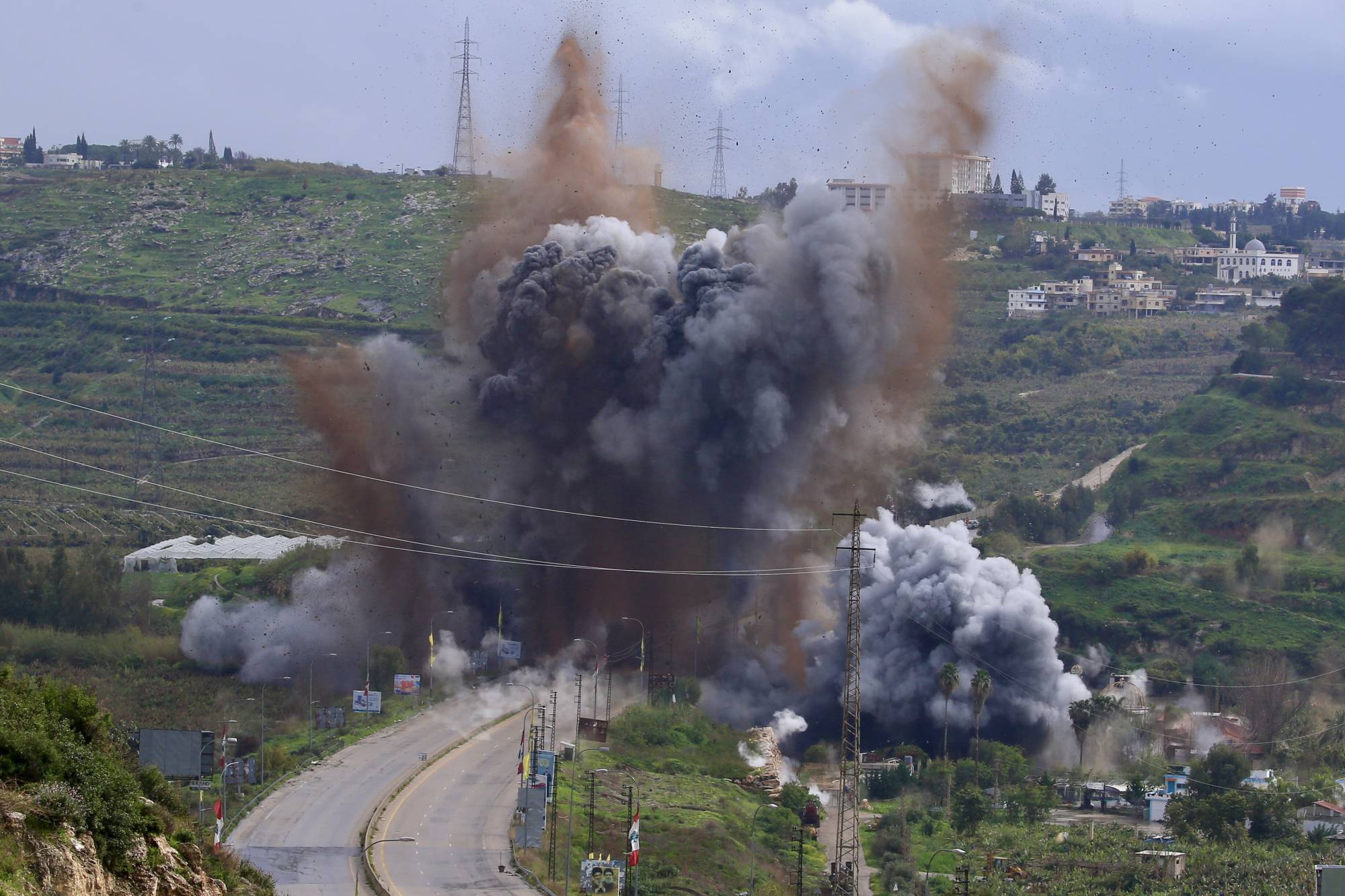
Israel struck a main bridge linking Lebanon's south to the rest of the country on Sunday after ordering its military to destroy all crossings over Lebanon's Litani River and to step up the demolition of homes near the southern border.

The destruction of bridges and homes marks a significant escalation in Israel's military campaign in Lebanon, which was pulled into the regional war on March 2 when armed group Hezbollah fired into Israeli territory.

International law generally prohibits militaries from attacking civilian infrastructure, and the United Nations human rights chief has criticised Israel's actions in Lebanon, particularly its use of widespread evacuation orders.

Sunday's strike pulverized a crossing on Lebanon's coastal highway that ran through farmland and was one of the main routes linking southern and central Lebanon, according to Reuters.

An Israeli military spokesperson had announced the army would strike the bridge earlier on Sunday.

Lama al-Fares, who lives on farmland adjacent to the crossing, said her family packed whatever they could into their car when they saw the warning. They drove about a kilometer north on the highway and waited out the strike on a hilltop overlooking the highway.

"Our house is right next to the bridge. It was destroyed in the last war and we had rebuilt a basic structure to live in - I hope it's still standing," she told Reuters.

Israel's strikes on Lebanon have killed more than 1,000 people, including nearly 120 children, 80 women and 40 medical personnel, according to Lebanon's health ministry.

The Israeli military had already destroyed three bridges in southern Lebanon in the last 10 days.

'HUMANITARIAN CATASTROPHE'

Ramzi Kaiss, Lebanon researcher at Human Rights Watch, told Reuters that international law requires armed actors to take into account the civilian harm caused by strikes on infrastructure like bridges, even if the targets were being used for military purposes.

"If all these bridges are struck, and the region that is south of the Litani becomes isolated from the rest of the country, then the civilian harm is going to be so immense that you have a humanitarian catastrophe as people still living in the south won't be able to access food, medicine and other basic needs," Kaiss said.

Destroying homes in southern Lebanon wholesale would amount to wanton destruction, which is a war crime, he added.

The Israeli military says its troops are carrying out what it describes as ground maneuvers and targeted raids on Hezbollah militants and weapons stores in southern Lebanon. Israeli officials say the air and ground campaigns are aimed at protecting residents in northern Israel near the Lebanese border from Hezbollah attacks.

French Foreign Minister Jean-Noel Barrot met with his Israeli counterpart, Gideon Saar, in Jerusalem on Friday, telling reporters that he had expressed France's reservations about a ground operation of "significant scale and duration".

Barrot said he had urged Lebanese and Israeli officials to find a lasting solution, which he said could not be achieved through military force alone.

Earlier this month, Katz warned the Lebanese government it would face infrastructure damage and territorial losses unless Hezbollah was disarmed. The Lebanese government has outlawed Hezbollah military activity and said it wanted to engage in direct talks with Israel.