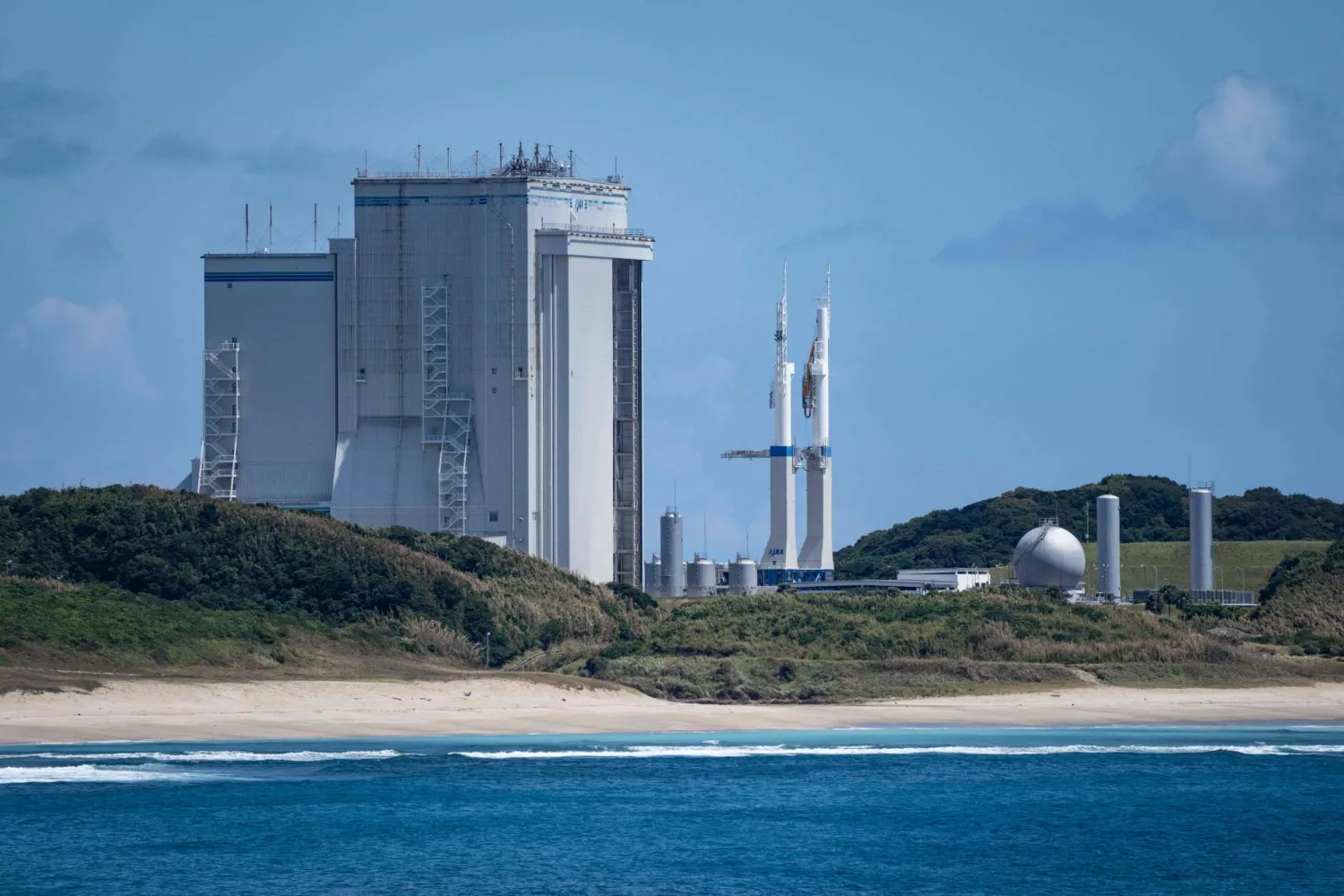
Japanese scientists are readying a mission to Mars's moons to retrieve samples that could help unlock the origins of the Solar System and life on Earth, in what aims to be the first round trip to the Martian region.
The unmanned Martian Moons eXploration (MMX) probe, a collaboration with US and European space agencies as well as numerous universities and tech companies, could also help lay the groundwork for eventual human exploration.
The flagship H3 rocket carrying the MMX is set to blast off from the Tanegashima Space Center Tuesday at 4:41 am (1941 GMT Monday), according to the Japan Aerospace Exploration Agency (JAXA).
The spacecraft will arrive near Mars one year later, where it will orbit its moon Phobos for up to three years before landing and collecting at least 10 grams (0.35 ounces) of material from the surface.
A rover dubbed IDEFIX -- the French name for the comic hero Asterix's dog -- will first conduct surface observations aimed at ensuring a safe landing.
"The sampling (from) Phobos is of course the world's first, but it means... this is the first round trip to the Martian system," MMX's project manager Yasuhiro Kawakatsu told AFP.
JAXA said the mission will also explore the possibility of using Phobos as a "natural space station" by establishing the requirements for a round trip to Mars -- something "essential for crewed Mars exploration".
It will also observe the Red Planet's moon Deimos, although it will not land on it, before returning to Earth.
JAXA hopes the mission will reveal how Mars and its two moons formed, a key piece of knowledge in working out how the Solar System was born.
One theory for the origin of the Martian moons -- the "giant impact" hypothesis -- is that they formed after a celestial body collided with Mars.
The "capture" hypothesis, meanwhile, postulates that the moons are asteroids captured by Mars's gravity.
Determining which is right will help reveal "how a habitable environment for life might have arisen on the terrestrial planets", JAXA said, referring to the four rocky worlds closest to the Sun -- Mercury, Venus, Earth and Mars.
"MMX will shed light on the transport mechanisms that delivered water, volatiles, and organic compounds from the outer Solar System to the inner rocky planet region -- processes that may have played a key role in making these worlds habitable," said Patrick Michel, a French astrophysicist working on IDEFIX.
"If Phobos and Deimos are indeed remnants of these early delivery systems, they may hold clues to the origins of life itself, or, to be more correct, to the transport of the materials that were key to the emergence of life on rocky planets," he told AFP.
MMX is a collaboration with France's National Centre for Space Studies (CNES), the German Aerospace Center (DLR), NASA, the European Space Agency (ESA), and about 20 universities and tech companies.
The development of the spacecraft's landing legs was particularly difficult, as gravity on Phobos is extremely weak, JAXA scientists say.
Japan's unmanned Smart Lander for Investigating Moon (SLIM) -- the "Moon Sniper" -- tipped over after touching down on Earth's Moon in 2024, but still transmitted data and survived several two-week lunar nights.
Japan also has experience in bringing back samples from space, including JAXA's unmanned Hayabusa-2, which returned 5.4 grams of rock and dust collected from an asteroid several hundred million kilometers from Earth in 2020.
One of the differences between JAXA's past asteroid probes and the MMX mission is that this time "we have to travel very close to Mars and return", which means escaping the planet's heavy gravity, Kawakatsu told reporters.
Phobos orbits about 6,000 kilometers above the Martian surface.
"Going deep into what we call the 'gravity well' is difficult," Kawakatsu said.
US and Chinese space agencies have been racing to be the first to return rock samples from Mars's surface back to Earth.
NASA's Perseverance rover, which has been roaming the Red Planet since 2021, has already collected samples.
The mission, however, was effectively cancelled by the administration of President Donald Trump following a vote by the US Congress in January.
China, meanwhile, has announced its Tianwen-3 spacecraft is scheduled for launch around 2028 and hopes to return Mars samples to Earth as early as 2031 -- potentially before the MMX's return.
JAXA scientists say sand and rocks from Phobos may offer a wider variety of samples than those on the planet itself, especially if it was formed by a collision between a celestial body and Mars.