


Clashes Intensify between Türkiye, Syrian Regime in Aleppo

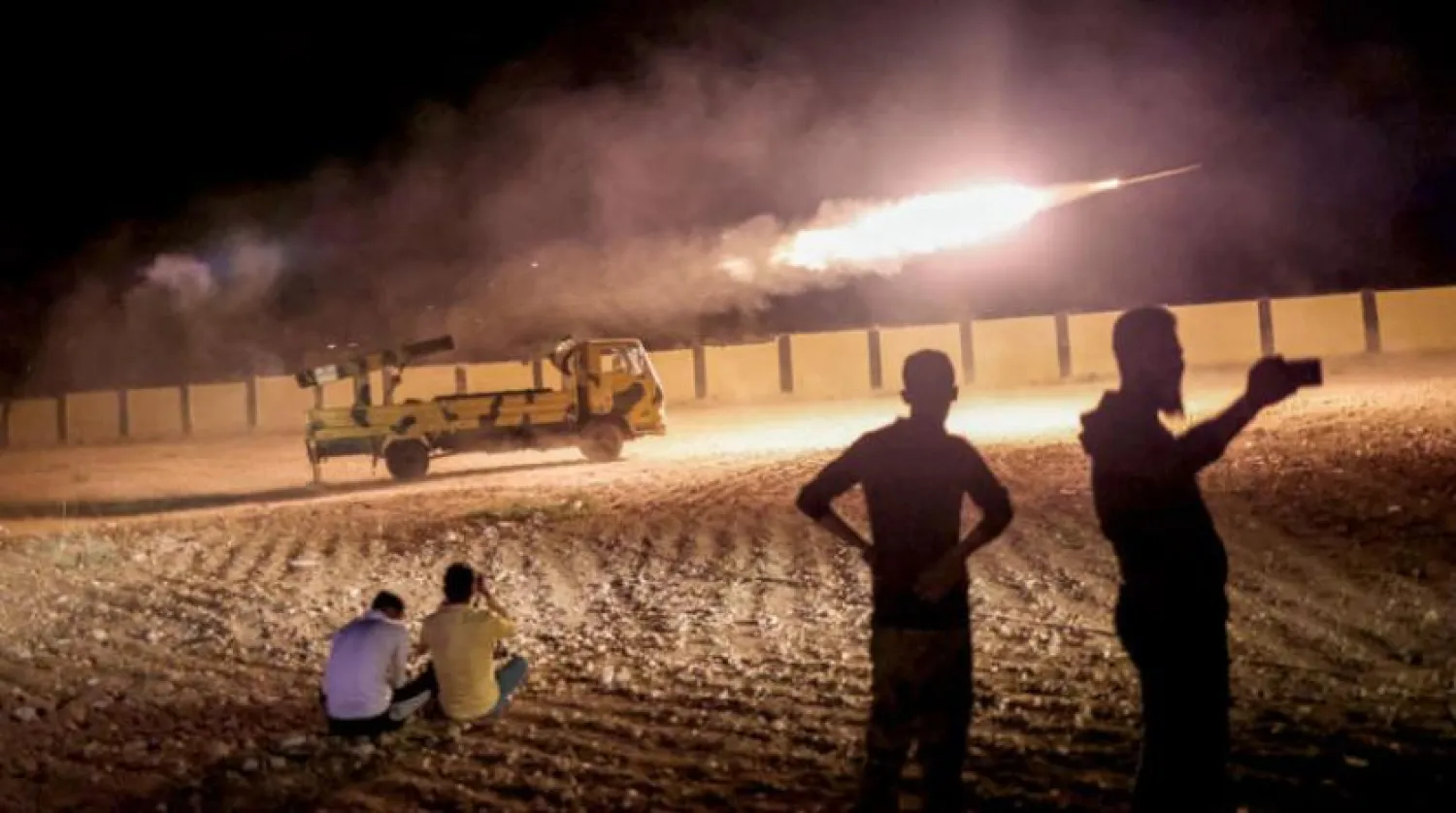
Members of the Türkiye-backed Syrian National Army fire missiles toward the positions of the Syrian regime forces in response to the al-Bab massacre (dpa)
TT

Clashes Intensify between Türkiye, Syrian Regime in Aleppo

Members of the Türkiye-backed Syrian National Army fire missiles toward the positions of the Syrian regime forces in response to the al-Bab massacre (dpa)

Clashes have intensified between the Turkish forces and the Syrian Democratic Forces (SDF) along with the Syrian regime in Aleppo following a massacre committed by regime forces in the al-Bab city.

The residents of al-Bab went into general strike to mourn the victims who fell during the Friday massacre in residential neighborhoods and a local market.

It is believed that the regime's bombing of the city was in response to the Turkish attack against its soldiers in a military base in Ayn al-Arab, following the killing of two Turkish soldiers and the wounding of three others in a bombing of a police station in Sanliurfa.

The Syrian Observatory for Human Rights (SOHR) reported that the regime forces' attack killed 17 people, including six children, and wounded 35 others.

The Turkish forces and the National Army factions exchanged shelling with the regime forces in the al-Bab countryside.

On Saturday, the Turkish forces and their loyal factions bombed nine villages in Aleppo's northern countryside within the areas of SDF deployment.

Meanwhile, the deputy head of the ruling Justice and Development Party, Numan Kurtulmus, said Türkiye is not responsible for the situation in Syria.

Kurtulmus said the Syrian people paid a heavy price for the ongoing war.

He added in a televised interview that foreign parties should find a quick solution "instead of sending weapons" to Syria. He was referring to US support for the Kurdish People's Protection Units (YPG).

The official urged to increase efforts to "guide the regime to peace and reach a solution that satisfies the Syrian people."

Kurtulmus reiterated that Türkiye is not responsible for the Syrian crisis, saying the Assad regime continues to pressure the people, and the Syrian people must be united for their territorial integrity.

Turkish President Recep Tayyip Erdogan said on Friday that his country has no ambitions in Syria and does not aim to overthrow the Assad regime but rather to combat terrorism that threatens its borders.



Hezbollah Rejects Latest Ceasefire Agreement as Israeli Strikes Kill 4 in Lebanon

A photograph taken from the southern area of Nabatieh shows smoke rising from the site of an Israeli airstrike in the village of Kfar Tibnit on June 4, 2026. (Photo by Abbas Fakih / AFP)
TT

Hezbollah Rejects Latest Ceasefire Agreement as Israeli Strikes Kill 4 in Lebanon

A photograph taken from the southern area of Nabatieh shows smoke rising from the site of an Israeli airstrike in the village of Kfar Tibnit on June 4, 2026. (Photo by Abbas Fakih / AFP)

Hezbollah on Thursday rejected the latest ceasefire agreement between Israel and the Lebanese government, and the militant group demanded a complete Israeli withdrawal from Lebanon as more fighting there hampered efforts to end the Iran war.

The Hezbollah announcement came as Israeli strikes killed at least four people, according to local authorities, and a UN peacekeeper was killed in the crossfire. An Israeli soldier was also killed in combat in southern Lebanon, The Associated Press said.

Hezbollah leader Naim Kassem, in a written statement read on TV, called the negotiations “absurd, humiliating and insulting.” He said the agreement’s demand that Hezbollah fighters leave southern Lebanon under fire would mean “surrender, defeat and achieving the enemy’s goals.”

“What we are concerned about is an end to the aggression, ceasefire and Israel’s withdrawal,” he said, underscoring that Hezbollah has not made any commitment to stop fighting. “So long as our villages are not safe and are being bombed and destroyed and our people are killed," he said, northern Israel “will not be safe.”

Sirens sound after Netanyahu visit

Following Kassem’s statement, drone alert sirens sounded in several border communities in northern Israel, including Shlomi, a town where Prime Minister Benjamin Netanyahu and several ministers had been meeting with local officials, his office said. Israeli media reported that Netanyahu left a short time before the alerts sounded.

The Israeli military later said the sirens were triggered by attempts to intercept several drones that hit near soldiers in southern Lebanon. No injuries were reported.

Lt. Gen. Eyal Zamir, the Israeli military’s chief of staff, acknowledged Thursday that the ongoing war was straining northern Israeli towns living under the threat of Hezbollah fire. He said Israel’s operations in Iran and Lebanon had “created a new security reality,” by weakening Iran and Hezbollah “to an unprecedented degree.”

Lebanese troops began moving Thursday afternoon into the southern village of Dibbine, in coordination with UN peacekeepers, after Israeli forces left the area, which saw intense clashes in recent days, state-run media reported. It was the first time Israeli troops withdrew from an area in southern Lebanon since the latest Israel-Hezbollah war began about three months ago.

The fighting in Lebanon, where Israeli forces have seized large swaths of the south, threatens efforts to end the Iran war and reopen the Strait of Hormuz, a key transit point for oil and gas. Its closure has jolted the world economy.

Iran has demanded that any lasting truce extend to Lebanon. Israeli Prime Minister Benjamin Netanyahu, who faces elections later this year, wants to press ahead with Israel’s offensive until Hezbollah no longer poses a threat.

US President Donald Trump, who faced a rare rebuke from Congress on Wednesday, has sought to downplay the diplomatic deadlock and the failure of declared ceasefires to end the fighting. He told reporters that in the Middle East, "a ceasefire is when you’re shooting in a more moderate manner.”

Serbian peacekeeper and Israeli soldier killed

A Serbian peacekeeper was killed and two others were wounded when a mortar struck their location near Marjayoun, a Christian-majority town that has seen intense fighting, according to the UN mission in southern Lebanon, known as UNIFIL, and the Serbian Defense Ministry.

Israel blamed Hezbollah for the firing that killed the UN peacekeeper, without offering evidence. Hezbollah and the UN did not immediately comment on who launched the shells.

Also Thursday, the Israeli military announced that a 21-year-old captain in the armored corps was killed in southern Lebanon.

Lebanon’s state-run National News Agency said a drone strike killed a motorcyclist and wounded four people in the village of Maaroub. The Israeli military said soldiers killed an armed militant and later found a Hezbollah cache of guns, grenades, surface-to-air missiles and other combat gear in the area.

The military also said it conducted strikes near the coastal city of Tyre and around Shaqra, another community in southern Lebanon.

The Lebanese news agency reported airstrikes in the south and said a strike on the village of Sohmor in the Bekaa Valley, in eastern Lebanon, killed three people and wounded others.

Israel has warned people not to go into parts of southern Lebanon where it says it is striking Hezbollah facilities.

Fighting has raged despite declared ceasefires

Hezbollah resumed rocket fire days after Israel and the United States launched their surprise Feb. 28 attack on Iran, which backs Hezbollah. Before then, Israel had regularly carried out strikes in Lebanon against what it said were militant targets, often killing civilians, despite an earlier truce reached in 2024.

After Hezbollah's rocket and drone attacks resumed, Israeli troops seized around a fifth of Lebanon, pushing further into the country's south than at any time since the end of Israel’s 1982-2000 occupation.

In the southern city of Sidon, residents reacted to Wednesday's ceasefire announcement with skepticism, saying previous agreements had failed to stop the violence.

“Every few days a ceasefire is announced, but people keep getting killed,” said Mayada Hijazi.

“It’s all talk and no action,” said Salah Nassab. “We keep going back to our homes, and then we get displaced again, back and forth. We’re very tired."

More than 3,500 people have been killed in Lebanon, and over 1.2 million have been displaced. The fighting has killed at least 28 Israeli soldiers and three civilians.

Latest ceasefire came from ongoing Israeli-Lebanese talks

The latest declared ceasefire came about through US-brokered talks between Israel and Lebanon's government, which accuses Hezbollah of dragging the country into war and had made efforts to disarm it before the latest hostilities.

The ceasefire agreement calls for Lebanon's armed forces to take control of security zones in Lebanon from which the militants would be banned.

Lebanese President Joseph Aoun on Thursday called the new agreement "the last chance to enter a final and comprehensive ceasefire.” He said Lebanon was ready to implement the deal once he receives responses from relevant factions in Lebanon, including Hezbollah. The United States — and Trump himself — would determine how and when the deal is implemented, Aoun told journalists.

The agreement terms Hezbollah “an enemy" of Israel, the US and Lebanon and calls for dismantling it. The government has promised to do so in the past but does not have the capabilities to disarm Hezbollah by force.

The latest agreement did not say when Israel would withdraw from southern Lebanon but said the US would support the Lebanese army as it works to assert control in areas where Hezbollah has long wielded power.


Iraq on Verge of Restructuring Popular Mobilization Forces

Members of Saraya al-Salam attend a ceremony in Samarra on June 4, 2026, marking their integration into Iraq’s security forces. (AFP)
TT

Iraq on Verge of Restructuring Popular Mobilization Forces

Members of Saraya al-Salam attend a ceremony in Samarra on June 4, 2026, marking their integration into Iraq’s security forces. (AFP)

The military wing loyal to Sadrist movement leader Moqtada al-Sadr handed over responsibility for security in Samarra to the Iraqi army on Thursday, in a symbolic ceremony that included lowering the faction’s flag at its operations headquarters.

The move, seen by observers as a “qualitative shift,” coincided with an announcement by the spokesman for Iraq’s armed forces that work had begun to restructure formations of the Popular Mobilization Forces and guarantee the rights of their members.

Saad Maan, head of the Security Media Cell, said all Saraya al-Salam fighters affiliated with Sadr were now under the command of the prime minister, the commander-in-chief of the armed forces.

Footage aired by state television showed Saraya al-Salam members lowering their faction’s flag outside the operations headquarters, in the presence of a military committee sent by Prime Minister Ali al-Zaydi.

Saraya al-Salam is part of the Popular Mobilization Forces through brigades 313, 314, and 315. It carries out security duties in several areas, most notably Samarra.

Sadr announced on May 27 that he was merging his military wing, Saraya al-Salam, into the state, and called on Popular Mobilization Forces factions to hand over their weapons.

Within a week, Asaib Ahl al-Haq and Kataib al-Imam Ali also announced their separation from the Popular Mobilization Forces. Kataib Hezbollah and Harakat al-Nujaba, however, have continued to reject demands to disarm and dismantle the factions.

Saraya under the commander’s authority

After the handover ceremony, Deputy Commander of Joint Operations Qais al-Mohammedawi said at a news conference that merging Saraya al-Salam meant placing it under the commander-in-chief of the armed forces.

He said, “A committee had been formed by government order to relink and redistribute armed formations so they move away from any other political title or formation.”

Saraya al-Salam brigades have been stationed in Samarra since the bombing of the Imam al-Askari shrine in June 2007. It remains unclear whether its members will leave the city for the first time in 19 years. But a military source told Asharq Al-Awsat the faction had handed over all its headquarters to the army, while its fighters now answer to the commander in chief of the armed forces.

Still, observers say the details of dismantling and disarmament remain unclear. Questions persist about the types and quantities of weapons held by the factions, whether they will hand them over to government authorities, and whether they will give them up entirely.

An Iraqi security official said the mechanism for placing all weapons under state control “remains unclear,” according to AFP. Local media, however, circulated claims that the Coordination Framework had put forward an initiative for discussion.

The proposal reportedly includes “securing tens of thousands of government jobs in official security institutions for individuals whose armed factions agreed to disengage.”

Restructuring the Popular Mobilization Forces

In a notable development, Sabah al-Numan, the spokesman for the commander in chief of the armed forces, said the committee formed at the commander in chief's direction had begun work to place all weapons under state control.

He said disengagement from the Popular Mobilization Forces included restructuring its formations and guaranteeing the rights of its members.

It is the first official reference to “restructuring the formations of the Popular Mobilization Forces” since the force was established in 2014 to fight ISIS.

Numan said the term “disengagement” involved administrative frameworks and restructuring these formations within the security services, while guaranteeing fighters’ rights and integrating them into military formations.

“The committee has been formed and has begun its work,” he said. “It will set the mechanisms for merging and incorporating the relevant formations, and for handing over weapons, equipment and camps to the Iraqi security authorities.”

Numan said “all weapons and all equipment” would be handed over to the central committee and Iraqi security authorities. A full inventory, he added, would be submitted within two days to the central committee, which is under the direct supervision, direction and follow-up of the commander in chief of the armed forces.

The committee includes several bodies, including the Defense Ministry, the Interior Ministry, the Joint Operations Command and the Popular Mobilization Forces Commission.

The Coordination Framework authorized Prime Minister and Commander in Chief Ali al-Zaydi to take the decisions and measures needed to protect the country’s higher interests.

It also backed “restricting weapons to the state and disengaging the Popular Mobilization Forces Commission from political, partisan and social frameworks.”

What comes next?

Asaib Ahl al-Haq, led by Qais al-Khazali, is expected to take a step similar to that of the Sadrist movement after agreeing with the prime minister to form a committee to separate from the Popular Mobilization Forces.

Khazali is under US sanctions and is one of the leaders of the Coordination Framework, which holds the largest parliamentary bloc. His political influence grew after his group won 27 seats in the latest parliamentary elections.

A source close to Asaib said the group “currently considers political work and presence in government more important than fighting. Therefore, it wants to give assurances to the United States.”

Kataib al-Imam Ali also said it would form a committee to “follow up the inventory, handover and transfer process under Zaydi’s supervision,” and another to “follow up the affairs of individuals and members and reintegrate them into state institutions.”

In practice, that means “all decisions related to their brigades within the Popular Mobilization Forces” will come under Zaydi’s authority “administratively,” according to a source close to the factions.

US special envoy to Syria and Iraq Tom Barrack welcomed a step that “will contribute to building order” and praised the initiative of Prime Minister Ali al-Zaydi, who, after taking office last month, pledged to restrict weapons to the state.

The move comes as Washington gains political and economic ground in Iraq, while Tehran’s regional influence has declined since the outbreak of the war in Gaza between Israel and Hamas, which is backed by Tehran, in 2023, followed by Israel’s first war against Iran in 2025, and then the second war launched by the United States and Israel in February, whose repercussions reached Iraq.

Disarmament plan

Asharq Al-Awsat revealed on May 9, 2026, that an Iraqi committee, including Prime Minister-designate Ali al-Zaydi, was working to complete an “executive project” to disarm armed factions before presenting it to Washington, amid mounting US pressure to keep militias away from the new government and key state institutions.

The committee had presented militia leaders with “ideas on how to disarm,” but some meetings “did not pass calmly,” according to informed sources.

The plan includes removing heavy and medium weapons and restructuring the Popular Mobilization Forces, alongside expected changes in sensitive security agencies, possibly including the intelligence service.

Political sources, however, questioned the government’s ability to implement the project, saying it may be aimed at “buying time.”


Israel, Hezbollah Dash Hopes for ‘Last-Chance’ Ceasefire Deal

The Lebanese and Israeli delegations, along with US State Department representatives, attend the latest round of negotiations in Washington.(AFP)
TT

Israel, Hezbollah Dash Hopes for ‘Last-Chance’ Ceasefire Deal

The Lebanese and Israeli delegations, along with US State Department representatives, attend the latest round of negotiations in Washington.(AFP)

Israel and Hezbollah have dashed hopes for a “last chance” ceasefire agreement in Lebanon, with Tel Aviv insisting it will continue military operations until a demilitarized zone is established, and Hezbollah vowing to fight on, calling the deal “a road map to exterminate part of the Lebanese people and enslave the rest.”

Lebanese contacts with domestic and international players are continuing in a bid to rescue the agreement.

The effort to salvage the deal, reached between the Lebanese state and Israel during direct talks in Washington on Wednesday, appeared to show that the crisis is tied to regional developments.

Lebanese ministerial sources said Lebanon had received Hezbollah’s rejection of the agreement from its secretary-general, Naim Qassem, “pending clarity on the Iranian position.” Parliament Speaker Nabih Berri, who supports a comprehensive ceasefire, remained silent.

Two obstacles appeared to be undercutting the agreement. The first was the failure to secure a comprehensive ceasefire across Lebanon. The second was Israel’s demand for “freedom of movement.”

A third hurdle, Hezbollah’s demand for a clause requiring Israel to withdraw from occupied territory, was eased after the Shiite duo accepted a timetable for withdrawal, starting after the ceasefire takes effect, with the next steps to proceed “step for step.”

A “last chance” agreement

Official Lebanon sees the deal as “the last chance” for a final and comprehensive ceasefire.

Lebanese President Joseph Aoun said in remarks to reporters that “each party must bear responsibility if it does not respond” to the statement and its provisions, which he described as highly important for Lebanon.

Aoun said that once replies are received from the concerned domestic parties, especially Hezbollah, Lebanon’s position will be relayed to the American side so the next steps can be determined.

Aoun praised the resolve of the Lebanese negotiating team, led by Ambassador Simon Karam, saying Wednesday’s talks were extremely difficult.

Karam, he said, suspended one round of negotiations and refused to move to any other issue before a comprehensive ceasefire was settled.

US Secretary of State Marco Rubio then intervened to resume the talks, which ended with Lebanon’s demand for a comprehensive ceasefire being accepted.

Aoun said he remained in contact with international and domestic parties throughout Wednesday and into the early hours of Thursday to secure the comprehensive ceasefire.

He said brotherly and friendly states had helped put pressure on Lebanon’s side, and that US President Donald Trump would be the direct guarantor of the agreement’s implementation.

The deal could take effect 24 hours after Trump is notified of approval and the necessary guarantees are provided.

Israel and Hezbollah respond

The response came quickly. Israeli Defense Minister Israel Katz said the army would not stop firing and would remain in the occupied areas “until Hezbollah elements are first removed from the entire area south of the Litani and a demilitarized zone is established.”

He also insisted on freedom of movement, including the right to strike targets in Beirut.

Qassem, for his part, called the agreement “a road map to exterminate part of the Lebanese people and enslave the rest.”

“We are concerned only with stopping the comprehensive aggression, with a ceasefire and Israel’s withdrawal,” he said.

“The ceasefire must be comprehensive. There can be no partition between the south and the rest of Lebanon, and no freedom for the Israeli enemy to kill in Lebanon. As long as the occupation exists, the resistance continues.”

Qassem said Hezbollah had given no one a pledge not to resist or respond to aggression.

“As long as the aggression continues, we will confront it with all the power we have, and we will reach it wherever we decide and are able,” he said.

“As long as our villages are not safe, are bombed and destroyed, and our people are killed, the settlements will not be safe, and they will see our force and severity.”

He said Hezbollah rejected any link between the presence of the resistance, stopping the aggression, and Israel’s withdrawal.

“No one has the right to interfere in Lebanon’s internal affairs among the Lebanese, in organizing their political, economic, and social life, and the decisions they agree on regarding the sovereignty and protection of their country within the national security strategy they agree on,” he said.

Prime Minister

Prime Minister Nawaf Salam supports the official negotiating track. Opening a cabinet session, Salam said: “The negotiating path we chose is the fastest and least costly route for Lebanon and the Lebanese, and for the south and its people.”

He said negotiation “was not the only available option, but it was the best option.”

Referring to Aoun’s statement that “the negotiations were not easy, and our delegation faced Israeli intransigence,” Salam said Lebanon’s demands were unchanged.

“What we are demanding in these negotiations is not new,” he said.

“It is what we said from day one, a full Israeli withdrawal from our land, the return of our people to their homes and villages with dignity and safety, armed with our right to our land, the support of our Arab brothers, international support, and American understanding.”

On clearing the area south of the Litani of gunmen and weapons, Salam said, “This is not a condition imposed on us by anyone. This is what Lebanon pledged to the world when it agreed to Resolution 1701 in 2006.”

On the state’s exclusive control of arms across Lebanon, he said, “We have been very late in implementing what was stipulated in the Taif Agreement, which the Lebanese signed, and what was also included in our ministerial statement. We missed the opportunity in 2000 after the Israeli withdrawal, and then after the Syrian withdrawal in 2005. We must not miss this opportunity as well, because missing it this time will have grave consequences.”

Salam urged “all parties to place the interest of Lebanon and its people above any other interest, whether foreign or factional, and to bear their responsibilities.”

“Whoever rejects or stalls will alone bear the burden of what may result from that, before history, and more importantly before the Lebanese people, who have suffered greatly and made the greatest sacrifices,” he said.