


Moderna Sues Pfizer/BioNTech for Patent Infringement over COVID Vaccine

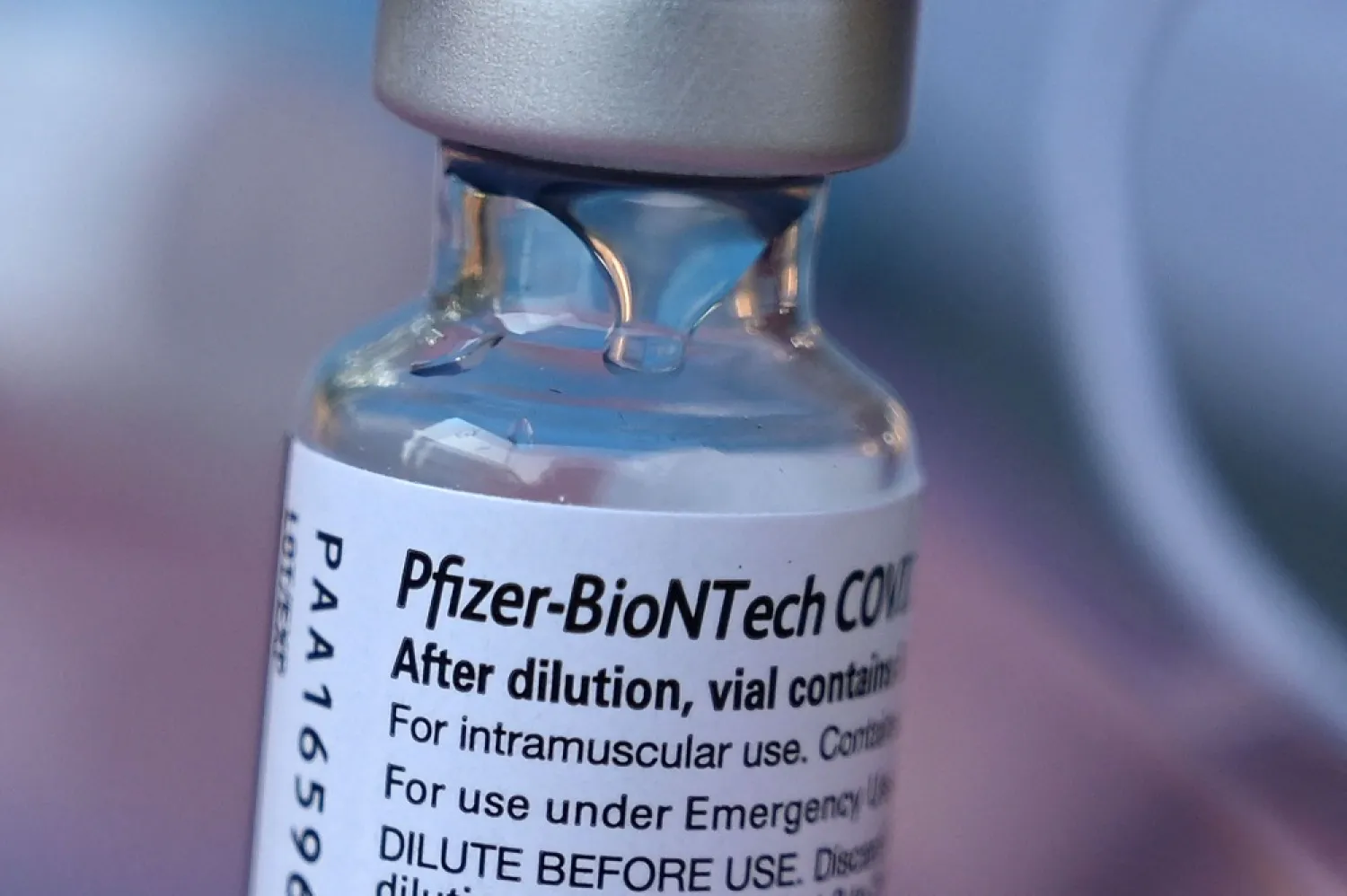
In this file photo taken on August 23, 2021, a vial of Pfizer/BioNTech Covid-19 vaccine is seen at a pop up vaccine clinic in the Arleta neighborhood of Los Angeles, California. (AFP)
TT

Moderna Sues Pfizer/BioNTech for Patent Infringement over COVID Vaccine

In this file photo taken on August 23, 2021, a vial of Pfizer/BioNTech Covid-19 vaccine is seen at a pop up vaccine clinic in the Arleta neighborhood of Los Angeles, California. (AFP)

Moderna sued Pfizer and its German partner BioNTech on Friday for patent infringement in the development of the first COVID-19 vaccine approved in the United States, alleging they copied technology that Moderna developed years before the pandemic.

Pfizer shares fell nearly 1%, while BioNTech US-listed shares were down about 1.5% and Moderna shares slipped 1.7% on Friday.

The lawsuit, which seeks undetermined monetary damages, was filed in US District Court in Massachusetts. In a news release on Friday, Moderna said the lawsuit would be filed also in the Regional Court of Duesseldorf in Germany.

Contacted by Reuters, a spokesperson for the Duesseldorf court said: "I cannot currently confirm the receipt of such a claim."

"We are filing these lawsuits to protect the innovative mRNA technology platform that we pioneered, invested billions of dollars in creating, and patented during the decade preceding the COVID-19 pandemic," Moderna Chief Executive Stephane Bancel said in the news release.

Moderna said its lawsuit was not meant to stop people from getting vaccines.

Moderna Inc, on its own, and the partnership of Pfizer Inc and BioNTech SE were two of the first groups to develop a vaccine for the novel coronavirus.

In an emailed statement, a Pfizer spokesperson said: "Pfizer/BioNTech has not yet fully reviewed the complaint but we are surprised by the litigation given the COVID-19 vaccine was based on BioNTech's proprietary mRNA technology and developed by both BioNTech and Pfizer."

"We remain confident in our intellectual property supporting the Pfizer/BioNTech vaccine and will vigorously defend against the allegations of the lawsuit," the spokesperson said.

BioNTech did not immediately reply to separate requests for comment.

Just a decade old, Moderna, based in Cambridge, Massachusetts, had been an innovator in the messenger RNA (mRNA) vaccine technology that enabled the unprecedented speed in developing the COVID-19 vaccine.

An approval process that previously took years was completed in months, thanks largely to the breakthrough in mRNA vaccines, which teach human cells how to make a protein that will trigger an immune response.

Germany-based BioNTech had also been working in this field when it partnered with the US pharma giant Pfizer.

The US Food and Drug Administration granted emergency use authorization for the COVID-19 vaccine first to Pfizer/BioNTech in December 2020, then one week later to Moderna.

Moderna's COVID vaccine - its lone commercial product - has brought in $10.4 billion in revenue this year while Pfizer's vaccine brought in about $22 billion.

The lawsuit will likely take years to play out, according to Cowen & Co analyst Tyler Van Buren.

Moderna alleges Pfizer/BioNTech, without permission, copied mRNA technology that Moderna had patented between 2010 and 2016, well before COVID-19 emerged in 2019 and exploded into global consciousness in early 2020.

Early in the pandemic, Moderna said it would not enforce its COVID-19 patents to help others develop their own vaccines, particularly for low- and middle-income countries. But in March 2022 Moderna said it expected companies such as Pfizer and BioNTech to respect its intellectual property rights. It said it would not seek damages for any activity before March 8, 2022.

Patent litigation is not uncommon in the early stages of new technology.

Pfizer and BioNTech are already facing multiple lawsuits from other companies who say the partnership's vaccine infringes on their patents. Pfizer/BioNTech have said they will defend their patents vigorously.

Germany's CureVac, for instance, also filed a lawsuit against BioNTech in Germany in July. BioNTech responded in a statement that its work was original.

Moderna has also been sued for patent infringement in the United States and has an ongoing dispute with the US National Institutes of Health over rights to mRNA technology.

In Friday's statement, Moderna said Pfizer/BioNTech appropriated two types of intellectual property.

One involved an mRNA structure that Moderna says its scientists began developing in 2010 and were the first to validate in human trials in 2015.

"Pfizer and BioNTech took four different vaccine candidates into clinical testing, which included options that would have steered clear of Moderna's innovative path. Pfizer and BioNTech, however, ultimately decided to proceed with a vaccine that has the same exact mRNA chemical modification to its vaccine," Moderna said.

The second alleged infringement involves the coding of a full-length spike protein that Moderna says its scientists developed while creating a vaccine for the coronavirus that causes Middle East Respiratory Syndrome (MERS).

Although the MERS vaccine never went to market, its development helped Moderna rapidly roll out its COVID-19 vaccine.



China Set for Latest Space Launch, with Hong Kong Astronaut Aboard

Astronauts for China's Shenzhou-23 space mission Lai Ka-ying (L), Zhu Yangzhu (C) and Zhang Zhiyuan (R) wave during a press conference before the launch of the mission at the Jiuquan Satellite Launch Center in the Gobi desert in Jiuquan, in northwestern China's Gansu province on May 23, 2026. (Photo by CNS / AFP) / China OUT
TT

China Set for Latest Space Launch, with Hong Kong Astronaut Aboard

Astronauts for China's Shenzhou-23 space mission Lai Ka-ying (L), Zhu Yangzhu (C) and Zhang Zhiyuan (R) wave during a press conference before the launch of the mission at the Jiuquan Satellite Launch Center in the Gobi desert in Jiuquan, in northwestern China's Gansu province on May 23, 2026. (Photo by CNS / AFP) / China OUT

A Hong Kong astronaut will join a Chinese space mission for the first time as part of a three-person crew launching on Sunday, as Beijing edges closer to its goal of landing people on the Moon.

The Tiangong space station -- crewed by teams of three astronauts that are typically rotated every six months -- is the crown jewel of China's space program, boosted by billions in state investment in a bid to catch up with the United States and Russia.

The Shenzhou-23 mission will blast off at 11:08 pm (1508 GMT) on Sunday from the Jiuquan Satellite Launch Center in northwestern China, carrying three astronauts to the space station, China Manned Space Agency (CMSA) spokesman Zhang Jingbo told reporters on Saturday.

The team comprises Lai Ka-ying, hailed by state media as Hong Kong's first astronaut, Zhu Yangzhu and Zhang Zhiyuan, AFP quoted the spokesman as saying.

Hong Kong's Chief Executive John Lee congratulated Lai on passing "the rigorous selection and training process.”

Flight engineer Zhu, who participated in the Shenzhou-16 mission in 2023, will be the commander.

"This is a ... test of our physical and psychological endurance, emergency response capabilities, coordination and teamwork, as well as our ability to work and live in orbit," Zhu told reporters.

"As mission commander, what I have thought about most is how to make thorough preparations in every aspect and how to lead the team in successfully completing the flight mission with zero mistakes and zero errors."

The mission's primary objectives are to "continue carrying out space science and application work, conduct astronauts' extravehicular activities and cargo transfer in and out of the cabin", the CMSA's Zhang told reporters.

One of the astronauts will remain on the station for a year, he added, without specifying who.
"Arranging for an astronaut to carry out a one-year in-orbit residency experiment is by no means a simple matter of adding together two six-month missions in terms of duration," Zhang said.

The one-year space residency, Zhang said, will collect data on astronauts on longer-duration spaceflights and test health support capabilities.

China is "steadily" building operational experience for "sustained occupation" of its Tiangong space station, and year-long missions are an important step towards future lunar and potentially deep-space ambitions, said Macquarie University's Richard de Grijs.

"A year in orbit pushes both hardware and humans into a different operational regime compared with the shorter Shenzhou missions of the program's earlier phases," the professor of physics and astronomy told AFP.

Beijing's space program, the third to put humans in orbit, has also landed robotic rovers on Mars and the Moon.

China has ramped up plans to achieve its "space dream" under President Xi Jinping.

Beijing says it aims to send a crewed mission to the Moon by 2030, with the goal of constructing a base on the lunar surface.

The CMSA said on Saturday it would "make every possible effort and strive tirelessly" to achieve that goal.


AI Will Help Make a Nobel Prize-Winning Discovery Within a Year

A robot holding a medicine box at the simulated pharmacy of the Beijing Humanoid Robot Innovation Center (EPA)
TT

AI Will Help Make a Nobel Prize-Winning Discovery Within a Year

A robot holding a medicine box at the simulated pharmacy of the Beijing Humanoid Robot Innovation Center (EPA)

An AI system will work with humans to make a Nobel prize-winning discovery within 12 months and tradespeople will be helped by bipedal robots in two years, according to the co-founder of Anthropic.

Jack Clark described a “vertiginous sense of progress” in the technology and made a series of predictions, including that companies run solely by AIs would be generating millions of dollars in revenue within 18 months, and that by the end of 2028, AI systems would be able to design their own successors, according to The Guardian.

In a lecture at Oxford University on Wednesday, he also said there remained plausible scenarios in which the technology had “a non-zero chance of killing everyone on the planet” and that it was “important to clearly state that that risk hasn’t gone away.”

Anthropic’s most popular model is called Claude, but it recently launched a version called Mythos that proved alarmingly capable at exploiting cybersecurity weaknesses.

Clark told students it would be better if humans could slow the development of the technology “to give ourselves more time as a species” to deal with the implications of its powers.

But he said this wouldn’t happen, in the breakneck development “by a variety of actors and a variety of countries, locked in a competition with one another, where commercial and geopolitical rivalries are often drowning out the larger existential-to-the-species aspects of the technology being built.” This was “not ideal,” he said.

Clark is one of the most senior figures at Anthropic, which was established by AI researchers who quit the rival firm OpenAI over disagreements on safety.

The $900 billion company has been accused by Donald Trump’s White House and other AI accelerationists of “fear-mongering” to encourage regulation that could cement its competitive position.

Anthropic disputes this, and Clark said many people appeared to be in denial about AI’s progress.

He said he wanted to encourage humanity to prepare for a technology that would “soon be more capable than all of us collectively.”

Comparing the failure to prepare for AI to the failure to prepare for pandemics such as COVID, he said: “If we stand by and let synthetic intelligence multiply, then we’ll eventually be forced into reactivity.”

Critics of the frontier AI companies such as Anthropic, OpenAI and Google fear over-reliance on their few AI models – which have been backed by huge amounts of profit-seeking capital – could create a “single point of failure” in global systems.


SpaceX's Upgraded Starship V3 Completes Debut Test Flight from Texas

22 May 2026, US, Starbase: A new version of the SpaceX Starship rocket launches from Starbase in Texas. Photo: Charles Briggs/ZUMA Press Wire/dpa
TT

SpaceX's Upgraded Starship V3 Completes Debut Test Flight from Texas

22 May 2026, US, Starbase: A new version of the SpaceX Starship rocket launches from Starbase in Texas. Photo: Charles Briggs/ZUMA Press Wire/dpa

SpaceX on Friday completed the 12th uncrewed test flight of its next-generation Starship, a high-stakes trial run of a newly upgraded version of the spacecraft as Elon Musk's rocket company nears a record-breaking public listing.

The debut flight of Starship V3 - designed to enable more frequent Starlink satellite launches and to send future NASA missions to the moon - marked a key milestone for the vehicle following months of testing delays. The outcome could also sway investor confidence ahead of SpaceX's initial public offering next month, expected to be the largest in history.

Starship, which SpaceX has spent more than $15 billion developing as a fully reusable spacecraft, is critical to Musk's goals of cutting launch costs, expanding his Starlink business and ⁠pursuing ambitions ranging ⁠from deep-space exploration to orbital data centers - all factored into his targeted $1.75 trillion IPO valuation.

SpaceX was counting on a successful test flight to reinforce its case that Starship, the world's largest and most powerful rocket ever flown, is nearing commercial readiness after years of explosive setbacks and development delays. The test appeared to have achieved most of its major objectives.

The towering vehicle, consisting of the upper-stage Starship astronaut vessel stacked atop a Super Heavy booster rocket, blasted off at about 5:30 p.m. CT ⁠on Friday (2230 GMT) from SpaceX facilities in Starbase, Texas, on the Gulf of Mexico near Brownsville.

A live SpaceX webcast of the liftoff showed the rocketship, more than 40 stories tall, climbing from the launch tower as the Super Heavy's cluster of Raptor engines thundered to life in a ball of flames and billowing clouds of vapor and exhaust.

The test ended about an hour later when the Starship vehicle made it through a blazing re-entry through Earth's atmosphere and splashed down into the Indian Ocean, nose up as planned, as SpaceX employees who gathered to watch a live webcast of the flight cheered.

The lower-stage Super Heavy came down separately in the Gulf of Mexico about six minutes after blast-off.

The launch marked SpaceX's 12th Starship test flight since 2023 and ⁠the first ever ⁠for the V3 iteration of both the cruise vessel and its Super Heavy booster, as well as the first blast-off from a new launch pad designed for the more powerful rocket.

During its suborbital cruise phase, Starship successfully released its payload of 20 mock Starlink satellites one by one, plus two actual modified satellites that scanned the spacecraft's heat shield and transmitted data back to operators on the ground during the vehicle's descent.

Starship made it to its cruise phase despite the loss of one of its six upper-stage engines, and mission controllers opted not to attempt an inflight re-ignition of the engines before re-entry.

But the vehicle did execute a return-landing burn at the very end of its flight, along with several aerodynamic maneuvers deliberately intended to place the spacecraft under maximum stress, and Starship completed those moves intact for its controlled final descent.