


Ukraine on Edge as Zaporizhzhia Nuclear Plant, Region’s Towns Shelled

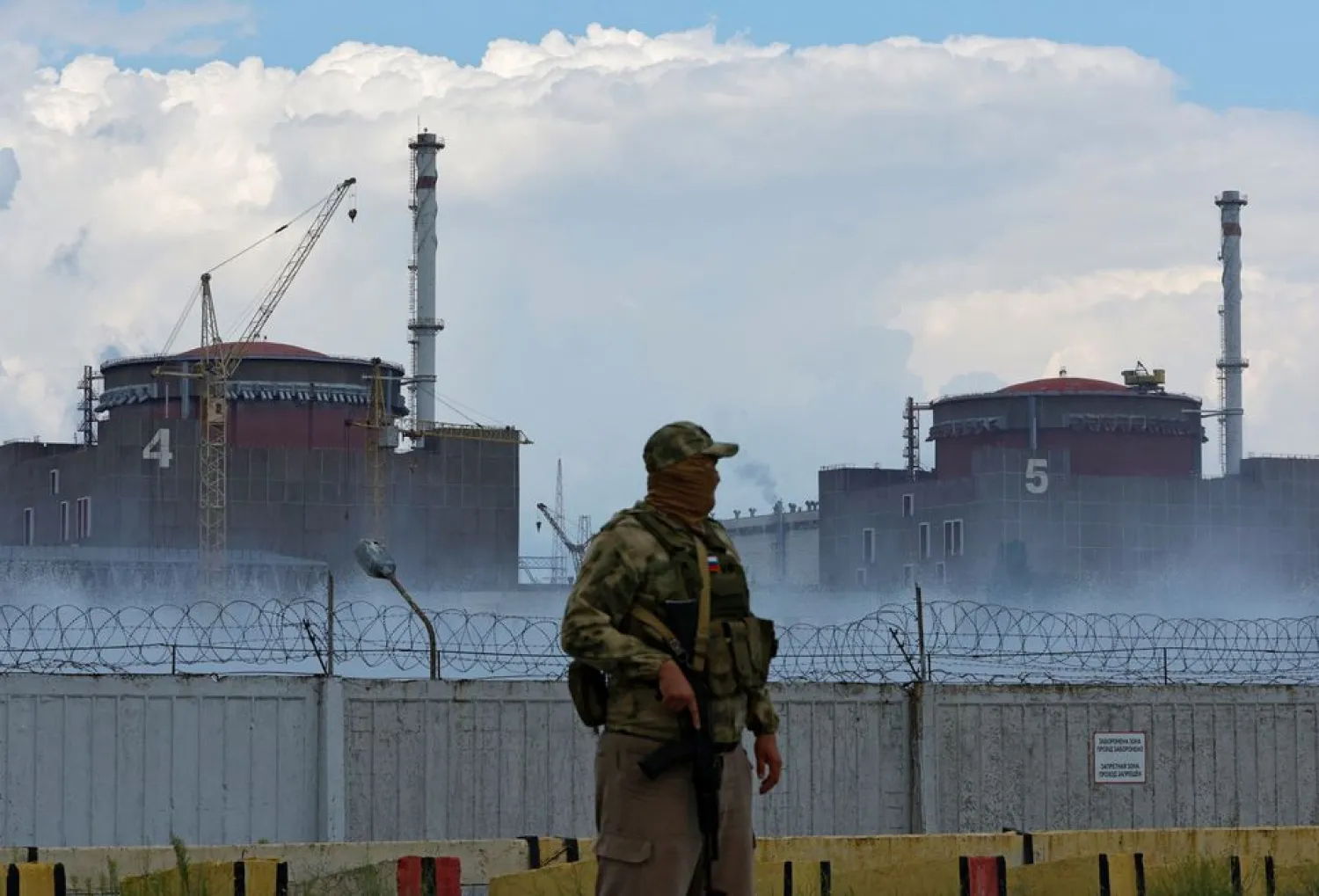
A serviceman with a Russian flag on his uniform stands guard near the Zaporizhzhia Nuclear Power Plant in the course of Ukraine-Russia conflict outside the Russian-controlled city of Enerhodar in the Zaporizhzhia region, Ukraine August 4, 2022. REUTERS/Alexander Ermochenko
TT

Ukraine on Edge as Zaporizhzhia Nuclear Plant, Region’s Towns Shelled

A serviceman with a Russian flag on his uniform stands guard near the Zaporizhzhia Nuclear Power Plant in the course of Ukraine-Russia conflict outside the Russian-controlled city of Enerhodar in the Zaporizhzhia region, Ukraine August 4, 2022. REUTERS/Alexander Ermochenko

Russian artillery fired at Ukrainian towns across the river from the Zaporizhzhia nuclear power plant overnight, local officials said on Sunday, adding to residents' anguish as reports of shelling around the plant fueled fears of a radiation disaster.

Russia's defense ministry said there was more Ukrainian shelling of the plant over the past 24 hours, just a day after Moscow and Kyiv traded accusations of targeting Europe's biggest nuclear plant, which has prompted grave international concern.

Ukrainian nuclear company Energoatom said it had no new information about attacks on the plant.

Captured by Russian troops in March, but still run by Ukrainian staff, the complex on the southern front line of the war has been one of the major hotspots in the six-month-old conflict.

The US State Department said in a statement on Sunday that Moscow did not want to acknowledge the grave radiological risk at the Zaporizhzhia plant and had blocked a draft agreement on nuclear non-proliferation because it mentioned such risk.

Regional governor Oleksandr Starukh said on Telegram on Sunday that Russian forces struck residential buildings in the region's main city of Zaporizhzhia, about a two-hour drive from the plant, and the town of Orikhiv further east.

On Saturday, Starukh told Ukrainian television residents were being taught how to use iodine in case of a radiation leak.

Ukraine's military reported shelling of nine more towns in the area on the opposite side of the Dnipro river from the plant in its daily report, while the RIA agency quoted the Russian defense ministry as saying its air force struck a Motor Sich plant in the region where helicopters were repaired.

Reuters could not verify those reports.

Russian Defense Ministry spokesman Igor Konashenkov said nine shells fired by the Ukrainian artillery in two separate attacks landed in the nuclear plant's grounds.

"At present, full-time technical personnel are monitoring the technical condition of the nuclear plant and ensuring its operation. The radiation situation in the area of the nuclear power plant remains normal," he said in a statement.

The United Nations and Kyiv have called for a withdrawal of military equipment and personnel from the plant to ensure it is not a target.

Continent at risk

Ukrainian Foreign Minister Dmytro Kuleba said that Russian forces had turned the plant into military base, putting the whole continent at risk, and had no business being there.

"Russian military must get out of the plant," he said on Twitter.

The UN nuclear watchdog IAEA is waiting for clearance for its officials to visit the plant, which its head said on Thursday should be "very, very close".

Ukrainian President Volodymyr Zelenskiy warned on Friday the situation at Zaporizhzhia remained "very risky" a day after it took hours to reconnect two of its reactors to the grid after shelling cut them off.

On Ukraine's eastern front, Ukrainian forces halted the latest Russian attempt to advance on the town of Sloviansk, Kyiv's military said in its daily report.

Ukrainian troops also repelled Russian attempts to attack in three directions, including in the area of Bakhmut and the coal-producing town of Avdiivka, it added in an afternoon update.

Having taken Sievierodonetsk and Lysychansk weeks ago, Moscow has have focused on Bakhmut, in their push to extend control over the Donbas region. According to regional governors, the cities of Kramatorsk and Sloviansk in Donetsk province were shelled by Russian forces overnight, but there were no reports of new casualties.

Reuters could not verify those accounts.

President Vladimir Putin launched the invasion of Russia's neighbor on Feb. 24, saying a "special operation" was needed to demilitarize the country and remove perceived security threats to Russia.

Ukraine and the West have dismissed this as a baseless pretext for an imperialist war of conquest that has killed thousands, displaced tens of millions, turned cities to rubble and threatened the global economy with an energy and food supply crisis, sending prices soaring.

Ukraine's foreign ministry said Kuleba would travel to Sweden on Monday followed by a trip to the Czech Republic on Tuesday as part of Kyiv's efforts to cement international support for Ukraine and push for more sanctions pressure on Russia.

In Prague, he will attend an informal meeting of EU foreign ministers that will discuss new sanctions on Moscow and an EU-wide visa ban for Russians. Zelenskiy called for such a ban earlier this month, but so far it found support mainly from Estonia, Latvia, Lithuania, Poland and Finland, which all share a border with Russia.



Trump to Travel to China Next Month, with US Trade Policy in Focus

US President Donald Trump arrives at Joint Base Andrews in Maryland, US, February 19, 2026. (Reuters)
TT

Trump to Travel to China Next Month, with US Trade Policy in Focus

US President Donald Trump arrives at Joint Base Andrews in Maryland, US, February 19, 2026. (Reuters)

US President Donald Trump will travel to China from March 31 to April 2 for a highly anticipated meeting between the world's two biggest economies, following the Supreme Court's decision to overturn Trump's sweeping tariffs against imported goods.

A White House official confirmed the trip on Friday, just before the highest US court struck down many of the tariffs Trump has used to manage sometimes-tense relations with China.

Trump is expected to visit Beijing and meet Chinese President Xi Jinping as part of a lavish, extended visit. Trump was last in China in 2017, ‌the most ‌recent trip by a US president.

A key topic had been whether ‌to ⁠extend a trade ⁠truce that kept both countries from further hiking tariffs. After Friday's ruling, however, it was not immediately clear whether - and under what legal authority - Trump would restore tariffs on imports from China.

TRUMP SEES TRADE IMBALANCE AS NATIONAL EMERGENCY

The administration has said the tariffs were necessary because of national emergencies related to trade imbalances and China's role in producing illicit fentanyl-related chemicals.

"That's going to be a wild one," Trump told foreign leaders visiting Washington on Thursday ⁠about the trip. "We have to put on the biggest display you've ‌ever had in the history of China."

The Chinese ‌embassy in Washington did not immediately respond to a request for comment. Beijing has not ‌confirmed the trip.

The visit would be the leaders' first talks since February and their first ‌in-person visit since an October meeting in South Korea. At that October meeting, Trump agreed to trim tariffs on China in exchange for Beijing cracking down on the fentanyl trade, resuming US soybean purchases and keeping rare earth minerals flowing.

While the October meeting largely sidestepped the sensitive issue of ‌Taiwan, Xi raised US arms sales to the island in February.

Washington announced its largest-ever arms sales deal with Taiwan in December, ⁠including $11.1 billion in ⁠weapons that could ostensibly be used to defend against a Chinese attack. Taiwan expects more such sales.

China views Taiwan as its own territory, a position Taipei rejects. The United States has formal diplomatic ties with China, but it maintains unofficial ties with Taiwan and is the island's most important arms supplier. The United States is bound by law to provide Taiwan with the means to defend itself.

Xi also said during the February call that he would consider further increasing soybean purchases, according to Trump.

Struggling US farmers are a major political constituency for Trump, and China is the top soybean consumer.

Although Trump has justified several hawkish policy steps from Canada to Greenland and Venezuela as necessary to thwart China, he has eased policy toward Beijing in the past several months in key areas, from tariffs to advanced computer chips and drones.


Diplomacy Is Still the Only Viable Path to Peace in Ukraine, UN Refugee Chief Barham Salih Says

UNCHR High Commissioner Barham Salih talks during an interview with The Associated Press in Kyiv, Ukraine, Friday, Feb. 20, 2026. (AP)
TT

Diplomacy Is Still the Only Viable Path to Peace in Ukraine, UN Refugee Chief Barham Salih Says

UNCHR High Commissioner Barham Salih talks during an interview with The Associated Press in Kyiv, Ukraine, Friday, Feb. 20, 2026. (AP)

There are many obstacles to a peace deal in Ukraine, but a diplomatic solution remains the only viable option, the newly appointed head of the UN refugee agency said Friday, warning that humanitarian operations are increasingly overstretched because of multiple global crises.

Barham Salih, Iraq’s former president who was elected UNHCR high commissioner in December, made his first visit to Ukraine since taking office.

After traveling to Ukraine’s front-line cities, including Kharkiv and Zaporizhzhia, he met with President Volodymyr Zelenskyy and discussed the latest in efforts to secure a peace deal. He also discussed the future of UNHCR operations as Ukraine endures Russian attacks on its energy grid during a harsh winter.

“You have to be hopeful, but I do understand the difficulties in the situation, and it’s clear, of course, there are many, many impediments along the way, but at the end of the day, there is no military solution. There needs to be peace, a durable and just peace so that people can go back to their lives,” he said, speaking to The Associated Press in an interview in Kyiv.

“Things are not necessarily easy, definitely not easy, but let’s redouble the effort to make sure that diplomacy has a chance and really bring about a durable and just peace to this war that has been going on for far too long,” he added.

Of the agency’s $470 million appeal for Ukraine, only $150 million has been pledged. The shortfall reflects deep cuts across the humanitarian sector, making it increasingly difficult to deliver aid across multiple crises.

There are 3.7 million Ukrainians displaced within the country and nearly 6 million Ukrainians outside the country who have become refugees in Europe and elsewhere, he said.

“This tells you the gap between what is needed and what is available,” he said. “My appeal to the international community is, really, this is not the moment to walk away, this is not a moment to look the other way round. These vulnerable populations need support. We should deliver this help to them.”

The UN agency in Ukraine predicts 10.8 million Ukrainians will require humanitarian assistance in 2026, according to a report from the agency. The most critical needs are concentrated along the war’s front lines in the eastern and southern parts of Ukraine, as well as in the northern border region. Intensified hostilities produce fresh waves of displacement.

The agency’s Ukraine appeal competes with large-scale conflicts in Sudan and Gaza. Since his appointment, Salih has spent only one week in his Geneva office, traveling to Kenya, Chad, Türkiye and Jordan before visiting Ukraine.

Drastic cuts to US humanitarian funding under President Donald Trump has accelerated the erosion of global humanitarian infrastructure and severely undermined the ability of organizations to deliver aid.

There are 117 million displaced people worldwide, including at least 42 million refugees, Salih said. Two-thirds face protracted displacement and remain dependent on humanitarian assistance.

Deciding where to prioritize given shrinking resources is “difficult” he said.

“It’s really very difficult to prioritize given the scale of the problem. I was in Kenya and I was in Chad recently and I was in Türkiye and in Jordan talking to refugees from Syria. And of course, now in Ukraine, these are all pressing issues, pressing requirements,” he said.

“We need to be there to help people, but also I have to say we really need to look at durable solutions too as well. It’s not a matter of sustaining dependency or humanitarian assistance,” he added.

In his meeting with Zelenskyy, Salih said they discussed the need to focus on the “recovery phase and sustainable solutions and self reliance as we go forward,” he said.


Israel Army Says on ‘Defensive Alert’ Regarding Iran but No Change to Public Guidelines

Israeli air defense system fires to intercept missiles during an Iranian attack over Tel Aviv, Israel, Thursday, June 19, 2025. (AP)
TT

Israel Army Says on ‘Defensive Alert’ Regarding Iran but No Change to Public Guidelines

Israeli air defense system fires to intercept missiles during an Iranian attack over Tel Aviv, Israel, Thursday, June 19, 2025. (AP)

The Israeli army said it was on "defensive alert" as the United States threatens potential military action against Iran, but insisted there were no changes in its guidelines for the public.

"We are closely monitoring regional developments and are aware of the public discourse concerning Iran. The (Israeli military) is on defensive alert," army spokesman Brigadier General Effie Defrin said in a video statement published Friday.

"Our eyes are wide open in all directions, and our finger is more than ever on the trigger in response to any change in the operational reality," he added, but emphasized "there is no change in the instructions".