North Korea Says UN Human Rights Expert is 'US Puppet'

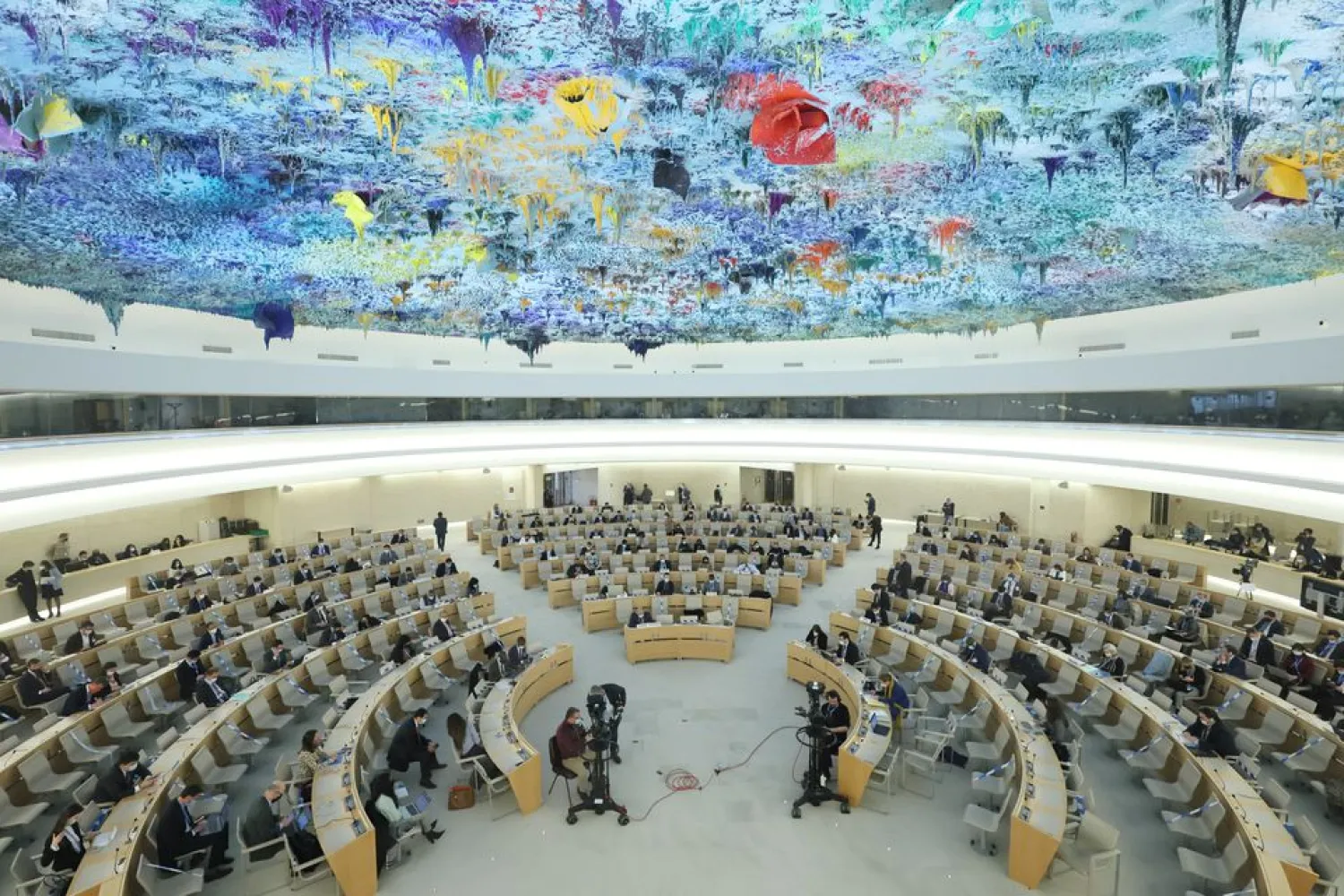
An overview of the special session on the situation in Ukraine of the Human Rights Council at the United Nations in Geneva, Switzerland, March 4, 2022. REUTERS/Denis Balibouse
TT

North Korea Says UN Human Rights Expert is 'US Puppet'

An overview of the special session on the situation in Ukraine of the Human Rights Council at the United Nations in Geneva, Switzerland, March 4, 2022. REUTERS/Denis Balibouse

Pyongyang on Friday accused the newly appointed UN special rapporteur on North Korean human rights of being a "puppet of the US" and making "unpardonable reckless remarks" against the regime.

The accusations came as the new rapporteur, Elizabeth Salmon, visited Seoul on her first trip since being appointed to the role last month, AFP said.

Salmon, a Peruvian professor of international law, has had a series of meetings with South Korean officials and civic group members to discuss the situation in the North since arriving earlier this week.

"We had already made clear our principled stand that we neither recognize nor deal with any 'special rapporteur' who is merely a puppet of the US", said an unnamed spokesman for North Korea's foreign ministry in an English statement carried by the official KCNA.

The spokesman said the rapporteur's activities were cover for an American smear campaign against the North, accusing Salmon of daring to make "unpardonable reckless remarks encroaching upon our inviolable system and sovereign rights".

"The UN should no longer allow its name and mission to be misused for the US hostile policy towards the DPRK," the spokesman added, using the acronym for the North's official name.

The statement referred to Salmon as "he" in an apparent mistake of her gender.

The UN established the special rapporteur on North Korean human rights in 2004 as international concerns grew over allegations of grave violations in the reclusive state.

None of the special envoys have been granted access to the country for a fact-finding mission.


Venezuela Approves US Military Flyover Drill

(FILES) The US flag flutters at the US embassy in Caracas on March 14, 2026, ten days after the restoration of diplomatic relations following the capture of ousted leader Nicolas Maduro in a US military raid. (Photo by Maryorin Mendez / AFP)
TT

Venezuela Approves US Military Flyover Drill

(FILES) The US flag flutters at the US embassy in Caracas on March 14, 2026, ten days after the restoration of diplomatic relations following the capture of ousted leader Nicolas Maduro in a US military raid. (Photo by Maryorin Mendez / AFP)

Venezuela said Thursday it had authorized the United States to perform a flyover of Caracas as part of an embassy evacuation drill -- a highly symbolic move five months after US airstrikes on the city.

“At the request of the Embassy of the United States of America, the authorities have authorized an evacuation drill to be held on Saturday, May 23, in preparation for potential medical emergencies or catastrophic events,” Foreign Minister Yvan Gil said.

“As part of the drill, two aircraft will conduct controlled flyovers of the city of Caracas and will land at the facilities of the Embassy of the United States of America,” he added in a statement on state television.

US forces typically use helicopters for evacuations.

The flyover will symbolize the dramatic shift in US-Venezuelan relations since the January 3 ousting of socialist president Nicolas Maduro by US forces.

Maduro's overthrow began with dawn airstrikes on Venezuela's air defenses and culminated with his capture at a military compound in Caracas.

He was flown to the United States where he was jailed pending his trial on drug and other charges.

His overthrow paved the way for a lightning rapprochement between Washington and Caracas.

The two countries restored ties on March 5, more than seven years after Maduro broke off relations.


Motjaba Khamenei Sets ‘Red Line’ on Sending Enriched Uranium Abroad

A woman walks next to a banner with a picture of Iran's new Supreme Leader Mojtaba Khamenei in Tehran, Iran, May 8, 2026. Majid Asgaripour/WANA (West Asia News Agency) via REUTERS
TT

Motjaba Khamenei Sets ‘Red Line’ on Sending Enriched Uranium Abroad

A woman walks next to a banner with a picture of Iran's new Supreme Leader Mojtaba Khamenei in Tehran, Iran, May 8, 2026. Majid Asgaripour/WANA (West Asia News Agency) via REUTERS

Iran's Supreme Leader has issued a directive that the country's near-weapons-grade uranium should not be sent abroad, two senior Iranian sources told Reuters on Thursday.

The directive sets an additional red line on one of the main US demands at peace talks, amid signs of a widening rift between Tehran and Washington over the future of Iran's nuclear program.

On Thursday, the Reuters report came shortly after Iran's foreign ministry spokesman Esmail Baghaei affirmed his country will not transfer uranium to any other state.

“Why should Iran move its material to another country?” he said. The spokesperson added that the US has proposed “several demands,” but Iran's nuclear program “has been and remains 100% peaceful,” Iranian media reported.

Mojtaba Khamenei's order could further frustrate US President Donald Trump and complicate talks on ending the US-Israeli war on Iran, according to Reuters.

Israeli officials have told the news agency that Trump has assured Israel that Iran's stockpile of highly enriched uranium, needed to make an atomic weapon, will be sent out of Iran and that any peace deal must include a clause on this.

Israel, the United States and other Western states have long accused Iran of seeking nuclear weapons, including pointing to its move to enrich uranium to 60%, far higher than needed for civilian uses and closer to the 90% needed for a weapon. Iran denies seeking nuclear weapons.

Israeli Prime Minister Benjamin Netanyahu has said he will not consider the war over until enriched uranium is removed from Iran, Tehran ends its support for ⁠proxy militias, and its ballistic missile capabilities are eliminated.

“The Supreme Leader’s directive, and the consensus within the establishment, is that the stockpile of enriched uranium should not leave the country,” said one of the two Iranian sources, who spoke on condition of anonymity because of the sensitivity of the matter.

Iran's top officials, the sources said, believe that sending the material abroad would leave the country more vulnerable to future attacks by the United States and Israel. Khamenei has the last say on the most important state matters.

The two sides have started to narrow some gaps, the sources said, but deeper splits remain over Tehran's nuclear program — including the fate of its enriched uranium stockpiles and Tehran's demand for recognition of its right to enrichment.

Iranian officials have repeatedly said Tehran’s priority is to secure a permanent end to the war and credible guarantees that the US and Israel will not launch further attacks.

Only after such assurances are in place, they said, would Iran be prepared to engage ⁠in detailed negotiations over its nuclear program.

Israel is widely believed to have an atomic arsenal but has never confirmed or denied it has nuclear weapons, maintaining a so-called policy of ambiguity on the issue for decades.

Before the war, Iran signaled willingness to ship out half of its stockpile of uranium which has been enriched to 60%, a level far higher than what is needed for civilian uses.

But sources said that position changed after repeated threats from Trump to strike Iran.

Israeli officials have told Reuters it is still unclear whether Trump will ⁠decide to attack and whether he would give Israel a green light to resume operations. Tehran has vowed a crushing response if attacked.

However, the source said there were “feasible formulas” to resolve the matter.

“There are solutions like diluting the stockpile under the supervision of the International Atomic Energy Agency,” one of the Iranian sources said.

The IAEA estimates that Iran had 440.9 kg of uranium enriched to 60% when Israel and the US attacked Iranian nuclear facilities in June 2025.

IAEA chief Rafael Grossi said in March that what remained of that stock was “mainly” stored in a tunnel complex in Iran's Isfahan nuclear facility, and that his agency believed slightly more than 200 kg of it was there. The IAEA also believes some is at the sprawling nuclear complex at Natanz, where Iran had two enrichment plants.

Iran says some highly enriched uranium is needed for medical purposes and for a research reactor in Tehran which runs on relatively small amounts of uranium enriched to around 20%.



US Voices Hope on Iran Deal Progress Before Pakistan Army Chief Visit

Secretary of State Marco Rubio speaks to the press before boarding his plane at Homestead Air Reserve Base, Thursday, May 21, 2026. Julia Demaree Nikhinson/Pool via REUTERS
TT

US Voices Hope on Iran Deal Progress Before Pakistan Army Chief Visit

Secretary of State Marco Rubio speaks to the press before boarding his plane at Homestead Air Reserve Base, Thursday, May 21, 2026. Julia Demaree Nikhinson/Pool via REUTERS

US Secretary of State Marco Rubio voiced hope on Thursday of progress on ending the war with Iran, with mediator Pakistan's army chief due to arrive in Iran for talks.

The expected visit by Field Marshal Asim Munir, a powerful figure with a growing role in Pakistan's foreign relations, comes a day after US President Donald Trump warned that negotiations to end the war were on the "borderline" between a deal and renewed strikes.

"I believe the Pakistanis will be travelling to Tehran today. So hopefully that'll advance this further," Rubio told reporters on Thursday, according to Reuters.

A ceasefire on April 8 halted the war launched weeks earlier by the US and Israel, but negotiation efforts have so far failed to yield a lasting peace agreement.

A war of words has taken the place of open conflict but the impasse continues to weigh on the world economy, leaving everyone from investors to farmers in a painful state of uncertainty.

On Thursday, Iran's ISNA news agency said Munir's visit was aimed at continuing "talks and consultations" with Iranian authorities, without providing details. Other Iranian media carried the same report.

Pakistan hosted in April the only direct negotiations between US and Iranian officials to take place since February 28, the day the war began.

Munir was at the center of the action during that round of talks, greeting both delegations on their arrival and displaying remarkable bonhomie with US Vice President JD Vance.

But the talks ultimately failed, with Iran accusing the US of making "excessive demands".

Since then, the two sides have exchanged multiple proposals, with the threat of renewed war looming all along.

"It's right on the borderline, believe me," Trump told reporters Wednesday. "If we don't get the right answers, it goes very quickly. We're all ready to go."

He said a deal could come "very quickly" or "in a few days", but warned Tehran would have to provide "100 percent good answers".

Rubio also criticized NATO allies for their refusal to help Trump's war against Iran.

"He's not asking them to commit troops. He's not asking them to send their fighter jets in. But they refuse to do anything," he said.

"We were very upset about that."

Tehran's chief negotiator Mohammad Bagher Ghalibaf on Wednesday accused Washington of seeking to restart the war, warning of a "forceful response" if Iran were to be attacked.

"The enemy's movements, both overt and clandestine, show that despite economic and political pressure, it has not abandoned its military objectives and is seeking to start a new war," Ghalibaf said.

Iran's foreign ministry spokesman Esmaeil Baqaei said Iran was examining points received from Washington, while repeating Tehran's demands for the release of its assets frozen abroad and an end to a US naval blockade.

Trump is under political pressure at home as energy costs rise.

The ceasefire halted the fighting but has not reopened the Strait of Hormuz, the vital waterway that normally carries about a fifth of the world's oil and liquefied natural gas.

The future of Hormuz remains a key sticking point in the negotiations, with fears growing that the global economy will feel more pain as pre-war oil stockpiles run down.

Iran imposed the blockade of Hormuz as part of its retaliation in the war, allowing only a trickle of vessels through in recent weeks while introducing a toll system.