


UN Atomic Watchdog: Iran Increases Uranium Stockpile Further

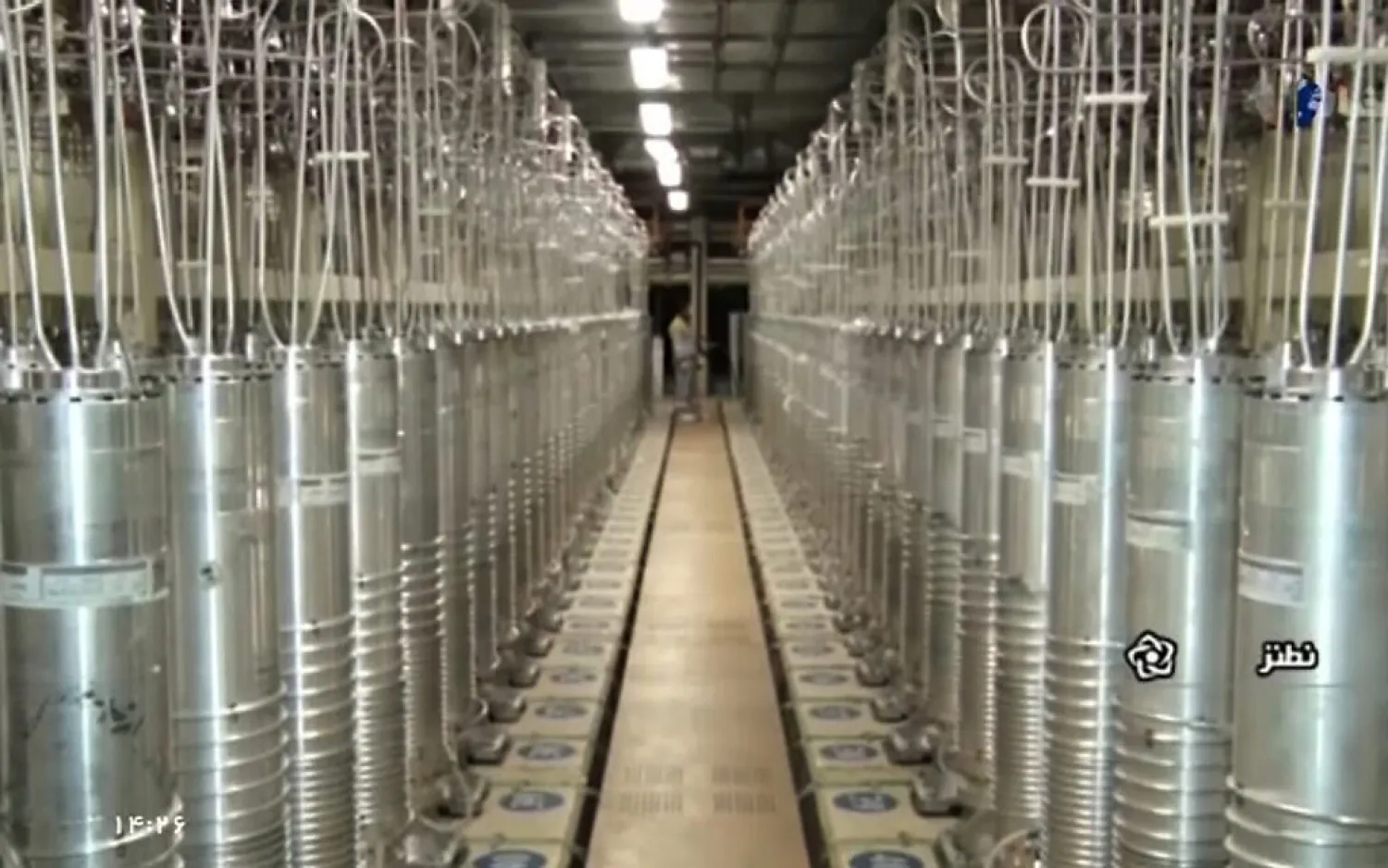
Various centrifuge machines line a hall at the Natanz Uranium Enrichment Facility, on April 17, 2021. (Screenshot/IRIB, via AP)
TT

UN Atomic Watchdog: Iran Increases Uranium Stockpile Further

Various centrifuge machines line a hall at the Natanz Uranium Enrichment Facility, on April 17, 2021. (Screenshot/IRIB, via AP)

The UN atomic watchdog said Wednesday it believes Iran has further increased its stockpile of uranium that is highly enriched to one short, technical step away from weapons-grade levels.

The International Atomic Energy Agency also voiced increasing concerns over Tehran's lack of engagement with a probe that has become a sticking point in efforts to revive Tehran’s nuclear deal with world powers.

In its confidential quarterly report, the IAEA told member nations that it believes Iran has an estimated 55.6 kilograms (122.6 pounds) of uranium enriched to up to 60% fissile purity, an increase of 12.5 kilograms since May.

That enrichment to 60% purity is one short, technical step away from weapons-grade levels of 90%. Nonproliferation experts have warned that Iran now has enough 60%-enriched uranium to reprocess into fuel for at least one nuclear bomb.

The IAEA report, which was seen by The Associated Press, also estimated that as of Aug. 21, Iran’s stockpile of all enriched uranium was at 3621.3 kilograms — an increase of 365.5 kilograms since the last quarterly report in May.

The Vienna-based IAEA said it was unable to verify the exact size of Iran’s stockpile of enriched uranium due to limitations that Tehran imposed on UN inspectors last year and the removal of the agency’s monitoring and surveillance equipment in June at sites in Iran.

While Iran long has maintained its program is peaceful, officials now openly discuss Tehran’s ability to seek an atomic bomb if it wanted.

The IAEA's assessment comes amid efforts to revive the 2015 nuclear deal, known as the Joint Comprehensive Plan of Action, which eased sanctions on Iran in return for curbs on its nuclear program.

The United States unilaterally pulled out of the accord in 2018 under then-President Donald Trump and reimposed sanctions on Iran, prompting Tehran to start backing away from the deal's terms.

Iran last week sent a written response in negotiations over a final draft of a roadmap for parties to return to the tattered nuclear deal, though the US cast doubt on Tehran’s offer. Neither side elaborated on the contents.

Were the deal to be renewed, the IAEA report said, the lack of surveillance and monitoring since IAEA cameras were removed in June would require “remedial action” to reestablish its knowledge of Iran's activities during this period.

In a separate report, IAEA officials said they are “increasingly concerned” that Iran has not engaged on the agency's probe into man-made uranium particles found at three undeclared sites in the country, which has become a key sticking point in the talks for a renewed deal.

Last week, Iran’s hard-line President Ebrahim Raisi maintained that the IAEA investigation into the issue must be halted in order for the 2015 deal to be renewed.

The IAEA has for years sought answers from Iran to its questions about the particles. US intelligence agencies, Western nations and the IAEA have said Iran ran an organized nuclear weapons program until 2003. Iran long has denied ever seeking nuclear weapons.

Iran was criticized by the IAEA’s board of governors, representing member states, in June over its failure to answer questions about the sites to the inspectors’ satisfaction.

Because Iran has not further engaged with the IAEA on the issue or offered “credible” explanations for the presence of these particles, the latest IAEA report said the agency “is not in a position to provide assurance that Iran's nuclear program is exclusively peaceful.”



Iran Says Redirects US-sanctioned Oil Tanker to Its Shores

FILE PHOTO: An aerial view of the Iranian shores and the island of Qeshm in the strait of Hormuz, December 10, 2023. REUTERS/Stringer/File Photo
TT

Iran Says Redirects US-sanctioned Oil Tanker to Its Shores

FILE PHOTO: An aerial view of the Iranian shores and the island of Qeshm in the strait of Hormuz, December 10, 2023. REUTERS/Stringer/File Photo

Iran said on Friday it redirected a US-sanctioned oil tanker carrying Iranian oil back to its shores, though it was unclear from its statement why it would have returned it, reported AFP.

"The Islamic Republic of Iran's navy, through a specially planned operation in the Sea of Oman, seized the offending tanker Ocean Koi," the army said in a statement carried by state television, adding that the oil belonged to Iran.

It said the ship was redirected to Iran's southern shores after it sought "to damage and disrupt Iran's oil exports," without elaborating.


Meloni Meets Rubio as Iran War Strains Italy-US Ties

US Secretary of State Marco Rubio leaves the San Damaso courtyard after meeting Pope Leo XIV at the Vatican, May 7, 2026. REUTERS/Yara Nardi
TT

Meloni Meets Rubio as Iran War Strains Italy-US Ties

US Secretary of State Marco Rubio leaves the San Damaso courtyard after meeting Pope Leo XIV at the Vatican, May 7, 2026. REUTERS/Yara Nardi

Italian Prime Minister Giorgia Meloni met US Secretary of State Marco Rubio on Friday at a moment of unusual strain between her government and President Donald Trump's administration, driven largely by the war with Iran.

Rubio is in Italy for a two-day trip aimed at easing ties with Pope Leo after unprecedented attacks on the pontiff by Trump, while also addressing Washington's frustration over Italy's refusal to support the US-Israeli war on Iran.

Meloni had been one of Trump's firmest supporters in Europe, cultivating close ties with him and presenting herself as a natural ‌bridge between Washington ‌and other EU states that had no natural political ‌affinity ⁠with the Republican ⁠US leader.

But that alignment has come under increasing strain in recent months, as the Iran war has forced her to balance loyalty to the United States against Italian public animosity to the war and the growing economic cost of the conflict.

Before heading to the prime minister's office, Rubio met Italy's Foreign Minister Antonio Tajani, who said the talks had been positive.

"I am convinced ⁠that Europe needs America, Italy needs America, but the United ‌States also needs Europe and Italy," Tajani ‌told reporters.

Meloni and Rubio were expected to discuss the situation in the Gulf, as ‌well as Russia's war on Ukraine, US tariffs on European goods and ‌the outlook for Cuba, which Washington is seeking to isolate both diplomatically and economically.

TRUMP'S ATTACKS ON POPE

The Italians will also be keen for a readout on Rubio's meetings at the Vatican. Trump's recent attacks on Pope Leo crossed a sensitive ‌line in overwhelmingly Catholic Italy and prompted Meloni to call them "unacceptable."

Her criticism in turn drew a sharp rebuke ⁠from Trump, who said ⁠she lacked courage and had let Washington down. He subsequently threatened to withdraw US troops from Italy.

Meloni said on Monday she would not support such a move, but acknowledged that the decision "doesn't depend on me".

Italy last month refused to allow US aircraft to use the Sigonella air base in Sicily for combat operations linked to the Iran conflict. Italian officials have said Washington had not sought prior authorization from Rome for the use of the site.

Defense Minister Guido Crosetto, a close Meloni ally, later warned that the Iran war was putting US global leadership at risk and said he feared the "madness" of nuclear escalation.

Pollsters say Meloni's ties to Trump could prove a potential liability with voters ahead of national elections due next year.


Trump Says Ceasefire Still Holds after Fighting Between the US and Iran Flares

US President Donald Trump looks on as he speaks to reporters near the Lincoln Memorial Reflecting Pool as it undergoes renovations, in Washington, D.C., US, May 7, 2026. REUTERS/Kylie Cooper
TT

Trump Says Ceasefire Still Holds after Fighting Between the US and Iran Flares

US President Donald Trump looks on as he speaks to reporters near the Lincoln Memorial Reflecting Pool as it undergoes renovations, in Washington, D.C., US, May 7, 2026. REUTERS/Kylie Cooper

US and Iranian forces clashed in the Gulf, but President Donald Trump said a ceasefire was still holding despite the flare-up, which dented hopes for a swift diplomatic resolution to the crisis.

The escalation came as Washington awaited Tehran's response to a US proposal to end the war, which began on February 28 when the US and Israel launched airstrikes on Iran.

Trump said on Thursday three US Navy destroyers were attacked as they moved through the Strait of Hormuz, a conduit for around a fifth of the world's oil and liquefied natural gas flows that Iran has all but closed since the conflict began.

"Three World Class American Destroyers just transited, very successfully, out of the Strait of Hormuz, under fire. There was no damage done to the three Destroyers, but great damage done to the Iranian attackers," Trump wrote on Truth Social.

He later told reporters the ceasefire remained in effect and played down the exchange.

"They trifled with us today. We blew them away," Trump said in Washington.

Iran, however, accused the United ⁠States of breaching ⁠the ceasefire, an agreement that has been punctuated by intermittent clashes since it was announced on April 7.

Iran's top joint military command said US forces had targeted an Iranian oil tanker and another ship, and carried out air attacks on civilian areas on Qeshm Island in the Strait of Hormuz and nearby coastal areas. It said Iranian forces responded by attacking US military vessels east of the strait and south of the port of Chabahar.

A spokesperson for Iran's Khatam al-Anbiya Central Headquarters said the Iranian strikes inflicted "significant damage," but US Central Command said none of its assets were hit.

Iranian state media later signaled a de-escalation, with Press TV reporting that, after several hours of exchanges, "the situation on Iranian islands and coastal cities by the Strait of Hormuz is back to normal now."