


Countries Growing 70% of World's Food Face 'Extreme' Heat Risk by 2045

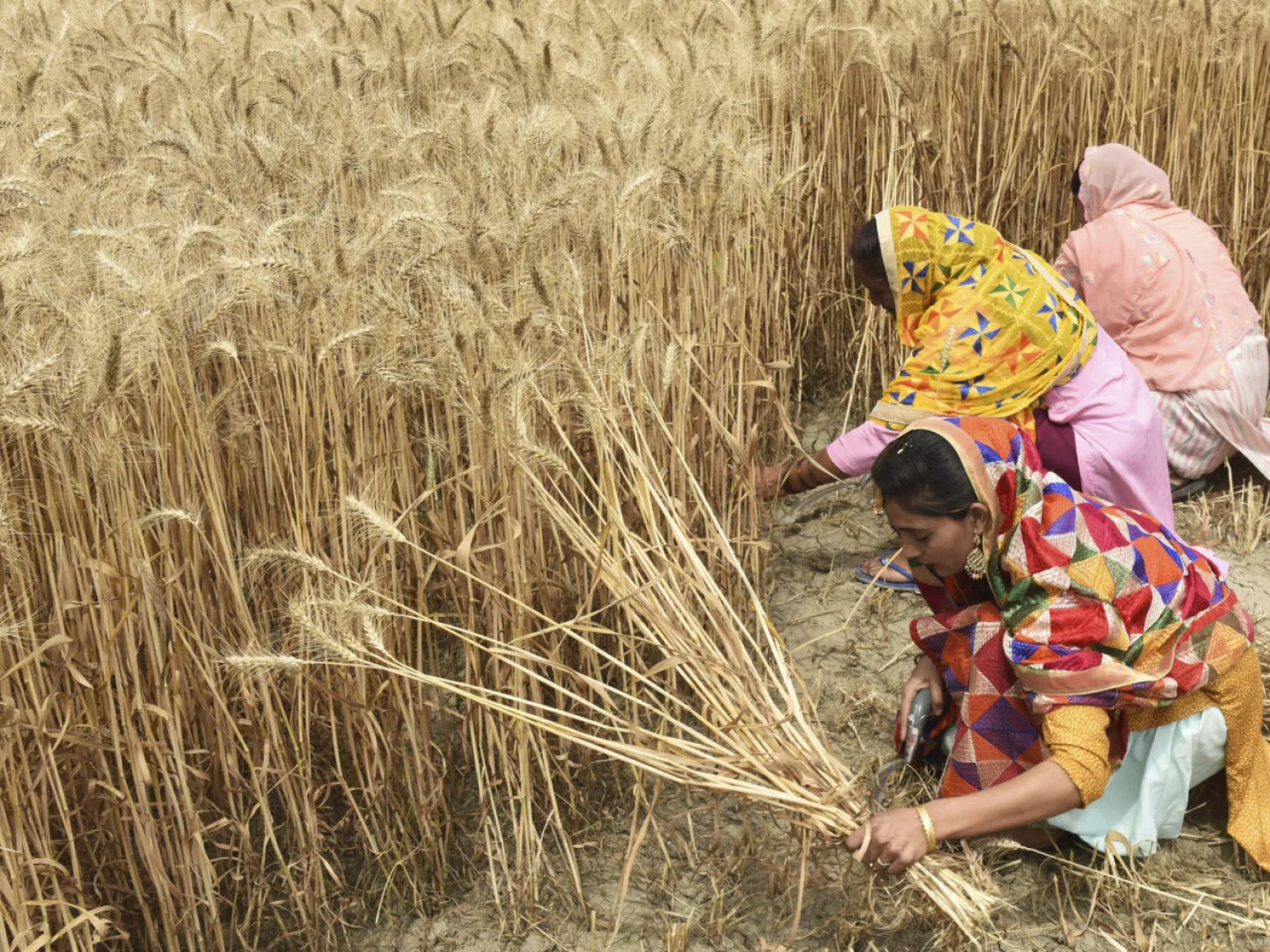
Record temperatures earlier this year hit India's wheat production NARINDER NANU AFP/File
TT

Countries Growing 70% of World's Food Face 'Extreme' Heat Risk by 2045

Record temperatures earlier this year hit India's wheat production NARINDER NANU AFP/File

Blistering crop-withering temperatures that also risk the health of agricultural workers could threaten swathes of global food production by 2045 as the world warms, an industry analysis warned Thursday.

Climate change is already stoking heatwaves and other extreme weather events across the world, with hot spells from India to Europe this year expected to hit crop yields, AFP said.

Temperature spikes are causing mounting concern for health, particularly for those working outside in sweltering conditions, which is especially dangerous when humidity levels are high.

The latest assessment by risk company Verisk Maplecroft brings those two threats together to calculate that heat stress already poses an "extreme risk" to agriculture in 20 countries, including agricultural giant India.

But the coming decades are expected to expand the threat to 64 nations by 2045 -- representing 71 percent of current global food production -- including major economies China, India, Brazil and the United States.

"With the rise in global temperatures and rise in global heat stress, we're going to see crops in more temperate countries as well start being affected by this," said Will Nichols, head of climate and resilience at Verisk Maplecroft.

Rice is particularly at risk, the assessment said, with other crops like cocoa and even tomatoes also singled out as of concern.

- Growing risk -
Maplecroft's new heat stress dataset, using global temperature data from the UK Met Office, feeds into its wider risk assessments of countries around the world.

It is based on a worst-case emissions scenario leading to around 2 degrees Celsius of warming above pre-industrial levels as soon as 2045.

However, the authors stress that in projections to mid-century, even scenarios that assume higher levels of carbon-cutting action could still result in temperatures nearing 2C.

India -- responsible for 12 percent of global food production in 2020 and heavily reliant on outdoor labor productivity -- is already rated as at extreme risk, the only major agricultural nation in that category at current temperatures.

"There's a very real worry that people in rural areas, which are obviously highly dependent on agriculture, are going to be much more vulnerable to these kinds of heat events going forward," Nichols told AFP.

That could impact productivity and in turn exports -- and have potentially "cascading" knock-on effects on issues such as the country's credit rating and even political stability, he said.

By 2045, the list grows much longer.

Nine of the top ten countries affected in 2045 are in Africa, with the world's second largest cocoa producer Ghana, as well as Togo and Central African Republic receiving the worst possible risk score.

The top 20 at-risk countries in the coming decades include key Southeast Asian rice exporters Cambodia, Thailand and Vietnam, the authors said, noting that rice farmers in central Vietnam have already taken to working at night to avoid the high temperatures.

The assessment highlights that major economies like the US and China could also see extreme risk to agriculture in 2045, although in these large countries the impacts vary by region.

Meanwhile, Europe accounts for seven of the 10 countries set to see the largest increase in risk by 2045.

"I think what it reinforces is that, even though a lot of us are sort of sitting in sort of Western countries, where we might think we're a bit more insulated from some of these threats, actually we are not necessarily," Nichols said.

"Both in terms of the sort of physical risks that we're facing, but also in terms of the kind of knock on effects down the supply chain."



Nepal Halts Search after Guide Killed, Iranian Climber Missing

A tourist looks at a view of Mt. Everest from the hills of Syangboche in Nepal December 3, 2009. REUTERS/Gopal Chitrakar
TT

Nepal Halts Search after Guide Killed, Iranian Climber Missing

A tourist looks at a view of Mt. Everest from the hills of Syangboche in Nepal December 3, 2009. REUTERS/Gopal Chitrakar

Bad weather forced Nepali rescuers to suspend the search Monday for an Iranian climber missing for four days after an accident which killed a Nepali team member, expedition organizers said.

Extreme conditions, including fierce winds, made rescue efforts impossible on the 8,481-meter (27,825-feet) high Mount Makalu, the world's fifth highest mountain.

Iranian climber Abolfazl Gozali, 42, and Nepali guide Phurba Ongel Sherpa, 44, were part of a rare winter expedition on the peak.

The four-member team successfully summited on Thursday, but during the descent the guide fell to his death.

Team lead Sanu Sherpa, who has climbed all 14 highest peaks in the world at least twice, and Lakpa Rinji Sherpa went to his aid but found that he had fallen hundreds of meters and did not survive.

When they returned to where they had left Gozali, he was no longer there.

"A team of eight experienced climbers have been sent but the wind has been very strong and affected the search," Madan Lamsal of expedition organizer Makalu Adventure told AFP.

"We hope to resume soon."

Lamsal said the rescuers intend to find Gozali, as well as recover the guide's body.

Phurba Ongel Sherpa was a highly experienced mountaineering guide with multiple summits of Everest and other major peaks.

Gozali is also an accomplished climber, who has climbed two of world's highest peaks and completed the "snow-leopard peaks" -- the five mountains of over 7,000 meters between Tajikistan and Kyrgyzstan.

This was his second attempt to summit Makalu in winter. Last year, freezing temperatures and high winds forced the team to turn back, just 800 meters short of the summit.

Nepal is home to eight of the world's 10 highest peaks, including Mount Everest, and welcomes hundreds of climbers every year during the spring and autumn climbing seasons.

Dangerous terrain and extreme weather can make winter expeditions particularly risky.


Shark Mauls Surfer in Sydney, 3rd Attack in Two Days

People stand next to warning signs in place, and beaches are closed after a surfer suffered a shark attack at Dee Why Beach in Sydney, Australia, January 19, 2026. REUTERS/Jeremy Piper
TT

Shark Mauls Surfer in Sydney, 3rd Attack in Two Days

People stand next to warning signs in place, and beaches are closed after a surfer suffered a shark attack at Dee Why Beach in Sydney, Australia, January 19, 2026. REUTERS/Jeremy Piper

A shark mauled a surfer off an ocean beach in Sydney on Monday in the Australian city's third shark attack in two days, authorities said.

The surfer, believed to be in his 20s, was in a critical condition in hospital with serious leg injuries after the attack at a northern Sydney beach, police said.

"The man was pulled from the water by members of the public who commenced first aid before the arrival of emergency services," New South Wales state police said in a statement.

All of Sydney's northern beaches were closed until further notice.

The attack at North Steyne Beach in the suburb of Manly came hours after a shark bit a large chunk out of a young surfer's board about 4 kilometers (2.5 miles) north along the coast at Dee Why Point.

That surfer, reportedly a boy aged about 11, was uninjured but the beach was closed immediately, AFP reported.

On Sunday, a large shark bit a 12-year-old boy in the legs as he played with friends at a beach in Sydney harbor, leaving him fighting for survival in hospital.

The boy and his friends were jumping from a six-meter (20-foot) rock into the water off Shark Beach in the eastern suburb of Vaucluse when the predator struck, police said.

"It was a horrendous scene at the time when police attended. We believe it was something like a bull shark that attacked the lower limbs of that boy," said Superintendent Joseph McNulty, New South Wales marine area police commander.

"That boy is fighting for his life now," he told reporters on Monday.

Recent heavy rain had drained into the harbor, and authorities believed the combination of the brackish seawater and the children's splashing created a "perfect storm" for a shark attack, McNulty said.

He warned people not to go swimming in the harbor or other river systems in New South Wales because of the risks.

He praised the boy's "brave" young friends for pulling him out of the water on Sunday.

Officers put the unconscious child in a police boat and gave him first aid, applying two tourniquets to stem the bleeding from his legs, McNulty said.

They tried to resuscitate the boy as they sped across the harbor to a wharf where ambulance paramedics were waiting.

The child, confirmed by police to be 12 years old, was in intensive care at Sydney Children's Hospital surrounded by family and friends, McNulty said.


China’s Population Falls Again as Births Drop to Lowest Rate Since 1949 Communist Revolution

 Women push baby strollers as they walk along a street in Beijing on January 4, 2026. (AFP)
Women push baby strollers as they walk along a street in Beijing on January 4, 2026. (AFP)
TT

China’s Population Falls Again as Births Drop to Lowest Rate Since 1949 Communist Revolution

 Women push baby strollers as they walk along a street in Beijing on January 4, 2026. (AFP)
Women push baby strollers as they walk along a street in Beijing on January 4, 2026. (AFP)

How do you persuade a population to have more babies after generations of limiting families to just one?

A decade after ending China's longtime one-child policy, authorities are pushing a range of ideas and policies to try and encourage more births — tactics that range from cash subsidies to taxing condoms to eliminating a tax on matchmakers and day care centers.

The efforts haven't paid off yet. At least, that's what population figures released Monday show for what is now the world's second-most populous nation. China's population of 1.4 billion continued to shrink, marking the fourth straight year of decrease, new government statistics show. The total population in 2025 stood at 1.404 billion, which was 3 million less than the previous year.

Measured another way, the birth rate in 2025 is the lowest on record since 1949, the year that Mao Zedong’s Communists overthrew the Nationalists and began running China. Figures before that, under the previous Nationalist government, were not available. The rate of 5.63% is the number of births per 1,000 people.

China was long the world’s most populous nation until 2023, when it was surpassed by regional neighbor and sometime rival India. Monday's statistics illustrate the stark demographic pressures faced by the country as it tries to pivot from a problem it is working hard to overcome: status as a nation with a growing but transitional economy that, as is often said, is “getting old before it gets rich.”

Is a snake involved? The number of new babies born was just 7.92 million in 2025, a decline of 1.62 million, or 17%. The latest birth numbers show that the slight tick upwards in 2024 was not a lasting trend. Births declined for seven years in a row through 2023.

Most families cite the costs and pressure of raising a child in a highly competitive society as significant hurdles that now loom larger in the face of an economic downturn that has impacted households struggling to meet their living costs. Another potential factor in the numbers: last year in China was the year of the snake, considered one of the least favored years for having a child under the Chinese zodiac.

Like many other countries in Asia, China has faced a declining fertility rate, or the average number of babies a woman is expected to have in her lifetime. While the government does not regularly publish a fertility rate, last saying it was 1.3 in 2020, experts have estimated it is now around 1. Both figures are far below the 2.1 rate that would maintain the size of China's population.

For decades, the Chinese government barred people from having more than one baby and often sanctioned those who did — a policy that produced more than two generations of only children. In 2015, the government raised the permitted amount of offspring to two and then, facing demographic pressure, further revised the limit to three kids in 2021.

The push for more births is about the economy. China now has 323 million people over 60, or 23% of the entire population. That number has continued to rise, while the working-age population is shrinking, meaning there are fewer workers to support the older population.

This demographic shift is happening while China is in the process of trying to transition away from labor-intensive industries like farming and manufacturing into a consumer-driven economy built with high-tech manufacturing. The difficulty is in trying to get richer as a country, while this population shift likely means a slowing economy.

Officials have had limited success with policy changes to incentivize families to have more children. In July, the government announced cash subsidies of 3,600 yuan ($500) per child to families.