


Ukraine’s Zelenskyy Visits Recently Retaken Strategic City

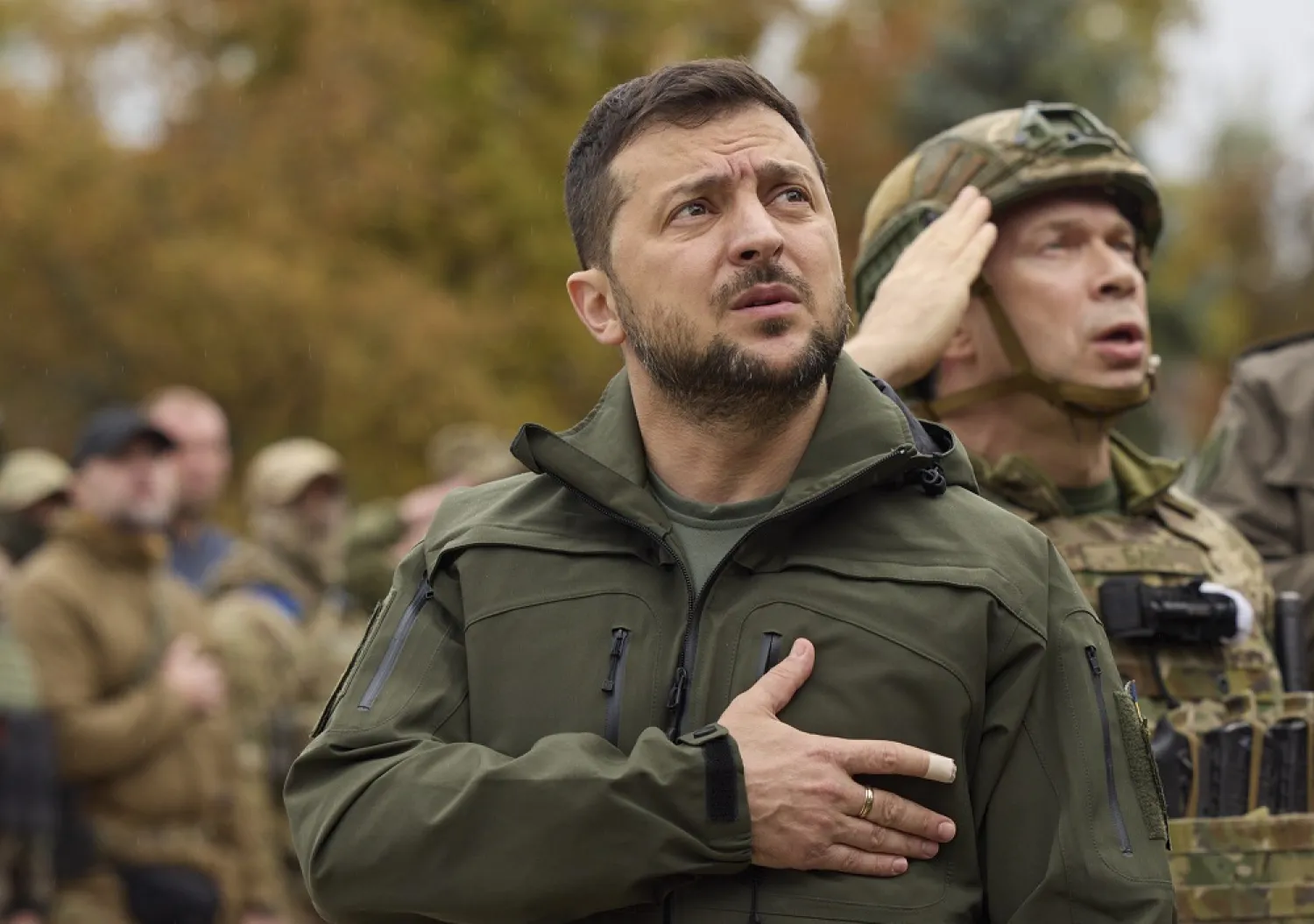
In this photo provided by the Ukrainian Presidential Press Office, Ukrainian President Volodymyr Zelenskyy, center, sings the Ukrainian national anthem during his visit to the city of Izium, Kharkiv region, Ukraine, Wednesday, Sept. 14, 2022. (Ukrainian Presidential Press Office via AP)
TT

Ukraine’s Zelenskyy Visits Recently Retaken Strategic City

In this photo provided by the Ukrainian Presidential Press Office, Ukrainian President Volodymyr Zelenskyy, center, sings the Ukrainian national anthem during his visit to the city of Izium, Kharkiv region, Ukraine, Wednesday, Sept. 14, 2022. (Ukrainian Presidential Press Office via AP)

Hand on heart, Ukrainian President Volodymyr Zelenskyy watched his country’s flag rise Wednesday above the recaptured city of Izium, making a rare foray outside the capital while highlighting Moscow’s embarrassing retreat from a Ukrainian counteroffensive.

Russian forces left the war-scarred city last week as Kyiv's soldiers pressed a stunning advance that has reclaimed large swaths of territory in Ukraine’s northeastern Kharkiv region.

As Zelenskyy looked on and sang the national anthem, the Ukrainian flag was raised in front of the burned-out city hall building. After almost six months under Russian occupation, Izium was left largely devastated, with apartment buildings blackened by fire and pockmarked by artillery strikes.

A gaping hole and piles of rubble stood where one building had collapsed.

“The view is very shocking, but it is not shocking for me,” Zelenskyy said in brief comments to the journalists, “because we began to see the same pictures from Bucha, from the first de-occupied territories … the same destroyed buildings, killed people.”

Bucha is a small city on the outskirts of Kyiv that Russian forces withdrew from in March. In the aftermath, Ukrainian authorities discovered the bodies of hundreds of civilians dumped in streets, yards and mass graves. Many bore signs of torture.

Prosecutors said they so far have found six bodies with traces of torture in recently retaken Kharkiv region villages. The head of the Kharkiv prosecutor’s office, Oleksandr Filchakov, said bodies were found in Hrakove and Zaliznyche, villages around 60 kilometers (35 miles) southeast of Kharkiv city.

“We have a terrible picture of what the occupiers did. ... Such cities as Balakliia, Izium, are standing in the same row as Bucha, Borodyanka, Irpin,” said Ukrainian Prosecutor General Andriy Kostin, listing the names of places where the Ukrainians have alleged Russian forces committed atrocities.

Local authorities have made similar claims in other areas previously held by Russia, but it was not immediately possible to verify their information. They have not yet provided evidence of potential atrocities on the scale described in Bucha, where the number and conditions of civilian casualties prompted demands for Russian officials to face war crime charges.

Moscow’s recent rout in northeast Ukraine was its largest military defeat since the withdrawal of Russian troops from areas around Kyiv, the Ukrainian capital. On the northern outskirts of Izium, the remains of Russian tanks and vehicles lay shattered along the road.

As Zelenskyy visited, his forces pressed their counteroffensive, demined liberated territory and investigated possible war crimes. He said that as Ukrainian soldiers retake occupied villages, “the life comes back.”

The Ukrainian governor of the eastern Luhansk region, Serhiy Haidai, said Ukrainian forces were preparing to retake the region, most of which has been under Russian control since July and which borders the Kharkiv region.

He told The Associated Press that Ukrainian guerrilla forces were flying Ukrainian flags in the cities of Svatove and Starobilsk.

But in Kreminna, another city where Ukrainians raised their flag, Russians returned Wednesday and “tore down the (Ukrainian) flags and are demonstrably showing that they’re there,” Haidai said.

A separatist military leader confirmed the Ukrainian advance on the Luhansk region. Andrei Marochko, a local militia officer, said on Russian TV that the situation was “really difficult.”

“In some places, the contact line has come very close to the borders of the Luhansk People’s Republic,” Marochko said, referring to the independent state the separatists declared eight years ago.

US President Joe Biden observed Wednesday that Ukrainian forces have made “significant progress” in recent days but said, "I think it’s going to be a long haul.”

In the wake of the recent gains, a new front line has started to emerge along the Oskil River, which largely traces the eastern edge of the Kharkiv region, a Washington-based think tank, the Institute for the Study of War, said Wednesday.

“Russian troops are unlikely to be strong enough to prevent further Ukrainian advances along the entire Oskil River because they do not appear to be receiving reinforcements, and Ukrainian troops will likely be able to exploit this weakness to resume the counteroffensive across the Oskil if they choose," the institute said.

The counteroffensive has also left more weapons in Ukrainian hands.

Russian forces likely left behind dozens of tanks, armored personnel carriers and other heavy weaponry as they fled Ukraine’s advance in the east of the country, a Ukrainian think tank said Wednesday.

The Center for Defense Strategies said one single Russian unit that was around Izium left behind more than three dozen T-80 tanks and about as many infantry fighting vehicles known by the acronym BMP. Another unit left behind 47 tanks and 27 armored vehicles.

The center said Russian forces tried to destroy some of the abandoned vehicles through artillery strikes as they fell back. Typically, armed forces destroy equipment left behind so their opponent can’t use it.

However, the chaos of the Russian withdrawal apparently saw them leave untouched ammunition and weapons behind.

In other areas, Russia continued its attacks, causing the death toll to keep rising in a war that has dragged on for nearly seven months.

Russian shelling of seven Ukrainian regions over the past 24 hours killed at least seven civilians and wounded 22 more, Ukraine’s presidential office reported Wednesday morning.

Two people were killed and three wounded after Russia attacked Mykolaiv with S-300 missiles overnight, said regional governor Vitaliy Kim. Settlements near the front line in Mykolaiv region remain under constant fire.

The Nikopol area, which is across a river from the shut down Zaporizhzhia Nuclear Power Plant, was shelled three times during the night, but no injuries were immediately reported, regional governor Valentyn Reznichenko said.

In the Luhansk region, where some of the Russian troops went after retreating from the Kharkiv region, mobile internet service was down, according to Haidai, and intense shelling of Ukrainian forces continued.

Fighting also raged on in the neighboring Donetsk region, where shelling killed five civilians and wounded 16 more. Together, Luhansk and Donetsk make up the Donbas region.

“Every night in Donbas is restless. The civilians should leave the region. It’s a matter of life and death,” Donetsk governor Pavlo Kyrylenko said.



Iran Says No Country Can Deprive it of Enrichment Rights

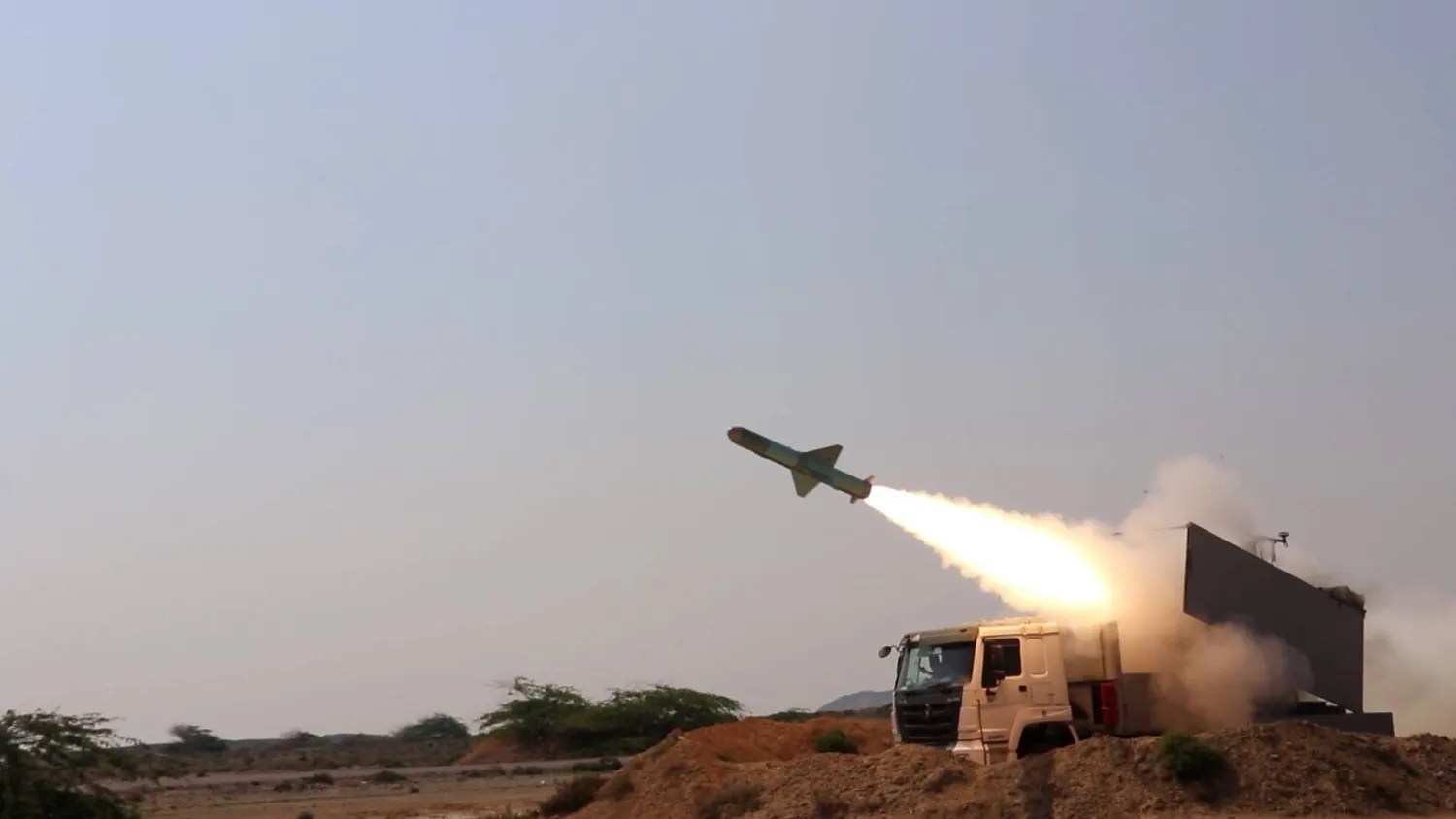
A handout photo made available by Iran's Revolutionary Guard Corps (IRGC)'s official website Sepahnews on 17 February 2026 shows IRGC conducting a military drill in the Strait of Hormuz, in the Arabian gulf, southern Iran. EPA/SEPAHNEWS HANDOUT
TT

Iran Says No Country Can Deprive it of Enrichment Rights

A handout photo made available by Iran's Revolutionary Guard Corps (IRGC)'s official website Sepahnews on 17 February 2026 shows IRGC conducting a military drill in the Strait of Hormuz, in the Arabian gulf, southern Iran. EPA/SEPAHNEWS HANDOUT

Iran's atomic energy chief Mohammad Eslami said no country can deprive the Iranian republic of its right to nuclear enrichment, after US President Donald Trump again hinted at military action following talks in Geneva.

"The basis of the nuclear industry is enrichment. Whatever you want to do in the nuclear process, you need nuclear fuel," said Eslami, according to a video published by Etemad daily on Thursday.

"Iran's nuclear program is proceeding according to the rules of the International Atomic Energy Agency, and no country can deprive Iran of the right to peacefully benefit from this technology."

The comments follow the second round of Oman-mediated talks between Tehran and Washington in Geneva on Tuesday.

The two foes had held an initial round of discussions on February 6 in Oman, the first since previous talks collapsed during the 12-day Iran-Israel war in June.

The United States briefly joined the war alongside Israel, striking Iranian nuclear facilities.

On Wednesday, Trump again suggested the United States might strike Iran in a post on his Truth Social site.

He warned Britain against giving up sovereignty over the Chagos Islands in the Indian Ocean, saying that the archipelago's Diego Garcia airbase might be needed were Iran not to agree a deal, "in order to eradicate a potential attack by a highly unstable and dangerous regime".

Washington has repeatedly called for zero enrichment, but has also sought to address Iran's ballistic missile program and its support for militant groups in the region -- issues which Israel has pushed to include in the talks.

Western countries accuse the Iranian republic of seeking to acquire nuclear weapons.

Tehran denies having such military ambitions but insists on its right to this technology for civilian purposes.

Trump, who has ratcheted up pressure on Iran to reach an agreement, has deployed a significant naval force to the region, which he has described as an "armada".

After sending the aircraft carrier USS Abraham Lincoln and escort battleships to the Gulf in January, he recently indicated that a second aircraft carrier, the Gerald Ford, would depart "very soon" for the Middle East.

Separately, the Iranian and Russian navies were conducting joint drills in the Sea of Oman and the northern Indian Ocean on Thursday.


Karachi Building Collapse after Blast Kills 16

Rescue workers and people gather at the site of a residential compound following a suspected gas leakage blast in Karachi, Pakistan, 19 February 2026. EPA/REHAN KHAN
TT

Karachi Building Collapse after Blast Kills 16

Rescue workers and people gather at the site of a residential compound following a suspected gas leakage blast in Karachi, Pakistan, 19 February 2026. EPA/REHAN KHAN

A building collapse caused by an explosion in Pakistan's southern megacity of Karachi killed at least 16 people on Thursday, including children, officials said.

More than a dozen people were injured in the incident in the Soldier Bazaar neighborhood of Karachi at around 4:00 am, when Muslim families start preparing Sehri, the pre-sunrise meal eaten during Ramadan.


Australian Police Investigate Threatening Letter to Country's Largest Mosque

FILE PHOTO: A security guard stands outside the Lakemba Imam Ali bin Abi Talib Mosque as people arrive for Friday prayers in Sydney, Australia, December 19, 2025. REUTERS/Hollie Adams/File Photo
TT

Australian Police Investigate Threatening Letter to Country's Largest Mosque

FILE PHOTO: A security guard stands outside the Lakemba Imam Ali bin Abi Talib Mosque as people arrive for Friday prayers in Sydney, Australia, December 19, 2025. REUTERS/Hollie Adams/File Photo

Australian police said on Thursday they had launched an investigation after a threatening letter was sent to the country’s largest mosque, the third such incident in the lead-up to the Muslim fasting month of Ramadan.

The letter sent to Lakemba Mosque in Sydney’s west on Wednesday contained a drawing of a pig and a threat to kill the "Muslim race", local media reported. Police said they had taken the letter for forensic testing, and would continue to patrol ‌religious sites including ‌the mosque, as well as community events.

The latest letter ‌comes ⁠weeks after a ⁠similar message was mailed to the mosque, depicting Muslim people inside a mosque on fire.

Police have also arrested and charged a 70-year-old man in connection with a third threatening letter sent to Lakemba Mosque's staff in January.

The Lebanese Muslim Association, which runs the mosque, told the Australian Broadcasting Corp (ABC) it had written to the government to request more funding for additional security guards and ⁠CCTV cameras.

Some 5,000 people are expected to attend ‌the mosque each night during Ramadan. More ‌than 60% of residents in the suburb of Lakemba identify as Muslim, according to ‌the Australian Bureau of Statistics.

Bilal El-Hayek, mayor of Canterbury-Bankstown council, where Lakemba ‌is located, said the community was feeling "very anxious".

"I've heard first-hand from people saying that they won't be sending their kids to practice this Ramadan because they're very concerned about things that might happen in local mosques," AFP quoted him as saying.

Prime Minister Anthony Albanese ‌condemned the recent string of threats.

"It is outrageous that people just going about commemorating their faith, particularly during the ⁠holy month ⁠for Muslims of Ramadan, are subject to this sort of intimidation," he told ABC radio.

"I have said repeatedly we need to turn down the temperature of political discourse in this country, and we certainly need to do that."

Anti-Muslim sentiment has been growing in Australia since the war in Gaza War in late 2023, according to a recent report commissioned by the government.

The Islamophobia Register Australia has also documented a 740% rise in reports following the Bondi mass shooting on December 14, where authorities allege two gunmen inspired by ISIS killed 15 people attending a Jewish holiday celebration.

"There's been a massive increase post-Bondi," Mayor El-Hayek said. "Without a doubt, this is the worst I have ever seen it. There's a lot of tension out there."