Morocco, Kuwait Discuss Judicial Cooperation

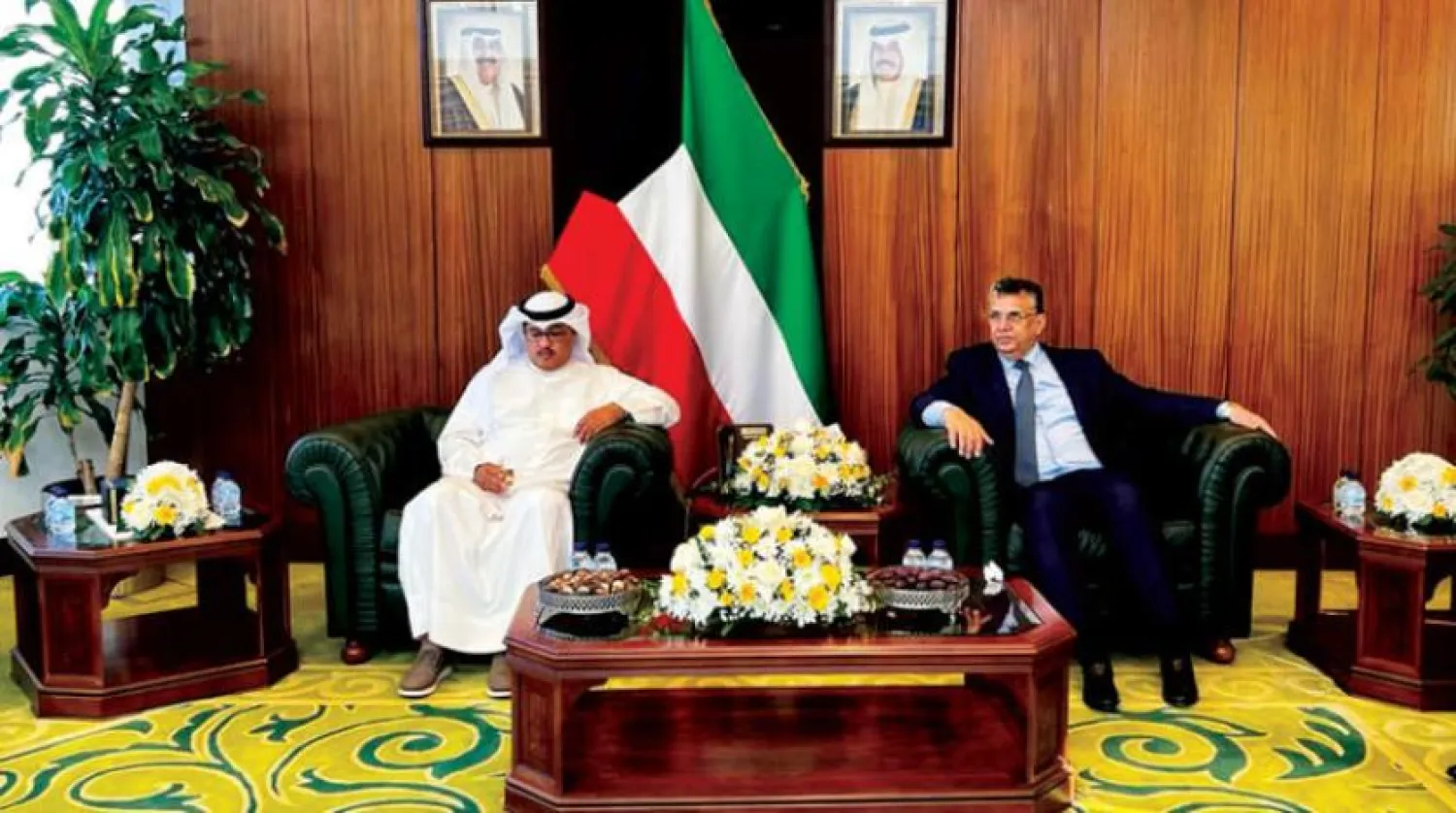
 Minister of Justice Abdellatif Ouahbi holds a meeting Monday in Kuwait with his Kuwaiti counterpart Jamal Hadhel Salem Al-Jalawi (Asharq Al-Awsat)
Minister of Justice Abdellatif Ouahbi holds a meeting Monday in Kuwait with his Kuwaiti counterpart Jamal Hadhel Salem Al-Jalawi (Asharq Al-Awsat)
TT

Morocco, Kuwait Discuss Judicial Cooperation

 Minister of Justice Abdellatif Ouahbi holds a meeting Monday in Kuwait with his Kuwaiti counterpart Jamal Hadhel Salem Al-Jalawi (Asharq Al-Awsat)
Minister of Justice Abdellatif Ouahbi holds a meeting Monday in Kuwait with his Kuwaiti counterpart Jamal Hadhel Salem Al-Jalawi (Asharq Al-Awsat)

Morocco's Minister of Justice Abdellatif Ouahbi held on Monday in Kuwait talks with his Kuwaiti counterpart Jamal Hadhel Salem Al-Jalawi.

During the meeting, Ouahbi highlighted the Moroccan experience in the field of justice at the levels of legislation, infrastructure, digitization, training and future plans.

Ouahbi stressed the importance of cooperation to achieve the development of the experience of both countries in the field of justice.

For his part, Al-Jalawi also highlighted Kuwait’s pioneering experience in the justice sector, affirming both sides shared desire to strengthen cooperation in this field.

Morocco and Kuwait hailed the excellent political relations between the two countries, which have been reflected positively on economic cooperation and investment.


Netanyahu Seeks Alternatives to Control over Palestinian Antiquities

One of the historic Solomon’s Pools in Bethlehem, which Israeli Finance Minister Bezalal Smotrich has vowed to take control of. (Bethlehem Municipality)
TT

Netanyahu Seeks Alternatives to Control over Palestinian Antiquities

One of the historic Solomon’s Pools in Bethlehem, which Israeli Finance Minister Bezalal Smotrich has vowed to take control of. (Bethlehem Municipality)

Israeli Prime Minister Benjamin Netanyahu has ordered a comprehensive review of a controversial Antiquities Authority bill for the West Bank and Gaza Strip, and instructed Cabinet Secretary Yossi Fuchs to look for “alternatives” to the draft law, which is now being debated by the Knesset Education Committee, after security and professional bodies warned of “serious international damage.”

Hebrew media outlets quoted Israeli sources on Tuesday as saying Netanyahu was effectively obstructing the bill because it threatens Israel’s foreign relations, making the chances of passing any version of it before the current Knesset is dissolved “slim.”

Netanyahu’s position followed warnings from legal and security officials against the law, which establishes a “civil heritage authority” in the West Bank and Gaza Strip.

The Knesset plenum approved the bill in its first reading this month. The legislation would give the Antiquities Authority, once established, absolute authority over archaeological sites in the occupied West Bank. The scope was later expanded to include the Gaza Strip.

Palestinian antiquities under an Israeli minister

The bill, submitted by Likud lawmaker Amit Halevi, whose party is led by Netanyahu, calls for establishing an “Antiquities Authority” under the responsibility of Israel’s “heritage minister.”

It would be “fully responsible for handling all heritage and antiquities affairs in the area,” with powers including land confiscation, archaeological excavations and their management, and law enforcement. The powers of the “archaeology officer” in the army’s Civil Administration would be transferred to it.

The Knesset Education and Culture Committee is discussing the bill to draft its final version and submit it for a second and third reading. During that process, disputes emerged and Netanyahu intervened.

A representative of Israel’s National Security Council confirmed on Tuesday that Netanyahu “authorized the Cabinet secretary to examine the matter and submit the findings to him.”

A representative of Israel’s Foreign Ministry who attended the Knesset Education Committee on Tuesday also confirmed this, telling members that “the prime minister authorized the Cabinet secretary, and alternative options to the law are currently being examined.”

Asked about the Foreign Ministry’s position, he said: “It is too early to express a position.”

Netanyahu’s stance confused the proposal’s supporters and those who had pushed for it.

Education Committee Chairman Zvi Sukkot said that the law was getting promoted in the committee.

‘A violation of law’

Tami Sela, the legal adviser to the Knesset Education Committee, submitted a legal opinion stating that the bill violates international law, raises legal difficulties, and could be interpreted as creeping annexation.

“This is an unusual proposal and an unprecedented one, as an Israeli civil authority that is not part of the Israeli military would be granted powers in Palestinian territories and over their residents,” she said.

“In addition, the proposed law contradicts the Oslo Accords and constitutes a violation of the rules of international law.”

Sela noted that military authority in the West Bank is considered temporary, and that “passing this law could strengthen claims of a gradual annexation process.”

In addition to Sela, security officials opposed the law. The Israeli army said it “would harm the standing of military and security officials, and would be viewed internationally as a step involving de facto annexation.”

The Israel Academy of Sciences and Humanities also appealed to Netanyahu to prevent the law from passing.

According to the Academy, the passage of the law will be viewed in political and academic circles as the annexation of Judea and Samaria.

This will undoubtedly lead to an immediate deterioration in Israel’s international relations in the field of archaeology and will also affect other areas of science and research.

The council of the Israel Antiquities Authority submitted a similar position paper, warning that “the bill could cause significant damage to academic relations with international bodies.”

It said the legislation “will be interpreted as a violation of international law, and will severely harm Israeli archaeologists’ membership in international organizations and research cooperation, including important excavation projects in the country.”

Israeli media outlets, including The Times of Israel, said the antiquities bill will most likely not be brought to a final vote in the plenum before the Knesset is dissolved.

The Times of Israel said the Knesset plenum convened on Tuesday with no bills on its agenda.

The coalition currently cannot rely on the support of the ultra-Orthodox parties in the Knesset, which led the campaign to dissolve the Knesset, to back its legislation.

This is the first time the Knesset has attempted to give a civil authority powers over Palestinian Authority territory and its residents.

It comes as the Israeli government has pushed a series of laws that would weaken and dismantle the Palestinian Authority and expand Israeli powers in the West Bank.

Smotrich enters Solomon’s Pools

Ignoring Netanyahu and the criticism, Israeli Finance Minister Bezalel Smotrich entered the archaeological area of Solomon’s Pools in Bethlehem on Monday and vowed to take control of it.

Speaking from the site, Smotrich said: “Transferring these pools and this heritage achievement to the terrorist Palestinians was a mistake. It should not have been transferred to Area A for them to desecrate. We will restore the area. I have taken it upon myself to rebuild these pools and open them to visitors. This is a historic matter and a matter of Zionist heritage. We will succeed, God willing, and we will achieve this important goal.”

Solomon’s Pools are among the most important historical, archaeological, and water landmarks in Palestine. They are located southwest of Bethlehem and consist of three very large heritage pools.

The Palestinian Ministry of Awqaf and Religious Affairs condemned Smotrich’s move, stressing that the area is “purely Islamic endowment property.”

“This incursion represents a blatant attack on endowment properties, and a desperate attempt to impose a new colonial reality and falsify the historical and Islamic identity of the area,” it said.

The ministry called on the international community, rights institutions, and UNESCO to intervene immediately to stop what it called this arrogance.


Qassem’s Call to Topple Lebanon's Govt Exposes Differences with Berri

President Joseph Aoun chairs a cabinet meeting at the Baabda palace. (Lebanese Presidency file)
TT

Qassem’s Call to Topple Lebanon's Govt Exposes Differences with Berri

President Joseph Aoun chairs a cabinet meeting at the Baabda palace. (Lebanese Presidency file)

Hezbollah Secretary-General Sheikh Naim Qassem’s call to topple the Lebanese government was not only rejected by the group’s political opponents, but also appeared out of step with the position of its main ally, Parliament Speaker Nabih Berri, who along with Hezbollah has ministers in government.

While Qassem escalated his attack on the negotiations the Lebanese state is conducting with Israel and called on the street to bring down the government, the positions of Berri’s Development and Liberation bloc appeared closer to containing the escalation and stressing the priority of preserving institutions and internal stability.

In the absence of any practical signs that Hezbollah intends to move toward executive steps, such as the resignation of its ministers or an actual push to topple the government, Qassem’s remarks appeared closer to raising the political ceiling and maintaining media and popular pressure against the negotiations.

Qassem had called on Sunday evening for “toppling the government that is implementing the American Israeli project,” saying “the people have the right to take to the streets and topple the government and the American Israeli project.”

“There is no political sovereignty in Lebanon; it is subject to American tutelage,” he alleged.

He renewed his attack on the direct negotiations the Lebanese state is conducting with Israel, saying “they are rejected and a net gain for Israel,” and calling on the Lebanese authorities to abandon the talks and “not give America what it is asking for.”

Divergence within the Shiite duo

Ministerial sources close to the Lebanese presidency said Qassem’s remarks were merely “part of Hezbollah’s escalation and continuing attack on the negotiations, something that has not received a positive response, not only among Hezbollah’s opponents, but also among its allies.”

Hezbollah and Berri’s Amal movement are allies, commonly known as the Shiite duo.

“If Hezbollah wants to overthrow the government in which it is represented, it should first start by withdrawing its ministers from it, which it will not do under the current circumstances,” the sources told Asharq Al-Awsat.

MP Qassem Hashem, a member of Berri’s bloc, said Qassem’s call to topple the government “is nothing more and nothing less than an opinion.”

Hashem said in a radio interview that “more work must be done to unify the internal position and confront challenges in order to preserve common ground among the Lebanese, and this is Speaker Nabih Berri’s position.”

He ruled out any possibility that Hezbollah would withdraw its ministers, saying “the situation does not allow that.” He stressed “the need to preserve all institutions, especially as the government withstood the most difficult circumstances.”

President Joseph Aoun had issued a statement marking Liberation Day on Monday, hours after Qassem’s comments, in which he said that “Lebanon will not accept this reality and will not make peace with it. The path toward full Israeli withdrawal will remain a firm national demand that cannot be abandoned.”

He added that the Lebanese state was working to achieve this “through the option of negotiation, which will not be a concession or surrender, but an affirmation of Lebanon’s exclusive right to protect its land and sovereignty and extend its authority through its army and legitimate security forces.”

“The army will remain the sole guarantor of national security and territorial integrity,” he declared.

Rejection of Qassem’s attack

Aoun’s positions and the government’s decisions continue to receive broad support in Lebanon.

On the centenary of the Lebanese Constitution, the Kataeb Party stressed “the need to uphold its authority as the national pact among the Lebanese and the fundamental guarantee for the establishment of the state and the protection of freedoms.”

The Kataeb placed Qassem’s remarks “within the context of Iran’s insistence on undermining the independence of Lebanese decision-making,” saying that “if he objects to the government’s performance and decisions, it would be more appropriate for him to withdraw his ministers from it instead of resorting to fueling strife.”

It stressed the need to continue the direct Lebanese-Israeli negotiations and implement the Lebanese government’s decisions independently of any negotiations underway in the region, with the aim of securing a ceasefire, ensuring Israeli withdrawal, releasing prisoners, enabling the return of the displaced, reconstruction and the demarcation of the land border.

The Kataeb also called on Lebanon’s friends among Arab countries and Western countries to support the government in this effort and back the army as it implements the government’s decisions.

MP Ghada Ayoub, of the Lebanese Forces bloc. Said: “Qassem’s remarks are misplaced. Hezbollah is participating in the government, and if it has an objection to it or to the negotiations taking place in the United States, it should have taken the initiative to withdraw its ministers from the government first before targeting it.”

“I believe Qassem’s remarks are a threat that reveals Hezbollah’s plan to turn inward if the results of the negotiations are not in its favor,” she said in a radio interview, pointing to “confusion in the party’s position.”


Palestinians Say Israeli Forces Kill Man in Jenin Refugee Camp

 Israeli soldiers keep watch during a weekly settlers' tour in Hebron, in the Israeli-occupied West Bank, May 23, 2026. (Reuters)
Israeli soldiers keep watch during a weekly settlers' tour in Hebron, in the Israeli-occupied West Bank, May 23, 2026. (Reuters)
TT

Palestinians Say Israeli Forces Kill Man in Jenin Refugee Camp

 Israeli soldiers keep watch during a weekly settlers' tour in Hebron, in the Israeli-occupied West Bank, May 23, 2026. (Reuters)
Israeli soldiers keep watch during a weekly settlers' tour in Hebron, in the Israeli-occupied West Bank, May 23, 2026. (Reuters)

Israeli forces killed a Palestinian man inside the Jenin refugee camp in the northern West Bank, the Palestinian health ministry said on Tuesday.

"A citizen... was killed by Israeli fire in the Jenin camp, and ambulance crews transported his body to Jenin Government Hospital," the Ramallah-based ministry said in a statement, without specifying when he was killed.

Contacted by AFP, Israel's military said it was "checking" reports of the man's killing.

The director of Jenin's Government Hospital, Wissam Baker, identified the victim as Nasser al-Saadi, noting that "he arrived dead at the hospital after being shot in the thigh".

"It appears he bled heavily after being injured before an ambulance was called to transport him to the hospital," Baker told AFP.

The Palestinian Red Crescent had earlier announced that Israeli forces handed over the body of a 30-year-old from inside the Jenin refugee camp, which is adjacent to the city of Jenin.

Israeli forces have occupied and barred access to the Jenin refugee camp since January 2025, when they launched a wide-ranging operation aimed at uprooting Palestinian armed groups from the West Bank's densely populated refugee camps.

The operation has caused the displacement of nearly 40,000 people from the camps, according to the UN agency for Palestinian refugees, UNRWA.

At least 1,073 Palestinians, including several armed fighters, have been killed by Israeli soldiers or settlers since the outbreak of the Gaza war following Hamas's attack on 7 October 2023, according to an AFP tally based on Palestinian Authority data.

On the other hand, official Israeli data shows at least 46 Israelis -- civilians and soldiers -- have been killed in Palestinian attacks or during Israeli military operations in the same period.