


Russia: Nuclear Warning Is Not a Bluff

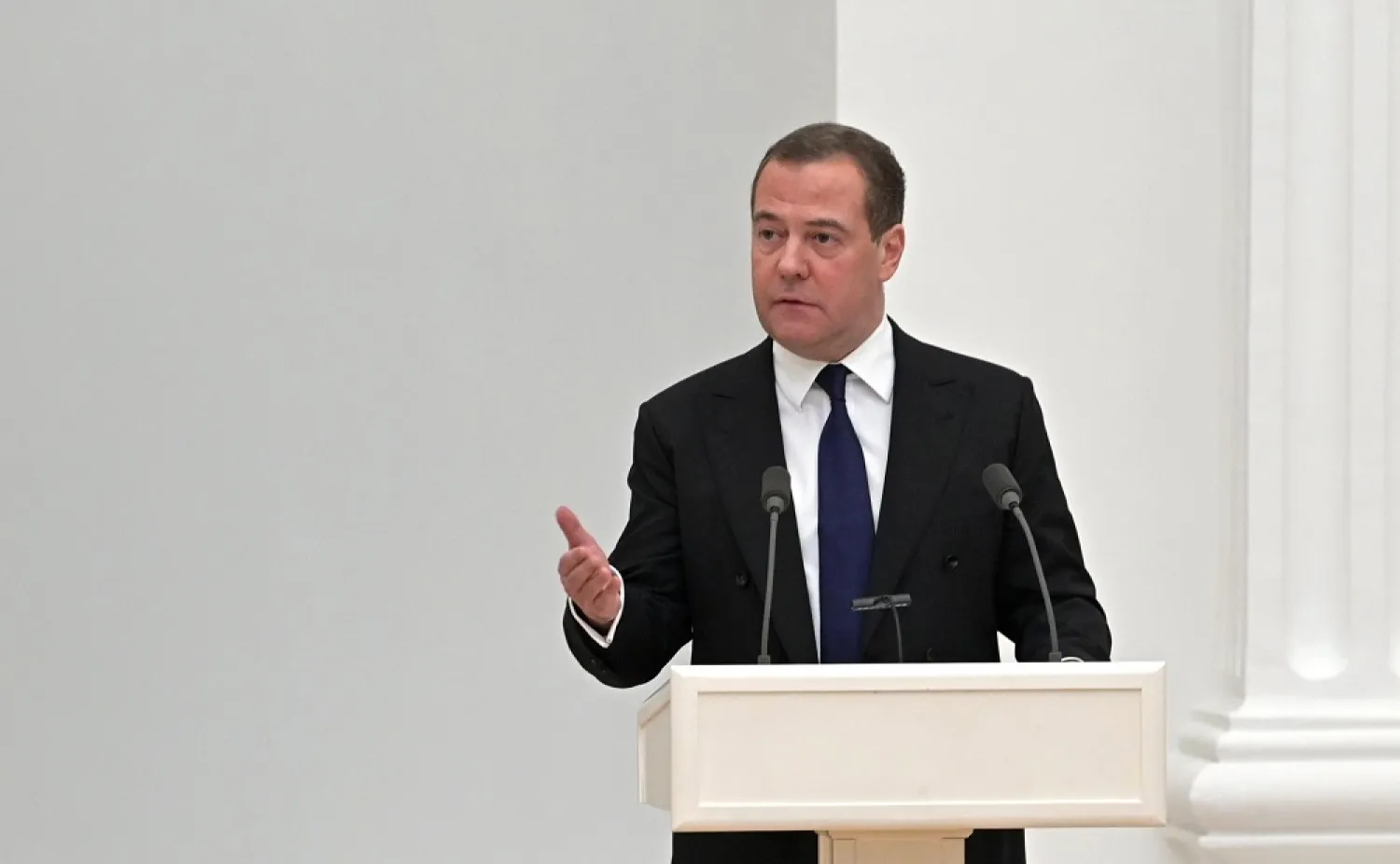
21 February 2022, Russia, Moscow: Dmitry Medvedev, then Deputy Chairman of the Russian Security Council, speaks at a council meeting in Moscow. (Kremlin/dpa)
TT

Russia: Nuclear Warning Is Not a Bluff

21 February 2022, Russia, Moscow: Dmitry Medvedev, then Deputy Chairman of the Russian Security Council, speaks at a council meeting in Moscow. (Kremlin/dpa)

An ally of President Vladimir Putin on Tuesday outlined the scenario of a nuclear strike on Ukraine, saying that the US-led NATO military alliance would be too scared of a "nuclear apocalypse" to directly enter the conflict in response.

Dmitry Medvedev, a former president who now serves as deputy chairman of Russia's Security Council, said Russia had the right to defend itself with nuclear weapons if it is pushed beyond its limits and that this is "certainly not a bluff".

Putin last week ordered Russia's first mobilization since World War Two and backed a plan to annex swathes of Ukraine, warning the West he was not bluffing when he said he would be ready to use nuclear weapons to defend Russia.

"Let's imagine that Russia is forced to use the most fearsome weapon against the Ukrainian regime which had committed a large-scale act of aggression that is dangerous for the very existence of our state," Medvedev said in a post on Telegram.

Medvedev's remarks quoted the exact terminology of one of the conditions of Russia's nuclear strike doctrine: "aggression against the Russian Federation with conventional weapons when the very existence of the state is threatened".

The 57-year-old Putin ally, who once presented himself as a reformer who was ready to work with the United States to liberalize Russia, has recast himself in recent months as the most publicly hawkish member of Putin's circle.

Since Russia invaded Ukraine, he has repeatedly raised the threat of nuclear chaos and used insults to describe the West.

Nuclear warning

Washington has not detailed what it would do if Putin ordered what would be the first use of nuclear weapons in anger since the United States unleashed the first atomic bomb attacks on the Japanese cities of Hiroshima and Nagasaki in 1945.

National Security Adviser Jake Sullivan said on Sunday that the United States would respond decisively to any Russian use of nuclear weapons against Ukraine and has spelled out to Moscow the "catastrophic consequences" it would face.

Around 90% of the world's nuclear warheads are held by Russia and the United States, who remain by far the world's biggest nuclear powers.

Russia has 5,977 nuclear warheads while the United States has 5,428 warheads, while China has 350, France has 290 and the United Kingdom has 225, according to the Federation of American Scientists.

Medvedev's comments come as Russia prepares to annex large swathes of Ukrainian territory after referendums in Russian-controlled regions in Ukraine which Ukraine and the West have described as an illegal sham.

Diplomats say Russia's nuclear saber rattling indicates Putin is trying to scare the West into reducing its support for Ukraine by hinting at using a tactical nuclear weapon to defend the annexed territories of Ukraine.

Tactical nuclear weapons, simply a nuclear device used on the battlefield, typically have much smaller explosive power than the vast strategic nuclear warheads which Russia and the United States point at each other's major cities.

"I have to remind you again - for those deaf ears who hear only themselves. Russia has the right to use nuclear weapons, if necessary," Medvedev said, adding that it would do so "in predetermined cases" and in strict compliance with state policy.

When describing a possible strike on Ukraine, a Slavic neighbor which Putin describes as an artificial historical construct, Medvedev said NATO would not get involved in such a situation.

"I believe that NATO would not directly interfere in the conflict even in this scenario," Medvedev said. "The demagogues across the ocean and in Europe are not going to die in a nuclear apocalypse."



A New Exchange of Fire with Iran in the Gulf Tests the Fragile Ceasefire

This handout photo released by Iran’s Revolutionary Guards Corps (IRGC)’s official website Sepanews on February 17, 2026, shows a rocket being fired from a boat during a military exercise by members of the IRGC and navy in the Strait of Hormuz via AFP
TT

A New Exchange of Fire with Iran in the Gulf Tests the Fragile Ceasefire

This handout photo released by Iran’s Revolutionary Guards Corps (IRGC)’s official website Sepanews on February 17, 2026, shows a rocket being fired from a boat during a military exercise by members of the IRGC and navy in the Strait of Hormuz via AFP

Iran fired ballistic missiles and drones toward Bahrain and Kuwait that were intercepted early Saturday, Bahrain’s government said, and called on Tehran to halt attacks on Gulf neighbors that test a fragile ceasefire in the Middle East conflict.

Iran said that it targeted American military assets in both countries, after the US attacked surveillance facilities on Qeshm Island and near Sirik that Iran said were used to protect borders and “ensure the security of navigation in international waters." Tehran called the attack a ceasefire violation.

Later Saturday, US Central Command said US forces had shot down two Iranian attack drones over the Strait of Hormuz.

The latest exchanges came as the Trump administration presses Iran to make a deal to end the war, which has strained the global economy and threatened a hunger crisis in some of the world's most vulnerable countries, The Associated Press reported.

Pakistan’s interior minister, Mohsin Naqvi, arrived in Iran on Saturday as part of mediation efforts.

Meanwhile, the US is seeking to ratchet up economic pressure on Iran. The US Treasury Department is considering allowing Gulf allies to tap into frozen Iranian assets to pay for damages they sustained in the war, according to a person familiar with Secretary Scott Bessent's thinking who spoke Saturday on condition of anonymity to share internal deliberations.

Iran says it targeted US air base and Navy

The US military said earlier that it had shot down several Iranian missiles and drones launched toward the Strait of Hormuz and Gulf Arab allies, and struck some of the Iranian Republic’s coastal surveillance radar sites in response.

“The attack drones posed an immediate threat to regional maritime traffic,” US Central Command said.

Iran’s Revolutionary Guard said it had targeted the Ali Al Salem air base, which hosts US forces in Kuwait, and the US Navy’s 5th Fleet in Bahrain, according to the state-run IRNA news agency.

The US military said there were no reports of harm to US personnel.

Earlier in the week, Iranian drones heavily damaged a passenger terminal at Kuwait’s main airport, killing one person and wounding dozens.

The US military kept up its blockade on Iranian ports in response to Tehran’s grip on the strait, a crucial corridor for global oil and natural gas shipments. Energy prices have spiked, posing political problems for US President Donald Trump's Republican Party before the midterm congressional election.

Deals remain elusive

Trump increasingly appears to be boxed in. US and Iranian negotiators reached a tentative agreement a week ago to extend the ceasefire by 60 days and start a new round of talks on Iran’s nuclear program. Trump, however, has called for unspecified changes, and Iranian officials have shown no public sign of agreeing to the deal.

The fighting in Lebanon, where Israeli forces have seized large swaths of the south while saying it targets the Iranian-backed Hezbollah militant group, also challenges efforts to end the Iran war and reopen the Strait of Hormuz. Iran has demanded that any lasting truce extends to Lebanon.

The Trump administration has touted the latest ceasefire agreed to earlier in the week by the Lebanese government and Israel after US-brokered talks in Washington. However, Hezbollah has rejected the agreement.


Iran Condemns 'Flagrant Ceasefire Violation' after US Strikes

Iranian Foreign Ministry spokesman  Esmaeil Baghaei (Iranian News Agency)
Iranian Foreign Ministry spokesman Esmaeil Baghaei (Iranian News Agency)
TT

Iran Condemns 'Flagrant Ceasefire Violation' after US Strikes

Iranian Foreign Ministry spokesman  Esmaeil Baghaei (Iranian News Agency)
Iranian Foreign Ministry spokesman Esmaeil Baghaei (Iranian News Agency)

Iran condemned on Saturday a nighttime US attack on coastal radar installations in the Gulf, calling it a "flagrant" violation of the ceasefire in place since April.

The foreign ministry said it was an attack "on the national sovereignty and territorial integrity of the Islamic republic", denouncing Washington's "hostile and provocative behavior".

It added that the United States would bear responsibility for any consequences arising from its unlawful actions and any further escalation.

Tensions between Iran and the United States escalated on Saturday after Iran's Revolutionary Guard Corps (IRGC) announced attacks on US bases in the region following confrontations linked to shipping traffic in the Strait of Hormuz and strikes on sites inside Iran.

While Tehran said it had launched missile attacks on US bases, Washington said it intercepted most of the projectiles and rejected Iranian claims that facilities associated with the US Fifth Fleet in Bahrain had been hit.

The IRGC said on Saturday that it had carried out attacks on US bases in the region following an attack on the city of Sirik and Qeshm Island, as well as the targeting of four oil tankers that had attempted to transit the Strait of Hormuz without coordination, according to dpa.

For its part, US Central Command (CENTCOM) said in a statement posted on X on Saturday that Iran had launched seven missiles toward Kuwait and Bahrain after US forces shot down four drones that had been launched toward the Strait of Hormuz.


Pope Urges Leaders to Temper Divisions at Start of Spain Trip

Spain's King Felipe VI (L), Queen Letizia (R), Crown Princess Leonor (L, rear), and Princess Sofia (R, rear) go up the Ambassadors Staircase with Pope Leo XIV during the welcoming ceremony held at the Royal Palace in Madrid, Spain, 06 June 2026.   EPA/DANIEL GONZALEZ
Spain's King Felipe VI (L), Queen Letizia (R), Crown Princess Leonor (L, rear), and Princess Sofia (R, rear) go up the Ambassadors Staircase with Pope Leo XIV during the welcoming ceremony held at the Royal Palace in Madrid, Spain, 06 June 2026. EPA/DANIEL GONZALEZ
TT

Pope Urges Leaders to Temper Divisions at Start of Spain Trip

Spain's King Felipe VI (L), Queen Letizia (R), Crown Princess Leonor (L, rear), and Princess Sofia (R, rear) go up the Ambassadors Staircase with Pope Leo XIV during the welcoming ceremony held at the Royal Palace in Madrid, Spain, 06 June 2026.   EPA/DANIEL GONZALEZ
Spain's King Felipe VI (L), Queen Letizia (R), Crown Princess Leonor (L, rear), and Princess Sofia (R, rear) go up the Ambassadors Staircase with Pope Leo XIV during the welcoming ceremony held at the Royal Palace in Madrid, Spain, 06 June 2026. EPA/DANIEL GONZALEZ

Pope Leo on Saturday urged global leaders to avoid dividing their electorates with "sterile simplifications" to gain popularity and called on them to listen to the world's cries for peace, in a forceful speech opening a week-long tour of Spain.

"Today, the temptation to gain popularity by fanning the flames of polarization seems to have grown rather than diminished, and human dignity continues to be violated," Leo said in a speech before King Felipe VI at the Royal Palace in Madrid, Reuters reported.

"I invite everyone to set aside the divisive and polarizing narratives of your societal reality and history, so as to overcome sterile simplifications through the fruitful appreciation of complexity," he added.

Technology was partly to blame for creating an environment which magnifies prejudices and weakens critical thinking, Leo said. The world was crying "from its depths for peace," he said.

He drew on Spain's history as an example of peaceful co-habitation between religions and cultures, making reference to how Christians, Muslims and Jews cooperated during medieval times to enhance human knowledge by translating Arabic texts into Latin, Spanish and Hebrew at the School of Translators in Toledo.

"Your own history suggests that a culture of encounter, not confrontation, is what fosters stability and prosperity. In reality, the message of peace, which at present unfortunately strikes some as naïve and others as confrontational, is welcomed by those who do not shut themselves off in preconceived ideologies, but are rather open to the truth," he said.

Thousands lined the streets of central Madrid, some waving Vatican and Spanish flags under clear spring skies, as Leo toured in an open-air popemobile. Huge gatherings are expected in the coming days for the first visit to Spain by a pope since 2011.

Leo, who has adopted a more assertive tone against the direction of global leadership in recent months, is scheduled to give more than 20 speeches during his first trip to a European Union country outside Italy, and will be the first pope to address the Spanish parliament.

Leo spent decades as a missionary and bishop in Peru before becoming pope last May, and will speak Spanish throughout most of the trip.