Floating Igloo Leaves France for Polar Exploration Mission

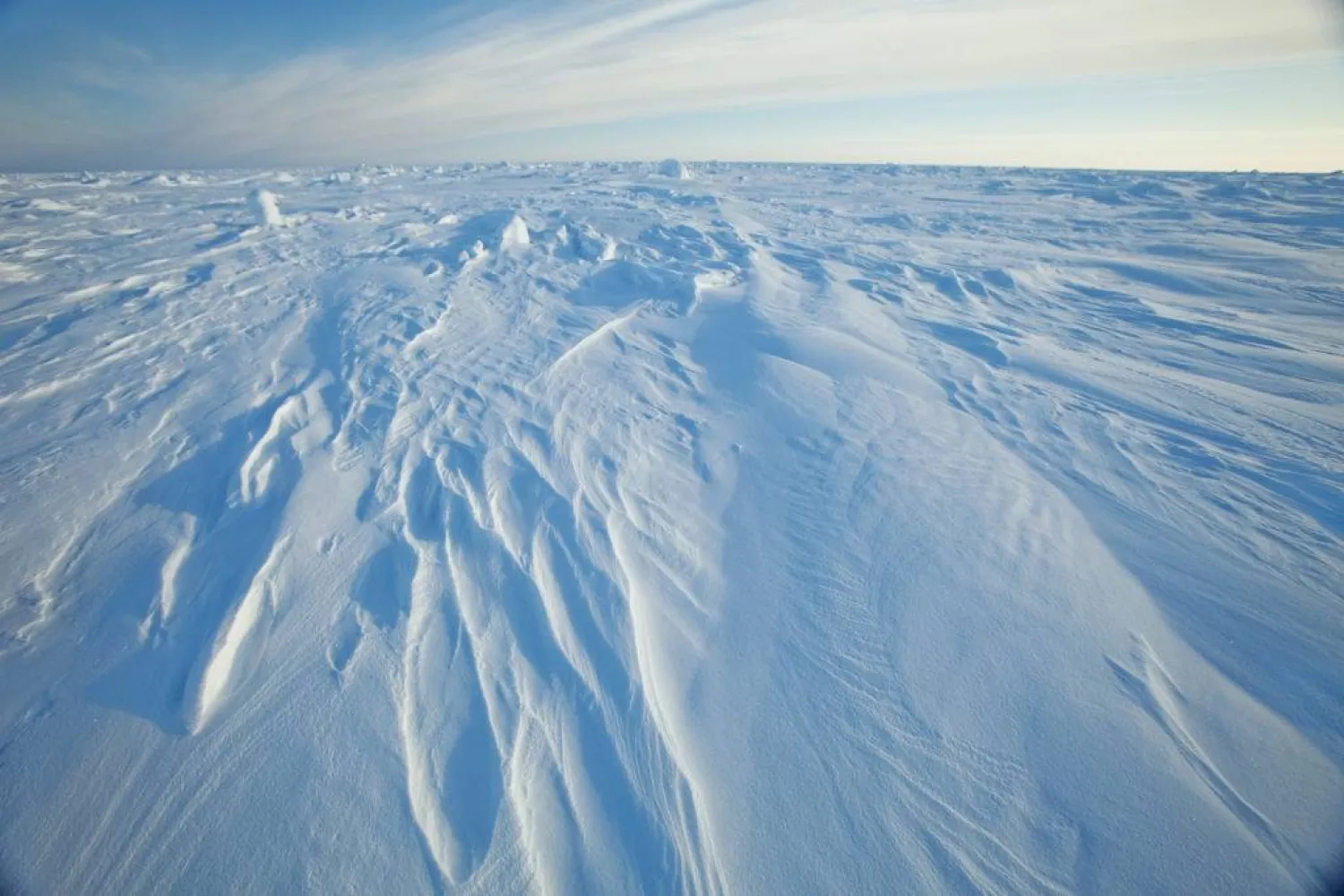
Wind patterns are left in the ice pack that covers the Arctic Ocean north of Prudhoe Bay, Alaska March 18, 2011. (Reuters)
TT

Floating Igloo Leaves France for Polar Exploration Mission

Wind patterns are left in the ice pack that covers the Arctic Ocean north of Prudhoe Bay, Alaska March 18, 2011. (Reuters)

A floating research station resembling a giant aluminium igloo on Sunday set out from France to begin a long-term mission in the Arctic that will see it drift with the polar ice in the most hostile of environments.

The Tara Polar Station's specific shape enables it to withstand ice pressure and drift for months on end in a controlled fashion with the pack ice to explore biodiversity and the impact of climate change.

While the vessel was built in France, some 30 research centers from 12 countries -- including Germany, Canada, Spain, the US, Switzerland, and Japan -- are participating in the expedition.

"The Arctic is an ocean that has been little studied and is already changing significantly. It is undergoing a major transformation," said Romain Trouble, executive director of the Tara Ocean Foundation.

"You cannot understand the environment if you only spend two months a year there," he added.

The vessel sailed from France's western port of Lorient with French Minister for the Sea Catherine Chabaud in attendance and hundreds of people cheering on the quayside.

The floating laboratory -- shaped like an igloo perched on a large buoy -- is designed to withstand sea-ice pressure and endure temperatures as low as -52C.

Starting in mid-August, the station will travel eastward along the Russian coast, with an icebreaker clearing the way.

Trapped in the pack ice by early September, the station is expected to drift at an average speed of 10 kilometers per day, eventually reaching the Fram Strait -- located between Greenland and Svalbard -- by the end of 2027.

Ten such expeditions are planned between 2026 and 2045, taking place every two years.

The vessel will carry 12 people during the winter, including six scientists, and 18 in the summer.

- 'Lose entire chapter of evolution' -

The international crew was carefully selected following medical and psychological aptitude tests and team-building.

"We weren't looking for adventurers who want to head to the North Pole alone. The idea is rather to have people who get along well to experience this confined human environment together," said Clementine Moulin, the expedition director.

Those staying through the winter will have to contend with five months of not just total darkness, claustrophobia and extreme cold, but also the presence of polar bears.

"Bears are a serious matter," said Eric Pelletier, a 58-year-old genomics researcher and crew member. "It's not a simple thing -- the bear is on its home turf and it's used to hunting and hides behind blocks of ice."

Every crew member has received firearms training to deal with potential attacks while a specially trained dog will accompany the crew to help spot approaching animals.

Using an opening in the hull and a wide array of onboard instruments, scientists will collect over 10,000 samples from the water, the atmosphere, and sea ice.

"There is biodiversity at the North Pole that is uniquely adapted to this environment. If the environment changes, that biodiversity might disappear," said Trouble.

"We could potentially lose an entire chapter of the evolution of life on this planet without even having had time to document it," he warned.


Prized Wild Pepper at Risk in Madagascar’s Shrinking Forests

A woman holds handful of fresh Tsiperifery (wild pepper) on display at the Analakely market, on September 21, 2026. (AFP)
TT

Prized Wild Pepper at Risk in Madagascar’s Shrinking Forests

A woman holds handful of fresh Tsiperifery (wild pepper) on display at the Analakely market, on September 21, 2026. (AFP)

A rare wild pepper endemic to Madagascar and prized by international chefs is facing an uncertain future, victim of its own success and the destruction of its forest habitat.

With its subtle, aromatic flavor, Voatsiperifery pepper grows on vines that reach into the canopy of the island's natural forests, which shrank 27 percent between 1990 and 2025, according to the UN Food and Agriculture Organization.

To reach the peppercorns without having to climb, harvesters often tear down the vine and, in many cases, the trees supporting them, contributing to the relentless retreat of Madagascar's forests.

"At times, I tell myself I should never have made it known," acclaimed French chef Olivier Roellinger, who first encountered the spice 30 years ago, told AFP.

"This pepper blew me away right from the start with that piperine punch that brings out a note of peat, resin, even citrus; it's incomparable," he said. "On a fruit salad, it's absolutely delicious."

Madagascar pepper sells for 150 to 200 euros ($169 to $225) per kilogram in France, its main export market.

Roellinger, the founder of the Epices Roellinger spice boutique, is collaborating with efforts to certify authentic pepper based on strictly regulated harvesting zones in Madagascar.

But he was "under no illusions" about the risk these rules could be circumvented, he said.

- Bush fires -

The village of Ambongamarina, northeast of the capital Antananarivo, was at the center of a rush two decades ago for the pepper, which has a characteristic woody tail, a remnant of its stem.

From a ridge on which the village sits, farmer Maminiaina Rabearison pointed into the distance.

"Until 2010-2012, it was still covered in natural forest," he told AFP.

"People used to go into the forest and, for 10 to 20 weeks a year, at least 100 kilograms were sold every week at the market to a trader," the 45-year-old said.

That trader has not visited in a long time. Harvests have dropped as the forest has been consumed by bush fires, charcoal production and slash-and-burn agriculture, or torched in protests against the distant central government.

The destruction of the vines has also forced harvesters to go deeper into the forest to find the plant, which in Malagasy is called tsiperifery, meaning "that makes wounds not exist", a reference to its medicinal use for generations.

Now, "you have to walk almost a full day to find pepper in the forest," said 51-year-old Herinaina Randrianarimanga, another farmer from the village, which is only 120 kilometers (75 miles) from the capital but takes five hours to reach in a four-by-four vehicle.

- 'A real boon' -

There is no national system to track the distribution, harvesting and export of this precious pepper, said Mima Chateauneuf, co-founder of bulk export company Jacarandas.

"Today, we have no idea whether the resource is becoming scarce," she said, calling for "traceability" to determine export volumes.

In the absence of a regulatory framework, Jacarandas is turning towards organic pepper, which has grown to make up one-third of its exports. "For organic products, traceability is mandatory," Chateauneuf said.

As research into the Voatsiperifery plant advances, French-Malagasy entrepreneur Olivier Ramaherison has been experimenting with domestic cultivation on land inherited from his father.

Between 500 and 1,000 vines -- the result of thousands of trials -- grew in terraces carved into the Mandraka forest, 60 kilometers east of the capital.

There are no support trees here: the plants, laden with fruit just a few weeks from maturity, cluster close to the ground.

"The idea was to try to find a solution to make it easier to pick," said Ramaherison, head of Essentialys, a company that produces aromatic plants, essential oils, coffee and pepper.

By chance, his team discovered that cuttings taken from the horizontal branches of the vine no longer tried to climb.

"If, like at the Piper nigrum (black pepper) plantations in Vietnam or Brazil, we manage to produce hundreds of tons of wild pepper, it would be a real economic boon for the country," he said.


British Family to Return Home After 5 years At Sea

Andy Sheath and his family. (Andy Sheath)
TT

British Family to Return Home After 5 years At Sea

Andy Sheath and his family. (Andy Sheath)

A family from the Isle of Man is returning home after spending five years at sea aboard the world’s largest floating book fair, according to the BBC.

Andy Sheath, his wife Rebecca and daughters Elsie and Sofie have lived on the Logos Hope since 2021.

The vessel, which is due to dock in Douglas Harbor between November 6 and 22, is home to more than 300 people from 60 countries and travels the world as the largest floating book fair.

Sheath said he had always hoped the ship would visit the island and was looking forward to finally coming home.

‘Treasured memories’

Sheath first visited the ship as a university student in 2010 and said he was the only Manxman on board.

He said stepping on to the vessel for the first time felt like coming home.

Since 2021, the ship has been the family’s home and holds “precious, treasured memories”, he said.

“My oldest daughter Elsie is five. These corridors echo memories of her first steps. Our table and dining room is where we’ve eaten for five years. It’s where my daughters have grown from baby to toddler, to now,” he said.

The family returned to the island for Sofie’s birth, meaning Elsie remembers visits to the wildlife park, fish and chips on the beach with her grandparents and ice cream at Peel.

Sheath said his family is excited to return to the island to start a new life, calling it “a huge homecoming.”

Fellow crew members have shared in the family’s excitement about this stop on the boat’s tour.

“They have asked me ‘what can I do on the island’, ‘can we see the TT route?’ and many other questions,” Sheath said.

He hoped the visit would not be the last from the Logos Hope.

“On the next visit I would love to see another Manx person on board,” he added.

“I have proudly waved the three legs of Man at every port and I would love to see more Manx people waving the flag on board at different ports.”


UN Sees Higher Global Warming, Even in Best-case Scenario

FILE - The coal-fired Mountaineer Power Plant, near New Haven, W.Va., operates across the Ohio River from the Lock 24 RV Park and Campground in Racine, Ohio, March 13, 2026. (AP Photo/Carolyn Kaster, File)
TT

UN Sees Higher Global Warming, Even in Best-case Scenario

FILE - The coal-fired Mountaineer Power Plant, near New Haven, W.Va., operates across the Ohio River from the Lock 24 RV Park and Campground in Racine, Ohio, March 13, 2026. (AP Photo/Carolyn Kaster, File)

Global warming is now projected to exceed previous estimates, with even the most optimistic scenario seeing average temperatures rise to 1.7-1.8 degrees Celsius above pre-industrial levels by mid-century, a UN report showed on Wednesday.

Despite a rapid expansion of renewable energy and climate policies that are reducing emissions in many countries, the report said "urgent and stringent" cuts were still needed ‌to achieve that ‌best-case outcome.

The UN Environment Program's report said ‌greenhouse ⁠gas emissions would need ⁠to fall 18% from 2025 levels by 2030, 45% by 2035 and 69% by 2040. Current national plans would cut emissions by only 5-8% by 2030 and 11-15% by 2035.

The report projected global warming of 2.8 Celsius by 2100 under current policies, or 2.6 C if countries fully implement existing climate pledges. ⁠Both estimates are higher than last year's projections, ‌reflecting the US withdrawal from ‌the Paris Agreement and revised assessments of historical emissions.

As countries prepare for ‌the next round of climate talks in Turkey, COP31, UN ‌Secretary-General António Guterres said it was crucial not to give up on efforts to rein in the emissions that are fueling floods, fires and other natural disasters.

"Overshoot is not surrender. We can still ‌keep it as small and as short as possible – and bring temperatures back below 1.5 degrees by ⁠the end ⁠of the century," he said.

Under the 2015 Paris Agreement, countries agreed to try to keep the average temperature increase at well below 2 degrees and ideally 1.5 C.

As limiting warming to 1.5 C with no or limited overshoot was no longer considered possible, the UN Environment Program said its new "lowest possible" overshoot scenario gives roughly a 50% chance that temperatures could return to 1.5 C or below by 2100.

The report said climate plans submitted since last year had made virtually no difference to future warming projections, and that returning to 1.5 C would depend on large-scale carbon removal, the feasibility of which was uncertain.