

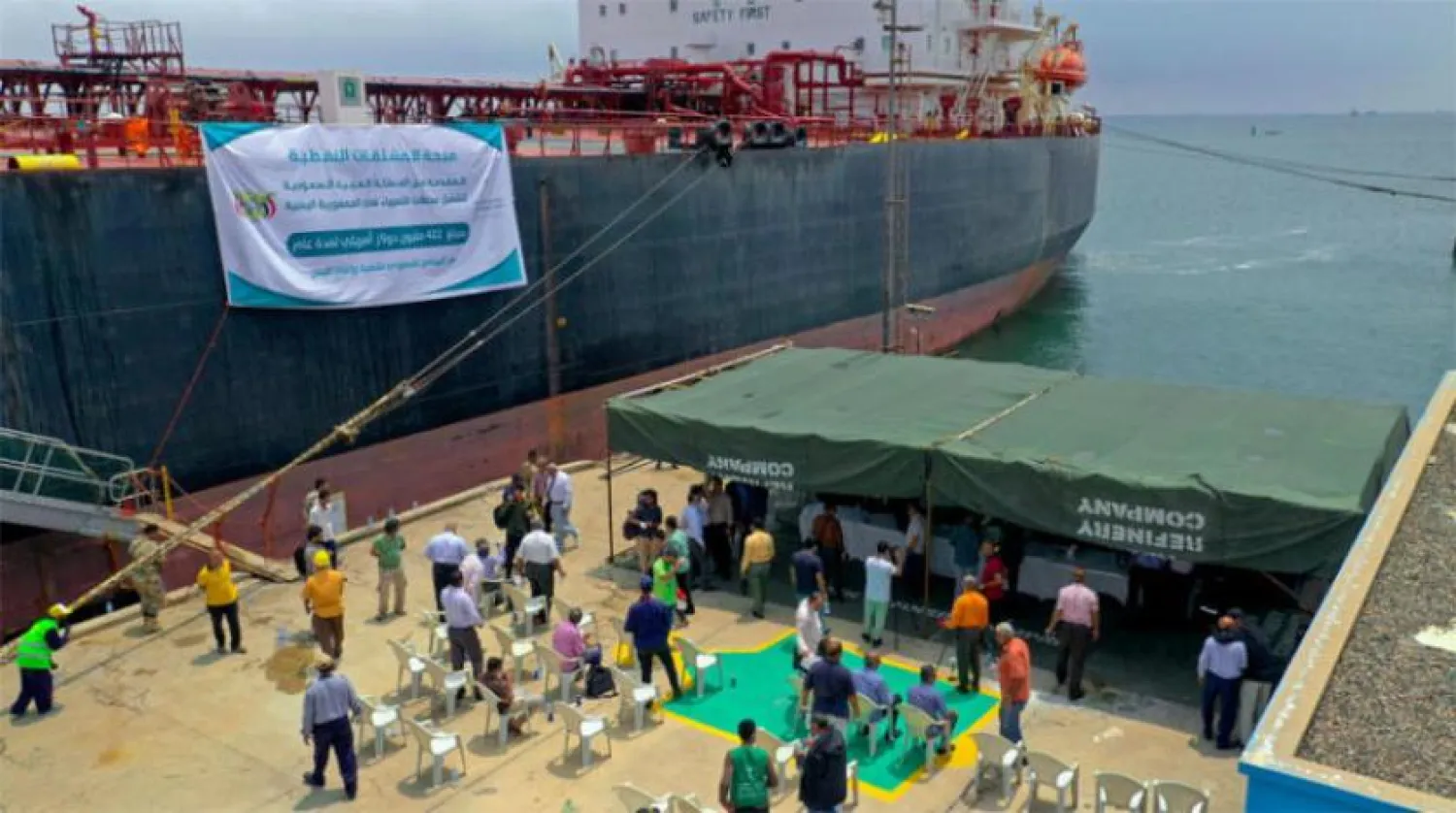

SDRPY Signs Grant Agreement of Oil Derivatives Worth $200 Mln for Yemen

SDRPY signed a grant agreement of Saudi oil derivatives with an estimated total value of $200 million. Asharq Al-Awsat
TT

SDRPY Signs Grant Agreement of Oil Derivatives Worth $200 Mln for Yemen

SDRPY signed a grant agreement of Saudi oil derivatives with an estimated total value of $200 million. Asharq Al-Awsat

The Saudi Development and Reconstruction Program for Yemen (SDRPY) signed on Thursday a grant agreement with an estimated total value of $200 million to provide 250,000 metric tons of oil derivatives to Yemen.

The Saudi side was represented by SDRPY Supervisor General Ambassador Mohammad Al Jaber and Yemen’s government was represented by Minister of Electricity and Energy Eng Mana bin Yamin.

This step comes under the directives of Custodian of the Two Holy Mosques King Salman bin Abdulaziz and Crown Prince Mohammed bin Salman and in response to a request by Yemen’s government to assist it in operating its power plants.

The signing ceremony was also attended by Yemen’s Minister of Finance Salem bin Salem bin Braik.

SDRPY has already delivered the first batch of oil derivatives worth $30 million out of the $200 million to operate more than 70 power generation plants in Yemen.

Al Jabir said that the new grant agreement reflects the bonds of brotherhood and solid ties between the Kingdom and Yemen.

He pointed out that this step is an extension of the Kingdom’s development and economic support to Yemen in all fields and aims to enhance and support Yemen’s economy in a way that enables the government to fulfill its other commitments.

Mana, for his part, hailed the Kingdom’s efforts through SDRPY to secure the grant, which directly contributed to increasing the ability of government institutions and the stability of electric power in various public and private institutions and the industrial sector, in addition to boosting the commercial activities in all governorates.

He added that providing electricity has also contributed to improving the basic services provided to citizens, mainly security and social stability.

Mana further noted that the grant had a direct impact on providing electricity in Yemen and maintaining good oil reserves, as well as disbursing amounts of oil derivatives in an organized and stable manner.

This was reflected in increasing operation periods of electricity plants to reach more than 20 hours per day in some governorates.

The new grant underlines the Kingdom’s keenness to achieve security, stability and development for Yemenis.

It is an extension of previous grants totaling $4.2 billion, the latest of which was $422 million that was paid over a course of a year and contributed to achieving economic stability, boosting the government’s budget, increasing the citizens’ purchasing power and improving security conditions. It also helped in boosting the service sector, improving life conditions, increasing the rate of daily service hours for the operation of power stations and ensuring the self-operation of power plants in the country.

Similar previous grants had contributed to lowering government expenditure partially by alleviating the public expenditure on the government and securing operational budget and wages for the Public Electricity Company with an amount exceeding $21 million between May 2021 and April 2022. They also doubled the plants’ production capacity to reach a target of 2,828 gigawatts per hour during their operation time.


Saudi Arabia Welcomes US Designation of 3 Muslim Brotherhood Branches as Terrorist 

This 2011 photo shows a Muslim Brotherhood office in Amman, Jordan. (AFP)
TT

Saudi Arabia Welcomes US Designation of 3 Muslim Brotherhood Branches as Terrorist 

This 2011 photo shows a Muslim Brotherhood office in Amman, Jordan. (AFP)

The Saudi Ministry of Foreign Affairs welcomed on Wednesday the United States' designation of the Muslim Brotherhood branches in Egypt, Jordan, and Lebanon as terrorist organizations.

The ministry stressed the Kingdom’s condemnation of extremism and terrorism, its support for all that achieves security, stability, and prosperity of Arab countries, and the security of the region and the world.


Islamic Military Coalition Launches ‘Competence’ Military Strategic Initiative in Sierra Leone

Officials are seen at Tuesday's launch. (SPA)
TT

Islamic Military Coalition Launches ‘Competence’ Military Strategic Initiative in Sierra Leone

Officials are seen at Tuesday's launch. (SPA)

The Islamic Military Counter-Terrorism Coalition (IMCTC) launched on Tuesday the “Competence” military strategic training for counter-terrorism in Sierra Leone.

The launch was attended by Sierra Leonean Minister of Internal Affairs Morie Lengor, IMCTC Secretary General of the Islamic Military Counter-Terrorism Coalition (IMCTC) Major General Pilot Mohammed bin Saeed Al-Moghedi, senior military and security officials, civil representatives, and members of the diplomatic corps accredited to Republic of Sierra Leone.

The initiative runs from January 13 to February 3, targeting the training and capacity building of 30 military and security personnel through an intensive 15-day program focused on counter-terrorism, including handling explosives, improvised devices, and unexploded ordnance, while enhancing the operational readiness of specialized forces.

The training aims to develop the skills and capabilities of personnel in counter-terrorism units and facilitate the transfer of advanced professional knowledge and expertise among member states, enabling them to address complex terrorist threats with high-level scientific and professional methods.


Saudi Govt Rejects Any Attempts to Undermine Somalia’s Sovereignty

Custodian of the Two Holy Mosques King Salman bin Abdulaziz Al Saud chairs the Cabinet meeting in Riyadh. (SPA)
TT

Saudi Govt Rejects Any Attempts to Undermine Somalia’s Sovereignty

Custodian of the Two Holy Mosques King Salman bin Abdulaziz Al Saud chairs the Cabinet meeting in Riyadh. (SPA)

The Saudi government stressed on Tuesday the Kingdom’s rejection of any attempts “to create parallel entities that undermine Somalia's unity, territorial integrity, or national sovereignty.”

Custodian of the Two Holy Mosques King Salman bin Abdulaziz Al Saud chaired the Cabinet meeting that was held in Riyadh.

The Cabinet welcomed the outcomes of the Organization of Islamic Cooperation's extraordinary meeting on Somalia in Jeddah that stressed the Kingdom’s stance on Somalia.

The Cabinet reviewed recent high-level discussions between the Kingdom and various countries, focusing on regional developments, ongoing efforts to anchor security and peace, and the Kingdom's commitment to multilateral initiatives that drive global stability and foster collective responses to shared challenges.

The Cabinet reiterated the centrality of the Palestinian cause, stressing the Kingdom's unwavering support for a ceasefire in the Gaza Strip. These efforts aim to enable the Palestinian people to exercise their right to self-determination and to establish an independent state within the 1967 borders, with East Jerusalem as its capital.

The Cabinet commended the successful conclusion of the Gulf Shield 2026 joint military exercise, hosted by Saudi Arabia. Featuring the air and air defense forces of the Gulf Cooperation Council (GCC) and the GCC Unified Military Command, the exercise underscored the commitment to boosting regional defense cooperation and strengthening collective military readiness.

The Cabinet reviewed several high-profile economic events hosted by the Kingdom, specifically highlighting the Saudi-Japan Ministerial Investment Forum and the Saudi-Canadian Business and Investment Forum. The summits resulted in numerous memoranda of understanding across strategic sectors, including space, cybersecurity, ICT, manufacturing, education, finance, water, and agriculture.