


Palestinians Mourn Boy Who Died ‘of Fear’ of Israeli Troops

30 September 2022, Palestinian Territories, Bethlehem: Burning tires block a road during a protest following the funeral of the 7 years old Rayan Suleiman. Rayan died after being chased by Israeli forces in Tequa town. (dpa)
TT

Palestinians Mourn Boy Who Died ‘of Fear’ of Israeli Troops

30 September 2022, Palestinian Territories, Bethlehem: Burning tires block a road during a protest following the funeral of the 7 years old Rayan Suleiman. Rayan died after being chased by Israeli forces in Tequa town. (dpa)

A throng of men clutching the body of a 7-year-old Palestinian boy marched through a town in the occupied West Bank toward the child's final resting place on Friday, a day after his parents say he died from fear of Israeli soldiers.

Rayan Suleiman, with bright eyes and a backpack emblazoned with an animated race car, was walking home from school on Thursday when his family says he and his brothers were chased by Israeli soldiers. After the boys bolted home, the troops banged furiously on the door and threatened to arrest the children, their parents say. Just moments later, Rayan, the youngest of the three brothers, was dead.

The story shot across the occupied West Bank, providing an emotive focus for fury over Israel’s military tactics and what Palestinians contend is their victimization by the Israeli occupation. The Israeli army called the death a tragedy and said its soldiers were not to blame.

Heavily armed Israeli soldiers routinely arrest Palestinian children in the West Bank, where nearly half a million Israeli settlers live on land that Palestinians want for a future independent state.

Rayan's death also struck a nerve with Palestinian parents. Fear for their children's safety and the dread of soldiers knocking on the door are part of daily life under an entrenched Israeli military rule that is now in its 56th year.

“He was just an innocent boy, just 7 years old, what can he do?” Yasser Suleiman, Rayan's father, told The Associated Press outside the hospital morgue on Friday, choking back tears.

The State Department demanded an investigation. The European Union said it was “shocked” by Rayan’s “tragic death.” UN Mideast envoy Tor Wennesland said he was “saddened” and called for an immediate probe.

Photographs of Rayan’s tiny, lifeless body under a sheet in the hospital became a potent new symbol overnight, threatening to fuel already heightened tensions just a day after the deadliest Israeli raid since the military escalated its crackdown on the West Bank earlier this year.

And like many such incidents in the decades-old Israeli-Palestinian conflict, his death has sparked contention. The Israeli military has denied any violence in the interaction with Rayan’s family, saying that just one officer came to the family’s house after spotting children throwing stones.

Lt. Col. Richard Hecht, a military spokesman, said the officer spoke in a “very calm manner” with Rayan's father and left.

“There was no violence, no entry into the house,” Hecht said.

Rayan's father said his son collapsed after he saw the Israeli soldiers who chased him appear at his front door. Yasser Suleiman said he was trying to reason with the soldiers, who accused his children of throwing rocks. The soldiers threatened to return at night and arrest all three children, including Rayan's older brothers, ages 8 and 10, Suleiman said. Rayan tried to run away and fell on the floor, unconscious.

“He died of fear on the spot,” Suleiman said.

Doctors at a hospital in Beit Jala, a Palestinian town south of Jerusalem, could not resuscitate him. A pediatric specialist, Dr. Mohamed Ismail, said Rayan was healthy and had no previous medical conditions.

“The most probable scenario of what happened is that under stress, he had excess adrenaline secretion, which caused the increase of his heart beat,” Ismail said. “He developed cardiac arrest.”

A forensic doctor is currently conducting an autopsy on Rayan. Until the doctor makes his determination, no death certificate will be issued.

In the meantime, on Friday, mourners thronged his body outside his stone house in Tequa, a Palestinian town that borders an Israeli settlement with some 4,000 residents. They kissed his head and feet, shrouded in a Palestinian flag.

“God is great!” they shouted, some jogging to stay ahead of his small body on the wooden pallet. “Oh Rayan, light of the eye!"

At the Suleiman house on Friday afternoon, women wept and wailed over Rayan's bed, displayed in the family's courtyard along with his English school books. His mother was crumpled over, inconsolably crying and calling out for her son. Extended family with watery eyes milled about in mourning.

Rayan's aunt, who was home at the time of the incident, said even she was terrified when Israeli soldiers burst into the home. She said they handed her a paper in Hebrew she couldn't read and yelled, ‘We want the boys, where are the boys?’"

“The kids are always in danger, from settlers from the army, on their way back from school,” said Rayan's aunt, who gave her name as Umm Ali, noting that soldiers sometimes patrol a verdant shortcut that kids take from school to their homes. “Rayan is not the first one, he is only the latest.”

His brothers are refusing to go to school again out of fear, she added.

Palestinians have seized on Rayan’s death as the latest Israeli provocation as deadly violence rises in the West Bank. Following a surge of Palestinian attacks inside Israel last spring that killed 19 Israelis, the Israeli military has conducted almost nightly raids into cities and towns to arrest suspects. Dozens of Palestinians have been killed, making 2022 the deadliest in seven years.

Human rights groups say that across the West Bank, Palestinian children live under constant threat of violence. Under Israeli military law, Palestinian children age 12 and above can go to prison for six months. Israel arrests hundreds of teenagers during night raids each year, bundling them handcuffed and blindfolded into armored cars for interrogation, reported Israeli human rights organization, HaMoked.

“That's hugely traumatizing for the teenage kids being arrested and for their mothers and fathers,” said Jessica Montell, executive director of HaMoked. “In this case, it was fatally traumatizing for this little boy.”

After Rayan's funeral, small crowds of young men cursed and hurled rocks at Israeli armored vehicles rumbling through the streets of Tequa.



Chad Govt Shuts Sudan Border Until Further Notice 

Children poke their heads and arms through holes in makeshift fabric fences in the strategic opposition-controlled town of Akobo, Jonglei State, on February 12, 2026. (AFP)
TT

Chad Govt Shuts Sudan Border Until Further Notice 

Children poke their heads and arms through holes in makeshift fabric fences in the strategic opposition-controlled town of Akobo, Jonglei State, on February 12, 2026. (AFP)

Chad's government said on Monday it was closing the border with Sudan until further notice, following several clashes between Chadian soldiers and armed groups involved in the civil war across the frontier.

"This decision follows repeated incursions and violations committed by the forces involved in the conflict in Sudan on Chadian territory," Communications Minister Mahamat Gassim Cherif said in a statement, adding that he wanted to halt "any risk of the conflict spreading" to his country.

Sudan's paramilitary Rapid Support Forces have been fighting government troops for almost three years in a conflict that has killed tens of thousands of people and forced 11 million to flee their homes, triggering what the UN says is one of the world's worst humanitarian crises.

The paramilitaries have conducted several operations near the Chad border and at least nine Chadian soldiers have been killed in separate incidents since December.

Monday's statement said Chad "reserves the right to retaliate against any aggression or violation of the inviolability of its territory and its borders".

"Cross-border movements of goods and people are suspended," the text said, adding that "exceptional exemptions" for humanitarian reasons would still be possible.


Report: US Forces to Complete Withdrawal from Syria within a Month 

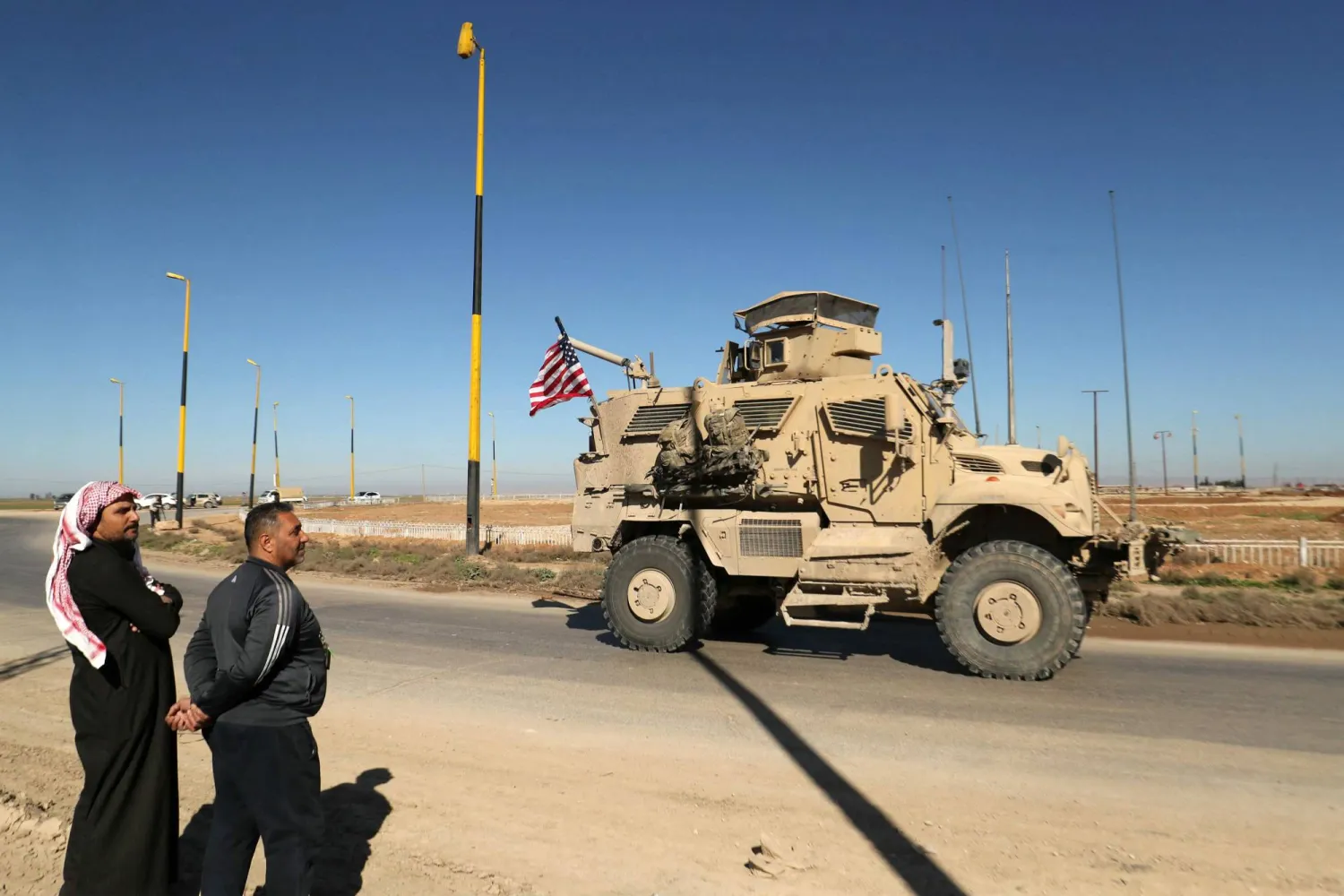
Men watch as a US military mine-resistant ambush protected (MRAP) armored fighting vehicle moves in a convoy along a highway outside Qamishli in Syria's northeastern Hasakeh province on February 23, 2026. (AFP) 
TT

Report: US Forces to Complete Withdrawal from Syria within a Month 

Men watch as a US military mine-resistant ambush protected (MRAP) armored fighting vehicle moves in a convoy along a highway outside Qamishli in Syria's northeastern Hasakeh province on February 23, 2026. (AFP) 

US forces that led the anti-ISIS coalition in Syria started leaving a major base in the northeast on Monday and should complete their withdrawal from the country within a month, sources told AFP. 

The move comes after Kurdish forces, long backed by Washington in the fight against the ISIS group, ceded territory to Damascus and agreed to integrate into the state. 

American forces have already withdrawn from two other bases in the past two weeks, Al-Tanf in the southeast and Shaddadi in the northeast. 

"Within a month, they will have withdrawn from Syria and there will no longer be any military presence in the bases," a Syrian government official said, with a Kurdish source confirming the timeline. 

A third source, a diplomat, said the withdrawal should be completed within 20 days. 

The United States has about 1,000 troops still deployed in Syria. It began withdrawing on Monday from the Qasrak base in the northeast, which is still under the control of Kurdish forces, a Kurdish official who requested anonymity told AFP. 

An AFP team saw a convoy of dozens of trucks, loaded with armored vehicles and prefabricated structures, on a road linking the Qasrak base in Hasakeh province to the border with Iraq. 

Syria's government recently extended its control to the northeast of the country. 

Washington has drawn close to Syria's new authorities since the fall of Bashar al-Assad in late 2024. 


Israeli Team in Peace Council Reveals Vision for Gaza Reconstruction

A female member of the al-Ghafir family, sits of the debris of the al-Hasayna Mosque as she recites from a copy of the Quran, during the holy month of Ramadan in western Gaza City on February 21, 2026. (Photo by Omar AL-QATTAA / AFP)
TT

Israeli Team in Peace Council Reveals Vision for Gaza Reconstruction

A female member of the al-Ghafir family, sits of the debris of the al-Hasayna Mosque as she recites from a copy of the Quran, during the holy month of Ramadan in western Gaza City on February 21, 2026. (Photo by Omar AL-QATTAA / AFP)

While many observers remain skeptical about the chances of success for President Donald Trump’s comprehensive Middle East peace plan, figures close to the US administration are projecting confidence. Among them are three Israelis selected for key roles in the project, though they do not formally represent the Israeli government.

According to a report in Yedioth Ahronoth, the officials insist the initiative is already underway, with Egypt, Türkiye and Qatar playing influential roles in persuading Hamas to cooperate. Despite skepticism within parts of Israel’s political and military leadership regarding the feasibility of the plan — and the ability of Trump advisers Steve Witkoff and Jared Kushner to implement it — the Peace Council members argue that progress so far is “encouraging.”

The Israeli members of the council are Israeli-Cypriot businessman Yakir Gabay, high-tech entrepreneur Liran Tancman, and Michael Eisenberg, who serves as Prime Minister Benjamin Netanyahu’s representative at the US coordination headquarters in Kiryat Gat.

They contend that Hamas’ agreement to disarm, coupled with reforms to Palestinian school curricula to promote “a culture of peace and tolerance,” would transform Trump’s initiative into “a historic opportunity to turn Gaza into a true Riviera.”

Gabay outlined the first phase: removing 70 million tons of rubble and unexploded ordnance, recycling usable materials, demolishing and sealing hundreds of kilometers of tunnels, and establishing rapid temporary housing in reinforced tents. Parallel efforts would focus on building infrastructure and permanent residential towers.

Plans also include modern hospitals, schools, factories, agricultural zones, road and rail networks, energy and water facilities, data centers, a seaport and an airport. Contractors experienced in constructing millions of housing units across the Middle East would be recruited, with funding reportedly secured. Hundreds of thousands of jobs are expected to be created. In addition to housing and workplaces, 200 hotels are planned.

Tancman, who advises Israel’s national cyber directorate, pledged to introduce advanced technological solutions in cooperation with American, Arab and Palestinian partners. This includes upgrading Gaza’s internet network from 2G to 5G and making access free of charge. Mechanisms for exporting Gaza-made goods are also under development.

A “New Era”?

Officials told Yedioth Ahronoth that reconstruction has effectively begun in Rafah and is expected to take three years. Israel is currently clearing debris, with 100,000 homes slated for construction in the first phase to house 500,000 residents. Infrastructure alone is projected to cost $5 billion. Ultimately, 400,000 homes are planned, with total infrastructure costs estimated at $30 billion, alongside a similar sum for construction.

A senior Peace Council member suggested that if Hamas responds positively, Israel could consider measures such as amnesty for its leaders or even purchasing weapons for cash. “Gaza and its people could enter a new era—connected and open to the world,” he said.

Separately, The Times of Israel cited a US official confirming that funds would not flow before Hamas agrees to disarm, adding that Israel must also act constructively.

An Arab diplomat cautioned that sustained pressure on both sides would be essential to ensure the plan’s success and the establishment of a technocratic administration in Gaza.