
Israeli Team in Peace Council Reveals Vision for Gaza Reconstruction

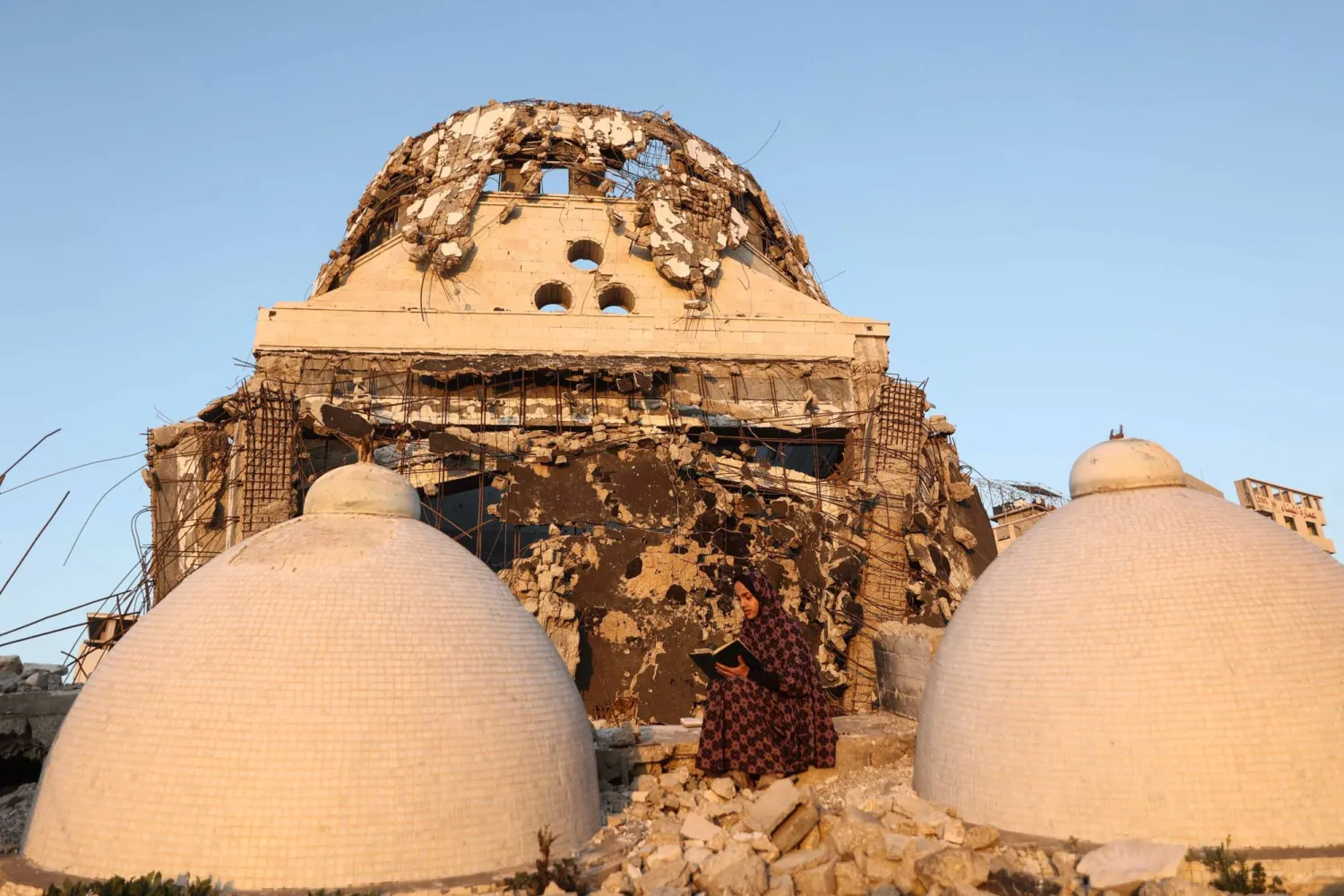
A female member of the al-Ghafir family, sits of the debris of the al-Hasayna Mosque as she recites from a copy of the Quran, during the holy month of Ramadan in western Gaza City on February 21, 2026. (Photo by Omar AL-QATTAA / AFP)
TT

Israeli Team in Peace Council Reveals Vision for Gaza Reconstruction

A female member of the al-Ghafir family, sits of the debris of the al-Hasayna Mosque as she recites from a copy of the Quran, during the holy month of Ramadan in western Gaza City on February 21, 2026. (Photo by Omar AL-QATTAA / AFP)

While many observers remain skeptical about the chances of success for President Donald Trump’s comprehensive Middle East peace plan, figures close to the US administration are projecting confidence. Among them are three Israelis selected for key roles in the project, though they do not formally represent the Israeli government.

According to a report in Yedioth Ahronoth, the officials insist the initiative is already underway, with Egypt, Türkiye and Qatar playing influential roles in persuading Hamas to cooperate. Despite skepticism within parts of Israel’s political and military leadership regarding the feasibility of the plan — and the ability of Trump advisers Steve Witkoff and Jared Kushner to implement it — the Peace Council members argue that progress so far is “encouraging.”

The Israeli members of the council are Israeli-Cypriot businessman Yakir Gabay, high-tech entrepreneur Liran Tancman, and Michael Eisenberg, who serves as Prime Minister Benjamin Netanyahu’s representative at the US coordination headquarters in Kiryat Gat.

They contend that Hamas’ agreement to disarm, coupled with reforms to Palestinian school curricula to promote “a culture of peace and tolerance,” would transform Trump’s initiative into “a historic opportunity to turn Gaza into a true Riviera.”

Gabay outlined the first phase: removing 70 million tons of rubble and unexploded ordnance, recycling usable materials, demolishing and sealing hundreds of kilometers of tunnels, and establishing rapid temporary housing in reinforced tents. Parallel efforts would focus on building infrastructure and permanent residential towers.

Plans also include modern hospitals, schools, factories, agricultural zones, road and rail networks, energy and water facilities, data centers, a seaport and an airport. Contractors experienced in constructing millions of housing units across the Middle East would be recruited, with funding reportedly secured. Hundreds of thousands of jobs are expected to be created. In addition to housing and workplaces, 200 hotels are planned.

Tancman, who advises Israel’s national cyber directorate, pledged to introduce advanced technological solutions in cooperation with American, Arab and Palestinian partners. This includes upgrading Gaza’s internet network from 2G to 5G and making access free of charge. Mechanisms for exporting Gaza-made goods are also under development.

A “New Era”?

Officials told Yedioth Ahronoth that reconstruction has effectively begun in Rafah and is expected to take three years. Israel is currently clearing debris, with 100,000 homes slated for construction in the first phase to house 500,000 residents. Infrastructure alone is projected to cost $5 billion. Ultimately, 400,000 homes are planned, with total infrastructure costs estimated at $30 billion, alongside a similar sum for construction.

A senior Peace Council member suggested that if Hamas responds positively, Israel could consider measures such as amnesty for its leaders or even purchasing weapons for cash. “Gaza and its people could enter a new era—connected and open to the world,” he said.

Separately, The Times of Israel cited a US official confirming that funds would not flow before Hamas agrees to disarm, adding that Israel must also act constructively.

An Arab diplomat cautioned that sustained pressure on both sides would be essential to ensure the plan’s success and the establishment of a technocratic administration in Gaza.



Lebanon to Transfer 129 Syrian Prisoners Next Week, Withholds Seven Over Security Concerns

Protesters in rural Homs last November demand the release of Syrian detainees held in Lebanese prisons (SANA). 
TT

Lebanon to Transfer 129 Syrian Prisoners Next Week, Withholds Seven Over Security Concerns

Protesters in rural Homs last November demand the release of Syrian detainees held in Lebanese prisons (SANA). 

Lebanon is set to transfer 129 convicted Syrian prisoners to Syrian authorities next week under a bilateral agreement signed in February, while withholding seven others pending further security reviews, a senior judicial source said.

The move reflects growing judicial and security cooperation between Beirut and Damascus after years of strained coordination. It also highlights Lebanon’s efforts to ease chronic prison overcrowding while ensuring that inmates deemed potential security risks are subjected to additional scrutiny before any transfer takes place.

The source told Asharq Al-Awsat that all legal procedures have been completed for the 129 prisoners, allowing them to be transferred to Syria to serve the remainder of their sentences. Seven other Syrian convicts have been excluded from the current transfer because their files contain security-related concerns that require further examination before a final decision is made on their status.

According to the source, Public Prosecutor Judge Ahmad Rami al-Hajj has completed his review of the lists of Syrian prisoners covered by the agreement and forwarded them to the Lebanese premiership for approval.

The Prime Minister’s Office is expected to issue a formal letter stating it has no objection to the names on the list, clearing the way for implementation.

Once that step is completed — likely within two or three days — the file will be referred to Justice Minister Adel Nassar, who will prepare and sign the final decision authorizing the transfer in accordance with the agreement.

The exact timing of the handover has not yet been determined. The source said the operation requires coordination among several security and administrative agencies.

After legal procedures are finalized, the Internal Security Forces will oversee the prisoners’ release from Lebanese jails and complete the necessary administrative and security paperwork. Lebanon’s General Security Directorate will then transport the prisoners to the Lebanese-Syrian border.

The prisoners will be handed over to a Syrian security team at the Masnaa border crossing in the Bekaa Valley under a mechanism agreed upon by the two countries.

The transfer program has become one of the most visible examples of renewed judicial cooperation between Lebanon and Syria. In March, Lebanon transferred 134 convicted Syrians, roughly a month after the agreement was signed, helping address cases that had remained unresolved for years.

The judicial source stressed that withholding some prisoners does not undermine or circumvent the agreement. Rather, it reflects the Lebanese authorities’ determination not to treat the matter as a purely administrative exercise.

Sensitive cases, particularly those involving security-related allegations or suspicions, require thorough judicial and security scrutiny, the source said.

The fate of the seven withheld prisoners will depend on the outcome of ongoing reviews and whether their cases warrant inclusion in a future third transfer or different legal measures.


Hezbollah’s Call to Reshuffle Lebanese Govt Face Berri’s Opposition

Speaker Nabih Berri (Lebanese Parliament) 
TT

Hezbollah’s Call to Reshuffle Lebanese Govt Face Berri’s Opposition

Speaker Nabih Berri (Lebanese Parliament) 

Lebanese are awaiting the publication of the reported US-Iran memorandum of understanding to determine whether it contains any provisions relating to Lebanon.

The document is expected to settle competing interpretations promoted by rival political camps, each claiming its provisions serve their interests.

Attention is also focused on how Hezbollah would respond if the memorandum does not address an Israeli withdrawal from southern Lebanon and instead limits itself to calling for an immediate and permanent cessation of military operations on all fronts, including Lebanon, while affirming the country’s sovereignty.

Such an outcome would contradict Hezbollah’s narrative that an Israeli withdrawal would be placed on the agenda of US-Iran talks, envisioned as a 60-day process that could be extended and potentially punctuated by further rounds of violence.

In its statement on the memorandum, Hezbollah stopped short of declaring victory and merely thanked Iran.

Opponents interpret this as an indication that the issue of Israel’s withdrawal from southern Lebanon has been deferred to the fifth round of Lebanese-Israeli negotiations, scheduled for June 23–25 at both military and political levels under US auspices.

They argue this will increase pressure on Hezbollah to surrender its weapons, echoing recent domestic and international calls, including those contained in the final communiqué of the Group of Seven summit.

At the same time, observers say it remains to be seen whether the US is willing to pressure Israel to withdraw, particularly amid reports of President Donald Trump’s frustration with Israeli Prime Minister Benjamin Netanyahu over strikes in Beirut’s southern suburbs and what critics describe as actions that complicated efforts to reach an understanding with Iran.

A Different Round of Negotiations

A cabinet source said the upcoming negotiations differ fundamentally from previous rounds because they come after the US-Iran understanding and amid a broader regional shift. According to the source, both Israel and Hezbollah will have to adapt to a new political reality.

The source argued that Hezbollah now faces a choice between changing its conduct or persisting in policies that, in the view of its critics, brought severe consequences for Lebanon through its support for Gaza and Iran.

The source maintained that Hezbollah no longer has the capacity to sustain a prolonged conflict and should instead align itself with the state’s diplomatic strategy and respond to demands from a majority of Lebanese for what was described as the “Lebanonization” of its political positions.

The same source said many domestic and international actors are counting on Parliament Speaker Nabih Berri to persuade Hezbollah to reassess both its political and military options after what critics regard as a costly period for the country.

Weapons and Withdrawal

According to the source, negotiations remain the only viable path toward restoring stability in southern Lebanon. The envisioned framework would pair a phased Israeli withdrawal with a timetable under which Hezbollah would gradually place its weapons under state authority.

The source argued that recent developments have demonstrated the limits of Hezbollah’s military deterrence against further Israeli expansion.

The source also rejected suggestions that any US-Iran understanding would revive Iran’s influence in Lebanon or restore Hezbollah to the position it held before the Gaza war.

Dispute Over the Government

As Lebanon prepares for what many see as a new phase, a source close to the Shiite political alliance said Hezbollah is divided over how to deal with Prime Minister Nawaf Salam’s government.

One faction, described as hardline, favors changing the government, while another believes current political conditions make such a move unrealistic because of parliamentary arithmetic and that priority should instead be given to securing an Israeli withdrawal and rebuilding devastated towns.

The source said opponents of changing the government view such a confrontation as a losing battle that would deepen Hezbollah’s isolation, strengthen support for the government, and reinforce the diplomatic approach pursued jointly by President Joseph Aoun and Salam.

The source added that Hezbollah currently needs international and Arab support for reconstruction and reconciliation with its own constituency more than it needs a political showdown.

Any effort to replace the government or reshuffle ministers, the source said, would first have to win over Berri, who has consistently called for national unity, reducing internal tensions, safeguarding civil peace, and preserving domestic stability in the face of Israel.

For that reason, he opposes attempts either to topple the government through street pressure or to seek its replacement.


Yemeni Sources: Prosecutor Orders Freeze of Dissolved STC Funds

Supporters of the dissolved Southern Transitional Council at a previous protest in Aden (AP) 
TT

Yemeni Sources: Prosecutor Orders Freeze of Dissolved STC Funds

Supporters of the dissolved Southern Transitional Council at a previous protest in Aden (AP) 

The Yemeni government has escalated its measures against the dissolved Southern Transitional Council (STC), with the public prosecutor ordering a precautionary freeze on the group’s assets and bank accounts while the government simultaneously presses the UN Security Council to impose sanctions on its leader, Aidarous al-Zubaidi.

According to informed sources cited by the Aden al-Ghad newspaper, Attorney General Judge Qaher Mustafa issued an order freezing all assets and bank accounts belonging to the dissolved STC held by banks, financial institutions, exchange companies and money-transfer businesses.

The move is part of efforts aimed at protecting public funds, combating corruption and money laundering, and restoring state control over financial and sovereign resources.

The order prohibits any disposal of the frozen funds, including withdrawals, transfers, assignments or other legal and financial transactions, pending the completion of investigations and further directives from the Public Prosecution or competent judicial authorities.

It also requires the Central Bank of Yemen, commercial and Islamic banks, financial institutions and exchange companies to implement the measures immediately and report any accounts, balances or assets linked to the entity under investigation.

The Public Prosecution said the action was based on what it described as sufficient preliminary indicators suggesting that the funds may be connected to matters currently under investigation. It stressed that the asset freeze is a temporary legal measure intended to preserve disputed funds until judicial proceedings are completed.

Earlier this year, Yemen’s Presidential Leadership Council removed al-Zubaidi from its membership and referred him to the attorney general on charges including “high treason aimed at undermining the independence of the republic” under Article 125 of the Crimes and Penalties Law, and harming the republic’s military, political and economic standing under Article 128.

The referral also accused him of forming an armed group, involvement in the killing of military officers and soldiers, exploiting and damaging the Southern cause through serious abuses against civilians and attacks on military installations, and engaging in sustained armed confrontations against government forces.

According to the decision, the charges further include violating the constitution and constitutional authorities under Articles 131 and 132 of the Crimes and Penalties Law, breaching national laws and infringing on the country’s sovereignty and independence.

The judicial action coincided with a diplomatic campaign by the Yemeni government, which urged the UN Security Council to impose sanctions on al-Zubaidi and add him to the UN sanctions list.

Yemen called on the council to regularly update sanctions lists to include individuals and entities accused of undermining state institutions or attempting to impose political or military realities by force outside constitutional and legal frameworks.

The request was made during a Security Council session on developments in Yemen. Yemen’s permanent representative said the government was prepared to cooperate fully with the United Nations and the sanctions committee and provide any additional information or documentation needed to support international accountability efforts.

The government accuses al-Zubaidi of leading unilateral political and military actions that weakened state institutions, obstructed efforts to unify security and military command structures, threatened domestic stability and hindered political settlement efforts.