


Tesla Previews Humanoid Robot, but Musk Cautions It Is Not Ready Just Yet

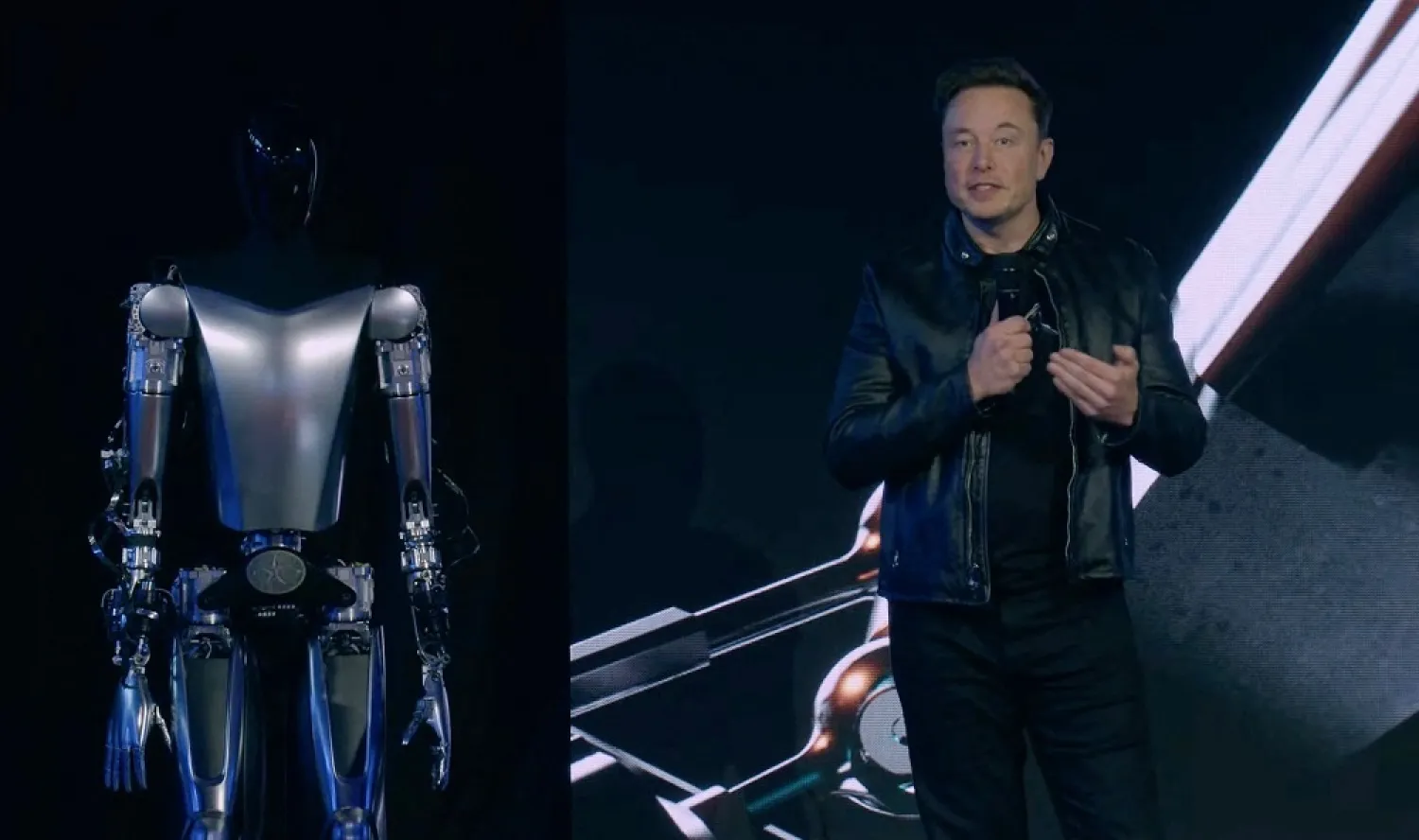
This video screen grab made from Tesla AI Day 2022 livestream shows Elon Musk standing on stage next to Optimus the humanoid robot in Palo Alto, California on September 30, 2022. (AFP/ Handout/ Tesla)
TT

Tesla Previews Humanoid Robot, but Musk Cautions It Is Not Ready Just Yet

This video screen grab made from Tesla AI Day 2022 livestream shows Elon Musk standing on stage next to Optimus the humanoid robot in Palo Alto, California on September 30, 2022. (AFP/ Handout/ Tesla)

Tesla CEO Elon Musk said on Friday the electric vehicle maker's eagerly anticipated humanoid robot "Optimus" would cost under $20,000 and cautioned it still had way to go before becoming fully functional.

"There's still a lot of work to be done to refine Optimus and prove it," Musk told the electric vehicle maker's "AI Day" event being held at a Tesla office in Palo Alto, California.

Musk said existing humanoid robots are "missing a brain" – and the ability to solve problems on their own. By contrast, he said, Optimus would be an "extremely capable robot" that Tesla would aim to produce in the millions. He said he expected it would cost less than $20,000.

Tesla said the company had developed a prototype for its robot in February. That early model walked out to wave at the crowd on Friday, and Tesla showed a video of it doing simple tasks, such as watering plants, carrying boxes and lifting metal bars at a production station at Tesla’s California plant.

Musk and Tesla representatives acknowledged that there was a lot of work to be done to achieve the goal of a mass-produced, low-cost robot, using Tesla-designed technology that would be capable of replacing humans at work.

Other automakers, including Toyota Motor and Honda Motor, have developed humanoid robot prototypes capable of doing complicated things like shooting a basketball, and production robots from ABB and others are a mainstay of auto manufacturing.

But Tesla is alone in pushing the market opportunity for a mass-market robot that could also be used in factory work.

A next-generation Tesla bot, which was rolled on stage by staff, will use Tesla-designed components, including a 2.3 kWh battery pack carried in its torso, a chip system and actuators to drive its limbs. The robot is designed to weigh 73 kg.

"It wasn’t quite ready to walk. But I think it will walk in a few weeks," Musk said.

Musk has described the event as intended to recruit workers, and the engineers on stage catered to a technical audience. They detailed the process by which Tesla designed robot hands and used crash-simulator technology to test the robot’s ability to fall on its face without breaking.

Musk, who has spoken before about the risks of artificial intelligence, said the mass rollout of robots had the potential to "transform civilization" and create "a future of abundance, a future of no poverty." But he said he believed it was important that Tesla shareholders had a role in vetting the company’s efforts.

"If I go crazy, you can fire me," Musk said. "This is important."

Tesla also discussed its long-delayed self-driving technology at the event. Engineers working on the auto self-driving software described how they trained software to choose actions, such as when to merge into traffic, and how they sped up the computer decision-making process.

In May, Musk said that the world's most valuable car maker would be "worth basically zero" without achieving full self-driving capability, and it faces growing regulatory probes, as well as technological hurdles.

Musk has said he expects Tesla will achieve full self-driving this year and mass produce a robotaxi with no steering wheel or pedal by 2024.

At an "Autonomy" event in 2019, Musk promised 1 million robotaxis by 2020 but has yet to deliver such a car.



OpenAI Introducing Ads to ChatGPT

FILE PHOTO: OpenAI logo is seen in this illustration taken May 20, 2024. REUTERS/Dado Ruvic/Illustration/File Photo
TT

OpenAI Introducing Ads to ChatGPT

FILE PHOTO: OpenAI logo is seen in this illustration taken May 20, 2024. REUTERS/Dado Ruvic/Illustration/File Photo

OpenAI announced Thursday it will begin testing advertisements on ChatGPT in the coming weeks, as the wildly popular artificial intelligence chatbot seeks to increase revenue to cover its soaring costs.

The ads will initially appear in the United States for free and lower-tier subscribers, the company said in a blog post outlining its long-anticipated move into advertising.

The integration of advertising has been a key question for generative AI chatbots, with companies largely reluctant to interrupt the user experience with ads.

But the exorbitant costs of running AI services may have forced OpenAI's hand.
Only a small percentage of its nearly one billion users pay for subscription services, putting pressure on the company to find new revenue sources.

Since ChatGPT's launch in 2022, OpenAI's valuation has soared to $500 billion in funding rounds -- higher than any other private company. Some expect it could go public with a trillion-dollar valuation.

But the ChatGPT maker burns through cash at a furious rate, mostly on the powerful computing required to deliver its services.

With its move, OpenAI brings its business model closer to tech giants Google and Meta, which have built advertising empires on the back of their free-to-use services.

Unlike OpenAI, those companies have massive advertising revenue to fund AI innovation -- with Amazon also building a solid ad business on its shopping and video streaming platforms.

"Ads aren't a distraction from the gen AI race; they're how OpenAI stays in it," said Jeremy Goldman, an analyst at Emarketer.

"If ChatGPT turns on ads, OpenAI is admitting something simple and consequential: the race isn't just about model quality anymore; it's about monetizing attention without poisoning trust," he added.

OpenAI's pivot comes as Google gains ground in the generative AI race, infusing services including Gmail, Maps and YouTube with AI features that -- in addition to its Gemini chatbot -- compete directly with ChatGPT.

To address concerns about its pivot into advertising, OpenAI pledged that ads would never influence ChatGPT's answers and that user conversations would remain private from advertisers.

"Ads do not influence the answers ChatGPT gives you," the company stated, according to AFP. "Answers are optimized based on what's most helpful to you. Ads are always separate and clearly labeled."

In an apparent reference to Meta, TikTok and Google's YouTube -- platforms accused of maximizing user engagement to boost ad views -- OpenAI said it would "not optimize for time spent in ChatGPT."

"We prioritize user trust and user experience over revenue," it added.

The commitment to user well-being is a sensitive issue for OpenAI, which has faced accusations of allowing ChatGPT to prioritize emotional engagement over safety, allegedly contributing to mental distress among some users.


US Allows Nvidia to Send Advanced AI Chips to China with Restrictions

An Nvidia logo and a computer motherboard appear in this illustration taken August 25, 2025. (Reuters)
TT

US Allows Nvidia to Send Advanced AI Chips to China with Restrictions

An Nvidia logo and a computer motherboard appear in this illustration taken August 25, 2025. (Reuters)

The US Commerce Department on Tuesday opened the door for Nvidia to sell advanced artificial intelligence chips in China with restrictions, following through on a policy shift announced last month by President Donald Trump.

The change would permit Nvidia to sell its powerful H200 chip to Chinese buyers if certain conditions are met -- including proof of "sufficient" US supply -- while sales of its most advanced processors would still be blocked.

However, uncertainty has grown over how much demand there will be from Chinese companies, as Beijing has reportedly been encouraging tech companies to use homegrown chips.

Chinese officials have informed some firms they would only approve buying H200 chips under special circumstances, such as development labs or university research, news website The Information reported Tuesday, citing people with knowledge of the situation.

The Information had previously reported that Chinese officials were calling on companies there to pause H200 purchases while they deliberated requiring them to buy a certain ratio of AI chips made by Nvidia rivals in China.

In its official update on Tuesday, the US Commerce Department's Bureau of Industry and Security said it had changed the licensing review policy for H200 and similar chips from a presumption of denial to handling applications case-by-case.

Trump announced in December an agreement with Chinese President Xi Jinping to allow Nvidia to export its H200 chips to China, with the US government getting a 25-percent cut of sales.

The move marked a significant shift in US export policy for advanced AI chips, which Joe Biden's administration had heavily restricted over national security concerns about Chinese military applications.

Democrats in Congress have criticized the move as a huge mistake that will help China's military and economy.

- Chinese chips -

Nvidia chief executive Jensen Huang has advocated for the company to be allowed to sell some of its more advanced chips in China, arguing the importance of AI systems around the world being built on US technology.

The chips -- graphic processing units or GPUs -- are used to train the AI models that are the bedrock of the generative AI revolution launched with the release of ChatGPT in 2022.

The GPU sector is dominated by Nvidia, now the world's most valuable company thanks to frenzied global demand and optimism for AI.

H200s are roughly 18 months behind the US company's most state-of-the-art offerings, which will still be off-limits to China.

Nvidia's Huang has repeatedly warned that China is just "nanoseconds behind" the United States as it accelerates the development of domestically produced advanced chips.

On Wednesday, leading Chinese AI startup Zhipu said it had used homegrown Huawei chips to train its new image generator.

Zhipu AI described its tool as "the first state-of-the-art multimodal model to complete the entire training process on a domestically produced chip".

The startup went public in Hong Kong last week and its shares have since soared 75 percent -- one of several dazzling recent initial public offerings by Chinese chip and generative AI companies, as high hopes for the sector outweigh concerns of a potential market crash.


Apple Rolls Out Creator Studio to Boost Services Push, Adds AI Features

A customer compares his old iPhone with the newly launched iPhone 17 pro max at an Apple retail store in Delhi, India, September 19, 2025. (Reuters)
TT

Apple Rolls Out Creator Studio to Boost Services Push, Adds AI Features

A customer compares his old iPhone with the newly launched iPhone 17 pro max at an Apple retail store in Delhi, India, September 19, 2025. (Reuters)

Apple on Tuesday unveiled Apple Creator Studio, a new subscription bundle of professional creative software priced at $12.99 a month or $129 a year, as the iPhone maker steps up its push into paid services for creators, students and professionals.

The company has used its services business, which includes its Apple ‌Music and ‌iCloud services, to drive ‌growth ⁠in recent ‌years, helping counter slower hardware growth and generate recurring revenue.

Apple Creator Studio bundles some of the company's best-known creative tools into a single subscription, including Final Cut Pro, Logic Pro ⁠and Pixelmator Pro across Mac and iPad.

The ‌package also adds premium ‍content and ‍new AI-powered features to Apple's productivity apps ‍Keynote, Pages and Numbers, while digital whiteboarding app Freeform will gain enhanced features later.

Final Cut Pro will offer new tools such as transcript-based search, visual search and beat detection to ⁠speed up video editing, while Logic Pro introduces AI-powered features like Synth Player and Chord ID to assist with music creation.

The company's Photoshop-alternative Pixelmator Pro will be available on iPad for the first time and will offer Apple Pencil support.

The subscription launches January 28 on ‌the App Store, Apple said.