

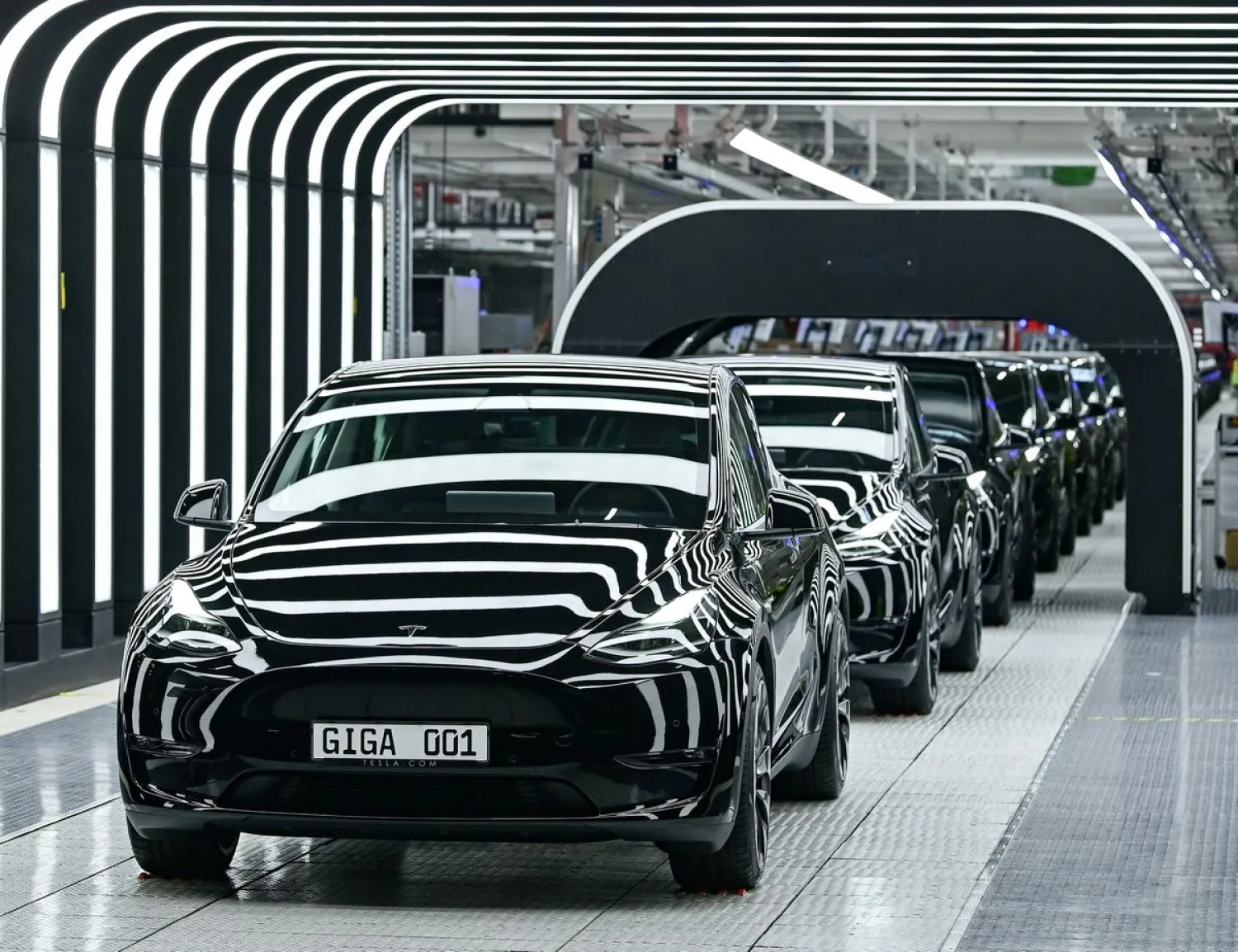

Tesla’s Logistical Challenges Overshadow Record Deliveries

Model Y cars are pictured during the opening ceremony of the new Tesla Gigafactory for electric cars in Gruenheide, Germany, March 22, 2022. Patrick Pleul/Pool via REUTERS/File Photo
TT

Tesla’s Logistical Challenges Overshadow Record Deliveries

Model Y cars are pictured during the opening ceremony of the new Tesla Gigafactory for electric cars in Gruenheide, Germany, March 22, 2022. Patrick Pleul/Pool via REUTERS/File Photo

Tesla Inc (TSLA.O) on Sunday announced lower-than-expected electric vehicle deliveries in the third quarter, as logistical challenges overshadowed its record deliveries.

The top electric car maker said "it is becoming increasingly challenging to secure vehicle transportation capacity and at a reasonable cost," but some analysts were also concerned about demand for high-ticket items due to the weakening global economy.

"The economy around the edges is still having a negative impact for Tesla that's mostly logistical. But that I think there is some demand (issues) sprinkled in there," Wedbush Securities analyst Dan Ives told Reuters after the delivery results.

"There is a dark cloud over the auto sector. And Tesla is not immune."

Ford Motor (F.N) said last month inflation-related costs would be $1 billion more than expected in the third quarter and that parts shortages had delayed deliveries.

Apple Inc. (AAPL.O) is backing off plans to increase production of its new iPhones this year after an anticipated surge in demand failed to materialize, Bloomberg reported last month, citing people familiar with the matter.

"I think that EVs are in for probably a little bit of a rough patch, just because people are probably going to be a little bit hesitant and less urgent to buy something new," OANDA senior market analyst Ed Moya said.

Tesla delivered 343,830 electric vehicles, a record for the world's most valuable automaker, but less than the 359,162 analysts on average had expected, according to Refinitiv. A year earlier Tesla delivered 241,300 units.

The latest deliveries fell short of Tesla's production of 365,923 vehicles, which is rare for the automaker which has seen its deliveries higher or similar to production in many of recent quarters.

"As our production volumes continue to grow, it is becoming increasingly challenging to secure vehicle transportation capacity and at a reasonable cost during these peak logistics weeks," Tesla said in a statement on Sunday.

Tesla CEO Elon Musk said on Sunday "Smoothing out crazy end of quarter delivery wave to reduce expedite costs & relieve stress on Tesla team."

Last year, he said Tesla is having a "crazy wave" of deliveries at the end of each quarter, because its Shanghai factory makes cars for exports to Europe and other countries in the first half of a quarter and then cars to be sold in China.

Tesla again asked employees to help deliver "a very high volume of vehicles to eagerly waiting customers during the final days of Q3" in California, according to an email seen by Reuters.

Tesla on Sunday said it has "began transitioning to a more even regional mix of vehicle builds each week, which led to an increase in cars in transit at the end of the quarter."

Tesla set an ambitious target to produce almost 495,000 Model Y and Model 3s in the fourth quarter of this year, internal plans reviewed by Reuters show.

The company's production ambitions come against the backdrop of increasingly gloomy outlook for global growth, with Musk himself telling top managers in June he had a "super bad feeling" about the economy and planned to cut staff.

During a conference call in July, Musk said at first that macroeconomic uncertainty might have some impact on demand for its electric vehicles, but when pressed for details by an analyst, he said the company did not have a demand problem but a production problem.

The automaker expanded production capacity in Shanghai after a resurgence in COVID-19 cases forced a suspension at the plant and fueled the first dip in deliveries after a nearly two-year-long record run.

In September, Tesla's vehicle order backlog fell, especially in China, Troy Teslike, a Tesla data tracker tweeted.

Tesla said it delivered 325,158 Model 3 compact cars and Model Y sport-utility vehicle, as well as 18,672 of its Model S and Model X premium vehicles to customers during the quarter.

Meanwhile, Musk on Friday showed off a prototype of its humanoid robot 'Optimus,' predicting the electric vehicle maker would be able to produce millions and sell them for under $20,000 - less than a third of the price of a Model Y.

Experts were impressed by the speed of development of Tesla's humanoid robots, but they agreed with Musk, who said "there's still a lot of work to be done to refine Optimus and prove it."



Sony Says to Stop Releasing PlayStation Games on Discs

French PlayStation' collector Cyril, poses with a PlayStaion 1, at his home in Vraiville, on November 20, 2024. (AFP)
TT

Sony Says to Stop Releasing PlayStation Games on Discs

French PlayStation' collector Cyril, poses with a PlayStaion 1, at his home in Vraiville, on November 20, 2024. (AFP)

Sony said Wednesday that it would stop releasing new video games for the PlayStation on disc in January 2028 following a shift in consumer preferences.

"Following this date, new games will be available on PlayStation Store and at retailers in digital formats only," the company said on its official PlayStation blog.

Sony said the upcoming shift "has no impact on games that already released, or will be releasing, prior to January 2028 in disc format."

The announcement comes as the upcoming exclusively digital release of "Grand Theft Auto VI", which is predicted to become the biggest-selling cultural product of all time, has caused some consternation among gamers.

There was grumbling on social media that the lack of a physical disc would eliminate any second-hand market for the title.

"This is a natural direction for Sony Interactive Entertainment to adapt to consumer trends as the general preference for digital media significantly outpaces physical discs," the company said.

"We remain committed to delivering a world-class gaming experience to our fans," it added.


Fear and Anger Brew Inside Meta amid AI Frenzy

The word "Hack" is seen in this aerial view of Meta's corporate headquarter offices in Menlo Park, California. JOSH EDELSON / AFP
TT

Fear and Anger Brew Inside Meta amid AI Frenzy

The word "Hack" is seen in this aerial view of Meta's corporate headquarter offices in Menlo Park, California. JOSH EDELSON / AFP

A frenzied push for artificial intelligence dominance comes with a different kind of cost for Meta, where massive layoffs, employee surveillance and departures have fueled reports of a heated internal climate.

As Meta spends billions annually to build out its AI capabilities, employees at Facebook, Instagram and WhatsApp are increasingly unhappy with their Mark Zuckerberg-led parent company, AFP reported.

Meta employees have weathered frequent layoffs since early 2025, including this spring when the company cut 10 percent of its workforce -- some 8,000 jobs -- and reshuffled another 7,000 employees.

For those who remain, an internal AI training initiative has drawn accusations of surveillance.

The company also underwent a major reorganization of its AI research division, into which Zuckerberg, Meta's founder and chief executive, has poured billions of dollars.

The malaise stands in stark contrast to Meta's robust finances -- driven by advertising, which makes up nearly 98 percent of its revenue. In the first three months of 2026, Meta's net income rose to more than $26 billion.

However, the bill for its AI investments is also exploding, prompting Zuckerberg, who has near-absolute power over the company, to impose sweeping cuts and increased monitoring of employees in the name of efficiency and savings.

The cuts are funding a massive race for infrastructure: Meta plans to spend up to $145 billion on AI investments this year, nearly twice last year's figure.

Harvesting data

After thousands of employees were reassigned to Meta's AI division, some, speaking anonymously to US media, have complained of "mind-numbing" tasks designed to train machines, or even automate away their own jobs.

That controversial program, called the Model Capability Initiative, was rolled out in April and suspended on June 22. It captured clicks, keystrokes and browsing activity of US employees to train AI agents -- software capable of independently performing tasks.

Zuckerberg, who has made AI the company's North Star, defended the program during an internal meeting: "AI models learn by watching really smart people do things," he said, according to Wired.

But the tool sparked a revolt. More than 1,600 employees signed a petition calling for it to end, with some likening the company to a "data extraction factory," according to media reports.

The pause came after private conversations, and performance data inadvertently became accessible to all staff. The system risked drawing the attention of European regulators, since it captured exchanges between employees on both continents.

In a statement to AFP Tuesday, a Meta spokesperson said the program was designed with privacy safeguards.

"While we have no indication at this time that any data was improperly accessed by Meta employees, we're pausing it while we investigate," the statement said.

One employee summed up the mood with a meme from "The Office," posted on an internal company forum, reading: "0 days since our last nonsense."

'Dead end quest'

All of these efforts aim to make up for a persistent lag behind Google, OpenAI and Anthropic, which dominate the race for cutting-edge AI models. Meta's own models, repeatedly delayed, have proved disappointing even internally.

To regain ground, Zuckerberg invested over $14 billion last year into Scale AI, a San Francisco-based startup, and poached its CEO Alexandr Wang -- who was 28 years old at the time -- to run a "superintelligence" lab inside Meta.

The expensive bet has yet to win people over. Several key figures have since walked out, among them Yann LeCun, considered one of the "godfathers" of modern AI, who had led Meta's AI research since 2013.

LeCun suddenly found himself reporting to Wang, more than 35 years his junior. He left Meta at the end of 2025 to launch his own startup.

In an interview with the Financial Times, the Turing Award winner lamented that, although "he learns fast," Wang has "no experience with research" and was on "a dead end" quest.

The stakes for Meta go beyond its social networks now. The company is also doubling down on consumer electronics with smart glasses and is considering a new prediction-market app called Arena, potentially in partnership with Polymarket and Kalshi, according to The New York Times.

Lawsuits also threaten to consume time and resources.

For the first time, a Los Angeles jury in March found Meta liable for the effects of social media addiction, just one day after a separate ruling in New Mexico said Meta had failed to protect minors.

Meta has appealed, but more lawsuits are expected this year.


South Korean Trade Watchdog Alleges Google Abused Its Position in Android App Store

A pedestrian walks past the Google offices in London, Britain, August 14, 2025. (Reuters)
TT

South Korean Trade Watchdog Alleges Google Abused Its Position in Android App Store

A pedestrian walks past the Google offices in London, Britain, August 14, 2025. (Reuters)

South Korea's antitrust regulator alleged on Wednesday that Alphabet's Google abused its dominant position in the Android app marketplace to hinder competition and will recommend corrective measures and a financial penalty.

The Korea Fair Trade Commission's (KFTC) Market Surveillance Bureau found Google's alleged abuse of market dominance in the Android app marketplace affected 14.16 trillion won ($9.1 billion) in revenue, the bureau said in a media briefing where it released its examiner's report on the matter.

From July ‌2019 to March ‌2026, Google's Games/Google Velocity Program, which it ‌internally ⁠called "Project Hug", offered domestic ⁠and overseas game developers financial support for using Google services such as Cloud, Ads and YouTube, provided that they launched games on Google's app store on terms at least as favorable as rival app marketplaces, the report said.

The contracts were also structured so that Google's financial ⁠support increased progressively as developers generated more ‌revenue through Google Play, creating ‌stronger incentives to prioritize Google's marketplace.

The program significantly reduced developers' ‌incentives to distribute games through competing app stores, including South ‌Korea's OneStore, blocking rivals' business activities and forcing developers into de facto exclusive dealing with Google, according to the report.

"Google Play competes fairly with other app stores and delivers numerous benefits ‌to developers and consumers in Korea.

"We have cooperated diligently with the KFTC's investigation, and ⁠we will ⁠continue to show the Commissioners that there has been no violation of the law,” Google said in a statement to Reuters.

If the commission ultimately concludes that Google abused its market dominance, it may impose a fine of up to 6% of the relevant affected revenue of $9.1 billion.

Google has eight weeks from receiving the examiner's report to submit a written response and review the evidence.

The bureau said it plans to convene the full commission and issue a final ruling promptly once Google's due process rights have been fully observed.