


Lebanon Practically Enters 'Presidential Vacuum' a Week before End of Aoun’s Term

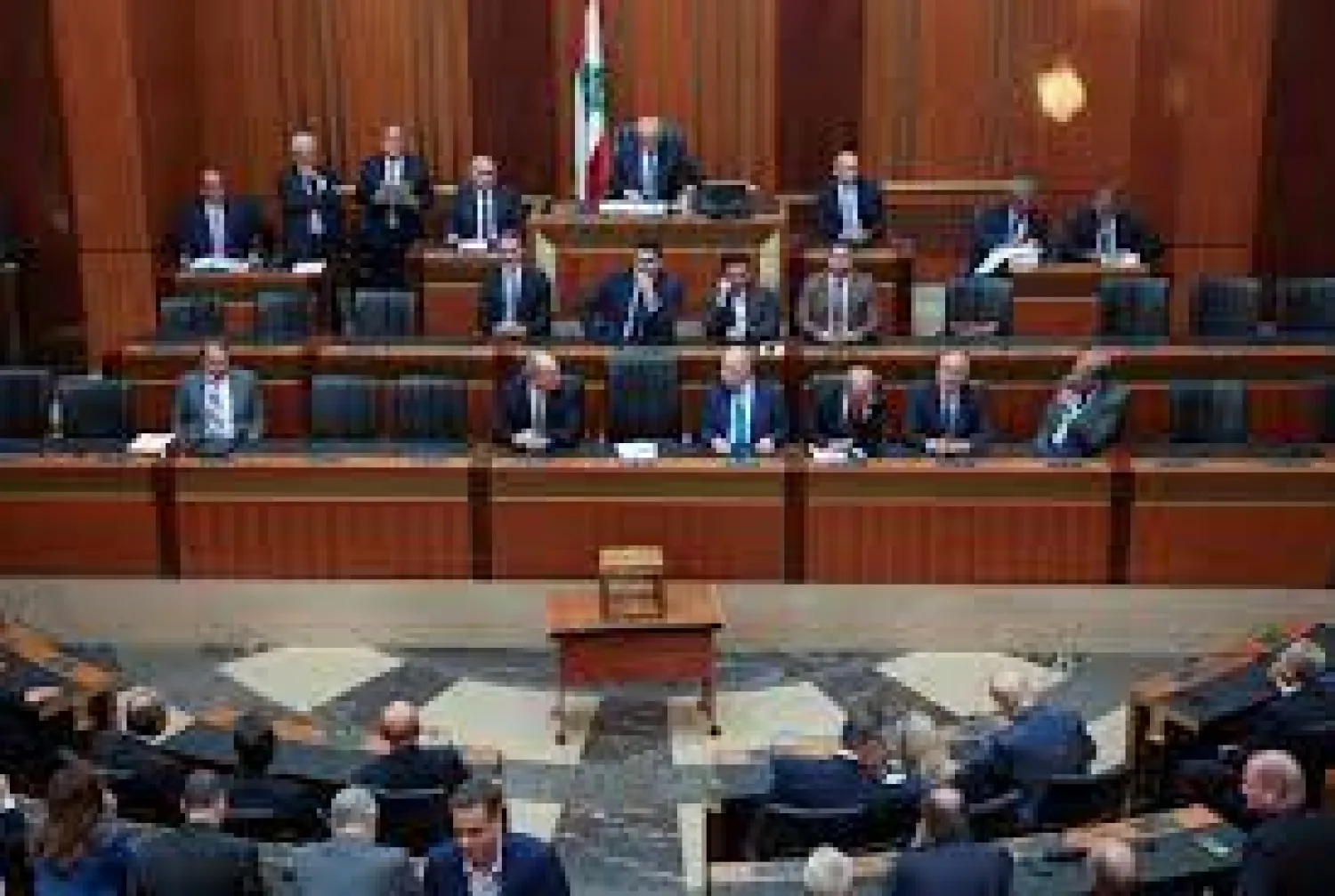
 Lebanese Parliament Speaker Nabih Berri heads the first session to elect a new president at the parliament building in Beirut, Lebanon September 29, 2022. REUTERS/Mohamed Azakir
Lebanese Parliament Speaker Nabih Berri heads the first session to elect a new president at the parliament building in Beirut, Lebanon September 29, 2022. REUTERS/Mohamed Azakir
TT

Lebanon Practically Enters 'Presidential Vacuum' a Week before End of Aoun’s Term

 Lebanese Parliament Speaker Nabih Berri heads the first session to elect a new president at the parliament building in Beirut, Lebanon September 29, 2022. REUTERS/Mohamed Azakir
Lebanese Parliament Speaker Nabih Berri heads the first session to elect a new president at the parliament building in Beirut, Lebanon September 29, 2022. REUTERS/Mohamed Azakir

A fourth attempt by the Lebanese Parliament to elect a new president for the country failed on Monday, as a result of a loss of quorum. Unlike previous sessions that ended similarly, Speaker Nabih Berri refrained from calling for a next round, telling Asharq Al-Awsat that the election sessions have become a “failed and useless play.”

“That’s why I will try to replace them with a dialogue between political forces,” he added.

Monday’s parliamentary session came about a week before the end of the tenure of President Michel Aoun, who will leave Baabda Palace next Sunday, one day before the end of his term, confirming the inevitability of a presidential vacuum amid continuous disagreements over the name of his successor.

Berri clearly explained his decision to stop convening the Parliament. He told Asharq Al-Awsat that the election sessions had become a “failed and useless play, and for this reason I will try to replace it with a dialogue between the political forces.”

He revealed that he has started sending his delegates to the political forces to solicit their opinion on the possibility of holding a national dialogue, with the aim to hold presidential elections that give the Lebanese “hope of getting out of the dangerous crises plaguing their country.”

In the same context, Berri asserted that he would not call for any dialogue before the end of Aoun’s current presidential term, refusing to assert that a vacuum occurred before all means were exhausted to avoid it.

In this context, he said: “It is useless to call for an election session in the absence of consensus and the balance of power within Parliament.”

“Dialogue will replace the sessions unless there is a possibility of consensus…” he added.

The fourth session did not bring anything new except for some changes in the distribution of votes. MP Michel Moawad obtained 39 votes, mainly from his Renewal Bloc, the Progressive Socialist Party (PSP), the Lebanese Forces (LF), and the Kataeb party. On the other hand, 50 blank papers were cast by representatives of Hezbollah and its allies, who left the session before the beginning of the second voting round. As a result, the quorum was lost.

Most of the Change Bloc deputies chose to vote for Issam Khalifeh (a university professor who defends Lebanon’s share in the maritime borders represented by what is known as Line 29 and not 23 as stipulated in the recent agreement), while the National Moderation deputies, as in the previous session, voted for “New Lebanon”, and two other votes were canceled.

In remarks following the session, Moawad said: “I got 39 votes due to the absence of a number of deputies, and I have a clear road map.”

He added: “Hezbollah wants a gray president who obeys to it. [The party] continues to isolate Lebanon.”

Moawad also pointed to the presence of “a dominant authority working to blackmail MPs and the Lebanese to maintain its quotas by disrupting sessions…”

Lebanese Forces MP George Adwan reiterated his support to Moawad’s candidacy. Responding to a question about the LF willingness to meet Hezbollah’s invitation to agree on a president, he said: “The point of disagreement with Hezbollah is based on the Constitution, the law, and arms outside state authority. Everything becomes possible if Hezbollah accepts the principle of the state, the Constitution and the law, and admits that no weapons remain outside the state.”

On the other hand, MP Alain Aoun, who is member of Aoun’s Free Patriotic Movement (FPM), stressed that the election of a new president could only be achieved by securing a minimum level of consensus.

“This requires dialogue, and [Monday’s session] is evidence that what is happening is not enough,” he stated.

In remarks before the beginning of the parliamentary session, Hezbollah MP Hassan Fadlallah said that his bloc would cast a blank paper.

“We hope that everyone will benefit from this experience.... We renew the call for understandings and for consensus on a name… We are open to dialogue. The issue is not a compilation of numbers,” he noted.



Germany Moves Troops Out of Iraq, Citing Mideast 'Tensions'

FILE PHOTO: German Defense Minister Ursula von der Leyen visits the Transport Helicopter Regiment 30 (Transporthubschrauberregiment 30) at the Hermann-Koehl-Kaserne in Niederstetten, Germany, August 20, 2018. REUTERS/Ralph Orlowski
TT

Germany Moves Troops Out of Iraq, Citing Mideast 'Tensions'

FILE PHOTO: German Defense Minister Ursula von der Leyen visits the Transport Helicopter Regiment 30 (Transporthubschrauberregiment 30) at the Hermann-Koehl-Kaserne in Niederstetten, Germany, August 20, 2018. REUTERS/Ralph Orlowski

Germany's military has "temporarily" moved some troops out of Erbil in northern Iraq because of "escalating tensions in the Middle East," a German defense ministry spokesman told AFP on Thursday.

Dozens of German soldiers had been relocated away from the base in Erbil, capital of Iraq's autonomous Kurdistan region.

"Only the personnel necessary to maintain the operational capability of the camp in Erbil remain on site," the spokesman said.

The spokesman did not specify the source of the tensions, but US President Donald Trump has ordered a major build-up of US warships, aircraft and other weaponry in the region and threatened action against Iran.

German troops are deployed to Erbil as part of an international mission to train local Iraqi forces.

The spokesman said the German redeployment away from Erbil was "closely coordinated with our multinational partners".


UN: At Least 15 Children Killed in Sudan Drone Strike

The war in Sudan, ongoing since mid-April 2023, has caused extensive destruction across the country (AFP)
TT

UN: At Least 15 Children Killed in Sudan Drone Strike

The war in Sudan, ongoing since mid-April 2023, has caused extensive destruction across the country (AFP)

A drone strike on a displacement camp in Sudan killed at least 15 children earlier this week, the United Nations reported late on Wednesday.

"On Monday 16 February, at least 15 children were reportedly killed and 10 wounded after a drone strike on a displacement camp in Al Sunut, West Kordofan," the UN children's agency said in a statement.

Across the Kordofan region, currently the Sudan war's fiercest battlefield, "we are seeing the same disturbing patterns from Darfur -- children killed, injured, displaced and cut off from the services they need to survive," UNICEF's Executive Director Catherine Russell said.


MSF Will Keep Operating in Gaza 'as Long as We Can'

(FILES) A Palestinian man walks on his crutches to the Doctors Without Borders or Medecins Sans Frontieres (MSF) clinic, in the al-Rimal neighborhood of Gaza City on new year's Eve, December 31, 2025. (Photo by Omar AL-QATTAA / AFP)
TT

MSF Will Keep Operating in Gaza 'as Long as We Can'

(FILES) A Palestinian man walks on his crutches to the Doctors Without Borders or Medecins Sans Frontieres (MSF) clinic, in the al-Rimal neighborhood of Gaza City on new year's Eve, December 31, 2025. (Photo by Omar AL-QATTAA / AFP)

The head of Doctors Without Borders in the Palestinian territories told AFP the charity would continue working in Gaza for as long as possible, following an Israeli decision to end its activities there.

In early February, Israel announced it was terminating all the activities in Gaza by the medical charity, known by its French acronym MSF, after it failed to provide a list of its Palestinian staff.

MSF has slammed the move, which takes effect on March 1, as a "pretext" to obstruct aid.

"For the time being, we are still working in Gaza, and we plan to keep running our operations as long as we can," Filipe Ribeiro told AFP in Amman, but said operations were already facing challenges.

"Since the beginning of January, we are not anymore in the capacity to get international staff inside Gaza. The Israeli authorities actually denied any entry to Gaza, but also to the West Bank," he said.

Ribeiro added that MSF's ability to bring medical supplies into Gaza had also been impacted.

"They're not allowed for now, but we have some stocks in our pharmacies that will allow us to keep running operations for the time being," he said.

"We do have teams in Gaza that are still working, both national and international, and we have stocks."

In December, Israel announced it would prevent 37 aid organizations, including MSF, from working in Gaza from March 1 for failing to submit detailed information about their Palestinian employees, drawing widespread condemnation from NGOs and the United Nations.

It had alleged that two MSF employees had links with Palestinian militant groups Hamas and Islamic Jihad, which the medical charity has repeatedly and vehemently denied.

MSF says it did not provide the names of its Palestinian staff because Israeli authorities offered no assurances regarding their safety.

Ribeiro warned of the massive impact the termination of MSF's operations would have for healthcare in war-shattered Gaza.

"MSF is one of the biggest actors when it comes to the health provision in Gaza and the West Bank, and if we are obliged to leave, then we will create a huge void in Gaza," he said.

The charity says it currently provides at least 20 percent of hospital beds in the territory and operates around 20 health centers.

In 2025 alone, it carried out more than 800,000 medical consultations, treated more than 100,000 trauma cases and assisted more than 10,000 infant deliveries.