

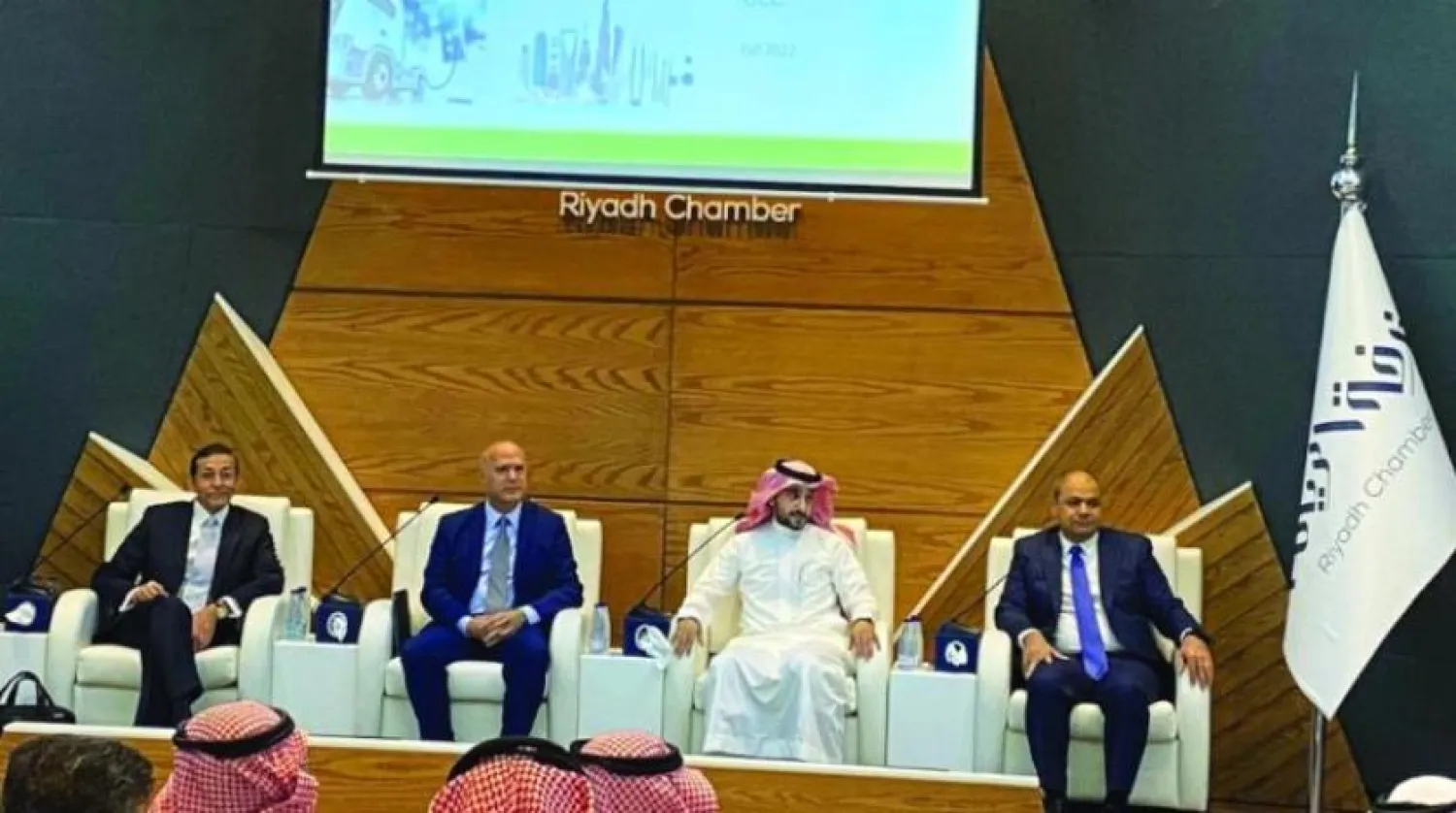

World Bank: Saudi Green Initiatives Will Grow Region’s Economy to $13 Trillion by 2050

A part of a World Bank conference in Riyadh addressing its latest reports (Asharq Al-Awsat)
TT

World Bank: Saudi Green Initiatives Will Grow Region’s Economy to $13 Trillion by 2050

A part of a World Bank conference in Riyadh addressing its latest reports (Asharq Al-Awsat)

The World Bank confirmed that Saudi green initiatives will grow the region's economy to $13 trillion by 2050. This came at a time the international financial institution projected a growth of 6.9% for Gulf Cooperation Council (GCC) economies in 2022.

“Saudi Arabia helps us provide financing to the world's poorest countries and advances the global development agenda, at a time when the global economy is still suffering from destabilizing shocks,” World Bank Country Director of the GCC Issam Abousleiman told Asharq Al-Awsat.

“Before the outbreak of the war in Ukraine, the global economy was on track to achieve a robust recovery from the coronavirus pandemic, albeit unevenly,” noted Abousleiman.

“However, the war is now disrupting supply chains,” he added, explaining that the disruption has been exacerbated by closures in China due to its strict policy to prevent the spread of the coronavirus.

Combined, the war and the closures dealt a serious blow to global recovery.

Abousleiman expected the global GDP growth to slow sharply this year. He predicted a growth of 2.9% in 2022 and 3% in 2023.

According to Abousleiman, Saudi Arabia’s economy is expected to grow 8.3 % in 2022, before moderating to 3.7 % and 2.3 % in 2023 and 2024 respectively.

The oil sector will remain the main driver of this growth despite a more cautious approach to production scheduled by OPEC+. Meanwhile, the non-oil sector will continue its growth path at 4.3 % in 2022.

The strong growth in the oil sector reflects the impact of the voluntary production cut of one million bpd, which the Kingdom decided to implement during the months of February and April in 2021, explained Abousleiman.

He pointed out that the most important factors contributing to growth are the recovery of private consumption, especially as the Kingdom eases all forms of social distancing across the country, in addition to investments and exports.

High oil revenues will be used to increase capital spending, and to generate indirect benefits in the non-oil sectors, noted Abousleiman.

“The World Bank and the Saudi government have had an important partnership and excellent cooperative relationship since the 1970s,” he affirmed.

“It covers a number of vital areas for the development of the Kingdom, including the energy sector, transportation, human development, private sector development, and public financial management.”

“The Kingdom is an increasingly important contributor to the World Bank's concessional financing window, which provides financing to the world’s poorest countries.”



Gold Retreats as Firmer Dollar Offsets Geopolitical Safe-haven Support

FILE PHOTO: Gold imitations are seen in this illustration picture taken February 20, 2026. REUTERS/Dado Ruvic/Illustration/File Photo
TT

Gold Retreats as Firmer Dollar Offsets Geopolitical Safe-haven Support

FILE PHOTO: Gold imitations are seen in this illustration picture taken February 20, 2026. REUTERS/Dado Ruvic/Illustration/File Photo

Gold prices eased on Tuesday, pulled back by a stronger dollar, while investors assessed the impact of an escalating US and Israeli air war against Iran.

Spot gold was down 0.4% at $5,305.23 per ounce, as of 0646 GMT. In the previous session, bullion climbed to its highest point in more than four weeks after the US and Israel launched strikes on ‌Iran over ‌the weekend.

US gold futures for April delivery ‌were ⁠up 0.3% at $5,326.40.

The ⁠dollar hovered close to a more than five-week high reached on Monday, supported by firm demand and cautious market sentiment. A stronger greenback typically makes dollar-denominated assets such as bullion more expensive for foreign buyers.

"Inflationary concerns are proving to be of benefit to the dollar while being of some hindrance to the gold ⁠price," KCM Trade chief market analyst Tim Waterer ‌said.

"Gold would arguably be trading ‌higher than current levels were it not for dollar appreciation since the ‌conflict intensified."

A senior official from the Iranian Revolutionary Guard Corps (IRGC) ‌said the Strait of Hormuz has been closed and warned Iran would fire on any ship trying to pass through the strategic waterway, according to Iranian media.

This is Iran's most explicit warning since ‌telling ships it was closing the export route on Saturday, a move that threatens to choke a ⁠fifth of ⁠global oil flows and send crude prices sharply higher.

US President Donald Trump has warned of a "big wave" of further attacks coming soon, without providing specific details.

"Persistent safe-haven demand due to the ongoing conflict is keeping a floor under the gold price," Waterer added.

The attack on Iran has pitched the Gulf into war, killing scores of civilians in Iran, Israel and Lebanon, thrown global air transport into chaos and shut down shipping through the Strait of Hormuz.

Silver fell 5.8% to $84.25/oz, after climbing to a more than four-week high on Monday. Platinum lost 4.4% to $2,200.89/oz, palladium fell 1.2% to $1,745.26.


Egypt’s Non-Oil Private Sector Contracted in February as Costs Rose

Egyptians walk past a poster depicting US dollars and other currencies outside an exchange office in Cairo, Egypt, Thursday, Jan. 12, 2023. (AP)
TT

Egypt’s Non-Oil Private Sector Contracted in February as Costs Rose

Egyptians walk past a poster depicting US dollars and other currencies outside an exchange office in Cairo, Egypt, Thursday, Jan. 12, 2023. (AP)

Egypt's non-oil ‌private sector output contracted in February for the first time in four months, as demand softened and cost pressures intensified, S&P Global reported on Wednesday.

The headline Purchasing Managers' Index (PMI) fell to 48.9 in February from 49.8 in January, remaining below the 50.0 threshold that separates growth from contraction. ‌Despite the decline, ‌the PMI was above ‌its ⁠long-run average of ⁠48.3.

Output declined for the first time since October, and all five sub-components of the PMI indicated a weakening in business conditions compared to January.

"The February PMI data pointed ⁠to a slowdown in ‌the Egyptian non-oil ‌private sector as activity curtailed and new ‌order volumes weakened," said David Owen, ‌Senior Economist at S&P Global Market Intelligence.

New orders saw a modest contraction, with downturns in manufacturing, wholesale & retail, and services, ‌while construction experienced an increase in new work. Employment fell for ⁠the ⁠third consecutive month, albeit at a slower pace, as firms implemented hiring freezes and job cuts.

Cost pressures accelerated, driven by rising global commodity prices, notably oil and metals, leading to the sharpest increase in business costs in nine months. Despite this, selling prices remained largely unchanged, with only a small fraction of firms passing on the higher costs to customers.


ECB's Chief Economist Warns Euro Zone Inflation Could Surge on Lengthy Iran War

FILE PHOTO: A view of the European Central Bank (ECB) headquarters in Frankfurt, Germany, March 6, 2025. REUTERS/Jana Rodenbusch/File Photo
TT

ECB's Chief Economist Warns Euro Zone Inflation Could Surge on Lengthy Iran War

FILE PHOTO: A view of the European Central Bank (ECB) headquarters in Frankfurt, Germany, March 6, 2025. REUTERS/Jana Rodenbusch/File Photo

A prolonged war in the Middle East could cause a substantial spike in euro zone inflation and reduce economic growth, European Central Bank Chief Economist Philip Lane told the Financial Times in an interview published on Tuesday.

A US and Israeli war against Iran widened on Monday, with no end in sight as Israel attacked Lebanon and Iran kept up its attacks on Gulf states, pushing up oil prices by over 10%.

"Directionally, a jump in energy prices puts upward pressure on inflation, especially in the ⁠near-term, and such ⁠a conflict would be negative for economic activity," Lane said.

"The scale of the impact and the implications for medium-term inflation depend on the breadth and duration of the conflict," he said, adding that the ECB would monitor the situation.

Previous sensitivity analyses done by the ECB showed ⁠that such a war would lead to a 'substantial spike' in energy-driven inflation and a 'sharp drop' in output, if there was a persistent drop in energy supplies out of the region, Lane said.

A separate analysis by the ECB from December meanwhile suggests that a permanent oil price spike of this magnitude could lift inflation by 0.5 percentage point and lower growth by 0.1 percentage point.

Euro zone inflation now stands at 1.7%, below the bank's 2% target, ⁠suggesting that ⁠a small jump in price growth is unlikely to trigger policy action, especially since monetary policy acts with long lags and is considered powerless against near-term swings in prices.

The ECB also tends to look past energy-induced volatility in prices as long as fluctuations do not impact longer-term expectations and do not seep into underlying inflation via second-round effects.

For now, market-based longer-term inflation expectations are little changed and markets continue to expect no change in the ECB's 2% deposit rate all year.