


Turkish Monthly Inflation Near 3%, Keeping Pressure on Central Bank

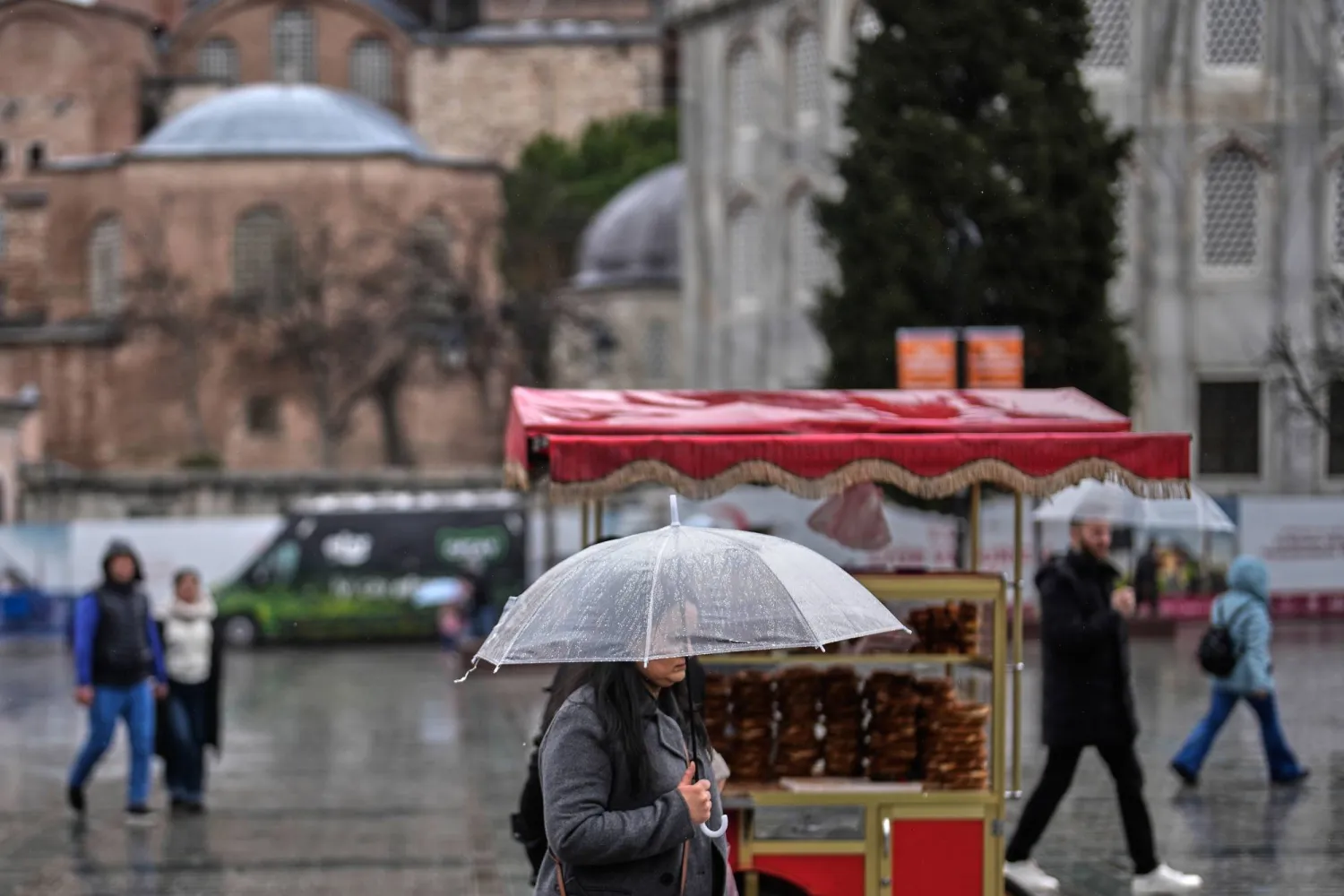
A woman holding an umbrella on a rainy day during the holy fasting month of Ramadan outside the Hagia Sophia mosque in Istanbul, Türkiye, Friday, Feb. 27, 2026. (AP)
TT

Turkish Monthly Inflation Near 3%, Keeping Pressure on Central Bank

A woman holding an umbrella on a rainy day during the holy fasting month of Ramadan outside the Hagia Sophia mosque in Istanbul, Türkiye, Friday, Feb. 27, 2026. (AP)

Turkish inflation cooled to 2.96% on a monthly basis in February while the annual figure rose to 31.53%, largely as expected, according to official data on Tuesday that tees up a tough rate decision for the central bank next week.

Beyond the price pressure, market turmoil due to war between US-Israel and neighboring Iran prompted emergency measures by the central bank, including some $8 billion in FX sales on Monday, resulting in a roughly 300 basis-point rise in ‌the overnight rate to ‌about 40%.

Analysts say the central bank could respond ‌by ⁠officially halting an easing ⁠cycle that began in late 2024. In January, the monetary policy committee trimmed the bank's main policy interest repo rate by 100 basis points to 37%.

In January, monthly consumer price inflation surged to a higher-than-expected 4.84% while the annual rate slipped to 30.65%.

In February, monthly inflation was driven by a 6.89% surge in food and drinks prices, according to the Turkish Statistical Institute, marking ⁠the second month of pressure that has raised worries ‌about a disinflation trend that began in ‌2024 but recently slowed.

Finance Minister Mehmet Simsek said he expected the recent high food ‌price increases to be offset in the coming period, depending on weather ‌conditions, while acknowledging the energy price rises triggered by the Iran conflict.

"We are working to limit the inflationary impact of rising oil prices due to geopolitical developments," he said, adding that all policy tools are being used in coordination to sustain the ‌disinflation process.

In a Reuters poll, monthly inflation was forecast to be 3% with the annual rate seen at ⁠31.55%.

The data ⁠also showed the domestic producer price index rose 2.43% month-on-month in February for an annual increase of 27.56%.

The central bank has in recent weeks kept rate-cut expectations on track even as it has repeated it was ready to tighten policy if needed.

JPMorgan - which like most analysts had previously predicted another cut at the central bank's March 12 policy meeting - said on Monday it now expects the bank to hold rates. It also revised its year-end inflation forecast to 25% from 24%.

Last month, the central bank nudged up its year-end inflation forecast range by two percentage points to 15–21% and maintained its interim 16% target, despite market doubts over whether the downward trend seen throughout 2025 is on track.



China Condemns EU’s Inclusion of Chinese Entities in Sanctions Package Against Russia

People gather at the Beijing International Automotive Exhibition (Auto China), in Beijing, China April 24, 2026. (Reuters)
TT

China Condemns EU’s Inclusion of Chinese Entities in Sanctions Package Against Russia

People gather at the Beijing International Automotive Exhibition (Auto China), in Beijing, China April 24, 2026. (Reuters)

China's commerce ministry on Saturday expressed "firm opposition" to the European Union's inclusion of Chinese entities in its 20th round of sanctions against Russia, demanding their immediate removal from ‌the list.

The ‌EU sanctions ‌package ⁠targets third-country suppliers ⁠of critical high-tech items, including China-based entities accused of providing dual-use goods or weapons systems to Russia's military-industrial ⁠complex.

The move "runs counter ‌to ‌the spirit of the ‌consensus reached between Chinese ‌and EU leaders, and seriously undermines mutual trust and the overall stability of ‌bilateral relations", a spokesperson for China's commerce ⁠ministry ⁠said in a statement.

The ministry warned it would take "necessary measures" to protect Chinese companies and said "all consequences will be borne by the EU side," the statement added.


US State Dept Orders Global Warning About Alleged AI Thefts by DeepSeek, Other Chinese Firms

The logo of DeepSeek is seen during the Global Developer Conference, organized by the Shanghai AI Industry Association in Shanghai on February 21, 2025. (AFP)
TT

US State Dept Orders Global Warning About Alleged AI Thefts by DeepSeek, Other Chinese Firms

The logo of DeepSeek is seen during the Global Developer Conference, organized by the Shanghai AI Industry Association in Shanghai on February 21, 2025. (AFP)

The US State Department has ordered a global push to bring attention to what it says are widespread efforts by Chinese companies, including AI startup DeepSeek, to steal intellectual property from US artificial intelligence labs, according to a diplomatic cable seen by Reuters.

The cable, dated Friday and sent to diplomatic and consular posts around the world, instructs diplomatic staff to speak to their foreign counterparts about "concerns over adversaries' extraction and distillation of US A.I. models."

"A separate demarche request and message has been sent to Beijing for raising with China," the document states.

Distillation is the process of training smaller AI models using output from larger, more ‌expensive ones as ‌part of an effort to lower the costs of training a ‌powerful ⁠new AI tool.

This ⁠week, the White House made similar accusations, but the cable has not been previously reported. The State Department did not immediately respond to a request for comment.

OpenAI has warned US lawmakers that DeepSeek was targeting the ChatGPT maker and the nation's leading AI companies to replicate models and use them for its own training, Reuters reported in February.

CHINA REJECTS ACCUSATIONS

The Chinese Embassy in Washington on Friday reiterated its stance that the accusations are baseless.

"The allegations that Chinese entities are stealing American AI intellectual property are ⁠groundless and are deliberate attacks on China's development and progress in the ‌AI industry," it said in a statement to Reuters.

DeepSeek, whose ‌low-cost AI model stunned the world last year, on Friday launched a preview of a highly anticipated ‌new model, called the V4, adapted for Huawei chip technology, underlining China's growing autonomy in the ‌sector.

DeepSeek also did not immediately respond to a request for comment. In the past, it has said that its V3 model used data naturally occurring and collected through web crawling and it had not intentionally used synthetic data generated by OpenAI.

Many Western and some Asian governments have banned their institutions and officials from using ‌DeepSeek, citing data privacy concerns. Nevertheless, DeepSeek's models have consistently been among the most used on international platforms that host open-source models.

The State Department ⁠cable said its purpose ⁠was to "warn of the risks of utilizing AI models distilled from US proprietary AI models, and lay the groundwork for potential follow-up and outreach by the US government."

It also mentioned Chinese AI firms Moonshot AI and MiniMax . Neither company immediately responded to a request for comment.

The cable said that "AI models developed from surreptitious, unauthorized distillation campaigns enable foreign actors to release products that appear to perform comparably on select benchmarks at a fraction of the cost but do not replicate the full performance of the original system."

It added that the campaigns also "deliberately strip security protocols from the resulting models and undo mechanisms that ensure those AI models are ideologically neutral and truth-seeking."

The White House accusations and the cable come just weeks before US President Donald Trump is set to visit Chinese President Xi Jinping in Beijing. They could well raise tensions in a long-running tech war between the rival superpowers, which had been lowered by a detente brokered last October.


Bessent Rules Out Renewal of Iranian and Russian Oil Waivers

US Secretary of Treasury Scott Bessent testifies during the Senate Appropriations Committee hearing on 'A Review of the President's FY2027 Budget Request for the Department of the Treasury' on Capitol Hill in Washington, DC, USA, 22 April 2026. (EPA)
TT

Bessent Rules Out Renewal of Iranian and Russian Oil Waivers

US Secretary of Treasury Scott Bessent testifies during the Senate Appropriations Committee hearing on 'A Review of the President's FY2027 Budget Request for the Department of the Treasury' on Capitol Hill in Washington, DC, USA, 22 April 2026. (EPA)

Treasury Secretary Scott Bessent said Friday that the US does not plan to renew a waiver allowing the purchase of Russian oil and petroleum products that are currently at sea.

He also said a renewal of a one-time waiver for Iranian oil at sea is totally off the table.

“Not the Iranians,” Bessent told The Associated Press. “We have the blockade, and there’s no oil coming out.”

In an AP interview about the impact of the war on the global energy market and other topics, Bessent also said he had no plans to extend the sanctions relief for Russia.

“I wouldn’t imagine that we’d have another extension. I think the Russian oil on the water has been largely sucked up,” he said.