

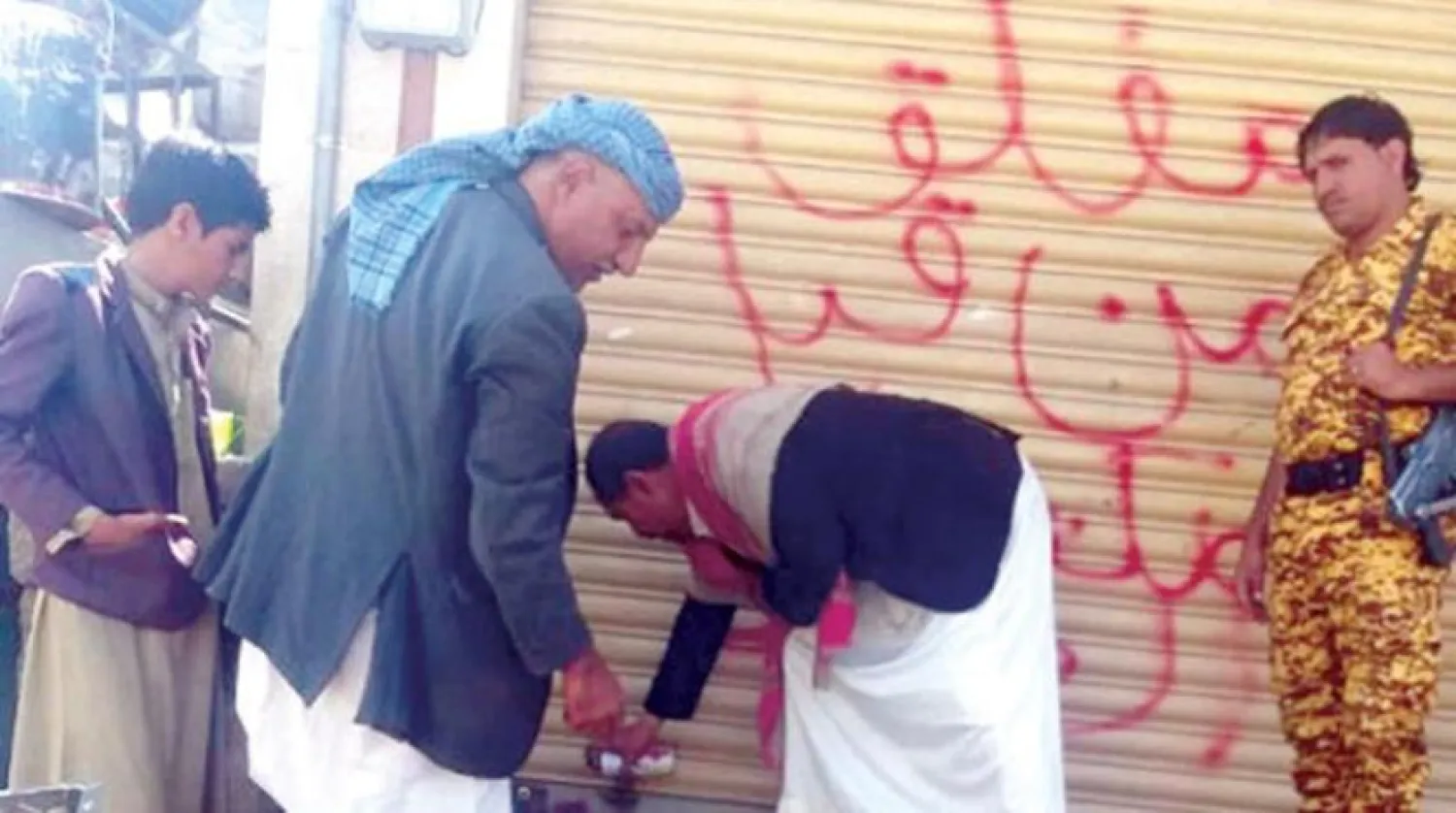

Houthis Target Private Sector Companies in 3 Governorates
Houthis closing a store in Sanaa, Yemen (Houthi media)
Once again, Houthi militias in Yemen are targeting the private trade sector in three different governorates as the Iran-backed group continues with its efforts to impose control over businesses operating in areas under its rule.
Around 3,000 Houthi militiamen have been deployed over the years to take over businesses and trades in Yemen, according to informed sources in the Houthi-run capital, Sanaa.
Officials in the Sanaa Chamber of Commerce told Asharq Al-Awsat that Houthis have registered about 600 investors of its members with the Chamber since the beginning of 2022. These investors had established new companies working in different fields.
In the past two years, a total of around 2,200 Houthi loyalists have been registered by the Chamber as businessmen.
Houthi escalation against the private sector in recent days saw the storming, closure and looting of private commercial establishments located in the governorates of Hodeida, Taiz and Sanaa.
Moreover, Houthis imposed levies on private sector companies in areas under militia control.
Hayel Saeed Anam Group, the biggest manufacturing and trade company in Yemen, announced the suspension of work in its sugar refinery factory in Hodeida.
This came after the Iran-backed Houthi militia held distribution trucks and detained the general manager of the factory.
In a letter sent to the interior minister of the so-called Houthi government, the Hayel Saeed Anam Group complained that the Houthi Security Assistance Director in Hodeida province suspended the company’s activity and obstructed its work by seizing shuttles used for transporting employees of the company.
Abu Mishaal, who was appointed by the group as assistant director of security for Hodeida Governorate, suspended the company’s activity and confiscated transport vehicles used by the company at the Salif Junction point.
Additionally, the company reiterated that the arbitrary action taken by Abu Mishaal in Hodeida is against the law and does not serve the public interest.
In conjunction with this incident, local sources reported that Houthi militiamen had stormed the Belqis Industrial Development Company and the Belqis Poultry Company in the Taiziyah District of Taiz.
The Houthis looted documents, property, and machinery from within company headquarters.
Even though the Houthi group imposes high taxes on commercial companies working in areas under their control, Houthi military leaders unlawfully intervene in the private sector and force companies to unlawfully pay taxes in the name of war effort.
Displaced Palestinians gather to receive hot meals distributed by a charity kitchen in the Khan Younis refugee camp in the southern Gaza Strip on June 29, 2026. (AFP)
TT
TT
UN Chief Warns Cash Crunch Threatens Palestinian Refugee Agency
Displaced Palestinians gather to receive hot meals distributed by a charity kitchen in the Khan Younis refugee camp in the southern Gaza Strip on June 29, 2026. (AFP)
UN chief Antonio Guterres warned Tuesday of the "increasingly precarious" situation of the UN agency for Palestinian refugees known as UNRWA, saying that millions of people's livelihoods were at risk.
The secretary-general said that further funding cuts for UNRWA -- which Israel has criticized as politically biased -- could "push conditions beyond breaking point."
Because of insufficient funding, UNRWA has scaled back its operations since the start of the year.
"As we meet here today, the safety and welfare of millions of Palestine refugees hangs in the balance," Guterres told a donor conference for the UN agency.
He noted the "utterly appalling" living conditions in Gaza, violence by Israeli settlers in the West Bank and Israeli strikes on Lebanon.
"It [UNRWA] faces sweeping restrictions throughout the Occupied Palestinian Territory. And a cash shortfall that imperils its work across the region," Guterres said.
"I am appalled by continuing efforts to marginalize and undermine UNRWA through disinformation, smear campaigns, legislative actions, operational restrictions, diplomatic roadblocks and more," he said.
Israel has long opposed UNRWA, created by the UN General Assembly in 1949, and intensified its criticism after October 7, alleging that employees participated in the deadly 2023 attack on Israel.
Hundreds of Thousands of Lebanese Head Home as Fighting Eases, Many Still Strandedhttps://english.aawsat.com/arab-world/5290519-hundreds-thousands-lebanese-head-home-fighting-eases-many-still-stranded
Lebanese people drive a vehicle loaded with mattresses as they return to their village in the town of Nabatieh, southern Lebanon, 23 June 2026, amid a ceasefire between Israel and Hezbollah. (EPA)
TT
TT
Hundreds of Thousands of Lebanese Head Home as Fighting Eases, Many Still Stranded
Lebanese people drive a vehicle loaded with mattresses as they return to their village in the town of Nabatieh, southern Lebanon, 23 June 2026, amid a ceasefire between Israel and Hezbollah. (EPA)
Some 400,000 Lebanese uprooted by war have returned to southern Lebanon, with more expected to follow in the coming week, a government minister said on Tuesday, encouraged by a lull in the four-month-long conflict between Israel and Hezbollah.
Yet many remain unable to go back. Since March, around 1 million people have been forced to flee their homes, and large numbers are still in shelters or temporary housing because their homes are destroyed or uninhabitable, said Hanine El Sayed, Minister of Social Affairs.
Roughly 40% of those displaced have now returned to their towns and villages. The number of people staying in collective shelters has fallen sharply, to about 13,000 from 37,000, she said.
While some shelters will remain open for families who cannot return, aid programs — including emergency cash support — will continue. The number of shelters has dropped from 692 at the height of the crisis to 479, with additional centers opened in Nabatieh for those wanting to stay near their home areas.
El Sayed said the headline figures conceal a gap between those able to return and those still displaced.
"These are families that are able to return to something, at least the basic minimum," she told Reuters. "The fact that the others have not returned means they have a much harder situation."
Authorities expect further returns in the coming days and hope within about a week to better gauge how many families cannot go back at all.
"In about a week's time ... we would really know the size of the problem - how many absolutely cannot return because their homes have been totally damaged," she said.
CHALLENGES OF GOING HOME
For many, returning home does not mean a return to normal life. Families are often finding damaged houses, scarce electricity and water, and destroyed businesses and livelihoods, as the government works to restore basic services and expand cash assistance, rental support and employment programs.
Yet despite these hardships, many are choosing to return.
"Many of the people of the south are very attached to their land and they want to rightfully make a claim back to it," El Sayed said.
The government estimates Lebanon will need billions of dollars to rebuild damaged homes and infrastructure, funding that it does not currently have, El Sayed said.
Nearly 90,000 housing units have been totally or partially destroyed in the latest conflict, adding to widespread damage from earlier fighting.
Aoun Optimistic on ‘Best Possible’ Deal for Lebanon, Banks on US Rolehttps://english.aawsat.com/arab-world/5290516-aoun-optimistic-%E2%80%98best-possible%E2%80%99-deal-lebanon-banks-us-role
In this photo, released by the Lebanese Presidency press office, Lebanese President Joseph Aoun, right, shakes hands with Adm. Brad Cooper, the top US military commander in the Middle East, at the presidential place in Baabda, east of Beirut, Lebanon, Monday, June 29, 2026. (Lebanese Presidency press office via AP)
Aoun Optimistic on ‘Best Possible’ Deal for Lebanon, Banks on US Role
In this photo, released by the Lebanese Presidency press office, Lebanese President Joseph Aoun, right, shakes hands with Adm. Brad Cooper, the top US military commander in the Middle East, at the presidential place in Baabda, east of Beirut, Lebanon, Monday, June 29, 2026. (Lebanese Presidency press office via AP)
In one phrase, Lebanese President Joseph Aoun answers critics of the framework agreement Lebanon and Israel signed late last week, an agreement he admits is “not ideal”, “Give me the alternative.”
For more than three years, Lebanon has been reeling from the fallout of Hezbollah’s successive “support” wars, first for Gaza in late 2023 and then for Iran on March 2 in wake of the war with the United States and Israel. Still, visitors to Aoun come away with a clear impression that the president is optimistic about the path opened by the agreement.
A senior Lebanese source said the reality created by those wars has added to Lebanon’s burden. Beirut had been negotiating over Israel’s withdrawal from five hills it occupied in the first round.
It then found itself negotiating under fire and occupation, as Israel’s presence expanded to the outskirts of Nabatieh in the east and Tyre on the coast, seizing Bint Jbeil in between.
The source placed direct responsibility for the war on Hezbollah. “Had it not been for its six rockets, which it fired last March, we would not be in this position today,” the source said.
The agreement is the result of facts imposed by the battlefield and by Lebanon’s condition as it buckles under rising human and material losses, with no clear path to a solution, it added.
A framework, not yet an agreement
Still, the source insisted the agreement “is not bad. More precisely, it has not become an agreement yet. It is a framework agreement that sets broad guidelines, pending the fine details that will be negotiated gradually.”
Lebanon is betting on the new US momentum to press Israel into making concessions on those details, it continued.
The clearest sign that the agreement is not bad, according to the source, “was Israel’s fierce rejection of it at first. That rejection would not have turned into approval without the major US pressure applied in the final hours before signing.”
The second sign was how quickly Israeli leaders moved to craft their own version of the agreement, “which has nothing to do with the truth,” the source said.
“Ninety percent of what Israeli Prime Minister Benjamin Netanyahu said is not true,” it stressed.
An Israeli military vehicle maneuvers on the Lebanese side of the Israel-Lebanon border, as seen from the Upper Galilee, 28 June 2026, amid an Israel-Lebanon ceasefire. (EPA)
US support
Lebanon sees clear US support as its best weapon against Israel’s lack of interest in a solution and its tilt toward constant escalation.
The strongest proof, Lebanese officials believe, is that US President Donald Trump has called Aoun twice so far. Both calls were highly positive, as were calls from other US officials who contacted Aoun more than once, including Vice President JD Vance and Secretary of State Marco Rubio, who remained in continuous contact with him.
The source asked: Can Lebanon afford to risk losing US support when everyone knows the Americans are the only party able to exert real pressure on Israel?
The source said Trump, in his latest call with Aoun, was very clear in adopting Lebanon’s demands for a full Israeli withdrawal “despite the disruptions.”
Trump also expressed readiness to help revive Lebanon and put it back on track. That track includes the return of displaced people, reconstruction, and extending state authority through its own forces across all Lebanese territory, a Lebanese demand above anyone else’s.
The Doha cell and a Hezbollah representative
The Americans are closely tracking developments in Lebanon.
Although Washington is separating what is being agreed on in the Pakistan with Iran track from the Lebanese-Israeli track, it is working in parallel on the Lebanese file. That includes setting up the cell provided for in the US-Iranian understanding to monitor the ceasefire in Lebanon.
The source said the committee would operate from a liaison point in the Qatari capital, Doha. It would include representatives of the United States, Lebanon, Qatar and Iran, as well as Hezbollah, likely the group’s representative in Tehran.
When practical negotiations over the withdrawal began, Aoun proposed starting with an Israeli pullback from Kfar Tibnit and the historic Beaufort Castle, the last point reached by Israeli forces in their advance. The aim was to push Israeli forces away from Nabatieh after they had reached the city’s outskirts.
But the proposal collided with Israel’s determination to reach the Ali al-Taher heights, believed to contain a massive underground Hezbollah military facility.
Aoun called Rubio and proposed that the Lebanese army enter the area, while the Israeli army would withdraw beyond the Litani River. Rubio contacted the Israelis. Aoun, through intermediaries, contacted Hezbollah.
Israel approved the proposal. Hezbollah gave two contradictory answers. The first allowed the army to deploy without entering the facility. The second rejected the idea completely.
Later, Hezbollah settled on one answer: the matter was absolutely unacceptable. The proposal collapsed.
The area’s importance goes beyond Hezbollah’s facility. If Israeli forces position themselves there, they would directly overlook Nabatieh. From the other side, the heights overlook Israeli settlements, especially Metula, just a few kilometers from Nabatieh.
The idea of a withdrawal from that area was shelved. Instead, the focus shifted to another pullback from Zawtar al-Gharbieh and to the launch of a “pilot zone” there and the towns of Froun and Ghandourieh in the central sector.
That was the middle-ground solution. A withdrawal from the coastal line falls under the same equation because of its proximity to the southern border and, therefore, its high sensitivity for Israel.
لم تشترك بعد
انشئ حساباً خاصاً بك لتحصل على أخبار مخصصة لك ولتتمتع بخاصية حفظ المقالات وتتلقى نشراتنا البريدية المتنوعة
