
‘Normal Thing to Do’: Japanese Fans Tidy Up at World Cup 

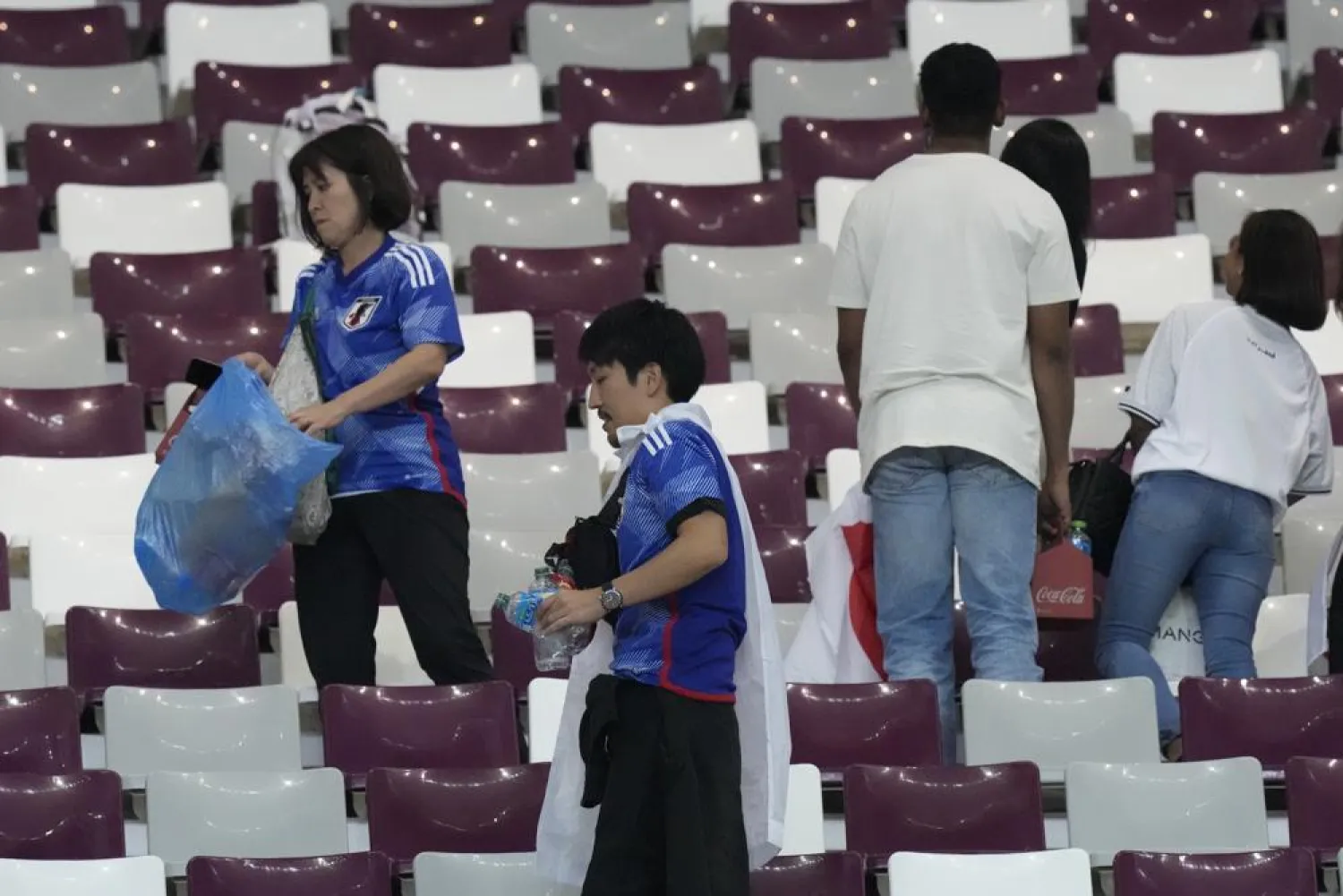
Japan supporters clean the stands at the end of the World Cup group E soccer match between Germany and Japan, at the Khalifa International Stadium in Doha, Qatar, Wednesday, Nov. 23, 2022. Japan won 2-1.(AP)
TT

‘Normal Thing to Do’: Japanese Fans Tidy Up at World Cup 

Japan supporters clean the stands at the end of the World Cup group E soccer match between Germany and Japan, at the Khalifa International Stadium in Doha, Qatar, Wednesday, Nov. 23, 2022. Japan won 2-1.(AP)

The sight of Japanese fans at a World Cup bagging trash after a match — win or lose — always surprises non-Japanese. Japanese players are famous for doing the same in their team dressing room: hanging up towels, cleaning the floor, and even leaving a thank-you note. 

The behavior is driving social media posts at the World Cup in Qatar, but it's nothing unusual for Japanese fans or players. They are simply doing what most people in Japan do — at home, at school, at work, or on streets from Tokyo to Osaka, Shizuoka to Sapporo. 

“For Japanese people, this is just the normal thing to do,” Japan coach Hajime Moriyasu said. “When you leave, you have to leave a place cleaner than it was before. That’s the education we have been taught. That’s the basic culture we have. For us, it's nothing special.” 

A spokeswoman for the Japanese Football Association said it's supplying 8,000 trash bags to help fans pick up after matches with “thank you” messages on the outside written in Arabic, Japanese, and English. 

Barbara Holthus, a sociologist who has spent the last decade in Japan, said cleaning up after oneself is engrained in Japanese culture. 

“You’re always supposed to take your trash home in Japan, because there are no trash cans on the street,” said Holthus, the deputy director of the German Institute for Japanese Studies. “You clean your classroom. From a very young age you learn you are responsible for the cleanliness of your own space.” 

Many Japanese elementary schools don't have janitors, so some of the clean-up work is left to the young students. Office workers often dedicate an hour to spruce up their areas. 

“It’s partly cultural, but also the education structures have been training you for a long time to do that,” Holthus added. 

This is Japan's seventh straight World Cup, and their cleanliness began making news at their first World Cup in 1998 in France. 

Prior to the 2020 Olympics, Tokyo Governor Yuriko Koike cautioned that visiting fans would have to learn to clean up after themselves. However, the problem never materialized after fans from abroad were banned from attending the Games because of the COVID-19 pandemic. 

Tokyo has few public trash receptacles. This keeps the streets cleaner, saves municipalities the costs of emptying trash cans, and keeps away vermin. 

Midori Mayama, a Japanese reporter in Qatar for the World Cup, said that fans collecting rubbish was a non-story back home. 

“Nobody in Japan would report on this,” she said, noting the same clean-up happens at Japanese professional baseball games. “All of this is so normal.” 

It may be normal to Japanese, but Alberto Zaccheroni, an Italian who coached Japan from 2010 to 2014, said it’s not how most teams act when they travel. 

“Everywhere in the world players take their kit off and leave it on the floor in the changing room. Then the cleaning staff come and collect it,” he said. “Not the Japanese players. They put all the shorts on top of the other, all the pairs of socks and all the jerseys.” 


Swiss Author Erich von Daeniken Dies at 90

Erich von Daeniken, co-founder and co-owner of Mystery Park, poses in front of the Panorama Tower at Mystery Park in Interlaken, Wednesday, April 23, 2003. (Gaetan Ball)/Keystone via AP, File)
TT

Swiss Author Erich von Daeniken Dies at 90

Erich von Daeniken, co-founder and co-owner of Mystery Park, poses in front of the Panorama Tower at Mystery Park in Interlaken, Wednesday, April 23, 2003. (Gaetan Ball)/Keystone via AP, File)

Swiss author Erich von Daeniken, who helped popularize the idea that astronauts from outer space visited Earth ​to help lay the foundations for human civilization, has died aged 90.

Swiss media including national broadcaster SRF reported his death, and a note on his website said it occurred on Saturday, The AP news reported.

Von Daeniken rose to ‌prominence with ‌his 1968 book "Chariots of ‌the ⁠Gods?" ​which posited ‌that structures such as the pyramids of Ancient Egypt, Britain's Stonehenge and Peru's Nazca lines were too advanced for their time, and needed outside help.

"In my opinion, ancient structures were made ⁠by humans, not by the extraterrestrials, but it was ‌the extraterrestrials who guided them, ‍who them, ‍who gave them the knowledge how to ‍do it," von Daeniken says in a video on his YouTube channel.

His theories were controversial with historians, scientists and fellow ​writers. But they were popular, and his books, which included "The Gods were ⁠Astronauts", sold nearly 70 million copies worldwide, appearing in more than 30 languages, SRF said.

Von Daeniken argued that ancient religions, myths and art contained evidence that millennia ago, the ancestors of modern humans had made contact with advanced extraterrestrial beings who appeared godlike to them and enabled them to progress.

One ‌day, von Daeniken said, those beings would return.


Massive Iconic Iceberg 'on Verge of Complete Disintegration'

Iceberg A23a has turned blue and is “on the verge of complete disintegration,” NASA said. This photo was taken on December 26, 2025 (NASA)
TT

Massive Iconic Iceberg 'on Verge of Complete Disintegration'

Iceberg A23a has turned blue and is “on the verge of complete disintegration,” NASA said. This photo was taken on December 26, 2025 (NASA)

One of the largest and oldest icebergs ever tracked by scientists has turned blue and is “on the verge of complete disintegration,” NASA said on Thursday.

A23a, a massive wall of ice that was once twice the size of Rhode Island, is drenched in blue meltwater as it drifts in the South Atlantic off the eastern tip of South America, NASA said in a new release, according to CBS News.

A NASA satellite captured an image of the fading berg the day after Christmas, showing pools of blue meltwater on its surface. A day later, an astronaut aboard the International Space Station captured a photograph showing a closer view of the iceberg, with an even larger melt pool.

The satellite image suggests that the A23a has also “sprung a leak,” NASA said, as the weight of the water pooling at the top of the berg punched through the ice.

Scientists say all signs indicate the so-called “megaberg” could be just days or weeks from totally disintegrating as it rides currents that are pushing it toward even warmer waters.

Warmer air temperatures during this season could also speed up A23a's demise in an area that ice experts have dubbed a “graveyard” for icebergs.

“I certainly don't expect A-23A to last through the austral summer,” retired University of Maryland, Baltimore County scientist Chris Shuman said in a statement.

Blue and white linear patterns visible on A23a are likely related to striations, which are ridges that were scoured hundreds of years ago when the iceberg was part of the Antarctic bedrock, NASA said.

“The striations formed parallel to the direction of flow, which ultimately created subtle ridges and valleys on the top of the iceberg that now direct the flow of meltwater,” said Walt Meier, a senior research scientist at the National Snow & Ice Data Center.

The berg detached from Antarctica in 1986. It remained stuck for over 30 years before finally breaking free in 2020.

According to current estimates from the US National Ice Center, in early January 2026, the berg's area is 1,182 square kilometers -- still larger than New York City but a fraction of its initial size.


Scores of Homes Razed, One Dead in Australian Bushfires

Smoke rises from a burning forest on a hillside behind a home near Longwood as bushfires continue to burn under severe fire weather conditions in Longwood, Victoria, Australia, January 9, 2026. AAP/Michael Currie via REUTERS
TT

Scores of Homes Razed, One Dead in Australian Bushfires

Smoke rises from a burning forest on a hillside behind a home near Longwood as bushfires continue to burn under severe fire weather conditions in Longwood, Victoria, Australia, January 9, 2026. AAP/Michael Currie via REUTERS

Bushfires have razed hundreds of buildings across southeast Australia, authorities said Sunday, as they confirmed the first death from the disaster.

Temperatures soared past 40C as a heatwave blanketed the state of Victoria, sparking dozens of blazes that ripped through more than 300,000 hectares (740,000 acres) combined.

Fire crews tallied the damage as conditions eased on Sunday. A day earlier, authorities had declared a state of disaster.

Emergency Management Commissioner Tim Wiebusch said over 300 buildings had burned to the ground, a figure that includes sheds and other structures on rural properties, AFP reported.

More than 70 houses had been destroyed, he said, alongside huge swathes of farming land and native forest.

"We're starting to see some of our conditions ease," he told reporters.

"And that means firefighters are able to start getting on top of some of the fires that we still have in our landscape."

Police said one person had died in a bushfire near the town of Longwood, about two hours' drive north of state capital Melbourne.

"This really takes all the wind out of our sails," said Chris Hardman from Forest Fire Management Victoria.

"We really feel for the local community there and the family, friends and loved ones of the person that is deceased," he told national broadcaster ABC.

Photos taken this week showed the night sky glowing orange as the fire near Longwood tore through bushland.

"There were embers falling everywhere. It was terrifying," cattle farmer Scott Purcell told ABC.

Another bushfire near the small town of Walwa crackled with lightning as it radiated enough heat to form a localized thunderstorm.

Hundreds of firefighters from across Australia have been called in to help.

Australian Prime Minister Anthony Albanese said he was talking with Canada and the United States for possible extra assistance.

Millions have this week sweltered through a heatwave blanketing much of Australia.

High temperatures and dry winds combined to form some of the most dangerous bushfire conditions since the "Black Summer" blazes.

The Black Summer bushfires raged across Australia's eastern seaboard from late 2019 to early 2020, razing millions of hectares, destroying thousands of homes and blanketing cities in noxious smoke.

Australia's climate has warmed by an average of 1.51C since 1910, researchers have found, fueling increasingly frequent extreme weather patterns over both land and sea.

Australia remains one of the world's largest producers and exporters of gas and coal, two key fossil fuels blamed for global heating.