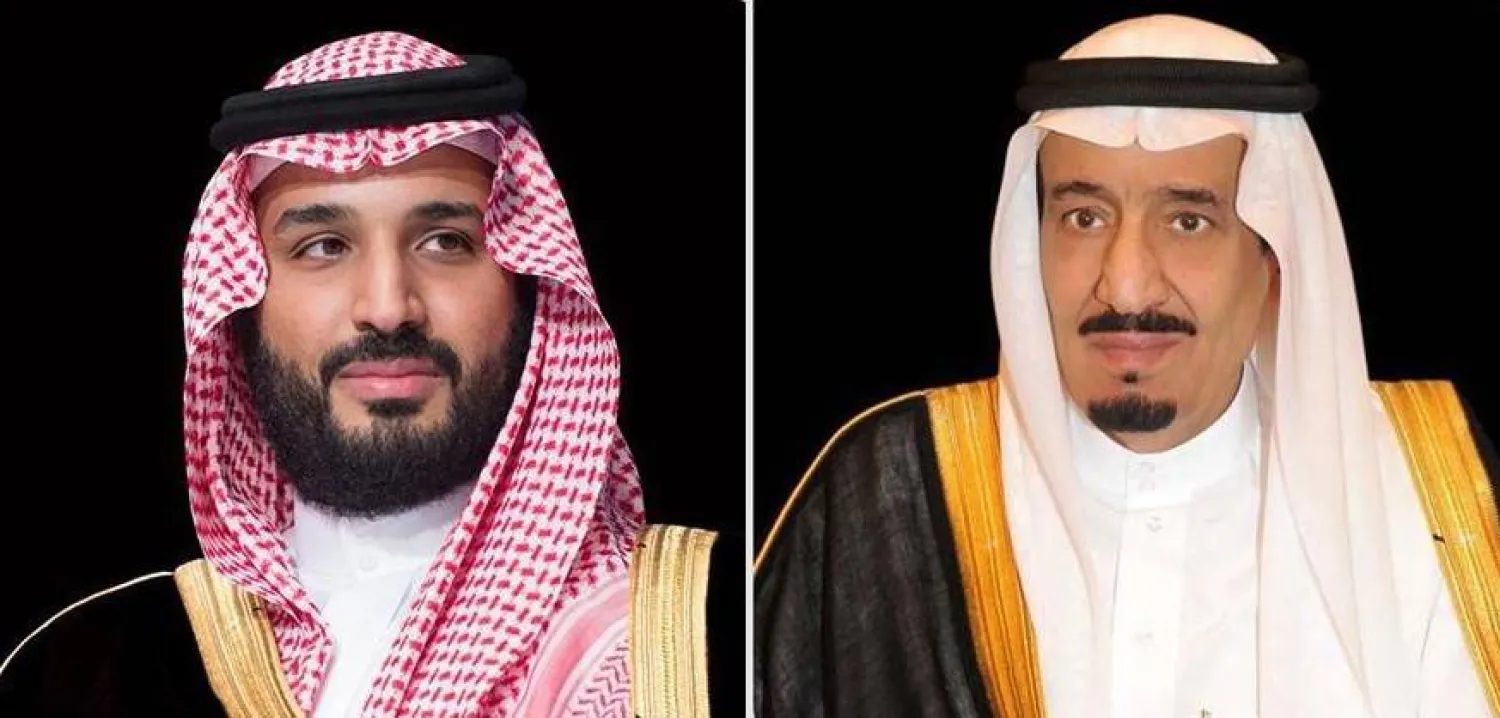
At Invitation of King Salman, Chinese President to Kick off Visit to Saudi Arabia on Thursday 

Three summits to be held, 30 heads of state to attend, deals worth 29 billion dollars to be signed.

Custodian of the Two Holy Mosques King Salman bin Abdulaziz meets with Chinese President Xi Jinping during a pas visit to Riyadh. (SPA)
TT

At Invitation of King Salman, Chinese President to Kick off Visit to Saudi Arabia on Thursday 

Custodian of the Two Holy Mosques King Salman bin Abdulaziz meets with Chinese President Xi Jinping during a pas visit to Riyadh. (SPA)

Chinese President Xi Jinping will kick off an official three-day visit to Saudi Arabia on Thursday at the invitation of Custodian of the Two Holy Mosques King Salman bin Abdulaziz.  

The visit will boost the historic ties and strategic partnership between their countries.  

King Salman and Xi will preside over a Saudi-Chinese summit with the participation of Prince Mohammed bin Salman, Crown Prince and Prime Minister.  

 Visit agenda 

The Saudi-Chinese, Riyadh-Gulf-Chinese and the Riyadh-Arab-Chinese cooperation and development summits will be held during Xi’s visit. 

Over 30 international leaders and organizations are set to attend, reflecting the importance of these summits on the regional and international levels. 

Over 40 preliminary agreements in the private and public sectors will be signed on the sidelines of the Saudi-Chinese summit. The agreements are valued at over 110 billion riyals (29.3 billion dollars). 

A document on the strategic partnership between the Kingdom and China will be signed. An agreement related to both Saudi Arabia’s Vision 2030 and China’s Belt and Road initiative will be signed. 

Officials will also declare the launch of the Prince Mohammed bin Salman award for cultural cooperation between Saudi Arabia and China. 

80 years of relations 

Diplomatic ties between Saudi Arabia and China have been witnessed marked growth. They are moving forward at a rapid pace towards achieving greater cooperation and understanding in various fields and for their mutual benefit. 

Relations between them were established 80 years ago and covered various aspects of cooperation. They were limited to trade relations and welcoming Chinese pilgrims in the Kingdom to perform the Hajj and Umrah. 

Relations were formally normalized in 1990 when Riyadh and Beijing agreed to establish full diplomatic ties and exchange ambassadors. 

Partnership 

Saudi Arabia, under the leadership of King Salman and Crown Prince Mohammed, is keen on developing bilateral relations with China as part of the Kingdom’s strategic approach in bolstering ties with all influential countries and international powers. It is keen on establishing balanced ties that would achieve the goals of the Kingdom and protect its interests. 

The high-level Saudi-Chinese committee, chaired by Crown Prince Mohammed and China’s Vice Premier of the State Council Han Zheng, has been leading efforts to increase political and security cooperation and bolstering cooperation in trade, investment, energy, technology and culture. 

Top partner 

China is Saudi Arabia's largest trading partner, with bilateral trade worth $87.3 billion in 2021. Chinese exports to Saudi Arabia reached $30.3 billion, while China's imports from the Kingdom totaled $57 billion. 

Saudi Arabia is China's top oil supplier, making up 18% of China's total crude oil purchases, with imports totaling 73.54 million tons (1.77 million barrels a day) in the first 10 months of 2022, worth $55.5 billion, Chinese customs data shows. 

Oil imports last year amounted to 87.56 million tons, worth $43.9 billion, making up 77% of China's total merchandise imports from Saudi Arabia. 

State-run Saudi Aramco has annual supply deals with half a dozen Chinese refiners including Sinopec, CNPC, CNOOC, Sinochem, Norinco as well as private refiner Zhejiang Petrochemical Corp. 

Saudi utility developer ACWA Power, partly owned by the Saudi sovereign wealth fund, said in September that it agreed with Silk Road Fund to jointly invest in a 1.5 gigawatt (GW) gas-fueled power plant in Uzbekistan for $1 billion, part of Beijing's One Belt One Road initiative. 

State-run China Energy Engineering Corp (CEEC) is building a 2.6-GW solar power station in Al Shuaiba in Saudi Arabia, also owned by ACWA Power, the Middle East's largest solar project. 


Muslim World League Affirms Support for Saudi Measures to Preserve Sovereignty

Muslim World League Affirms Support for Saudi Measures to Preserve Sovereignty
TT

Muslim World League Affirms Support for Saudi Measures to Preserve Sovereignty

Muslim World League Affirms Support for Saudi Measures to Preserve Sovereignty

The Muslim World League (MWL) has affirmed its full support for the supplementary statement issued by the Kingdom of Saudi Arabia regarding recent escalatory actions by the Southern Transitional Council in the Hadramout and Al-Mahara governorates.

The league also expressed its support for the statement from the Coalition to Restore Legitimacy in Yemen concerning the unauthorized movement of ships carrying weapons and heavy vehicles from the Port of Fujairah to the Port of Mukalla, SPA reported.

These shipments were reportedly transported without the necessary official permits from the coalition’s Joint Forces Command. The MWL emphasized its unwavering solidarity with the Kingdom and its support for all measures taken to safeguard its national security.

In an official statement released by the General Secretariat, MWL Secretary-General and Organization of Muslim Scholars Chairman Sheikh Dr. Mohammed bin Abdulkarim Al-Issa commended the decisive and wise content of the Saudi statement.

Speaking on behalf of the league’s global assemblies and councils, Al-Issa noted that these measures are vital to ensuring peace, security, and the unity of the Yemeni people under their internationally recognized leadership.

Al-Issa highlighted that the priority remains preserving stability in Yemen and the broader region. He noted that outstanding issues, including the Southern cause, must be resolved through dialogue within established legal and legitimate frameworks.

Furthermore, he warned that supporting illegitimate practices only deepens internal divisions and serves those who do not have Yemen’s best interests at heart. He cautioned that any further steps deviating from the legitimate path would only ignite sedition, the heavy cost of which would be borne by the Yemeni people.

Concluding the statement, Al-Issa called upon all Yemeni parties to prioritize wisdom and the national interest. He urged them to unite under their legitimate leadership to preserve the country's sovereignty, independence, and territorial integrity, paving the way for a secure and prosperous future for Yemen.


President of Yemeni Presidential Leadership Council Nullifies Joint Defense Agreement with UAE

Dr. Rashad Al-Alimi during his interview with Asharq Al-Awsat (Yemeni Presidency)
TT

President of Yemeni Presidential Leadership Council Nullifies Joint Defense Agreement with UAE

Dr. Rashad Al-Alimi during his interview with Asharq Al-Awsat (Yemeni Presidency)

President of the Presidential Leadership Council of the Republic of Yemen Dr. Rashad Mohammed Al-Alimi issued a presidential decree on Tuesday nullifying the joint defense agreement with the United Arab Emirates, based on the Constitution of the Republic of Yemen, the Gulf Cooperation Council Initiative and its implementation mechanism, the decision on the transfer of power, the formation of the Presidential Leadership Council, and the powers granted to it under the constitution, according to the Yemen News Agency (Saba).

Article Two of the decree mandates that all UAE forces and personnel withdraw from Yemeni territory within 24 hours, according to SPA.

Article Three instructs the Homeland Shield forces to assume control of all military camps in Hadramout and Al-Mahara governorates.


Yemeni Government Commends Saudi Historic Stance and Its Leadership of the Coalition to Restore Legitimacy

File photo of the Saudi flag/AAWSAT
TT

Yemeni Government Commends Saudi Historic Stance and Its Leadership of the Coalition to Restore Legitimacy

File photo of the Saudi flag/AAWSAT

The Yemeni government commended the Kingdom of Saudi Arabia's historic and steadfast stances, highlighting its crucial role in ensuring Yemen's security and stability.

The government acknowledged Saudi Arabia's leadership of the Coalition to Restore Legitimacy and its ongoing commitment to protecting civilians, de-escalating tensions, and preventing the eastern governorates from being drawn into conflicts that serve hostile agendas, SPA reported.

In an official statement, the government called on the Southern Transitional Council to withdraw immediately and unconditionally from the governorates of Hadramout and Al-Mahara. It urged the council to hand over all locations and camps to the Homeland Shield Forces and local authorities in these governorates, to adhere to the terms of reference of the transitional phase, and to cease all military or escalatory actions that threaten local security and undermine de-escalation efforts.

The statement, which was reported by the Yemen News Agency (Saba), expressed the government's full support for the decisions made by President of the Presidential Leadership Council of the Republic of Yemen Dr. Rashad Mohammed Al-Alimi, who is also Supreme Commander of the Armed Forces.

This includes declaring a state of emergency across Yemen and taking necessary sovereign measures to protect local security, preserve the unity and sovereignty of the state, and maintain its legal status in light of the dangerous developments in Yemen's eastern governorates.

The government stated: "The declaration of a state of emergency is grounded in the constitution and the references of the transitional phase, based on the recommendations of the National Defense Council.

It is a legitimate constitutional measure necessitated by our national duty to confront armed rebellion, protect civil peace, and prevent a descent into chaos that could undermine state institutions."