


Lebanese Banks Battered by Meltdown Struggle to Survive

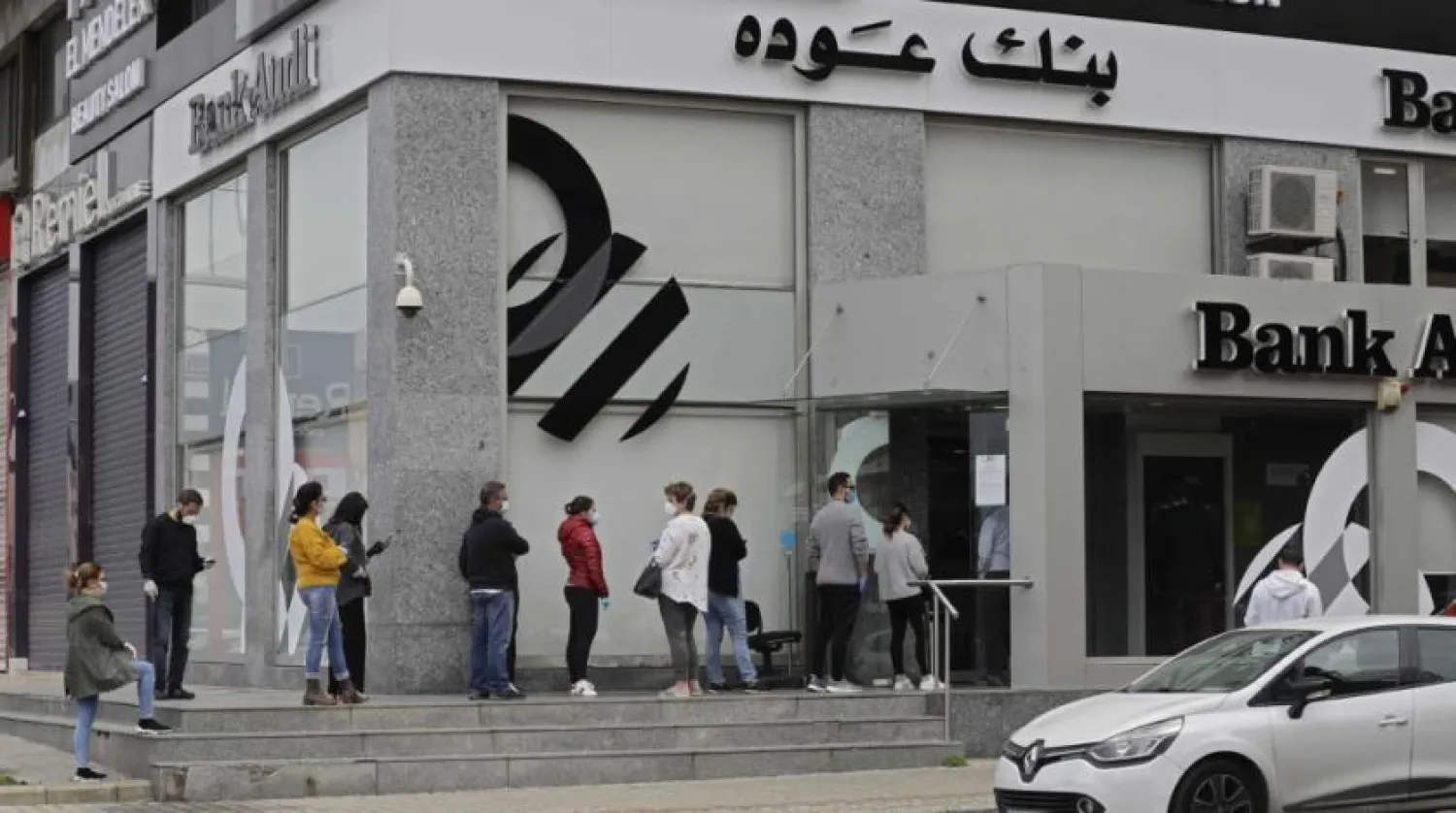
Mask-clad clients queue outside a bank in the Zalka suburb of Beirut, Lebanon. (AFP file photo)
TT

Lebanese Banks Battered by Meltdown Struggle to Survive

Mask-clad clients queue outside a bank in the Zalka suburb of Beirut, Lebanon. (AFP file photo)

Lebanon’s once burgeoning banking sector has been hard hit by the country’s historic economic meltdown. It has suffered staggering losses worth tens of billions of dollars and many of the small nation’s lenders now face possible closures or mergers.

Yet bankers have been resisting attempts to make their shareholders assume responsibility for those losses and instead have been trying to shift the burden to the government or even their own depositors. The country’s political class, blamed for decades of corruption and mismanagement that led to the meltdown, has also resisted reforms, The Associated Press reported.

Restructuring the banking sector is a key demand of the International Monetary Fund to start getting Lebanon out of its paralyzing financial crisis. The proposed IMF reforms will likely force most of the country’s 46 banks — a huge number for a nation of 5 million people — to close down or merge.

In the years after Lebanon’s 15-year civil war ended in 1990, the banking sector was the crown jewel of the country’s economy, offering high-interest rates that lured in investments and deposits from around the world.

Most of those depositors have now lost access to their savings after the country’s lenders for years made risky investments by buying Lebanese treasury bills despite widespread corruption and overspending by the country’s political class. These practices helped lead to the economic crisis that started in October 2019.

Today, banks in Lebanon neither give loans nor take new deposits, and they return to people a small fraction of their savings in US dollars at an exchange rate that is far lower than market value.

“They have become zombie banks,” says financial adviser Michel Kozah, who writes a financial column for a Lebanese newspaper.

Despite the banks' informal capital controls, billions of dollars are estimated to have been laundered out of the country by major political and financial officials, according to local reports.

In recent months, angry depositors have been storming bank branches around Lebanon to get their trapped savings by force, leading to confrontations with bank employees, who have also been victims of the meltdown.

Since the crisis began, the number of bank employees dropped by one-third, to just under 16,500 and one in five branches has closed.

Jinane Hayek, who lost her job as a branch manager at one of the largest banks in the country two years ago, said she understands the pain of the depositors, but that the bank branches are constrained by the current economic conditions.

“There are some people who cannot afford to eat because their money is stuck in the bank,” she said at the bakery she opened after her layoff in the mountain town of Bekfaya, adding that she is happy to be far from the fray.

The future of banks is unclear. A tentative agreement between the IMF and the Lebanese government, reached in April, called for an “externally assisted bank-by-bank evaluation for the 14 largest banks.”

But so far nothing has been done by either the government or the lenders. The banking sector has mounted a vigorous opposition to proposed measures that would put the system’s losses on the shoulders of shareholders rather than ordinary depositors.

A proposed government economic recovery plan released in September values the financial sector’s losses at about $72 billion, mostly at the central bank. The plan noted that the huge scale of the losses means that the central bank cannot give back the banks most of their money and the banks cannot return most of the money to depositors.

The World Bank said in a recent report that the losses are more than three times the GDP of 2021, making a bailout impossible because there aren’t enough public funds. The best solution is “a bail-in (that) makes large creditors and shareholders bear the main cost of bank restructuring” rather than small depositors, the report said.

Banks have been opposed to a bail-in solution, suggesting that state assets should be sold or invested to make up for the losses on the long-term.

Nassib Ghobril, chief economist at Byblos Bank, one of Lebanon’s largest lenders, accused the government of a “complete abdication of responsibility.”

He said that while the banking sector was attracting foreign currency from around the world, the government failed to implement any structural reforms and squandered the funds. He said a 2017 decision to increase civil service salaries, initially estimated at $800 million, ended up costing three times as much. It doubled the fiscal deficit in one year and contributed to the financial crisis, he said.

The banks were also negatively affected by the government’s decision to default on its foreign debt in March 2020, he said.

Kozah, the financial columnist, said that a solution to covering the losses is still possible by having an auditing firm look into accounts and return the money that was illicitly transferred outside the country by influential people after the crisis began, as well as attempting to separate good banks from bad ones.

Meanwhile, there has been little progress in talks with the IMF over the proposed reforms.

In October, Lebanon’s parliament approved amendments to a banking secrecy law, another IMF demand, but advocacy groups say the amendments are not enough. The central bank still uses several exchange rates at a time when the IMF has been pressing for unifying them to one rate.

Progress on other proposed measures is now on hold amid a power vacuum in the presidency and the Cabinet.

Deputy Prime Minister Saadeh Shami, who is leading the talks with the IMF, said recently that all deposits worth $100,000 and less will be returned to depositors while those with larger amounts will be compensated in the long term through a sovereign fund.

“There is no fair plan for all depositors,” Shami acknowledged.

Caretaker Economy Minister Amin Salam said that whenever the government is discussing the distribution of losses and responsibilities, there is a push back from the banks.

The government is aware that it “needs to save the banking sector, because ... without a banking sector, we will not be able to get the economy standing back on its feet."



Israeli Airstrike Kills Two in Gaza Including Girl, Hospital Staff Say

A Palestinian boy looks for his belongings amid the debris of a collapsed house that was previously damaged by an Israeli strike, at the Maghazi refugee camp in the central of Gaza Strip on January 5, 2026. (AFP)
TT

Israeli Airstrike Kills Two in Gaza Including Girl, Hospital Staff Say

A Palestinian boy looks for his belongings amid the debris of a collapsed house that was previously damaged by an Israeli strike, at the Maghazi refugee camp in the central of Gaza Strip on January 5, 2026. (AFP)

Israel killed at least two Palestinians including a girl, and wounded four others including other children, in an airstrike on Khan Younis in the southern Gaza Strip on Monday, officials at the city's main Nasser Hospital said.

The Israeli military said the strike, carried out in an area controlled by Hamas, had targeted a Hamas fighter who was planning to attack Israeli troops in southern Gaza.

Israel has carried out repeated air ‌strikes in Gaza ‌since a US-brokered deal took ‌effect ⁠in October ‌that halted most fighting. Israel says its strikes are aimed at preventing attacks or destroying militant infrastructure.

Gaza's health ministry says 422 Palestinians have been killed since the ceasefire took effect. Gaza fighters have killed three Israeli soldiers during the same period.

Under the first phase ⁠of the deal, brokered by US President Donald Trump, Israel has ‌retained control of 53% of Gaza. ‍Hamas agreed to release ‍living hostages and hand over remains in exchange ‍for the freeing of Palestinians detained by Israel.

The final hostage remains still to be handed over belong to an Israeli police officer killed on October 7, 2023 - the day Gazan gunmen invaded Israel, killing 1,200 and taking some 250 hostages, according to Israeli ⁠tallies.

Israel's offensive in Gaza has killed more than 71,000 Palestinians, most of them civilians, according to local health authorities. Most of the territory is in ruins, with the population of more than 2 million living mainly in makeshift homes or damaged buildings in areas where Israeli forces withdrew.

Earlier on Monday, a father and son in Gaza were killed in the collapse of their house which had been damaged in ‌an earlier Israeli strike, authorities in Gaza said.


Israel Strikes North of Litani, Eastern Lebanon After Evacuation Warnings

Smoke billows after Israeli warplanes targeted the Rihan Heights in the southern Lebanese district of Jezzine, on January 2, 2026. (AFP)
TT

Israel Strikes North of Litani, Eastern Lebanon After Evacuation Warnings

Smoke billows after Israeli warplanes targeted the Rihan Heights in the southern Lebanese district of Jezzine, on January 2, 2026. (AFP)

The Israeli military launched strikes on southern and eastern Lebanon on Monday, Lebanese state media reported, after warning it would hit what it called Hezbollah and Hamas targets in four villages.

It was the first such warning issued by the Israeli military this year, as Israel continues to strike targets in Lebanon despite a ceasefire with Hezbollah.

An AFP photographer in Kfar Hatta, one of the targeted villages in south Lebanon, saw dozens of families flee the village after the warning was issued, amid drone activity in the area, adding that ambulances and fire trucks were on standby.

The Israeli military said in a statement it "began striking Hezbollah and Hamas terror targets in Lebanon".

Lebanon's state-run National News Agency (NNA) reported strikes on the four villages.

In two separate posts on X, the military's Arabic-language spokesman, Colonel Avichay Adraee, said the villages were Kfar Hatta and Annan in south Lebanon, and Al-Manara and Ain al-Tinah in eastern Lebanon.

Adraee said the military would hit Hezbollah sites in Kfar Hatta and Ain al-Tinah, and Hamas sites in Annan and Al-Manara.

The NNA said the home targeted in Al-Manara belonged to Sharhabil Sayed, a Hamas leader in Lebanon who was killed by Israel in 2024.

- Repeated attacks -

Despite a year-old ceasefire between Israel and Hezbollah, Israel carries out regular strikes on Lebanon, usually saying it is bombing Hezbollah sites and operatives, and occasionally Hamas targets.

Two people were killed in an Israeli strike that targeted a vehicle on Sunday, around 10 kilometers (six miles) from the border, the Lebanese health ministry said.

In November, an Israeli strike on south Lebanon's Ain al-Hilweh Palestinian refugee camp killed 13 people.

Israel said it targeted a Hamas compound, with the group rejecting the claim.

It has also hit Hamas' ally in Lebanon, the Jamaa Islamiya group, which claimed responsibility for multiple attacks against Israel before the ceasefire.

Under heavy US pressure and fears of expanded Israeli strikes, Beirut has committed to disarming Hezbollah, which was badly weakened after more than a year of hostilities with Israel including two months of open war that ended with the November 2024 ceasefire.

Lebanon's army was expected to complete the disarmament south of the Litani River -- about 30 kilometers from the border with Israel -- by the end of 2025, before tackling the rest of the country.

All four of Monday's targeted villages are located north of the river.

Israel's Foreign Minister Gideon Saar on Sunday called the disarmament efforts far from sufficient.

Lebanon's cabinet is to meet on Thursday to discuss the army's progress, while the ceasefire monitoring committee -- comprising Lebanon, Israel, the United States, France and UN peacekeepers -- is also set to meet this week.

At least 350 people have been killed by Israeli fire in Lebanon since the ceasefire, according to an AFP tally of Lebanese health ministry reports.


EU Chief von der Leyen to Visit Syria, Lebanon This Week

European Commission President Ursula von der Leyen, addresses journalists during a visit to Sarajevo, Bosnia and Herzegovina, January 23, 2024. (Reuters)
TT

EU Chief von der Leyen to Visit Syria, Lebanon This Week

European Commission President Ursula von der Leyen, addresses journalists during a visit to Sarajevo, Bosnia and Herzegovina, January 23, 2024. (Reuters)

EU chief Ursula von der Leyen will visit Syria later this week on a first trip to the country since the fall of Bashar al-Assad, a spokeswoman said Monday. 

Von der Leyen will head to Syria as part of a tour of the Middle East that will also see her visit Jordan and Lebanon, spokeswoman Paula Pinho said. 

Von der Leyen's visit to the devastated country comes as the international community seeks to bolster fragile efforts to rebuild a year after Assad's downfall. 

Syrian President Ahmed al-Sharaa has been scrambling to boost support from abroad and shore up security. 

But the country remains in a perilous position and is still grappling with sectarian violence and the threat of the ISIS group. 

The EU is a key financial donor for Damascus and has rolled back sanctions imposed during the civil war to try to boost reconstruction efforts.