

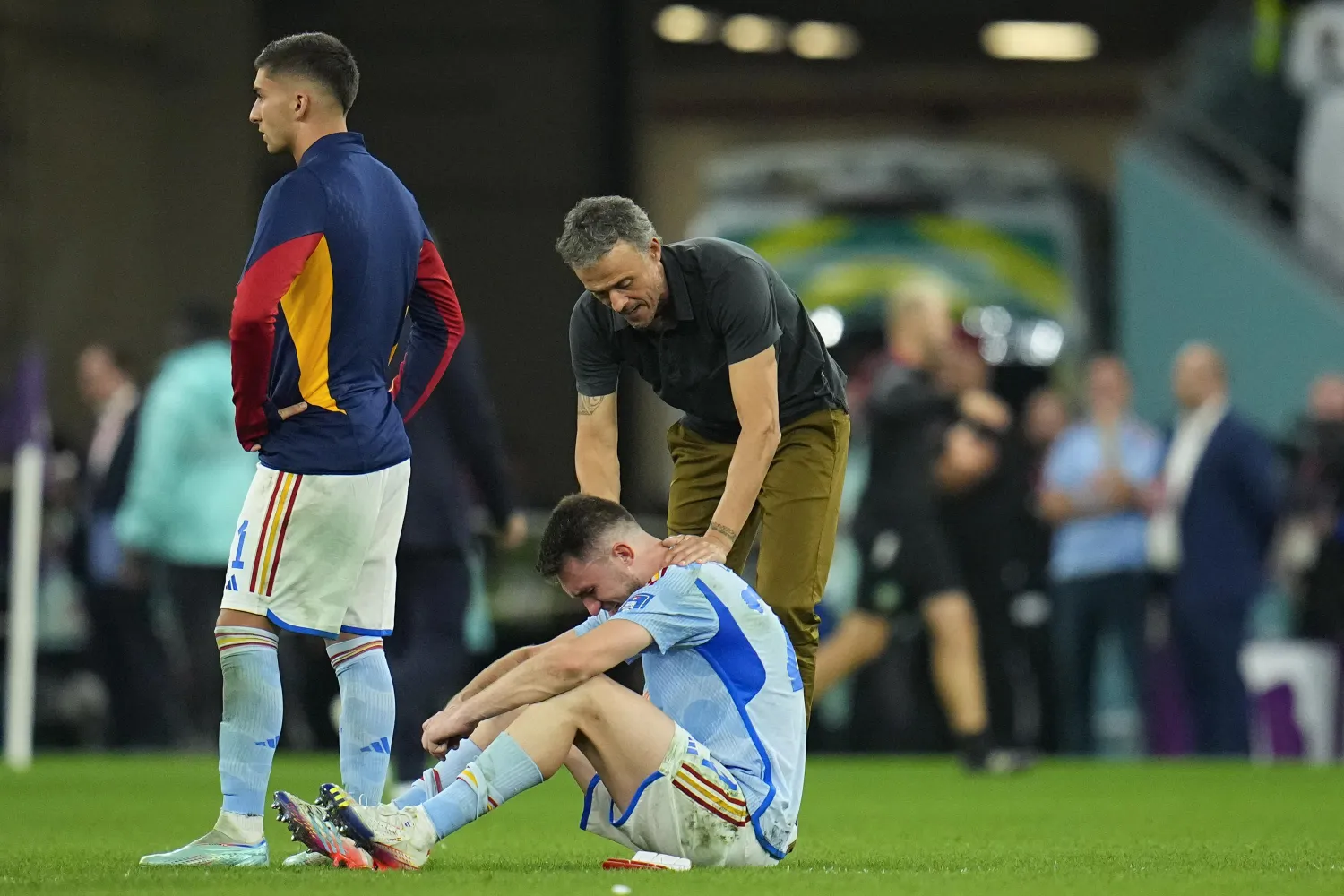

Spain's 'Tiki-Taka' under Attack again after World Cup Loss

Spain's head coach Luis Enrique consoles Aymeric Laporte at the end of the World Cup round of 16 soccer match between Morocco and Spain, at the Education City Stadium in Al Rayyan, Qatar, Tuesday, Dec. 6, 2022. (AP Photo/Julio Cortez)
TT

Spain's 'Tiki-Taka' under Attack again after World Cup Loss

Spain's head coach Luis Enrique consoles Aymeric Laporte at the end of the World Cup round of 16 soccer match between Morocco and Spain, at the Education City Stadium in Al Rayyan, Qatar, Tuesday, Dec. 6, 2022. (AP Photo/Julio Cortez)

The Morocco players fell back on defense and patiently watched as Spain kept passing the ball around midfield during their round of 16 match at the World Cup. Side to side, from one Spanish player to another.

Pass after pass, Spain tried to find an opening through the Moroccan defense, but the Moroccans stayed committed, unwavering, patiently waiting with 11 men behind the ball in front of their goal, AFP said.

The traditional “tiki-taka” ball-possession style allowed Spain to keep the ball during most of the match Tuesday, but not to get the goals it needed to keep its World Cup campaign alive, and it lost 3-0 in a penalty shootout after a 0-0 draw in regulation and extra time to end its World Cup campaign.

It was the third time Spain failed to make it past the last 16 at the World Cup after winning its lone title in 2010, when Xavi and Andrés Iniesta were the leaders of the ball-possession style that amazed the soccer world.

Spain’s “tiki-taka” clearly has not produced the results it once did, not in the international level or the club level with Barcelona, which was where it all started. Barcelona hasn’t won a Champions League since 2015, and was eliminated in the group stage of the top European club competition that last two seasons after Lionel Messi left and signed with Paris Saint-Germain.

The recent failures have led to some to question whether it’s time for a philosophical overhaul of Spanish soccer, or if it’s just a matter of adjusting the style to modern days or finding the right players to make it work again.

It's been a while since Spain lost Xavi and Iniesta, key elements that made the “tiki-taka” thrive, and it hasn't had a top-notch striker since Fernando Torres and David Villa, who were key to help transform ball possession into goals when La Roja won its back-to-back European Championships and the World Cup more than a decade ago. This year, Spain had only a true striker in its squad, Álvaro Morata, who is far from being considered a finisher like Torres and Villa.

It looked like Spain was going to make the “tiki-taka” work again in Qatar after youngsters Pedri and Gavi led the team to a resounding 7-0 opening win over Costa Rica, when La Roja completed a record 1,003 passes for a 90-minute game and finished with 75% of ball possession with 17 attempts against zero by Costa Rica.

But La Roja couldn’t win again after that, and it scored only two more goals in its next three matches. If left the tournament with the most passes completed, with an average of 847 per game.

It didn’t take long for the criticism to start pouring back home.

“A lot of possession and not enough shots,” the sports daily AS said in its front page.

“Spain clearly dominates but can’t get the goal to advance,” said the newspaper Sport.

Opponents have clearly found ways to keep the “tiki-taka” from working.

“We knew we were not going to have a lot of possession and we were not afraid of that,” Morocco coach Walid Regragui said after his team's win over Spain. “I looked at the last 20 games and Spain generally speaking had 70% of possession in those games. So I accepted that.”

Spain had 68% of possession and completed 967 passes Tuesday but made only one attempt on target, two fewer than Morocco with its strategy that relied solely on counterattacks.

“I knew it was going to be tough," Regragui said. "We would have to be extremely well organized. The defense and our midfielders and attackers worked very hard to make sure that they didn’t have those angles for the passes.”

It worked to perfection.

One of the last times Spain tried to move away from the “tiki-taka” was with coach Julen Lopetegui ahead of the 2018 World Cup. Spain still tried to control possession, but it was more direct when attacking. The team went to Russia with an impressive unbeaten streak but Lopetegui was fired just days before the team’s debut after accepting a job with Real Madrid without telling federation officials. Spain was eliminated in a penalty shootout against the hosts in the round of 16.

Since 2010, Spain has won only three of its last 11 World Cup matches.

Whether there will be an overhaul to Spanish soccer or not will depend largely on whether Luis Enrique — the former Barcelona player and coach — will remain at the helm of La Roja. He said after the loss to Morocco he would rest before starting talks with the federation to decide about his future.

If he stays, there will be more “tiki-taka" coming, whether it works or not.

“We lacked goals, but I'm more than satisfied with what my team did,” he said. “The players executed my idea of football to perfection.”



Shakhtar Boss Pays Ukrainian Racer $200,000 After Games Disqualification

Ukrainian President Volodymyr Zelenskiy holds helmet as he meets with a Ukrainian skeleton racer Vladyslav Heraskevych , who was disqualified from the Olympic skeleton competition over his "helmet of remembrance" depicting athletes killed since Russia's invasion and his father and coach, Mykhailo Heraskevych, amid Russia's attack on Ukraine, in Munich, Germany February 13, 2026. (Ukrainian Presidential Press Service/Handout via Reuters)
TT

Shakhtar Boss Pays Ukrainian Racer $200,000 After Games Disqualification

Ukrainian President Volodymyr Zelenskiy holds helmet as he meets with a Ukrainian skeleton racer Vladyslav Heraskevych , who was disqualified from the Olympic skeleton competition over his "helmet of remembrance" depicting athletes killed since Russia's invasion and his father and coach, Mykhailo Heraskevych, amid Russia's attack on Ukraine, in Munich, Germany February 13, 2026. (Ukrainian Presidential Press Service/Handout via Reuters)

The owner of ‌Ukrainian football club Shakhtar Donetsk has donated more than $200,000 to skeleton racer Vladyslav Heraskevych after the athlete was disqualified from the Milano Cortina Winter Games before competing over the use of a helmet depicting Ukrainian athletes killed in the war with Russia, the club said on Tuesday.

The 27-year-old Heraskevych was disqualified last week when the International Bobsleigh and Skeleton Federation jury ruled that imagery on the helmet — depicting athletes killed since Russia invaded Ukraine in 2022 — breached rules on athletes' expression at ‌the Games.

He ‌then lost an appeal at the Court ‌of ⁠Arbitration for Sport hours ⁠before the final two runs of his competition, having missed the first two runs due to his disqualification.

Heraskevych had been allowed to train with the helmet that displayed the faces of 24 dead Ukrainian athletes for several days in Cortina d'Ampezzo where the sliding center is, but the International Olympic Committee then ⁠warned him a day before his competition ‌started that he could not wear ‌it there.

“Vlad Heraskevych was denied the opportunity to compete for victory ‌at the Olympic Games, yet he returns to Ukraine a ‌true winner," Shakhtar President Rinat Akhmetov said in a club statement.

"The respect and pride he has earned among Ukrainians through his actions are the highest reward. At the same time, I want him to ‌have enough energy and resources to continue his sporting career, as well as to fight ⁠for truth, freedom ⁠and the remembrance of those who gave their lives for Ukraine," he said.

The amount is equal to the prize money Ukraine pays athletes who win a gold medal at the Games.

The case dominated headlines early on at the Olympics, with IOC President Kirsty Coventry meeting Heraskevych on Thursday morning at the sliding venue in a failed last-minute attempt to broker a compromise.

The IOC suggested he wear a black armband and display the helmet before and after the race, but said using it in competition breached rules on keeping politics off fields of play. Heraskevych also earned praise from Ukraine President Volodymyr Zelenskiy.


Speed Skating-Italy Clinch Shock Men’s Team Pursuit Gold, Canada Successfully Defend Women’s Title

 Team Italy with Davide Ghiotto, Andrea Giovannini, Michele Malfatti, celebrate winning the gold medal on the podium of the men's team pursuit speed skating race at the 2026 Winter Olympics, in Milan, Italy, Tuesday, Feb. 17, 2026. (AP)
Team Italy with Davide Ghiotto, Andrea Giovannini, Michele Malfatti, celebrate winning the gold medal on the podium of the men's team pursuit speed skating race at the 2026 Winter Olympics, in Milan, Italy, Tuesday, Feb. 17, 2026. (AP)
TT

Speed Skating-Italy Clinch Shock Men’s Team Pursuit Gold, Canada Successfully Defend Women’s Title

 Team Italy with Davide Ghiotto, Andrea Giovannini, Michele Malfatti, celebrate winning the gold medal on the podium of the men's team pursuit speed skating race at the 2026 Winter Olympics, in Milan, Italy, Tuesday, Feb. 17, 2026. (AP)
Team Italy with Davide Ghiotto, Andrea Giovannini, Michele Malfatti, celebrate winning the gold medal on the podium of the men's team pursuit speed skating race at the 2026 Winter Olympics, in Milan, Italy, Tuesday, Feb. 17, 2026. (AP)

An inspired Italy delighted the home crowd with a stunning victory in the Olympic men's team pursuit final as

Canada's Ivanie Blondin, Valerie Maltais and Isabelle Weidemann delivered another seamless performance to beat the Netherlands in the women's event and retain their title ‌on Tuesday.

Italy's ‌men upset the US who ‌arrived ⁠at the Games ⁠as world champions and gold medal favorites.

Spurred on by double Olympic champion Francesca Lollobrigida, the Italian team of Davide Ghiotto, Andrea Giovannini and Michele Malfatti electrified a frenzied arena as they stormed ⁠to a time of three ‌minutes 39.20 seconds - ‌a commanding 4.51 seconds clear of the ‌Americans with China taking bronze.

The roar inside ‌the venue as Italy powered home was thunderous as the crowd rose to their feet, cheering the host nation to one ‌of their most special golds of a highly successful Games.

Canada's women ⁠crossed ⁠the line 0.96 seconds ahead of the Netherlands, stopping the clock at two minutes 55.81 seconds, and

Japan rounded out the women's podium by beating the US in the Final B.

It was only Canada's third gold medal of the Games, following Mikael Kingsbury's win in men's dual moguls and Megan Oldham's victory in women's freeski big air.


Lindsey Vonn Back in US Following Crash in Olympic Downhill 

Milano Cortina 2026 Olympics - Alpine Skiing - Women's Downhill 3rd Official Training - Tofane Alpine Skiing Centre, Belluno, Italy - February 07, 2026. Lindsey Vonn of United States in action during training. (Reuters)
TT

Lindsey Vonn Back in US Following Crash in Olympic Downhill 

Milano Cortina 2026 Olympics - Alpine Skiing - Women's Downhill 3rd Official Training - Tofane Alpine Skiing Centre, Belluno, Italy - February 07, 2026. Lindsey Vonn of United States in action during training. (Reuters)

Lindsey Vonn is back home in the US following a week of treatment at a hospital in Italy after breaking her left leg in the Olympic downhill at the Milan Cortina Games.

“Haven’t stood on my feet in over a week... been in a hospital bed immobile since my race. And although I’m not yet able to stand, being back on home soil feels amazing,” Vonn posted on X with an American flag emoji. “Huge thank you to everyone in Italy for taking good care of me.”

The 41-year-old Vonn suffered a complex tibia fracture that has already been operated on multiple times following her Feb. 8 crash. She has said she'll need more surgery in the US.

Nine days before her fall in Cortina d'Ampezzo, Italy, Vonn ruptured the ACL in her left knee in another crash in Switzerland.

Even before then, all eyes had been on her as the feel-good story heading into the Olympics for her comeback after nearly six years of retirement.