

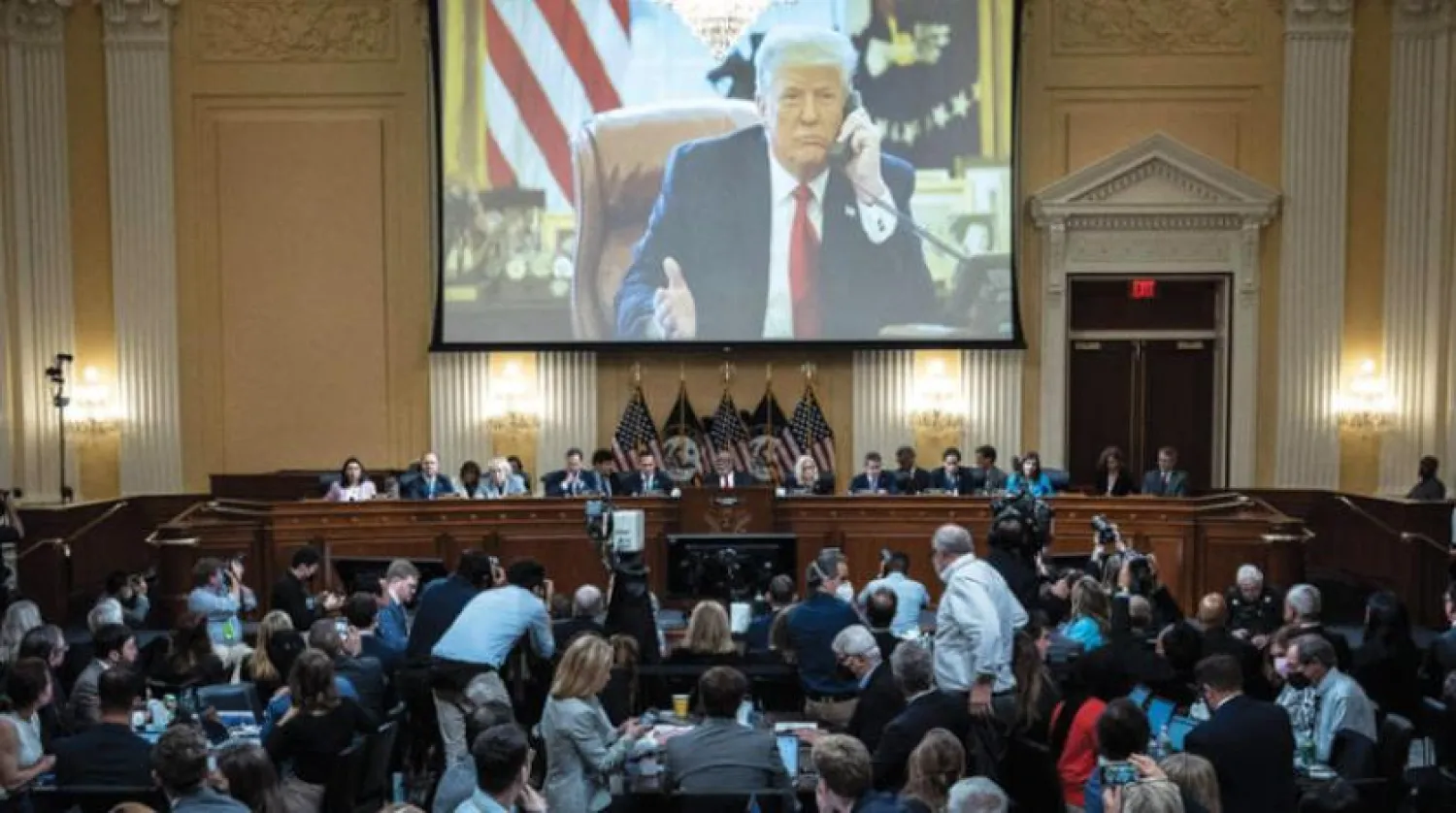

A Democratic Party View of 2023: Modest Victories and a Bumpy Road Ahead

An image of former President Donald Trump is displayed during the committee's third hearing on June 16. (AFP/Getty Images)
TT

A Democratic Party View of 2023: Modest Victories and a Bumpy Road Ahead

An image of former President Donald Trump is displayed during the committee's third hearing on June 16. (AFP/Getty Images)

Democrats have good reason to be happy with 2022. In Congress and at the polls, they had an extraordinary year. Led by President Joe Biden, Congress passed a $1 trillion infrastructure bill, a $750 billion package to fight climate change and reduce the cost of prescription drugs for senior citizens, a $52 billion measure to revive the US semiconductor industry, and the first gun safety law in 30 years.

Internationally, President Biden led the world in helping Ukraine push back the Russian invasion and killed al-Qaeda terrorist leader Ayman al-Zawahiri. Quite a record for President Biden and his party, which did it all with a tiny majority in the House of Representatives and the slimmest possible majority in the Senate.

But if US history is to be believed, the President's party loses – and loses big – at the polls two years into his term. The thing is...that's not what happened. Instead of picking up 30, 40, or more seats in the House, the Republicans only gained nine. In the Senate, the Democrats did even better. Rather than losing seats, they picked up one.

Taken together, that's virtually unheard of. Analysts say that popular opposition to the Supreme Court's overruling of Roe v. Wade, which guaranteed the right to abortion, and incompetent, even buffoonish, candidates backed by former President Donald Trump drove the Democrats' strong electoral performance.

But 2023 ain't gonna be 2022...to say the least. Republicans now control the House, and that's going to make a huge difference.

Democrats will lose the ability to drive bills through the lower chamber, and Republicans will unleash their House committees to investigate everything from serious issues like the Afghanistan withdrawal and migrants and drugs crossing America's borders to conspiracy theories about Hunter Biden, Covid vaccines, and virtually anything else they can think of.

The Democrats still control the Senate, but not with a filibuster-proof margin – so moving legislation will remain difficult and require compromise with Republicans.

Given the headwinds, Democrats options are limited. They'll have to curtail their agenda and be prepared to defend the Biden Administration. Nevertheless, there are still things the Democrats can achieve.

First, their ability to approve the President's nominees for executive branch positions and federal judgeships – which come with life-long appointments – has grown substantially. Even though the Democrats only upped their Senate majority by one seat, from 50 to 51, that one seat makes a big difference. In a 50/50 Senate, committees were divided 50/50 between Democrats and Republicans. But now the Democrats will have a majority on every Senate Committee and will be able to advance President Biden's nominees on their own, speeding the process in the usually plodding Senate.

Second, given that legislating in a divided Congress will be exceptionally more difficult, Democrats' attention will turn to getting the most out of President Biden's executive powers. They'll seek to work with the President and the various cabinet departments to see that laws are implemented and money is spent in accordance with their shared priorities.

Democrats will try to contrast their legislative successes of 2022 in which they seek to use the power of government to help people and grow the economy against Republican efforts in 2023 to cut taxes and shrink the size of the government. This debate has echoed in the United States across many decades and will do so again next year on key issues, including climate change, healthcare, transportation, energy, and education.

Third, just as Republicans will utilize House committees to investigate President Biden's agenda, family, and cabinet members, the Democrats will seek to awaken the investigative powers of Senate committees. Unlike House Republicans, however, they don't have an Administration of the opposite party to rake over the coals. Even if grass roots Democrats think Congress should still try to expose excesses of the former Trump Administration, the general public may be done looking through the rear-view mirror – so Senate Democratic-run committees will have to pick their battles carefully.

Finally, during the last decade, Democrats were relatively unified when in the majority. While there were certainly divisions between the far left and moderates, in the end, they usually stood together on big picture items even with their slim majorities.

That may not be the case with Republicans. Their Trumpian far-right, now with even more members, has much greater power in the Republican Party and is not particularly interested in governing. The future Republican Speaker of the House will struggle to round up 218 Republican votes to pass key appropriations bills or raise the debt ceiling. This means Speaker Kevin McCarthy – or whoever wins that post – will likely have to turn to Democrats to keep the government operating and the country out of default...and the new House Democratic minority leadership will be waiting to exploit the division to press for greater domestic spending on health, education, and the environment.

We shouldn't be surprised if we see a meltdown or two in the House Republican conference, possibly leading to a government shutdown, before major bills pass.

Even though Democrats and Republicans are deeply divided at home – especially on former President Trump's twisted efforts to overturn the election of 2020 – the parties have often been more united on foreign policy. For the most part, they both support efforts to help Ukraine battle Russia, share concerns about the Iranian nuclear program and support popular demonstrators, and recognize the challenges posed by China.

But there are definitely distinctions. Some on the Republican MAGA right have had sympathies for Vladimir Putin's Russia, and Republican leadership in the Senate and House will look for ways to placate them with enhanced oversight and legislative gimmicks which will seem like they are pushing back against Biden's policy when they really aren't.

On Iran, disagreements about former President Barack Obama's Iran nuclear deal have, for the time being, given way to bipartisan support for the women and men taking on the Iranian regime. But Iran's expanding nuclear program and its growing stockpile of enriched uranium will likely capture American attention once again, reinvigorating disputes over how to keep the Ayatollahs from building an atomic weapon.

And while both parties are increasingly concerned about China's threats against Taiwan and its expanding military presence in the South China Sea, congressional Republicans are decidedly more hawkish.

No discussion of 2023 would be complete without talking about 2024. In America, the next election begins as soon as the last one ends and both parties will begin the process of selecting their presidential candidates in the coming year.

On the Democratic side, President Biden is the obvious front-runner and almost certainly will be the party's candidate. But he is 80 years old and whispers of concern across the party may grow.

For Republicans, their top candidate remains former President Trump. But he is substantially weakened given his party's poor performance in the 2022 elections and may face indictments in the coming year for his efforts to overturn the 2020 election, his improper possession and storage of classified documents, and his business practices, for which his company has already been criminally convicted. Regardless, many believe Trump can again win his party's nomination among a divided Republican field, potentially teeing up a rematch with President Biden.

So, buckle in and put your tray tables in their upright and locked position because 2023 is going to be a bumpy political year. We'll likely see fights over policy and politics, possible indictment of a former president, and even a government shutdown or two. Save me a seat and buy me some popcorn. Let's watch together.

*Jason Steinbaum worked on Capitol Hill for more than three decades, during which time he served as Staff Director of the House Committee on Foreign Affairs.



Trump Set to Expand Immigration Crackdown in 2026 despite Brewing Backlash

A woman holds a poster as immigrants rights activists stage a traditional Mexican posada, reenacting Mary and Joseph’s search for shelter, to symbolize immigrants seeking refuge from Immigration and Customs Enforcement (ICE) agents during the ongoing immigration operation "Catahoula Crunch", in New Orleans, Louisiana, US, December 18, 2025. REUTERS/Seth Herald
TT

Trump Set to Expand Immigration Crackdown in 2026 despite Brewing Backlash

A woman holds a poster as immigrants rights activists stage a traditional Mexican posada, reenacting Mary and Joseph’s search for shelter, to symbolize immigrants seeking refuge from Immigration and Customs Enforcement (ICE) agents during the ongoing immigration operation "Catahoula Crunch", in New Orleans, Louisiana, US, December 18, 2025. REUTERS/Seth Herald

US President Donald Trump is preparing for a more aggressive immigration crackdown in 2026 with billions in new funding, including by raiding more workplaces — even as backlash builds ahead of next year’s midterm elections.

Trump has already surged immigration agents into major US cities, where they swept through neighborhoods and clashed with residents. While federal agents this year conducted some high-profile raids on businesses, they largely avoided raiding farms, factories and other businesses that are economically important but known to employ immigrants without legal status.

ICE and Border Patrol will get $170 billion in additional funds through September 2029 - a huge surge of funding over their existing annual budgets of about $19 billion after the Republican-controlled Congress passed a massive spending package in July.

Administration officials say they plan to hire thousands more agents, open new detention centers, pick up more immigrants in local jails and partner with outside companies to track down people without legal status, Reuters reported.

The expanded deportation plans come despite growing signs of political backlash ahead of next year’s midterm elections.

Miami, one of the cities most affected by Trump’s crackdown because of its large immigrant population, elected its first Democratic mayor in nearly three decades last week in what the mayor-elect said was, in part, a reaction to the president.

Other local elections and polling ‌have suggested rising concern among ‌voters wary of aggressive immigration tactics. "People are beginning to see this not as an immigration question anymore ‌as ⁠much as it ‌is a violation of rights, a violation of due process and militarizing neighborhoods extraconstitutionally," said Mike Madrid, a moderate Republican political strategist.

"There is no question that is a problem for the president and Republicans." Trump’s overall approval rating on immigration policy fell from 50% in March, before he launched crackdowns in several major US cities, to 41% in mid-December, for what had been his strongest issue.

Rising public unease has focused on masked federal agents using aggressive tactics such as deploying tear gas in residential neighborhoods and detaining US citizens.

'NUMBERS WILL EXPLODE'

In addition to expanding enforcement actions, Trump has stripped hundreds of thousands of Haitian, Venezuelan and Afghan immigrants of temporary legal status, expanding the pool of people who could be deported as the president promises to remove 1 million immigrants each year – a goal he almost certainly will miss this year. So far, some 622,000 immigrants ⁠have been deported since Trump took office in January.

White House border czar Tom Homan told Reuters Trump had delivered on his promise of a historic deportation operation and removing criminals while shutting down illegal immigration across ‌the US-Mexico border. Homan said the number of arrests will increase sharply as ICE hires more ‍officers and expands detention capacity with the new funding.

“I think you're going to ‍see the numbers explode greatly next year,” Homan said.

Homan said the plans “absolutely” include more enforcement actions at workplaces.

Sarah Pierce, director of social policy at the ‍center-left group Third Way, said US businesses have been reluctant to push back on Trump's immigration crackdown in the past year but could be prompted to speak up if the focus turns to employers.

Pierce said it will be interesting to see "whether or not businesses finally stand up to this administration."

Trump, a Republican, recaptured the White House promising record levels of deportations, saying it was needed after years of high levels of illegal immigration under his Democratic predecessor, Joe Biden. He kicked off a campaign that dispatched federal agents to US cities in search of possible immigration offenders, sparking protests and lawsuits over racial profiling and violent tactics.

Some businesses shut down to avoid raids or because of a lack of customers. Parents vulnerable to arrest kept their children home from school or had neighbors ⁠walk them. Some US citizens started carrying passports. Despite the focus on criminals in its public statements, government data shows that the Trump administration has been arresting more people who have not been charged with any crimes beyond their alleged immigration violations than previous administrations.

Some 41% of the roughly 54,000 people arrested by ICE and detained by late November had no criminal record beyond a suspected immigration violation, agency figures show.

In the first few weeks in January, before Trump took office, just 6% of those arrested and detained by ICE were not facing charges for other crimes or previously convicted.

The Trump administration has taken aim at legal immigrants as well. Agents have arrested spouses of US citizens at their green card interviews, pulled people from certain countries out of their naturalization ceremonies, moments before they were to become citizens, and revoked thousands of student visas.

PLANS TO TARGET EMPLOYERS

The administration’s planned focus on job sites in the coming year could generate many more arrests and affect the US economy and Republican-leaning business owners.

Replacing immigrants arrested during workplace raids could lead to higher labor costs, undermining Trump’s fight against inflation, which analysts expect to be a major issue in the closely watched November elections, determining control of Congress. Administration officials earlier this year exempted such businesses from enforcement on Trump’s orders, then quickly reversed, Reuters reported at the time.

Some immigration hardliners have ‌called for more workplace enforcement.

"Eventually you’re going to have to go after these employers,” said Jessica Vaughan, policy director for the Center for Immigration Studies, which backs lower levels of immigration. “When that starts happening the employers will start cleaning up their acts on their own.”


At Least 16 Files Have Disappeared from the DOJ Webpage for Documents Related to Jeffrey Epstein

Ghislaine Maxwell and Jeffrey Epstein are seen in this image released by the Department of Justice in Washington, D.C., US, on December 19, 2025 as part of a new trove of documents from its investigations into the late financier and convicted sex offender Jeffrey Epstein. US Justice Department/Handout via REUTERS
TT

At Least 16 Files Have Disappeared from the DOJ Webpage for Documents Related to Jeffrey Epstein

Ghislaine Maxwell and Jeffrey Epstein are seen in this image released by the Department of Justice in Washington, D.C., US, on December 19, 2025 as part of a new trove of documents from its investigations into the late financier and convicted sex offender Jeffrey Epstein. US Justice Department/Handout via REUTERS

At least 16 files disappeared from the Justice Department’s public webpage for documents related to Jeffrey Epstein — including a photograph showing President Donald Trump — less than a day after they were posted, with no explanation from the government and no notice to the public.

The missing files, which were available Friday and no longer accessible by Saturday, included images of paintings depicting nude women, and one showing a series of photographs along a credenza and in drawers. In that image, inside a drawer among other photos, was a photograph of Trump, alongside Epstein, Melania Trump and Epstein's longtime associate Ghislaine Maxwell.

The Justice Department did not say why the files were removed or whether their disappearance was intentional. A spokesperson for the department did not immediately respond to a request for comment.

Online, the unexplained missing files fueled speculation about what was taken down and why the public was not notified, compounding long-standing intrigue about Epstein and the powerful figures who surrounded him. Democrats on the House Oversight Committee pointed to the missing image featuring a Trump photo in a post on X, writing: “What else is being covered up? We need transparency for the American public.”

The episode deepened concerns that had already emerged from the Justice Department’s much-anticipated document release. The tens of thousands of pages made public offered little new insight into Epstein’s crimes or the prosecutorial decisions that allowed him to avoid serious federal charges for years, while omitting some of the most closely watched materials, including FBI interviews with victims and internal Justice Department memos on charging decisions.

Scant new insight in the initial disclosures

Some of the most consequential records expected about Epstein are nowhere to be found in the Justice Department's initial disclosures, which span tens of thousands of pages.

Missing are FBI interviews with survivors and internal Justice Department memos examining charging decisions — records that could have helped explain how investigators viewed the case and why Epstein was allowed in 2008 to plead guilty to a relatively minor state-level prostitution charge.

The gaps go further.

The records, required to be released under a recent law passed by Congress, hardly reference several powerful figures long associated with Epstein, including Britain’s former Prince Andrew, renewing questions about who was scrutinized, who was not, and how much the disclosures truly advance public accountability

Among the fresh nuggets: insight into the Justice Department’s decision to abandon an investigation into Epstein in the 2000s, which enabled him to plead guilty to that state-level charge, and a previously unseen 1996 complaint accusing Epstein of stealing photographs of children.

The releases so far have been heavy on images of Epstein’s homes in New York City and the US Virgin Islands, with some photos of celebrities and politicians.

There was a series of never-before-seen photos of former President Bill Clinton but fleetingly few of Trump. Both have been associated with Epstein, but both have since disowned those friendships. Neither has been accused of any wrongdoing in connection with Epstein and there was no indication the photos played a role in the criminal cases brought against him.

Despite a Friday deadline set by Congress to make everything public, the Justice Department said it plans to release records on a rolling basis. It blamed the delay on the time-consuming process of obscuring survivors' names and other identifying information. The department has not given any notice when more records might arrive.

That approach angered some Epstein accusers and members of Congress who fought to pass the law forced the department to act. Instead of marking the end of a yearslong battle for transparency, the document release Friday was merely the beginning of an indefinite wait for a complete picture of Epstein’s crimes and the steps taken to investigate them.

“I feel like again the DOJ, the justice system is failing us,” said Marina Lacerda, who alleges Epstein started sexually abusing her at his New York City mansion when she was 14.

Many of the long-anticipated records were redacted or lacked context Federal prosecutors in New York brought sex trafficking charges against Epstein in 2019, but he killed himself in jail after his arrest.

The documents just made public were a sliver of potentially millions of pages records in the department’s possession. In one example, Deputy Attorney General Todd Blanche said Manhattan federal prosecutors had more than 3.6 million records from sex trafficking investigations into Epstein and Maxwell, though many duplicated material already turned over by the FBI.

Many of the records released so far had been made public in court filings, congressional releases or freedom of information requests, though, for the first time, they were all in one place and available for the public to search for free.

Ones that were new were often lacking necessary context or heavily blacked out. A 119-page document marked “Grand Jury-NY," likely from one of the federal sex trafficking investigations that led to the charges against Epstein in 2019 or Maxwell in 2021, was entirely blacked out.

Trump’s Republican allies seized on the Clinton images, including photos of the Democrat with singers Michael Jackson and Diana Ross. There were also photos of Epstein with actors Chris Tucker and Kevin Spacey, and even Epstein with TV newscaster Walter Cronkite. But none of the photos had captions and was no explanation given for why any of them were together.

The meatiest records released so far showed that federal prosecutors had what appeared to be a strong case against Epstein in 2007 yet never charged him.

Transcripts of grand jury proceedings, released publicly for the first time, included testimony from FBI agents who described interviews they had with several girls and young women who described being paid to perform sex acts for Epstein. The youngest was 14 and in ninth grade.

One had told investigators about being sexually assaulted by Epstein when she initially resisted his advances during a massage.

Another, then 21, testified before the grand jury about how Epstein had hired her when she was 16 to perform a sexual massage and how she had gone on to recruit other girls to do the same.

“For every girl that I brought to the table he would give me $200,” she said. They were mostly people she knew from high school, she said. “I also told them that if they are under age, just lie about it and tell him that you are 18.”

The documents also contain a transcript of an interview Justice Department lawyers did more than a decade later with the US attorney who oversaw the case, Alexander Acosta, about his ultimate decision not to bring federal charges.

Acosta, who was labor secretary during Trump’s first term, cited concerns about whether a jury would believe Epstein’s accusers.

He also said the Justice Department might have been more reluctant to make a federal prosecution out of a case that straddled the legal border between sex trafficking and soliciting prostitution, something more commonly handled by state prosecutors.

“I’m not saying it was the right view,” Acosta added. He also said that the public today would likely view the survivors differently.

“There’s been a lot of changes in victim shaming,” Acosta said.


Kremlin Says Chances of Peace Not Improved by European and Ukrainian Changes to US Proposals

Russian President Vladimir Putin, right, and Russian Presidential foreign policy adviser Yuri Ushakov, left, attend talks with US special envoy Steve Witkoff, back to a camera, at the Senate Palace of the Kremlin in Moscow, Russia, Tuesday, Dec. 2, 2025. (Alexander Kazakov, Sputnik, Kremlin Pool Photo via AP)
TT

Kremlin Says Chances of Peace Not Improved by European and Ukrainian Changes to US Proposals

Russian President Vladimir Putin, right, and Russian Presidential foreign policy adviser Yuri Ushakov, left, attend talks with US special envoy Steve Witkoff, back to a camera, at the Senate Palace of the Kremlin in Moscow, Russia, Tuesday, Dec. 2, 2025. (Alexander Kazakov, Sputnik, Kremlin Pool Photo via AP)

Russian President Vladimir Putin's top foreign policy aide said on Sunday that he was sure the chances of peace in Ukraine were not improved by changes to US proposals made by the Europeans and Ukraine, ‌Interfax news agency ‌reported. 

"This is ‌not ⁠a forecast," ‌Kremlin foreign policy aide Yuri Ushakov told reporters. 

"I am sure that the proposals that the Europeans and Ukrainians have made or are trying to make definitely ⁠do not improve the document and do ‌not improve the possibility ‍of achieving long-term ‍peace." 

European and Ukrainian negotiators have ‍been discussing changes to a US set of proposals for an agreement to end the nearly four-year-old war, though it is unclear exactly what changes have been ⁠made to the original US proposals. 

US negotiators met Russian officials in Florida on Saturday. 

Putin's special envoy Kirill Dmitriev told reporters after meeting US special envoy Steve Witkoff and President Donald Trump’s son-in-law, Jared Kushner, that the talks were constructive and would continue ‌on Sunday.