




Since assuming power in 1989, Iran’s supreme leader Ali Khamenei did not find any president agreeable to his desires and line of thought until Ebrahim Raisi, the current president, took office in 2021. Even Mahmoud Ahmadinejad, who came to office with the support of the Revolutionary Guards (IRGC), and pretended to be obedient to Khamenei, gradually adopted positions opposing Khamenei’s will, which, in his second term, brought him into direct conflict with the Iranian leader.
The conflict between Khamenei and the three presidents, Akbar Hashemi Rafsanjani (1989-1997), Mohammad Khatami (1997-2005), and Hassan Rouhani (2013-2021), was mainly over the leader’s unconditional support of the hard-line conservatives, which on several occasions would lead to sabotaging the three presidents’ policies.
Foreign policy was at the heart of the clash between Khamenei and the Revolutionary Guards, on one side, and the presidents on the other. Relations with the world, especially with the United States and to a lesser degree with the West in general, and regional policies that Khamenei and the IRGC viewed as a means to broaden the Islamic Republic’s sphere of influence (inspired by the doctrine of exporting the revolution) stood at the center of the battle.
Hard-liners, who form the core of power, consider enmity with America a justification of their existence and identity. Reconciliation with America would mean the end of the revolution. With the end of the revolution, there would be no need for the leader of the revolution, nor for the Revolutionary Guards, and the hard-liners’ camp would become totally irrelevant. The IRGC emphasizes that the US-Iran conflict is “fundamental, ideological, and existential and cannot be resolved through negotiations”.
At the end of Hassan Rouhani's presidency in 2021, Khamenei and his supporters decided to put an end to the caricature-like state of democracy in Iran for good and purge reformists and moderates inside the pyramid of power for good.
Hard-liners, under the leadership of Khamenei, decided that, by having the Guardian Council disqualify moderate or reformist first-tier, and even second-tier, candidates, they would pave the way for the hard-liners to gain control over the legislative and executive branches, thus, extinguishing any glimmers of hope for a huge faction of the society that supports modernity - a major reason behind the current uprising.
In fact, the current uprising is mainly the continuation of a century-old battle between the conservative camp, meaning the traditionalists, and the modernists (liberal Muslims and secularists). In any case, the disaffected faction of society, which for about 25 years was devoted to the theory that reforms are possible through the ballot box, faced a new reality.
As a result, this extremely large faction turned their backs on the ballot boxes in the 2019 parliamentary elections. The turnout rate was slightly more than 40%, the lowest in 11 parliamentary elections. In the Tehran province, participation decreased from 50% in the previous elections to 25%: of about 10 million eligible voters, about 7.5 million did not vote.
Since holding an independent and reliable poll is not possible in Iran, it is hard to determine accurately what percentage of society opposes the regime. But perhaps one of the most striking findings from the secret bulletin, prepared by Fars News - the news agency managed by the IRGC - for IRGC commander Hossein Salami and leaked by the hacker group Black Reward, depicts “religious democracy” in Iran.
The report states: “70% of people do not want to participate in a march in support of the regime and the revolution while 21.4% chose the option ‘very much’ and 5.9% chose the option ‘somewhat.’” Simply put, according to a survey conducted by the regime itself, between 70 and 75% of the country's population do not support the regime, considering that conservative supporters of the regime are too devoted not to participate in a simple demonstration.
There are many reports about the protests of November 2019 (known as Bloody November), all of which emphasize that the backbone of the protests was the poor “tohidestan”.
Outspoken former MP Ali Motahari said in a speech in parliament: “According to the confession of the intelligence agencies, the protesters were the poor masses.” With the widespread and brutal crackdown on the protests, which, according to Yadullah Javani, the political deputy of the IRGC, took place “in 29 provinces” (out of 31) and “hundreds of cities”, the regime became overconfident that it had nullified the potential for new protest movements for several years.
Following the elimination of reformist and moderate candidates in the parliamentary elections, the Guardian Council also staged the 2021 presidential elections, which led to the election of Ebrahim Raisi and his accompanying team, undoubtedly the most incompetent among all post-revolutionary administrations.
A glaring outcome of this move was the new administration adopting a scornful position during the nuclear talks in Vienna, thus losing the opportunity to reach a nuclear agreement, which would lead to the removal of the US sanctions and the release of billions of dollars of Iran’s blocked funds. For instance, the hard-line negotiators insisted that an inquiry by the International Atomic Energy Agency into nuclear particles found at Iran’s nuclear sites must be dropped as a pre-condition to signing a nuclear agreement.
Confident that they would face no resistance, radical fanatics reactivated the Guidance Patrol, now operating under the Morality Police, to arrest women who violated the Islamic dress code. Shocking scenes of arresting women over the hijab issue were recorded and posted on social networks.
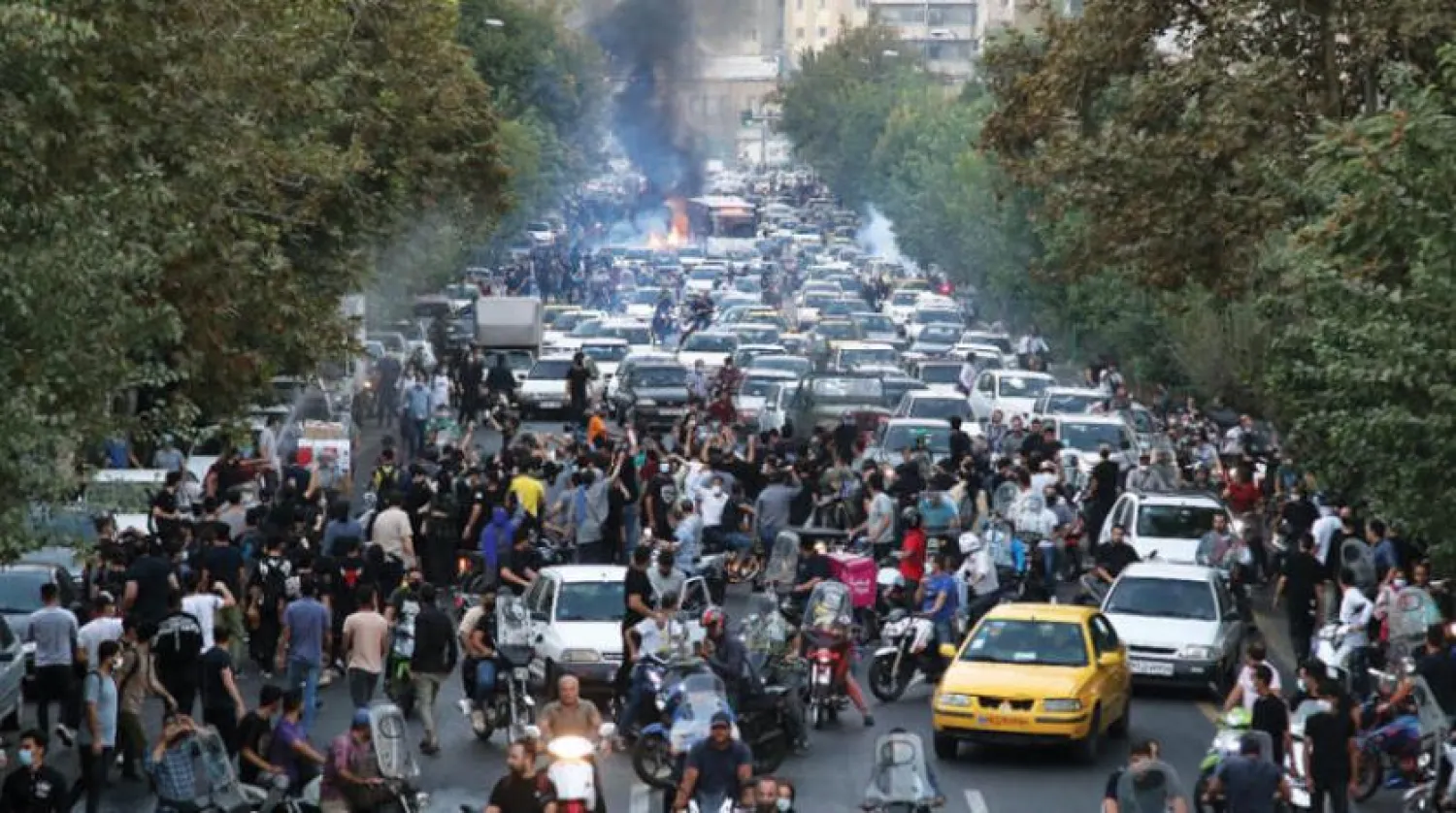
The tragic death of 22-year-old Mahsa Amini in September, following a violent encounter with the Morality Police, was the spark that activated the dormant volcano of public anger. “Woman, life, freedom” became the central slogan of the protests, and women formed the main pillar of the movement in an unprecedented way.
But a major difference between this new wave of protests and those in 2019 was evident. The massive attacks by the protesters on chain stores and banks in 2019 showed that the poor were the leading force behind that uprising. Slogans also indicated that protesters’ main concerns were livelihood and economic hardships. Slogans such as: “poverty, massacre, high cost - people have become victims” or “fuel has become more expensive - the poor have become poorer” were common, although the slogans of “death to the dictator” and “death to Khamenei” were also chanted.
In the recent protests, however, the slogans are mainly based on women’s rights and express intense abhorrence of dictatorship.
Another point that distinguishes the protests of 2019 and 2022 from each other was the 2019 use of slogans praising the last two Shahs of Iran, whose dynasty the 1979 revolution overthrew. Those slogans have not been heard often in the recent protests. This shows that the 2019 protesters were not sensitive about dictatorship and were only looking for relief from livelihood hardships.
On the contrary, this year’s protesters had a strong anti-dictatorship position and, even opposing the Islamic Republic, did not demand the return of a government like that of Reza Shah and Mohammad Reza Shah.
This year's protests, like all in the past, lacked a “leader with high popularity beyond the reach of the Islamic Republic” and were therefore vulnerable. A false comparison was common among protesters who argued that the countries where the “Arab Spring” took place did not have any clear and well-known leaders. The problem with this argument is that, precisely for that reason, all those movements faced defeat after the fall of the incumbent regimes.
To succeed, a protest movement needs a popular leader who can mobilize and unite the protesters, give them direction, and, finally, fill the power vacuum after the fall of the current regime.
Another major weakness of the current protests is the inability to attract the low-income classes of the society. Since the driving force of the movement is the defense of women’s rights and opposition to the dictatorship, livelihood-related slogans were seldom heard. The protests do not attract the huge low-income faction of society whose concern is bread.
It is puzzling that, throughout the life of the Islamic Republic, no matter who has appeared as the leader of the opposition, inside and outside of Iran and including reformist leaders who came from the urban middle classes, not one emerged as the voice of the huge population of the poor.
According to the Ministry of Labor, 30 million Iranians live in “absolute poverty. A report by the semiofficial Iranian Labour News Agency (ILNA) maintains that seven out of ten Iranians live under poverty line.
The leader of the Iranian 1979 revolution, Khomeini, grasped this concept. He constantly emphasized that the main feature of his movement was the revolution of kookh’neshinan (those who live in very poor accommodations), the barefoot, and the oppressed.
He used to say, “We will build housing for the homeless all over Iran. We will provide free water and electricity for the poor, free buses for the poor,” although not a single one of those promises was fulfilled.
Explaining the state of Iran's disintegrated economy requires a separate article. It is enough to know that food prices have risen so dramatically that, according to the latest World Bank report, Iran is third in “real food inflation” among 161 countries, after Zimbabwe and Lebanon.
To tackle the economic crisis, the Raisi administration, as dictated by Khamenei, instead of seeking the removal of US sanctions to increase desperately-needed foreign currency income and release of blocked assets, printed money at an astronomical rate, leading to the explosion of prices.
The exchange rate with the dollar, which was 250,000 rials at the beginning of Raisi's presidency, has surpassed the 420,000 mark at the time of writing this article. Simply put, within 16 months, the national currency lost 45% of its value.
While the depreciation of the national currency has accelerated, experts in Iran consider the current internal unrest and the resulting political instability as the main reason behind the trend.
Another factor that has caused concern in Iran and made the situation of Iran’s currency more unstable was the recent trip of Chinese President Xi Jinping to Saudi Arabia.
Although even before this trip, China was Saudi Arabia’s largest trade partner, with a trade volume of $87 billion per year, the signing of several memoranda of understanding worth about $30 billion during the same trip and the signing of the "Comprehensive Strategic Partnership Agreement” strengthened the impression in Iran that China does not view Iran a reliable source of oil supply, because of the country’s internal instability and its belligerent foreign policy, especially its ongoing conflict with the US. At the 20th Communist Party Congress in October, Xi emphasized that “energy security” is a key priority for China.
It seems that, to get out of the current political and economic storm, the Islamic Republic is leaning towards returning to the negotiating table to finalize a nuclear accord.
Iran’s foreign minister Hossein Amir Abdollahian has declared Iran’s readiness to sum up the Vienna talks based on the draft of the negotiation package that was the result of months of intensive and difficult talks. Reaching an agreement would not only significantly increase the possibility of selling oil by the Islamic Republic, but also would release funds blocked in foreign banks, which a UN representative declared to be $100 to $120 billion.
All that said, signing a new nuclear agreement may provide the Iranian regime with a temporary relief but will not solve the structural problems that now, more frequently than before, destabilize the system.
First, any agreement between the Islamic Republic and the United States is unstable. Khamenei has forbidden talks and de-escalation with America because the continuation of enmity with America, as discussed earlier, is one of the pillars of this system's survival.
However, in the contemporary history of international relations, it is impossible to find an example where two countries have been in irreconcilable conflict with each other and do not talk to de-escalate, but an agreement between them remains stable.
At the height of the Cold War, several agreements were signed to reduce tension (détente) between the Soviet Union and the United States. The scenario of Trump’s exit from the nuclear deal could be repeated.
Second, the gap caused by the hostile encounter between opponents of the regime and the government has become so deep that even silencing these protests will only stoke the anger of the suppressed, like a fire under the ashes, looking for another moment to erupt. This will not be the end of it.
Finally, a study by the US National Bureau of Economic Research, using game theory and building a mathematical model, concluded that “dictators survive not because of their use of force or ideology but because they convince the public - rightly or wrongly - that they are competent.… If citizens conclude that the dictator is incompetent, they overthrow him in a revolution.. The study shows “that incompetent dictators can survive as long as economic shocks are not too large.”
*Shahir Shahidsaless is an Iranian-Canadian political analyst and freelance journalist writing about Iranian domestic and foreign affairs, the Middle East, and the US foreign policy in the region.


