


Israeli Minister Sees Possible Attack on Iran ‘in Two or Three Years’ 

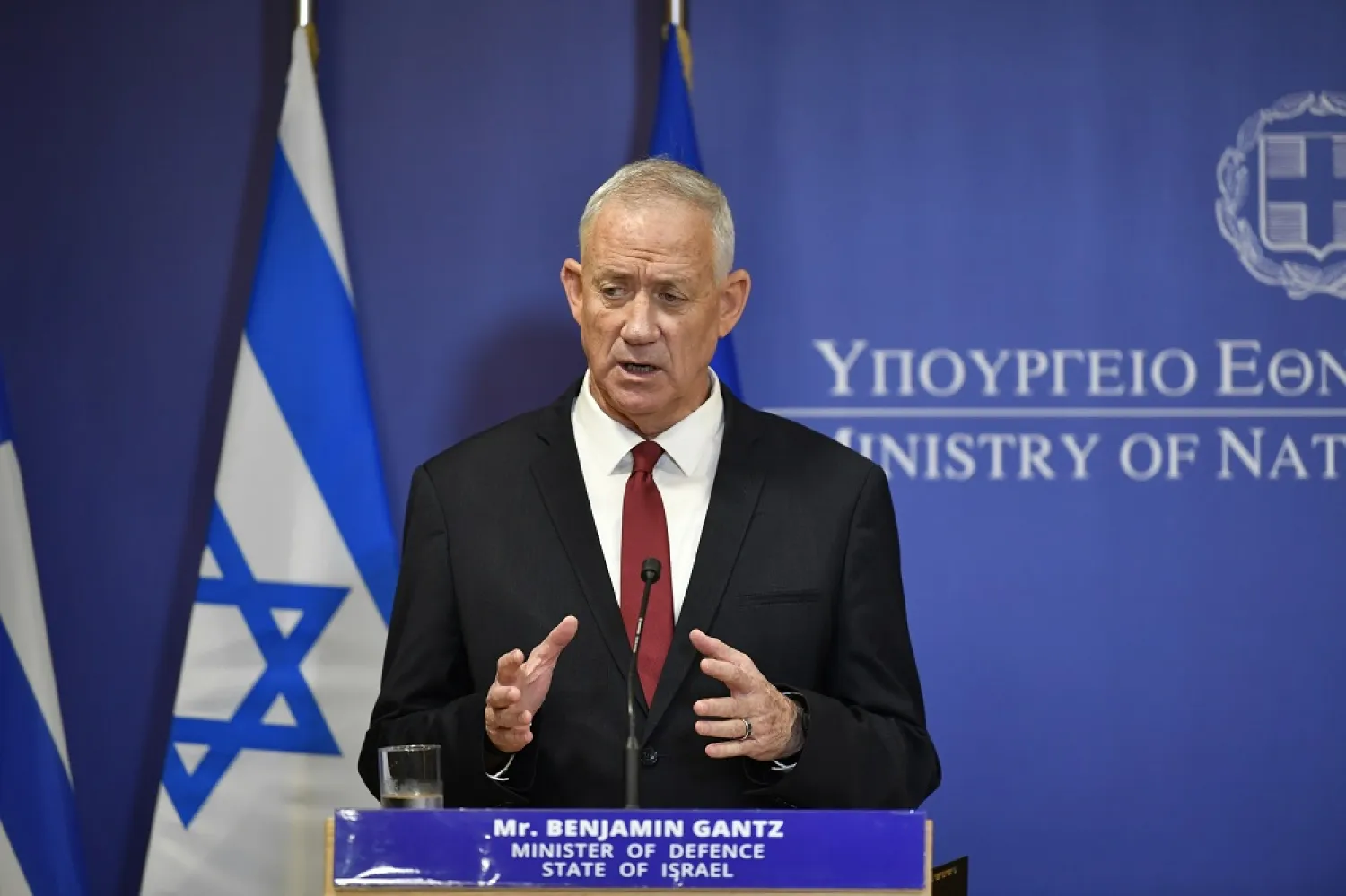
Israeli Defense Minister Benny Gantz, speaks during a joint press conference with his Greek counterpart Nikos Panagiotopoulos, at the Greek Ministry of Defense, in Athens, Greece, Friday, Nov. 18, 2022. (AP)
TT

Israeli Minister Sees Possible Attack on Iran ‘in Two or Three Years’ 

Israeli Defense Minister Benny Gantz, speaks during a joint press conference with his Greek counterpart Nikos Panagiotopoulos, at the Greek Ministry of Defense, in Athens, Greece, Friday, Nov. 18, 2022. (AP)

Israel could attack Iranian nuclear sites in two or three years, its defense minister said on Wednesday, in unusually explicit comments about a possible timeline. 

With international efforts to renew a 2015 nuclear deal having stalled, the Iranians have ramped up uranium enrichment, a process with civilian uses that can also eventually yield fuel for nuclear bombs - though they deny having any such design. 

Experts say Iran could potentially raise the fissile purity of its uranium to weapons-grade in short order. But building a deliverable warhead would take it years, they say - an estimate echoed by an Israeli military intelligence general this month. 

"In two or three years, you may be traversing the skies eastward and taking part in an attack on nuclear sites in Iran," Defense Minister Benny Gantz told graduating air force cadets in a speech. 

For more than a decade, Israel has issued veiled threats to attack its arch-enemy's nuclear facilities if it deems world powers' diplomacy with Tehran a dead end. However, some experts doubt Israel has the military clout to deliver lasting damage to Iranian targets that are distant, dispersed and well-defended. 

The Israeli military intelligence forecast for 2023 is that Iran "will continue on its current path of slow progress" in the nuclear realm, according to Israel Hayom newspaper on Sunday. 

"Iran will only change its policies if extreme sanctions are imposed on it; then it could decide to accelerate enrichment to military grade," said the report, which a military spokesperson confirmed as citing genuine intelligence assessments. 

Under an ambiguity policy designed to deter surrounding foes while avoiding provocations that can spur arms races, Israel neither confirms nor denies having nuclear weaponry. Scholars believe it does, having acquired the first bomb in late 1966. 

Unlike Iran, Israel is not a signatory to the voluntary Non-Proliferation Treaty of 1970, which offers access to civilian nuclear technologies in exchange for the forswearing of nuclear weaponry. 



Finland Summons Iran Envoy Over Deadly Protests

A Finnish flag flies over the City Hall in Helsinki, Finland, February 10, 2024. REUTERS/Tom Little/File photo
TT

Finland Summons Iran Envoy Over Deadly Protests

A Finnish flag flies over the City Hall in Helsinki, Finland, February 10, 2024. REUTERS/Tom Little/File photo

Finland's foreign minister said Tuesday that she would summon Iran's ambassador, after Tehran's nationwide shutdown of the internet and violent crackdown on protests.

"Iran's regime has shut down the internet to be able to kill and oppress in silence," Finland's Minister of Foreign Affairs Elina Valtonen wrote on X.

"This will not be tolerated. We stand with the people of Iran — women and men alike", she said, adding that she would "summon the Iranian ambassador this morning."

Valtonen also said the Nordic country was also "exploring measures to help restore freedom to the Iranian people" together with the EU.

Norway-based NGO Iran Human Rights (IHR) said Monday that the violent crackdown on a wave of protests in Iran has killed at least 648 people.

A nationwide shutdown of the internet by authorities in Iran, which activists fear is aimed at masking the scale of a crackdown, has now lasted over 108 hours, a monitor said on Tuesday.


North Korea's Kim Revamps Private Security Detail, South Says

North Korean leader Kim Jong Un gestures as he visits a greenhouse farm construction site along the country's border with China, in North Korea, January 2, 2026, in this picture released by North Korea's official Korean Central News Agency.  KCNA via REUTERS
North Korean leader Kim Jong Un gestures as he visits a greenhouse farm construction site along the country's border with China, in North Korea, January 2, 2026, in this picture released by North Korea's official Korean Central News Agency. KCNA via REUTERS
TT

North Korea's Kim Revamps Private Security Detail, South Says

North Korean leader Kim Jong Un gestures as he visits a greenhouse farm construction site along the country's border with China, in North Korea, January 2, 2026, in this picture released by North Korea's official Korean Central News Agency.  KCNA via REUTERS
North Korean leader Kim Jong Un gestures as he visits a greenhouse farm construction site along the country's border with China, in North Korea, January 2, 2026, in this picture released by North Korea's official Korean Central News Agency. KCNA via REUTERS

North Korean leader Kim Jong Un has replaced three top officials in charge of his personal security, Seoul said Tuesday, a sign the despot may increasingly fear assassination plots.

Seoul's Unification Ministry -- responsible for managing relations with Pyongyang -- said three state agencies handling Kim's security had new bosses, AFP said.

The reshuffle was spotted during a military parade in October, the ministry said.

The changes at the Bodyguard Command in particular, which handles security measures against drone or electronic attacks, could be linked to Kim's decision to send troops to aid Russia's war in Ukraine, an expert said.

"Change in the pattern of Kim's security detail was detected from October 2024, when he deployed North Korean troops to Russia," Hong Min, an analyst at the Korea Institute for National Unification, told AFP.

"He could have judged there could be an assassination attempt against him involving Ukrainians amid heightened international spotlight due to the deployment," he added.

Seoul's spy agency previously said Kim had upgraded the level of security around him due to the risk of attempts on his life.

Kim's office sought to obtain equipment capable of jamming communications and drone detection gear in response, the agency said.

In the past year, Kim has often been seen accompanied by his daughter Ju Ae on official duties including the inspection of a nuclear-powered submarine.

Analysts say she is likely next in line to run the nuclear-armed dictatorship.

This month's capture by the United States of Venezuelan President Nicolas Maduro has also likely heightened security fears in Pyongyang, analysts say.

The operation represents a nightmare scenario for North Korea's leadership, which has long feared a so-called "decapitation strike" of that kind and accused Washington of seeking to remove it from power.


Leaders of Japan and South Korea Discuss Economy and Regional Challenges at Summit

13 January 2026, Japan, Nara: Japan's Prime Minister Sanae Takaichi shakes hands with South Korea's President Lee Jae Myung at the start of their summit meeting in Nara. (dpa)
TT

Leaders of Japan and South Korea Discuss Economy and Regional Challenges at Summit

13 January 2026, Japan, Nara: Japan's Prime Minister Sanae Takaichi shakes hands with South Korea's President Lee Jae Myung at the start of their summit meeting in Nara. (dpa)

South Korean President Lee Jae Myung and Japanese Prime Minister Sanae Takaichi agreed to step up cooperation between the neighbors, whose relations are occasionally strained, as they both face growing uncertainty and regional challenges.

"I believe cooperation between Korea and Japan is now more important than ever and anything else, as we have to continue moving forward to a new, better future amid this complex, unstable international order," Lee said at the outset of the summit Tuesday.

Takaichi said she renewed her determination to further improve Japan's relations with South Korea “as I believe the two countries should cooperate and contribute for the stability in the region.”

“This year I will elevate Japan-South Korea relations even higher," said Takaichi, who aims to secure stable ties with Seoul while Tokyo struggles with a worsening dispute with China.

The meeting could deliver a political win as Takaichi seeks to shore up her power. A few months after taking office, she enjoys strong approval ratings but her party has a majority in only one of two houses of Parliament. There is growing speculation she may be planning a snap election in hopes of gaining more seats.

Takaichi is hosting Lee in her hometown, Nara, an ancient capital known for its treasured deer and centuries-old Buddhist temples, following a request by Lee during the October APEC meeting in Gyeongju, South Korea.

Nara, the center of cultural exchanges between the Korean Peninsula and Japan in ancient times, “carries a special meaning at a time Korea-Japan exchanges are more important than ever," Lee said.

Takaichi was in Nara on Monday to prepare and posted on X: “I hope to further push forward Japan’s relations with South Korea in the forward-looking way as we meet in the ancient capital of Nara with more than 1,300 years of history and longstanding cultural exchanges between Japan and the Korean Peninsula.”

The Japanese prime minister faces intensifying trade and political tension with China over a remark about Taiwan that angered Beijing days after she took office. Takaichi said that potential Chinese military action against Taiwan, the island democracy Beijing claims as its own, could justify Japanese intervention.

Tuesday's meeting was intended to focus on trade and the challenges of China and North Korea, as well as efforts to deepen trust between the two countries.

Japan and South Korea, both key US allies, must also figure out how to deal with President Donald Trump’s unpredictable diplomacy, and both countries are under US pressure to increase defense spending.

Lee was in Beijing last week for talks with Chinese leader Xi Jinping as China steps up economic and political pressure against Japan and seeks to cozy up to Seoul. During the visit, the South Korean leader told reporters that relations with Japan are as important as those with China but that South Korea's ability to broker reconciliation between its neighbors is limited.

Lee, in an interview Monday with Japan’s NHK television, noted his interest in gaining Japanese backing for South Korea's participation the 12-member Comprehensive and Progressive Agreement for Trans-Pacific Partnership. He said that would involve South Korea lifting a ban on imports from Fukushima and nearby Japanese prefectures affected by the 2011 Fukushima Daiichi nuclear disaster and may take time because of health concerns among South Koreans.

Lee also said his country wants to cooperate with Japan on security under a trilateral framework that includes the US, but “what’s really important is the issue of deep mutual trust.”

Relations between Seoul and Tokyo have begun improving in recent years in the face of shared challenges such as growing China-US competition and North Korea’s advancing nuclear program.

There were early concerns about Takaichi's ability to work with Lee, fed by her reputation as a security hawk and an assumption by some that the left-wing South Korean leader would tilt toward North Korea and China. But so far, both leaders have sought to set aside their differences.

While the two leaders are expected to avoid discussing their historical disputes, media reports say they may discuss possible humanitarian cooperation in the ongoing effort to recover remains from a former undersea mining site in western Japan where 180 workers, mostly Korean forced laborers, were killed in a 1942 accident.
