
Iranian Killed at Memorial for Slain Protesters

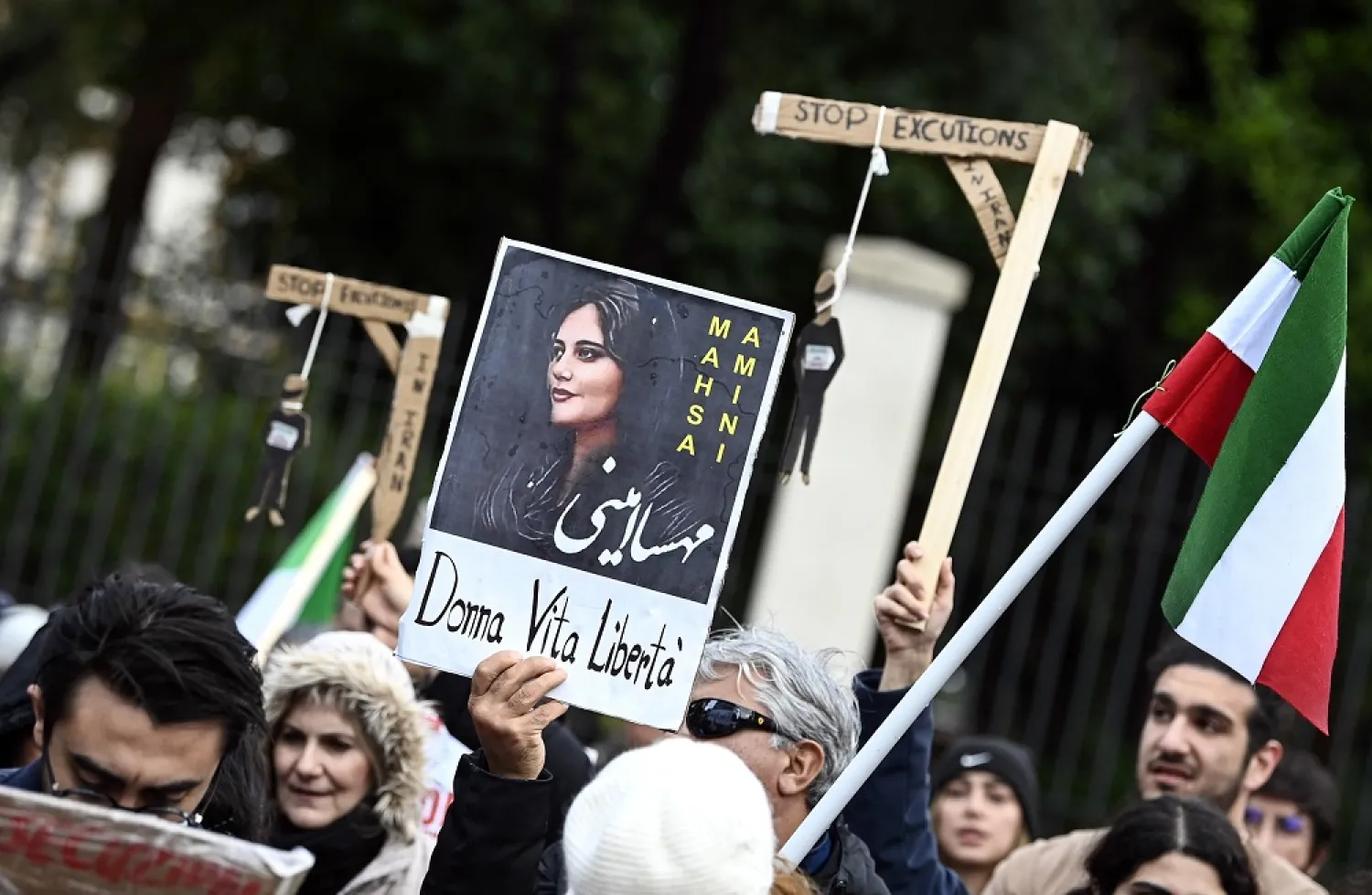
A person holds a placard showing late Iranian woman Mahsa Amini with a message reading "woman, life, freedom" outside the Iranian embassy in Rome, Italy, 10 December 2022, following the execution of a protester in Iran. (EPA)
TT

Iranian Killed at Memorial for Slain Protesters

A person holds a placard showing late Iranian woman Mahsa Amini with a message reading "woman, life, freedom" outside the Iranian embassy in Rome, Italy, 10 December 2022, following the execution of a protester in Iran. (EPA)

Iran's security forces fired on a crowd in the Kurdish-populated west on Saturday, killing a 22-year-old, a rights group said, more than 100 days after the death of Kurdish woman Mahsa Amini sparked nationwide protests. 

The country has been rocked by demonstrations since Amini died in custody on September 16 following her arrest for an alleged breach of the country's strict dress code for women. 

Norway-based human rights group Hengaw said the man was killed in a cemetery in the city of Javanroud as residents marked the end of a 40-day mourning period for slain protesters. 

Security forces fired live ammunition and tear gas, killing Borhan Eliasi and wounding eight others, Hengaw said, in a report that could not be independently verified. 

Two of those wounded were said to be in critical condition. 

Activists have used social media to call for gatherings in Tehran and other cities to protest the worsening economic situation. 

The sanctions-hit country replaced its central bank chief on Thursday, state media said, after the rial shed nearly a third of its value on the parallel market in the past two months. 

US-based Human Rights Activists News Agency (HRANA) reported small gatherings in the capital and the central cities of Isfahan and Najafabad, sharing videos of protesters chanting anti-regime slogans. AFP was unable to immediately verify the footage. 

On Friday, hundreds took to the streets of the southeastern city of Zahedan, which has seen weekly protests since the security forces killed more than 90 people in the city on September 30, in what has been dubbed "Bloody Friday". 

Footage shared by protest monitor 1500tasvir and verified by AFP shows the crowd in the Sistan-Baluchistan provincial capital chanting "Death to the dictator", taking aim at Iran's supreme leader Ali Khamenei. 

Sistan-Baluchistan, an impoverished province on Iran's border with Afghanistan and Pakistan, had been the site of often deadly violence even before protests erupted over Amini's death.  

At least 14,000 people have been arrested since the nationwide unrest began, the United Nations said last month. HRANA has put the figure at 19,000.  

Retrial for death row inmate 

Iranian officials say hundreds of people have been killed in the unrest, including members of the security forces, and thousands arrested.  

In an updated death toll issued Tuesday, Oslo-based group Iran Human Rights (IHR) said 476 protesters have been killed so far.  

Earlier in December, Iran executed two people in connection with the protests.  

The judiciary's Mizan Online news website reported that the supreme court has ordered the retrial of a third death row inmate sentenced over the nationwide protests.  

Foreign-based rights groups had reported Sahand Nourmohammad-Zadeh was sentenced to death for tearing down street railings and setting fire to rubbish bins and tyres.  

Mizan said the 26-year-old had been granted a retrial.  

"The appeal against the decision issued by a Tehran Revolutionary Court was upheld in the Supreme Court," a statement said, adding that Nourmohammad-Zadeh's case had been referred to a different court to be tried again.  

His lawyer, Hamed Ahmadi, told the ILNA news agency on December 21 that Nourmohammad-Zadeh had been sentenced to death after being convicted of the religious law offense of "moharebeh", or "enmity against God".  

Nourmohammad-Zadeh is the third person reportedly on death row to be granted a retrial after Kurdish rapper Saman Seydi, also known as Saman Yasin, and Mahan Sadrat.  

Majidreza Rahnavard, 23, was hanged in public on December 12 after being sentenced to death by a court in Iran's second city Mashhad for killing two members of the security forces with a knife.  

Four days earlier, Mohsen Shekari, also 23, was executed for wounding a member of the security forces.  

The judiciary has said nine others have been sentenced to death, while IHR said this week that dozens of protesters face charges that can carry the death penalty. 


Trump Warns of ‘Very Strong Action’ if Iran Hangs Protesters

 In this photo obtained by The Associated Press, Iranians attend an anti-government protest in Tehran, Iran, Friday, Jan. 9, 2026. (UGC via AP)
In this photo obtained by The Associated Press, Iranians attend an anti-government protest in Tehran, Iran, Friday, Jan. 9, 2026. (UGC via AP)
TT

Trump Warns of ‘Very Strong Action’ if Iran Hangs Protesters

 In this photo obtained by The Associated Press, Iranians attend an anti-government protest in Tehran, Iran, Friday, Jan. 9, 2026. (UGC via AP)
In this photo obtained by The Associated Press, Iranians attend an anti-government protest in Tehran, Iran, Friday, Jan. 9, 2026. (UGC via AP)

US President Donald Trump warned of unspecified "very strong action" if Iranian authorities go ahead with threatened hangings of some protesters, with Tehran calling American warnings a "pretext for military intervention".

International outrage has built over the crackdown that a rights group said has likely killed thousands during protests posing one of the biggest challenges yet to Iran's clerical leadership.

Iran's UN mission posted a statement on X, vowing that Washington's "playbook" would "fail again".

"US fantasies and policy toward Iran are rooted in regime change, with sanctions, threats, engineered unrest, and chaos serving as the modus operandi to manufacture a pretext for military intervention," the post said.

Iranian authorities have insisted they had regained control of the country after successive nights of mass protests nationwide since.

Rights groups accuse the government of fatally shooting protesters and masking the scale of the crackdown with an internet blackout that has now surpassed the five-day mark.

New videos on social media, with locations verified by AFP, showed bodies lined up in the Kahrizak morgue just south of the Iranian capital, with the corpses wrapped in black bags and distraught relatives searching for loved ones.

Trump -- who earlier told the protesters in Iran that "help is on its way" -- said Tuesday in a CBS News interview that the United States would act if Iran began hanging protesters.

Tehran prosecutors have said Iranian authorities would press capital charges of "moharebeh", or "waging war against God", against some suspects arrested over recent demonstrations.

"We will take very strong action if they do such a thing," said the American leader, who has repeatedly threatened Iran with military intervention.

"When they start killing thousands of people -- and now you're telling me about hanging. We'll see how that's going to work out for them," Trump said.

The US State Department on its Farsi language X account said 26-year-old protestor Erfan Soltani had been sentenced to be executed on Wednesday.

"Erfan is the first protester to be sentenced to death, but he won't be the last," the State Department said, adding more than 10,600 Iranians had been arrested.

Rights group Amnesty International called on Iran to immediately halt all executions, including Soltani's.

Trump urged on his Truth Social platform for Iranians to "KEEP PROTESTING", adding: "I have cancelled all meetings with Iranian Officials until the senseless killing of protesters STOPS. HELP IS ON ITS WAY."

It was not immediately clear what meetings he was referring to or what the nature of the help would be.

- 'Rising casualties' -

European nations also signaled their anger over the crackdown, with France, Germany and the United Kingdom among the countries that summoned their Iranian ambassadors, as did the European Union.

"The rising number of casualties in Iran is horrifying," said EU chief Ursula von der Leyen, vowing further sanctions against those responsible.

Norway-based NGO Iran Human Rights said it had confirmed 734 people killed during the protests, including nine minors, but warned the death toll was likely far higher.

"The real number of those killed is likely in the thousands," IHR's director Mahmood Amiry-Moghaddam said.

Iranian state media has said dozens of members of the security forces have been killed, with their funerals turning into large pro-government rallies.

Authorities in Tehran have announced a mass funeral ceremony in the capital on Wednesday for the "martyrs" of recent days.

Amir, an Iraqi computer scientist, returned to Baghdad on Monday and described dramatic scenes in Tehran.

"On Thursday night, my friends and I saw protesters in Tehran's Sarsabz neighborhood amid a heavy military presence. The police were firing rubber bullets," he told AFP in Iraq.

Reza Pahlavi, the US-based son of Iran's ousted shah, called on the military to stop suppressing protests.

"You are the national military of Iran, not the military of the Islamic Republic," he said in a statement.

- 'Serious challenge -

The government on Monday sought to regain control of the streets with mass nationwide rallies that supreme leader Ali Khamenei hailed as proof that the protest movement was defeated, calling them a "warning" to the United States.

In power since 1989 and now aged 86, Khamenei has faced significant challenges, most recently the 12-day war in June against Israel, which forced him to go into hiding.

Analysts have cautioned that it is premature to predict the immediate demise of the theocratic system, pointing to the repressive levers the leadership controls, including the Revolutionary Guard Corps, which is charged with safeguarding the revolution.

Nicole Grajewski, professor at the Sciences Po Center for International Studies, told AFP the protests represented a "serious challenge" to the country, but it was unclear if they would unseat the leadership, pointing to "the sheer depth and resilience of Iran's repressive apparatus".


‘We Choose Denmark,’ Says Greenland Ahead of W. House Talks

Danish Prime Minister Mette Frederiksen and Greenlandic Prime Minister Jens-Frederik Nielsen attend a press conference in Copenhagen, Denmark, January 13, 2026. (Reuters)
TT

‘We Choose Denmark,’ Says Greenland Ahead of W. House Talks

Danish Prime Minister Mette Frederiksen and Greenlandic Prime Minister Jens-Frederik Nielsen attend a press conference in Copenhagen, Denmark, January 13, 2026. (Reuters)

Greenland would choose to remain Danish over a US takeover, its leader said Tuesday, ahead of crunch White House talks on the future of the Arctic island which President Donald Trump has repeatedly threatened.

Trump has been talking up the idea of buying or annexing the autonomous territory for years, and further stoked tensions this week by saying the United States would take it "one way or the other".

"We are now facing a geopolitical crisis, and if we have to choose between the United States and Denmark here and now, we choose Denmark," Greenland's Prime Minister Jens-Frederik Nielsen said at a press conference.

"One thing must be clear to everyone: Greenland does not want to be owned by the United States. Greenland does not want to be governed by the United States. Greenland does not want to be part of the United States."

He was speaking alongside Danish leader Mette Frederiksen, who said it had not been easy to stand up to what she slammed as "completely unacceptable pressure from our closest ally".

"However, there are many indications that the most challenging part is ahead of us," Frederiksen said.

Danish Foreign Minister Lars Lokke Rasmussen and his Greenlandic counterpart Vivian Motzfeldt are to meet US Vice President JD Vance and Secretary of State Marco Rubio on Wednesday to discuss Greenland's future.

Lokke said they had requested a meeting with Rubio, and Vance had asked to take part and host it at the White House.

Vance made an uninvited visit to the island in March where he criticized Denmark for what he said was a lack of commitment to Greenland and security in the Arctic, and called it a "bad ally".

The comments enraged Copenhagen, which has been an ardent trans-Atlantic supporter and which has sent troops to fight US wars in Iraq and Afghanistan.

- 'Misunderstandings' -

For Nuuk and Copenhagen, Wednesday's meeting at the White House is aimed at ironing out "misunderstandings".

These relate to Greenland's defense, Chinese and Russian military presence in the Arctic, and the relationship between Greenland and Copenhagen, which together with the Faroe Islands make up the Kingdom of Denmark.

"To the uninformed American listener, the ongoing (independence) talks between Denmark and Greenland might have been construed as if Greenland's secession from Denmark was imminent," said Greenland specialist Mikaela Engell.

For these listeners, "I can understand that, in this situation, it would be better for the Americans to take hold of that strategic place", the former Danish representative on the island told AFP.

But this "discussion has been going on for years and years and it has never meant that Greenland was on its way out the door", she stressed.

Denmark's foreign minister said the reason Copenhagen and Nuuk had requested Wednesday's meeting was "to move the entire discussion... into a meeting room, where you can look each other in the eye and talk through these issues".

Greenland's location is highly strategic, lying on the shortest route for missiles between Russia and the United States. It is therefore a crucial part of the US anti-missile shield.

Washington has accused Copenhagen of doing little to protect Greenland from what it perceives as a growing Arctic threat from Russia and China, though analysts suggest Beijing is a small player in the region.

Denmark's government has rejected US claims, recalling that it has invested almost 90 billion kroner ($14 billion) to beef up its military presence in the Arctic.

The Danish prime minister on Tuesday called for stronger cooperation with the US and NATO to improve the region's security.

She also called for NATO to defend Greenland, and said that security guarantees would be "the best defense against Chinese or Russian threats in the Arctic".

Diplomats at NATO say some Alliance members have floated the idea of launching a new mission in the region, although no concrete proposals are yet on the table.

Rutte said on Monday that NATO was working on "the next steps" to bolster Arctic security.

Greenland's foreign minister and Danish Defense Minister Troels Lund Poulsen are to meet NATO's Secretary General Mark Rutte on January 19 to discuss the issue.

"We are now moving forward with the whole issue of a more permanent, larger presence in Greenland from the Danish defense forces but also with the participation of other countries," Lund Poulsen told reporters.


ICJ Hears Gruesome Violence Against Rohingya in Myanmar Genocide Case

A view of the courtroom during the first hearing in which Myanmar is accused of committing genocide against the country's Muslim minority, the Rohingya, at the International Court of Justice in The Hague, The Netherlands, 12 January 2026. (EPA)
TT

ICJ Hears Gruesome Violence Against Rohingya in Myanmar Genocide Case

A view of the courtroom during the first hearing in which Myanmar is accused of committing genocide against the country's Muslim minority, the Rohingya, at the International Court of Justice in The Hague, The Netherlands, 12 January 2026. (EPA)

Myanmar soldiers rampaged door-to-door, systematically killing, raping, and burning Rohingya men, women and children, the International Court of Justice heard on Tuesday, on day two of a genocide hearing.

ICJ judges are hearing three weeks of testimony as they weigh accusations by The Gambia that Myanmar committed genocide against the Rohingya in a 2017 crackdown.

Tafadzwa Pasipanodya, a lawyer for The Gambia, laid out harrowing evidence of an alleged attack on a village in northern Rakhine State in Myanmar.

Soldiers decapitated old men, gang raped women and girls, threw infants into rivers.

After killing everyone in the villages, they "systematically" burned the buildings following the so-called "clearance operations", alleged Pasipanodya.

"The totality of this evidence... convincingly show that Myanmar, through its state organs, acted with the intent to destroy the Rohingya," said Pasipanodya.

Myanmar has always maintained the crackdown by its armed forces, known as the Tatmadaw, was justified to root out Rohingya insurgents after a series of attacks left a dozen security personnel dead.

The violence forced hundreds of thousands of Rohingya to flee to neighboring Bangladesh.

Today, 1.17 million Rohingya live crammed into dilapidated camps spread over 8,000 acres in Cox's Bazar in Bangladesh.

Lawyers for Myanmar will begin their response on Friday.

A final decision could take months or even years, and while the ICJ has no means of enforcing its decisions, a ruling in favor of The Gambia would heap more political pressure on Myanmar.

The Gambia is taking Myanmar to the ICJ, which rules in disputes between states, alleging breaches of the 1948 UN Genocide Convention, under which any state can haul another before the ICJ if it believes genocide is being committed.

Legal experts are watching this case as it could give clues for how the ICJ will handle similar accusations against Israel over its military campaign in Gaza, in a case brought by South Africa.