


Syria Says Türkiye Agreed to Withdraw from Syrian Territory

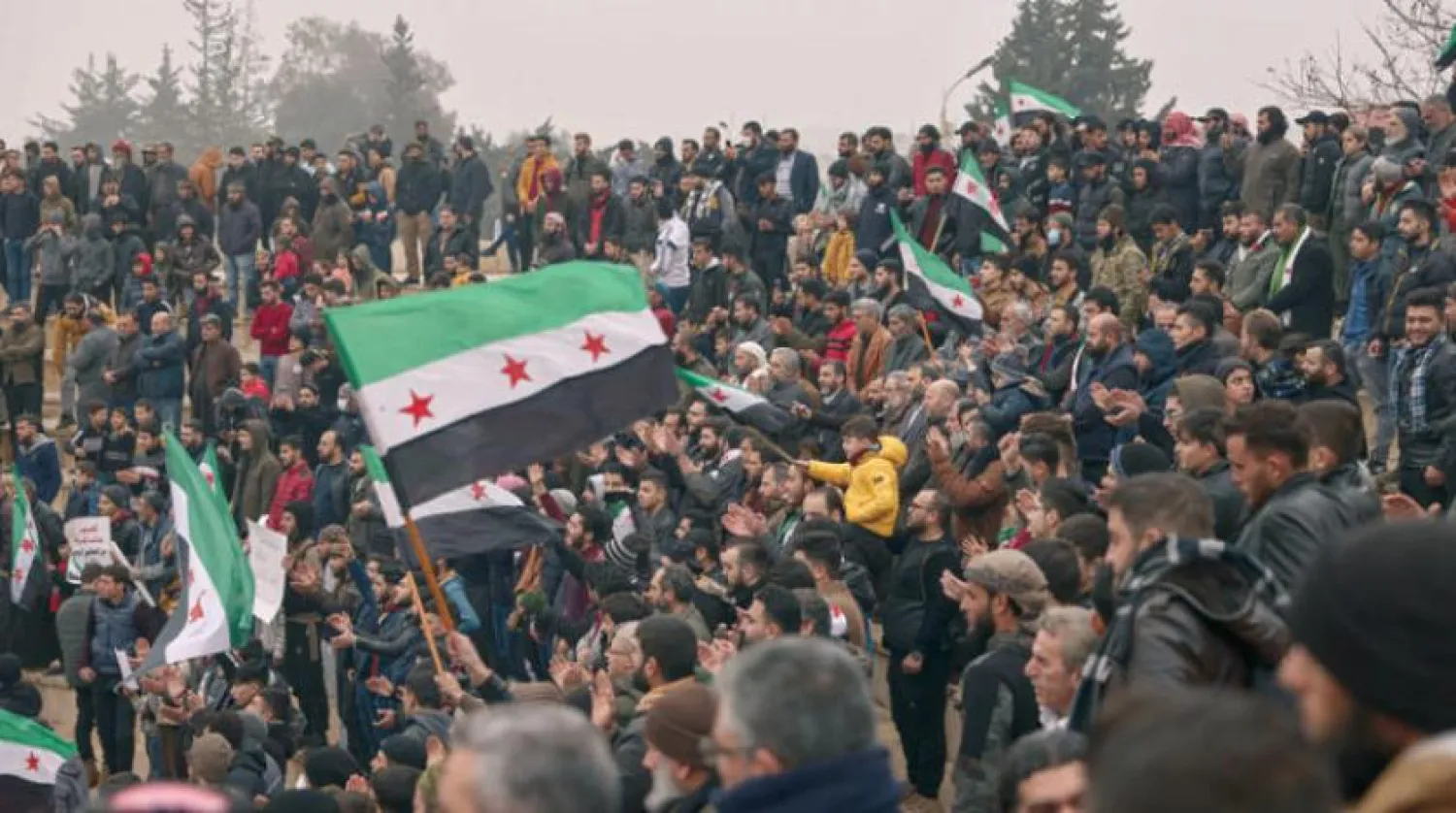
Protests in Idlib on Friday against the rapprochement between Türkiye and the Syrian regime (DPA)
TT

Syria Says Türkiye Agreed to Withdraw from Syrian Territory

Protests in Idlib on Friday against the rapprochement between Türkiye and the Syrian regime (DPA)

Türkiye and Syria announced new details on Sunday about the tripartite meeting between the defense ministers of Russia, Türkiye and Syria, that tackled the return of Syrian refugees, the fight against terrorism, and the Turkish military presence in northern Syria.

Turkish Defense Minister Hulusi Akar asserted Türkiye's respect for Syria's territorial integrity during the meeting, adding that it only seeks to fight terrorism.

Akar also explained to the Syrian side the reason for the presence of the Turkish army on its territory.

Several media outlets close to the Syrian regime reported that Türkiye agreed, after the tripartite meeting, to withdraw its forces from Syria.

The media quoted sources who spoke on condition of anonymity as saying that Türkiye agreed to withdraw its forces from the areas it occupied in northern Syria, stressing that Russia, Türkiye, and Syria discussed the implementation of the agreement reached in Moscow on March 5, 2020, regarding the Aleppo - Latakia International Highway-M4.

The sources added that the meeting resulted in an agreement between the Turkish, Russian, and Syrian parties that the banned PKK is an "agent of Israel and the US" and poses the greatest threat to Damascus and Ankara.

Meanwhile, the Daily Sabah reported that Akar explained that terrorist groups control a third of the Syrian territory and that the Turkish army is in Syria to fight the People's Defense Units (PKK), ISIS, and other terrorists.

Ankara also wanted to prevent the mass exodus of Syrians toward Türkiye, adding that authorities sought to ensure Syrian refugees' safe and voluntary return to their homeland.

The sources indicated that the recent meeting in Moscow between the defense ministers and heads of the intelligence services of Türkiye, Syria, and Russia discussed a roadmap for normalizing relations between Ankara and Damascus.

The meeting tackled four main issues: the safe and dignified return of refugees, the return of property to their owners upon arrival, ensuring fair trials, and completing constitutional amendments to hold free and fair elections.

The meeting was held at the level of defense ministers and not at the level of foreign ministers, and the next step in the roadmap would be a meeting of the foreign ministers, but the timing has yet to be determined.

Turkish Foreign Minister Mevlut Cavusoglu stressed the need to ensure a safe return of Syrian refugees, noting that the Syrian regime wanted them to return.

Cavusoglu revealed his country's readiness to hand over areas under its control to the Syrian regime "if political stability is achieved." He said it was possible to establish joint work if common ground is formed between Syria and Türkiye in combating terrorism.

The minister asserted that Türkiye respects the unity and sovereignty of the Syrian territories, adding that the presence of the Turkish forces in Syria is to combat terrorism since the Syrian authorities cannot secure stability.

During the consultations in Istanbul in December, Russia suggested a formula based on withdrawing the Syrian Democratic Forces (SDF) with their weapons from Manbij and Ain al-Arab in northern Syria to be replaced by the regime forces.

Türkiye seeks to establish a security region 30 kilometers deep inside Syrian territory.



Israel Reinforces Separation between Negotiations with Lebanon, Strikes on Hezbollah

A destroyed house is seen from an armored vehicle of the United Nations Interim Force in Lebanon (UNIFIL) in the village of Blida, near the border with northern Israel, southern Lebanon, 08 December 2025. (EPA)
TT

Israel Reinforces Separation between Negotiations with Lebanon, Strikes on Hezbollah

A destroyed house is seen from an armored vehicle of the United Nations Interim Force in Lebanon (UNIFIL) in the village of Blida, near the border with northern Israel, southern Lebanon, 08 December 2025. (EPA)

Israel sharply escalated its military campaign in Lebanon on Friday, carrying out air strikes north of the Litani River in southern Lebanon, including the Zahrani district about 40 km from the border, for the first time since civilian negotiations between the neighbors began two weeks ago, amid mounting Israeli threats of a wider war against Hezbollah.

A series of intense air strikes hit scattered areas across four districts, Nabatieh, Jezzine, Zahrani and the western Bekaa, reinforcing a pressure by fire equation as the framework governing the current negotiating track, even as diplomatic activity intensifies to avert a wider war.

Air strikes

After no reported pursuit of Hezbollah members in the south since the start of the month, Israeli strikes on Friday morning targeted Jabal al-Rafi and the outskirts of Sajd in the Iqlim al-Tuffah area, Jabal Safi and Jbaa in Nabatieh, Wadi Zalaya in the western Bekaa, as well as the outskirts of Aaramta, al-Rayhan, al-Jarmaq and al-Mahmoudiya in Jezzine, and Wadi Bnaafoul, Tebna and al-Zrariyeh in Zahrani.

The strikes were accompanied by heavy low altitude flights by Israeli warplanes over the Bekaa and Baalbek, while an Israeli drone dropped a stun grenade on the outskirts of the Labbouneh area.

The Israeli army said its air force had struck a training complex used by Hezbollah’s Radwan Force, adding that the strikes also hit additional Hezbollah military infrastructure in several areas of southern Lebanon.

The raids came amid Western and Arab diplomatic moves aimed at separating the diplomatic track from developments on the ground, but Israel has offered no concrete guarantees to halt the bombardment.

Washington, while affirming support for preventing a slide into a comprehensive war, is treating the Israeli strikes within a framework that distinguishes between the Lebanese state and Hezbollah, while pressing Lebanon to accelerate steps to impose state monopoly over arms.

Paris, which continues to act as a political and military interlocutor through channels with the Lebanese army and the United Nations Interim Force in Lebanon (UNIFIL), is focusing on preventing a collapse of the situation in Lebanon, but is running up against a field reality beyond its ability to contain and a Lebanese inability to use the international support to protect it against Israeli attacks, according to Lebanese sources familiar with the contacts.

Negotiations under fire

A Lebanese parliamentary source following the movement of international envoys told Asharq Al-Awsat that Speaker of Parliament Nabih Berri’s position reflects a clear rejection of negotiations under fire, as he sets a ceasefire and its consolidation as a precondition for any negotiating path and rejects turning the mechanism committee into a dialogue channel operating under bombardment.

The source said that despite the clarity of this stance, it has yet to be translated into a comprehensive Lebanese negotiating strategy.

The source added that the ongoing military escalation effectively reflects the failure of the current negotiating track so far, noting that Lebanon now finds itself negotiating under fire, an illogical equation that cannot be built upon.

It said the striking point is that talks are being conducted while Israeli bombardment continues, without the Lebanese side possessing real pressure cards or a clear negotiating vision, asking what Lebanon is bringing to the negotiating table.

The source said the absence of a clear negotiating objective makes the track closer to crisis management than genuine negotiations, stressing that any serious talks require a vision and mutual elements of strength, which do not appear to be available so far.

The source noted that Hezbollah is adopting a policy of silence and discretion at this stage and only comments through its official channels, recalling that its last declared position expressed acceptance of arrangements south of the Litani River, while showing high sensitivity to any proposal related to areas north of the Litani.

The source said what is unfolding amounts to a form of ongoing war at a controlled pace, adding that Israel is formally separating negotiations from escalation but in practice is using military pressure to improve its political terms, while the core dilemma remains the absence of a unified and clear Lebanese vision.


Gaza Amputees Struggle to Rebuild Lives as the Enclave Faces Shortages of Prosthetic Limbs

Prosthetic limb technician Ahmed Al-Ashqar, 34, prepares a leg amputation splint in the first stage of building an artificial leg at Hamad Hospital in Zawaida, central Gaza Strip, Thursday, Nov. 27, 2025. (AP Photo/Abdel Kareem Hana)
TT

Gaza Amputees Struggle to Rebuild Lives as the Enclave Faces Shortages of Prosthetic Limbs

Prosthetic limb technician Ahmed Al-Ashqar, 34, prepares a leg amputation splint in the first stage of building an artificial leg at Hamad Hospital in Zawaida, central Gaza Strip, Thursday, Nov. 27, 2025. (AP Photo/Abdel Kareem Hana)

Sitting in her wheelchair, Haneen al-Mabhouh dreams of rebuilding her family, of cradling a new baby. She dreams of walking again. But with her leg gone, her life in Gaza is on hold, she says, as she waits to go abroad for further treatment.

An Israeli airstrike in July 2024 smashed her home in central Gaza as she and her family slept. All four of her daughters were killed, including her 5-month-old baby. Her husband was severely burned. Al-Mabhouh’s legs were crushed under the rubble, and doctors had to amputate her right leg above the knee.

“For the past year and a half, I have been unable to move around, to live like others. For the past year and a half, I have been without children,” she said, speaking at her parents’ home.

The 2-month-old ceasefire in Gaza has been slow to bring help for thousands of Palestinians who suffered amputations from Israeli bombardment over the past two years. The World Health Organization estimates there are some 5,000 to 6,000 amputees from the war, 25% of them children.

Those who lost limbs are struggling to adapt, faced with a shortage of prosthetic limbs and long delays in medical evacuations out of Gaza.

The WHO said a shipment of essential prosthetic supplies recently made it into Gaza. That appears to be the first significant shipment for the past two years.

Previously, Israel had let in almost no ready-made prosthetic limbs or material to manufacture limbs since the war began, according to Loay Abu Saif, the head of the disability program at Medical Aid for Palestinians, or MAP, and Nevin Al Ghussein, acting director of the Artificial Limbs and Polio Center in Gaza City.

The Israeli military body in charge of coordinating aid, known as COGAT, did not respond when asked how many prosthetic supplies had entered during the war or about its policies on such supplies.

‘My future is paralyzed’ Al-Mabhouh was asleep with her baby girl in her arms when the strike hit their home in Nuseirat, she said. For several weeks while recovering in the hospital, al-Mabhouh had no idea her children had been killed.

She underwent multiple surgeries. Her hand still has difficulty moving. Her remaining leg remains shattered, held together with rods. She needs a bone graft and other treatments that are only available outside of Gaza.

She was put on the list for medical evacuation 10 months ago but still hasn’t gotten permission to leave Gaza.

Waiting for her chance to go, she lives at her parents’ house. She needs help changing clothes and can’t even hold a pen, and remains crushed by grief over her daughters. “I never got to hear her say ‘mama,’ see her first tooth or watch her take her first steps,” she said of her baby.

She dreams of having a new child but can’t until she gets treatment.

“It’s my right to live, to have another child, to regain what I lost, to walk, just to walk again,” she said. “Now my future is paralyzed. They destroyed my dreams.”

Medical evacuations remain slow

The ceasefire has hardly brought any increase in medical evacuations for the 16,500 Palestinians the UN says are waiting to get vital treatment abroad — not just amputees, but patients suffering many kinds of chronic conditions or wounds.

As of Dec. 1, 235 patients have been evacuated since the ceasefire began in October, just under five a day. In the months before that, the average was about three a day.

Israel last week said it was ready to allow patients and other Palestinians to leave Gaza via the Israeli-held Rafah crossing between Gaza and Egypt. But it's unsure that will happen because Egypt, which controls the crossing’s other side, demands Rafah also be opened for Palestinians to enter Gaza as called for under the ceasefire deal.

Dr. Richard Peeperkorn, the WHO's representative in the occupied Palestinian territory, told The Associated Press that the backlog is caused by the lack of countries to host the evacuated patients. He said new medevac routes need to be opened, especially to the Israeli-occupied West Bank and east Jerusalem, where hospitals are ready to receive patients.

For those waiting, life grinds to a standstill

Yassin Marouf lies in a tent in central Gaza, his left foot amputated, his right leg barely held together with rods.

The 23-year-old and his brother were hit by Israeli shelling in May as they returned from visiting their home in northern Gaza that their family had been forced to flee. His brother was killed. Marouf lay bleeding on the ground, as a stray dog attacked his mangled left leg.

Doctors say his right leg will also need to be amputated, unless he can travel abroad for operations that might save it. Marouf said he can’t afford painkillers and can’t go to the hospital regularly to have his bandages changed as they’re supposed to.

“If I want to go to the bathroom, I need two or three people to carry me,” he said.

Mohamed al-Naggar had been pursuing an IT degree at the University of Palestine before the war.

Seven months ago, shrapnel pierced his left leg during strikes on the house where his family was sheltering. Doctors amputated his leg above the knee. His right leg was also badly injured and shrapnel remains in parts of his body.

Despite four surgeries and physical therapy, the 21-year-old al-Naggar can’t move around.

“I’d like to travel abroad and put on a prosthetic and graduate from college and be normal like young people outside Gaza,” he said.

Gaza faces prosthetic limb shortage

Some 42,000 Palestinians have suffered life-changing injuries in the war, including amputations, brain trauma, spinal cord injuries and major burns, the WHO said in an October report.

The situation has “improved slightly” for those with assistance needs but “there is still a huge overall shortage of assistive products,” such as wheelchairs, walkers and crutches. Gaza has only eight prosthetists able to manufacture and fit artificial limbs, the WHO said in a statement to the AP.

The Artificial Limbs and Polio Center in Gaza City, one of two prosthetics centers still operating in the territory, received a shipment of material to manufacture limbs just before the war began in 2023, said its director, Al Ghussein. Another small shipment entered in December 2024, but nothing since.

The center has been able to provide artificial limbs for 250 cases over the course of the war, but supplies are running out, Al Ghussein said.

No pre-made prosthetic legs or arms have entered, according to Abu Saif of MAP, who said Israel does not ban them, but its procedures cause delays and “in the end they ignore it.”

Ibrahim Khalif wants a prosthetic right leg so he can get a job doing manual labor or cleaning houses to support his pregnant wife and children.

In January, he lost his leg when an Israeli airstrike hit Gaza City while he was out getting food.

“I used to be the provider for my kids, but now I’m sitting here," Khalif said. "I think of how I was and what I’ve become.”


UN: Israeli Settlements in West Bank Growing at Highest Level Since 2017

Israeli settlements seen from Bethlehem in the West Bank. (AFP file)
TT

UN: Israeli Settlements in West Bank Growing at Highest Level Since 2017

Israeli settlements seen from Bethlehem in the West Bank. (AFP file)

The expansion of Israeli settlements in the occupied West Bank is at its highest level since at least 2017, when the United Nations began tracking such data, according to a report by the UN chief seen by AFP on Friday.

In 2025, "plans for nearly 47,390 housing units were advanced, approved, or tendered, compared with some 26,170 in 2024," the report said.

UN Secretary-General Antonio Guterres condemned the "relentless" expansion, saying it "continues to fuel tensions, impede access by Palestinians to their land and threaten the viability of a fully independent, democratic, contiguous and sovereign Palestinian State."

"These figures represent a sharp increase compared to previous years," he added, noting an average of 12,815 housing units were added annually between 2017 and 2022.

Excluding east Jerusalem, which was occupied and annexed by Israel in 1967, some 500,000 Israeli settlers live in the West Bank, along with about three million Palestinian residents.

"These developments are further entrenching the unlawful Israeli occupation and violating international law and undermining the right of the Palestinian people to self-determination," Gutteres said.

Guterres also condemned the "continued escalation of violence and tensions in the occupied West Bank," pointing out operations by the Israeli army in the northern West Bank that have killed a "high number" of people, displaced residents and destroyed homes and other infrastructure.

Violence in the West Bank has soared since Hamas's October 2023 attack on Israel triggered the Gaza war.

Israeli troops or settlers have killed at least 1,022 Palestinians in the West Bank -- both militants and civilians -- since the start of the conflict, according to an AFP tally based on Palestinian health ministry figures.

At least 44 Israelis have been killed in the West Bank from Palestinian attacks or Israeli military operations during the same period, according to Israeli data.