
Brazil Cracks Down Post-riot and Vows to Protect Democracy 

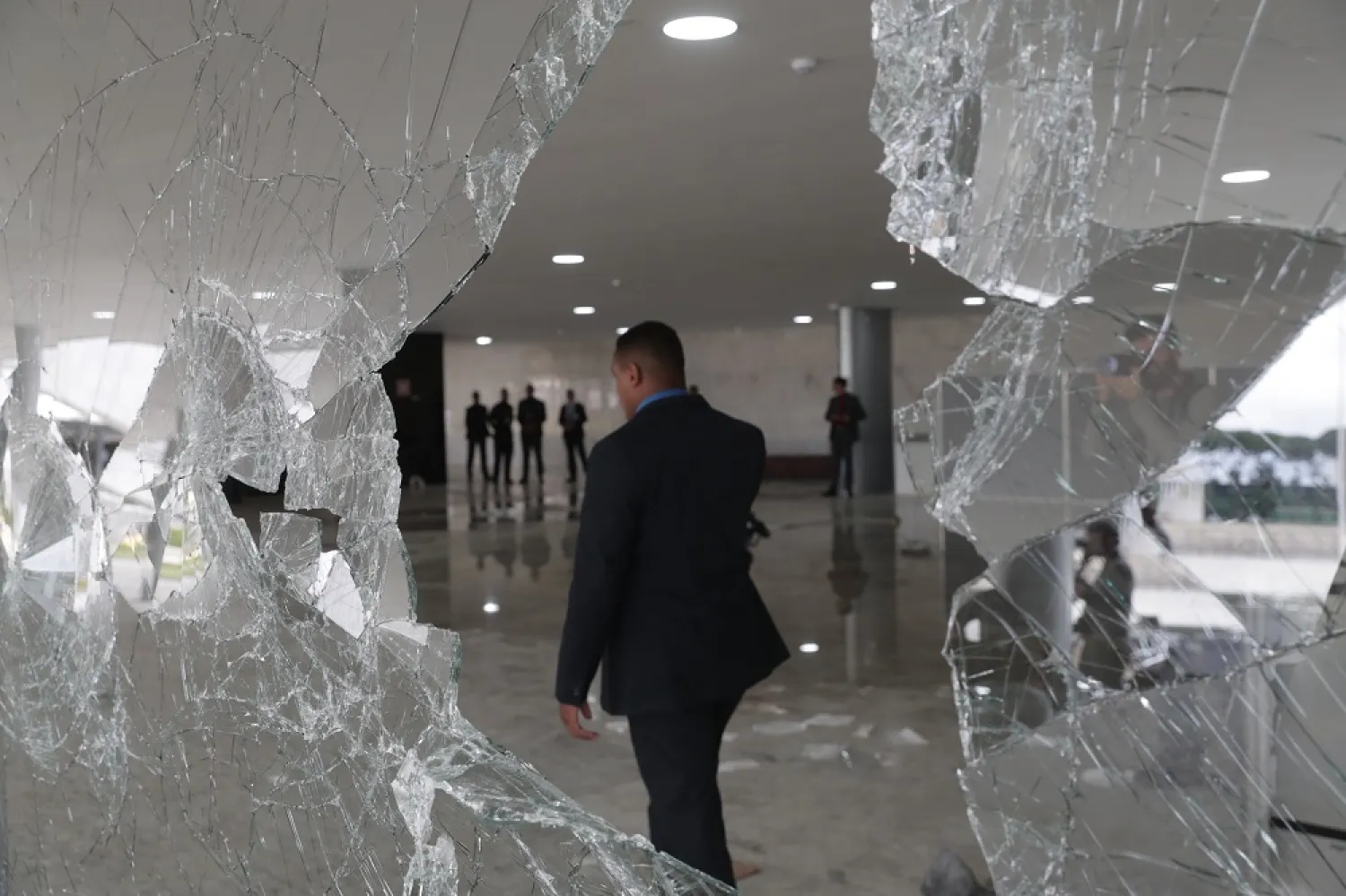
Officials inspect the damage to the Planalto Palace after Bolsonaro supporters took over the Plaza de los Tres Poderes (Square of the Three Powers) to invade government buildings, in Brasilia, Brazil, 09 January 2023. (EPA)
TT

Brazil Cracks Down Post-riot and Vows to Protect Democracy 

Officials inspect the damage to the Planalto Palace after Bolsonaro supporters took over the Plaza de los Tres Poderes (Square of the Three Powers) to invade government buildings, in Brasilia, Brazil, 09 January 2023. (EPA)

Brazilian authorities vowed Monday to protect democracy and punish thousands of supporters of ex-President Jair Bolsonaro who stormed and trashed the nation’s highest seats of power in chaos with striking similarities to the Jan. 6, 2021, insurrection at the US Capitol. 

The protesters swarmed into Congress, the Supreme Court and presidential palace on Sunday. Many have said they want the Brazilian army to restore the far-right Bolsonaro to power and oust the newly inaugurated leftist Luiz Inácio Lula da Silva. 

Police broke down a pro-Bolsonaro encampment outside a military building Monday and detained some 1,200 people there, the justice ministry’s press office told The Associated Press. 

Lula and the heads of the Supreme Court, Senate and Lower House also signed a letter Monday denouncing acts of terrorism and vandalism and saying they were taking legal measures. 

Justice Minister Flávio Dino told reporters police have begun tracking those who paid for the buses that transported protesters to the capital. At the news conference late Sunday, Brazil’s minister of institutional relations said the buildings would be inspected for evidence including fingerprints and images to hold people to account, and that the rioters apparently intended to spark similar unrest nationwide. 

“They will not succeed in destroying Brazilian democracy. We need to say that fully, with all firmness and conviction,” Dino said. “We will not accept the path of criminality to carry out political fights in Brazil. A criminal is treated like a criminal.” 

Rioters donning the green and yellow of the national flag on Sunday broke windows, toppled furniture, hurled computers and printers to the ground. They punctured a massive Emiliano Di Cavalcanti painting at the presidential palace in seven places and completely destroyed other works of art. They overturned the U-shaped table at which Supreme Court justices convene, ripped a door off one justice's office and vandalized an iconic statue outside the court. The monumental buildings' interiors were left in states of ruin. 

Monday's arrests came in addition to the 300 held Sunday while caught in the act. 

But police were noticeably slow to react - even after the arrival of more than 100 buses - leading many to ponder whether authorities had either simply ignored numerous warnings, underestimated the protesters' strength, or been somehow complicit. 

Public prosecutors in the capital said local security forces had at very least been negligent. A supreme court justice temporarily suspended the regional governor. Another justice blamed authorities for not swiftly cracking down on budding neofascism in Brazil. 

After his Oct. 30 electoral defeat, Bolsonaro, who has gone to Florida, has been stoking belief among his hardcore supporters that the electronic voting system was prone to fraud — though he never presented any evidence. His lawmaker son Eduardo Bolsonaro held several meetings with former US President Donald Trump, Trump's longtime ally Steve Bannon and his senior campaign adviser, Jason Miller. 

Results from Brazil's election — the closest in over three decades — were quickly recognized by politicians across the spectrum, including some Bolsonaro allies, as well as dozens of governments. And Bolsonaro surprised nearly everyone by promptly fading from view. He neither conceded defeat nor emphatically cried fraud, though he and his party submitted a request to nullify millions of votes that was swiftly dismissed. 

Brazilians have used electronic voting since 1996 that security experts consider less secure than hand-marked paper ballots because they leave no auditable paper trail. Brazil’s system is, however, closely scrutinized and domestic authorities and international observers have never found evidence of it being exploited to commit fraud. 

Still, Bolsonaro's supporters refused to accept the results. They blocked roads and have remained camped outside military buildings, urging the armed forces to intervene. Dino, the justice minister, referred to the encampments as incubators of terrorism. Protests were overwhelmingly peaceful, but isolated threats — including a bomb found on a fuel truck headed to Brasilia’s airport — prompted security concerns. 

Two days before Lula's Jan. 1 inauguration, Bolsonaro flew to the US and took up temporary residence in Orlando. Many Brazilians expressed relief that, while he declined to participate in the transition of power, his absence allowed it to occur without incident. 

Or so it had been, until Sunday's havoc. 

“Bolsonarism mimics the same strategies as Trumpism. Our Jan. 8 — an unprecedented manifestation in Brazilian politics — is clearly copied from Jan. 6 in the Capitol,” said Paulo Calmon, a political science professor at the University of Brasilia.  

“Today’s sad episodes represent yet another attempt to destabilize democracy and demonstrate that the authoritarian, populist radicalism of Brazil's extreme right remains active under the command of former President Bolsonaro, the ‘Trump of Latin America.'” 

US President Joe Biden, Mexican President Andrés Manuel López Obrador and Canadian Prime Minister Justin Trudeau jointly said Monday that “Canada, Mexico, and the United States condemn the January 8 attacks on Brazil’s democracy and on the peaceful transfer of power. We stand with Brazil as it safeguards its democratic institutions.” 

Analysts told the AP that the upheaval could yield greater political support for Lula and his stated mission to pacify the polarized country, with many right-wing citizens and politicians repulsed by Sunday's scenes and eager to distance themselves from far-right radicalism. The leader of Bolsonaro's own party called the uprising “an embarrassment.” 

“This may have been the beginning of the end. The political system will want to isolate that radical movement and move away from it,” said Mario Sérgio Lima, political analyst at Medley Advisors. “I think what we will see now is the right trying to create new alternatives and new leaders, and the center distancing itself.” 

In a news conference from Sao Paulo state, Lula read a freshly signed decree for the federal government to assume control of security in the federal district. He said that the so-called “fascist fanatics,” as well as those who financed their activities, must be punished, and also accused Bolsonaro of encouraging their uprising. 

Bolsonaro repudiated the president's accusation late Sunday. Writing on Twitter, he said peaceful protest is part of democracy, but vandalism and invasion of public buildings are “exceptions to the rule.” 

Unlike the 2021 attack in the US, few officials would have been working in the top government buildings on a Sunday. And videos showed limited presence of the capital’s military police. 

One video showed a group of protesters easily pushing through a police barricade, with only a few officers using pepper spray. Another showed officers standing by as protesters stormed the Congress, including one using his phone to record what was happening. 

“This was a gross error by the federal district's government. It was a tragedy foretold,” said Thiago de Aragão, director of strategy at Brasilia-based politician consultancy Arko Advice. “Everyone knew they (the protesters) were coming to Brasilia. The expectation was that the federal district's government was going to mount a response to protect the capital. They didn't do any of that." 

Lula said at his news conference there was “incompetence or bad faith” on the part of police, and he promised some would be punished. 

Federal District Gov. Ibaneis Rocha confirmed on Twitter he had fired the capital city’s head of public security, Anderson Torres — hours before a Supreme Court justice suspended the governor from office, alleging “intentional omission.” 

“Two years since Jan. 6, Trump’s legacy continues to poison our hemisphere,” US Sen. Bob Menendez, who chairs the Senate’s foreign relations committee, tweeted, adding that he blamed Bolsonaro for inciting the acts. “Protecting democracy & holding malign actors to account is essential.” 


Russian Strikes Kill 8 in Ukraine, Damage Maternity Clinic

A woman walks in front of a house destroyed in a Russian strike on a residential neighbourhood in Kyiv, Ukraine, Thursday, Sept. 24, 2026. (AP Photo/Evgeniy Maloletka)
TT

Russian Strikes Kill 8 in Ukraine, Damage Maternity Clinic

A woman walks in front of a house destroyed in a Russian strike on a residential neighbourhood in Kyiv, Ukraine, Thursday, Sept. 24, 2026. (AP Photo/Evgeniy Maloletka)

Russian drone and missile strikes on Ukraine's capital Kyiv and its northeast killed eight people on Thursday in attacks that included a maternity hospital and a farm, officials said.

Moscow has stepped up its air war in recent months, deploying more of its faster and harder-to-stop drones while Ukraine is short of interceptors to down ballistic missiles.

Two people died in the latest assault on Kyiv, according to President Volodymyr Zelenskiy, who was in New York for the UN General Assembly.

"As people were sleeping, flashes from explosions ⁠lit up the sky," ⁠Zelenskiy said on Telegram.

"Once again, the main targets of their strike were Kyiv and civilian infrastructure, residential buildings, a maternity hospital, energy infrastructure, and logistics."

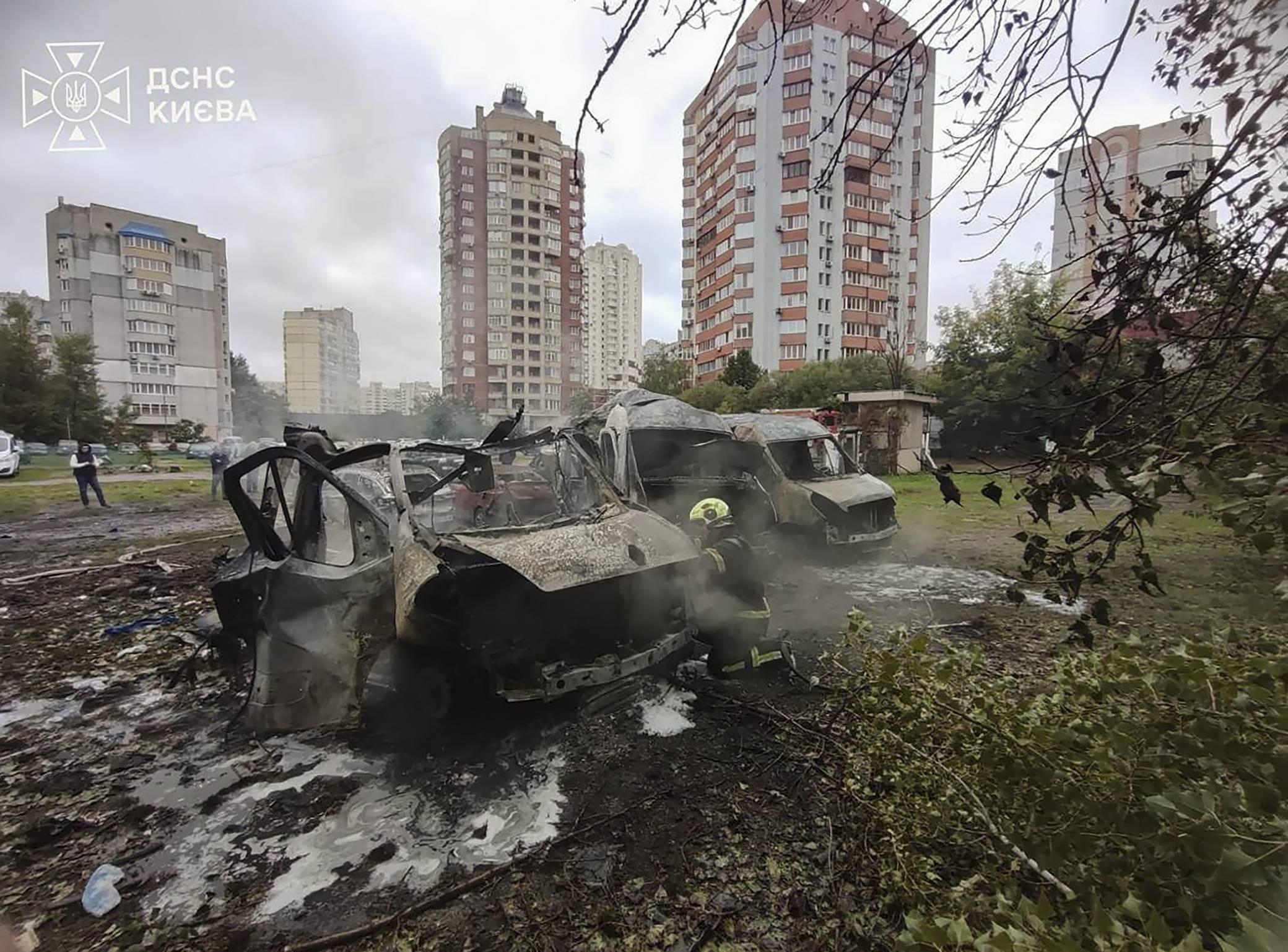
Police said nine homes, a post office, warehouses and dozens of cars were also damaged in Kyiv.

A separate Russian attack on a vegetable storage facility at a farm in a village of the northeastern Kharkiv region killed six people and injured a further ⁠12, prosecutors said.

The overnight barrage around Ukraine included an unspecified number of hypersonic and ballistic missiles, 282 drones and other weapons, Ukraine's air force said.

In Kyiv, eight people were injured as well as the two fatalities, one of whom was in the parking lot of the maternity hospital, Reuters quoted city mayor Vitali Klitschko as saying.

Part of the hospital's facade, windows and doors were damaged, officials said, adding that no patients or medics were injured.

A handout photo made available by the State Emergency Service (SES) shows Ukrainian rescuers working at the site of an overnight Russian attack on a residential area in Kyiv, Ukraine, 24 September 2026, amid the Russian invasion. EPA/STATE EMERGENCY SERVICE / HANDOUT

Authorities in the northwestern region of Rivne said infrastructure was damaged in overnight strikes that continued into Thursday morning, without providing further details. Volyn region bordering Poland also came under attack.

Insufficient pressure on Moscow ⁠was allowing ⁠it to launch repeated strikes, said Zelenskiy.

"Right now, the United States has the opportunity to respond strongly," he said. "We need ballistic interceptors to protect lives."

Russia's defense ministry said its forces hit Ukrainian defense facilities, logistics and telecoms centers, as well as vessels used by the military.

In the Black Sea port of Odesa, military administration head Serhiy Lysak said overnight Russian strikes damaged a medical facility and shattered windows in nearby houses and a school.

Moldova's President Maia Sandu said four Russian drones crossed into its airspace and at least one exploded, while Romania said a drone also crashed in its territory.

NATO alliance member Poland said it deployed aviation twice on Thursday due to Russian attacks on Ukraine.


Quake Rattles Southeastern Türkiye

Image of earthquake monitoring (Reuters)
TT

Quake Rattles Southeastern Türkiye

Image of earthquake monitoring (Reuters)

An earthquake of 5.4 magnitude rattled cities in southeastern Türkiye on Thursday but there were no immediate reports of damage or injuries, the disaster agency said.

The quake, which occurred at 10:40 am (0740 GMT) was centered just north of the city of Sanliurfa, Türkiye's AFAD disaster agency said, adding "there are currently no reports of adverse effects".

Hasan Silda, governor of Sanliurfa province, said the quake had been felt "intensely", AFP reported.

"According to initial reports, there are no casualties or injuries. There is no destruction. There may be some partial damage to buildings," he told NTV private television.

Türkiye is crisscrossed by several geological fault lines that have previously caused catastrophes in the country.

A massive quake in February 2023 killed at least 53,000 people in southeastern Türkiye and around 7,000 others in Syria, that also caused damage and more than 300 deaths in Sanliurfa.


For Pope Leo, the Risk of an AI Apocalypse is a Major Concern

Pope Leo XIV leads the weekly Angelus prayer from a window at the Vatican, August 9, 2026. Vatican Media/Mario Tomassetti/­Handout via REUTERS
TT

For Pope Leo, the Risk of an AI Apocalypse is a Major Concern

Pope Leo XIV leads the weekly Angelus prayer from a window at the Vatican, August 9, 2026. Vatican Media/Mario Tomassetti/­Handout via REUTERS

The Vatican warned about the risk of an apocalypse spurred by artificial intelligence years before major American firms sounded the alarm at the United Nations Security Council on Wednesday - a concern that Pope Leo is placing at the heart of his papacy.

Leo, who in May called on world leaders for global rules to oversee the industry, is expected to warn about AI again on Friday in a speech at the Paris headquarters of the UN's culture and education body, UNESCO.

"This is not happening on day zero for the Holy See," Rev. Paolo Benanti, a leading Vatican advisor on AI issues, told Reuters, referring to recent calls for a slowdown that has been endorsed by the CEOs of AI firms Anthropic, OpenAI and xAI, among others.

"The transformative power of AI ... ‌could produce a magnitude ‌of societal changes that are very hard to predict," said Benanti, an Italian academic ‌who ⁠recently took part ⁠in the AI summit hosted by Britain's King Charles.

The priest said he could not reveal details about the contents of the summit's confidential discussions.

CARDINAL: THE FUTURE OF HUMANITY IS AT STAKE

Leo, the first US-born pope, has raised the possible dangers of AI development frequently throughout his 16-month-old papacy and first discussed the issue publicly on his third day in office.

In his May appeal, released as his first major document, Leo warned that AI systems spread misinformation, prioritize conflict and could lead the world down a path of unending war.

Cardinal Pietro Parolin, the Vatican's top diplomat, reiterated Leo's call for international regulation of ⁠the industry at an event in Rome last week, warning that countries cannot "go it alone" ‌on the technology.

"The future of humanity is really at stake here," ‌Parolin said. The world, he said, needs "everyone's involvement in establishing some common rules that can genuinely govern this phenomenon."

Anthropic co-founder Chris Olah ‌spoke at the Vatican's launch event for the pope's May document, known as an encyclical.

Asked if the Vatican is ‌in ongoing dialogue with any AI firms, Benanti stressed the decentralized nature of the global church and said some discussions are being led by local bishops.

On September 16, the US bishops' conference said it had created a new AI taskforce after several of its leaders met with executives that day.

"The dialogue focused on ways to keep any system of artificial intelligence at the service of ‌humanity and the urgent need to address the real and present dangers such technology presents," a statement said.

LEO WARNS ABOUT AUTONOMOUS WEAPONS

The Vatican began warning about the ⁠risks of AI in 2019, hosting ⁠two conferences that year on the possible dangers of the technology. The late Pope Francis warned attendees at one of the events that misinformation spread by AI could spark a world war.

The Vatican also teamed with Microsoft, IBM , the UN's Food and Agriculture Organization and the Italian government in 2020 to issue a call for AI development that "does not have as its sole goal greater profit or the gradual replacement of people in the workplace."

Leo has urged oversight especially for the development of weapons systems, such as those being used in the Russia-Ukraine war. He said in his encyclical that such weapons have advanced "practically beyond any human reach to govern them."

The Vatican's advocacy on the global stage against autonomous weaponry goes back decades, Benanti said, likening AI-powered drones to landmines that are indiscriminate with their targets.

The priest compared the Vatican's warnings about the risks of AI to how popes have long called for nuclear disarmament.

"If nuclear weapons can destroy humanity ... the manipulation of generative AI content in social spaces can destroy the capabilities of people to stay together as a society," he said.

"Nuclear weapons have to be stocked inside facilities and you can count and control them. AI is not this visible."