


Meta Reports Sales Fall, but Beats Expectations

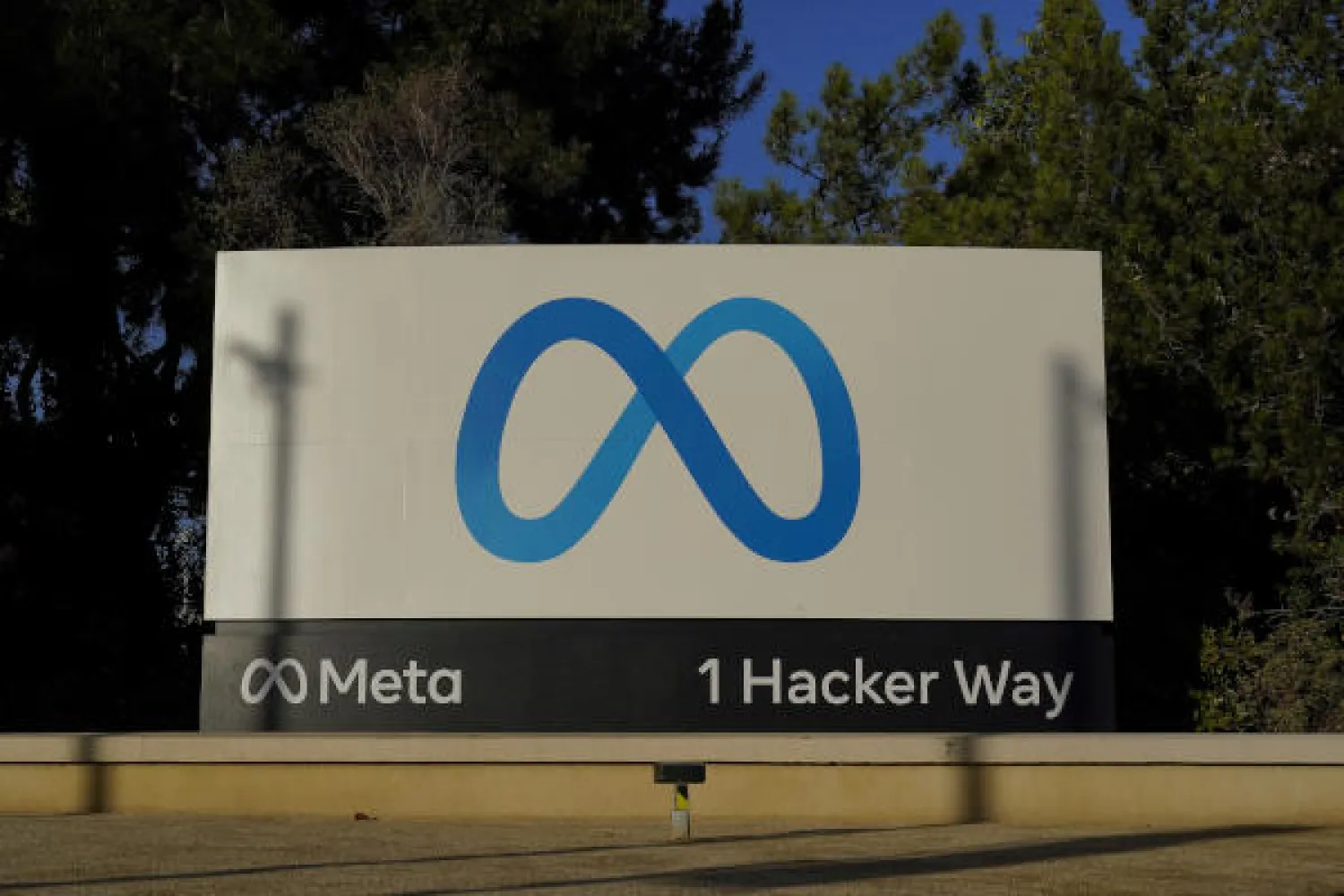
FILE - Meta's logo can be seen on a sign at the company's headquarters in Menlo Park, Calif., on Nov. 9, 2022. Meta reports their earnings on Wednesday, Feb. 1, 2023. (AP Photo/Godofredo A. Va¡squez, File)
TT

Meta Reports Sales Fall, but Beats Expectations

FILE - Meta's logo can be seen on a sign at the company's headquarters in Menlo Park, Calif., on Nov. 9, 2022. Meta reports their earnings on Wednesday, Feb. 1, 2023. (AP Photo/Godofredo A. Va¡squez, File)

Facebook and Instagram owner Meta on Wednesday reported its first annual sales drop since the company went public in 2012, but the fall was less brutal than expected, sending its share price soaring.

The social media giant said sales dropped one percent to $116.6 billion in 2022, while it also announced that the number of daily users on Facebook hit two billion for the first time, AFP said.

CEO and founder Mark Zuckerberg pointed to the success of improved algorithms on Meta's video Reels service, that was delivering short clips more efficiently to users on Facebook and Instagram.

Meta competes fiercely with TikTok, the Chinese owned video-sharing platform that has proved a formidable rival in attracting young users away from once-dominant Instagram.

"The number of people daily using Facebook, Instagram and WhatsApp is the highest it's ever been," Zuckerberg said in an earnings call.

Zuckerberg also lauded improved artificial intelligence (AI) to better distribute ads after changes on the iPhone decided by Apple seriously hampered Meta's ability to target users.

- Year of Efficiency' -
The 2022 results ended a bad year for Meta, which in November announced it would lay off 11,000 employees or 13 percent of staff in the largest worker reduction in the company's history.

Zuckerberg said his company's "management theme for 2023 is the 'Year of Efficiency' and we're focused on becoming a stronger and more nimble organization."

Zuckerberg said Meta is working on eliminating layers of middle management as well as deploying AI tools to help engineers be more productive.

Meta will also be more aggressive when it comes to cutting projects that are not performing or are not priorities, he added.

Big tech platforms have been suffering from the souring economic climate, which is forcing advertisers to cut back on marketing, and Apple's data privacy changes, which have reduced leeway for ad personalization.

But Meta beat market expectations as the effect of iPhone privacy changes on ad targeting appeared to be waning and cost-cutting started bringing results, Wedbush analyst Dan Ives said in a tweet.

"At first glance... Meta getting its mojo back," Baird Equity Research said in a note to investors about the earnings report.

- Targeted advertising -
Apple sent shockwaves through the industry in 2021 when it began inviting iPhone users to opt out of having their online activity tracked by apps for the purpose of targeting ads.

This dealt a punishing blow to Facebook and Instagram that depend on super-targeted advertising for revenue.

Meta last year said Apple's policy, which impacts the precision of the ads it sells and thus their price, would cost the social media giant $10 billion in lost revenue in 2022.

Apple's iPhones hold about 55 percent of the smartphone market in the United States and about one third of smartphone users in Europe, the world's biggest ad markets.

The company is also under pressure for making a huge gamble on the metaverse, the world of virtual reality that Meta believes will be the next frontier online.

The bet however has yet to pay off with Meta's Reality Labs, the division that builds the necessary VR headsets and software, posting an operating loss of $4.28 billion in the last quarter of 2022. This followed big losses in the previous quarters.

"With losses at its VR division mounting, Mark Zuckerberg is going to have to accept an unfortunate reality: Virtual worlds are simply not what businesses or consumers want right now," said Insider Intelligence analyst Debra Aho Williamson.

Investors last year punished Meta, sending the company's share price down by an astonishing two thirds over 12 months, but the stock has recovered some of the ground in 2023.

In after-hours trading, Meta's share price was up more than 19 percent to $182.83


India Eyes $200B in Data Center Investments as It Ramps Up Its AI Hub Ambitions

FILE -Google CEO Sundar Pichai, right, interacts with India's Minister for Information and Technology Ashwini Vaishnaw during Google for India 2022 event in New Delhi, Dec. 19, 2022. (AP Photo/Manish Swarup), File)
TT

India Eyes $200B in Data Center Investments as It Ramps Up Its AI Hub Ambitions

FILE -Google CEO Sundar Pichai, right, interacts with India's Minister for Information and Technology Ashwini Vaishnaw during Google for India 2022 event in New Delhi, Dec. 19, 2022. (AP Photo/Manish Swarup), File)

India is hoping to garner as much as $200 billion in investments for data centers over the next few years as it scales up its ambitions to become a hub for artificial intelligence, the country’s minister for electronics and information technology said Tuesday.

The investments underscore the reliance of tech titans on India as a key technology and talent base in the global race for AI dominance. For New Delhi, they bring in high-value infrastructure and foreign capital at a scale that can accelerate its digital transformation ambitions.

The push comes as governments worldwide race to harness AI's economic potential while grappling with job disruption, regulation and the growing concentration of computing power in a few rich countries and companies.

“Today, India is being seen as a trusted AI partner to the Global South nations seeking open, affordable and development-focused solutions,” Ashwini Vaishnaw told The Associated Press in an email interview, as New Delhi hosts a major AI Impact Summit this week drawing participation from at least 20 global leaders and a who’s who of the tech industry.

In October, Google announced a $15 billion investment plan in India over the next five years to establish its first artificial intelligence hub in the South Asian country. Microsoft followed two months later with its biggest-ever Asia investment announcement of $17.5 billion to advance India’s cloud and artificial intelligence infrastructure over the next four years.

Amazon too has committed $35 billion investment in India by 2030 to expand its business, specifically targeting AI-driven digitization. The cumulative investments are part of $200 billion in investments that are in the pipeline and New Delhi hopes would flow in.

Vaishnaw said India’s pitch is that artificial intelligence must deliver measurable impacts at scale rather than remain an elite technology.

“A trusted AI ecosystem will attract investment and accelerate adoption,” he said, adding that a central pillar of India’s strategy to capitalize on the use of AI is building infrastructure.

The government recently announced a long-term tax holiday for data centers as it hopes to provide policy certainty and attract global capital.

Vaishnaw said the government has already operationalized a shared computing facility with more than 38,000 graphics processing units, or GPUs, allowing startups, researchers and public institutions to access high-end computing without heavy upfront costs.

“AI must not become exclusive. It must remain widely accessible,” he said.

Alongside the infrastructure drive, India is backing the development of sovereign foundational AI models trained on Indian languages and local contexts. Some of these models meet global benchmarks and in certain tasks rival widely used large language models, Vaishnaw said.

India is also seeking a larger role in shaping how AI is built and deployed globally as the country doesn’t see itself strictly as a “rule maker or rule taker,” according to Vaishnaw, but an active participant in setting practical, workable norms while expanding its AI services footprint worldwide.

“India will become a major provider of AI services in the near future,” he said, describing a strategy that is “self-reliant yet globally integrated” across applications, models, chips, infrastructure and energy.

Investor confidence is another focus area for New Delhi as global tech funding becomes more cautious.

Vaishnaw said the technology’s push is backed by execution, pointing to the Indian government's AI Mission program which emphasizes sector specific solutions through public-private partnerships.

The government is also betting on reskilling its workforce as global concerns grow that AI could disrupt white collar and technology jobs. New Delhi is scaling AI education across universities, skilling programs and online platforms to build a large AI-ready talent pool, the minister said.

Widespread 5G connectivity across the country and a young, tech-savvy population are expected to help with the adoption of AI at a faster pace, he added.

Balancing innovation with safeguards remains a challenge though, as AI expands into sensitive sectors such as governance, health care and finance.

Vaishnaw outlined a fourfold strategy that includes implementable global frameworks, trusted AI infrastructure, regulation of harmful misinformation and stronger human and technical capacity to hedge the impact.

“The future of AI should be inclusive, distributed and development-focused,” he said.


Report: SpaceX Competing to Produce Autonomous Drone Tech for Pentagon 

The SpaceX logo is seen in this illustration taken, March 10, 2025. (Reuters)
TT

Report: SpaceX Competing to Produce Autonomous Drone Tech for Pentagon 

The SpaceX logo is seen in this illustration taken, March 10, 2025. (Reuters)

Elon Musk's SpaceX and its wholly-owned subsidiary xAI are competing in a secret new Pentagon contest to produce voice-controlled, autonomous drone swarming technology, Bloomberg News reported on Monday, citing people familiar with the matter.

SpaceX, xAI and the Pentagon's defense innovation unit did not immediately respond to requests for comment. Reuters could not independently verify the report.

Texas-based SpaceX recently acquired xAI in a deal that combined Musk's major space and defense contractor with the billionaire entrepreneur's artificial intelligence startup. It occurred ahead of SpaceX's planned initial public offering this year.

Musk's companies are reportedly among a select few chosen to participate in the $100 million prize challenge initiated in January, according to the Bloomberg report.

The six-month competition aims to produce advanced swarming technology that can translate voice commands into digital instructions and run multiple drones, the report said.

Musk was among a group of AI and robotics researchers who wrote an open letter in 2015 that advocated a global ban on “offensive autonomous weapons,” arguing against making “new tools for killing people.”

The US also has been seeking safe and cost-effective ways to neutralize drones, particularly around airports and large sporting events - a concern that has become more urgent ahead of the FIFA World Cup and America250 anniversary celebrations this summer.

The US military, along with its allies, is now racing to deploy the so-called “loyal wingman” drones, an AI-powered aircraft designed to integrate with manned aircraft and anti-drone systems to neutralize enemy drones.

In June 2025, US President Donald Trump issued the Executive Order (EO) “Unleashing American Drone Dominance” which accelerated the development and commercialization of drone and AI technologies.


SVC Develops AI Intelligence Platform to Strengthen Private Capital Ecosystem

The platform offers customizable analytical dashboards that deliver frequent updates and predictive insights- SPA
TT

SVC Develops AI Intelligence Platform to Strengthen Private Capital Ecosystem

The platform offers customizable analytical dashboards that deliver frequent updates and predictive insights- SPA

Saudi Venture Capital Company (SVC) announced the launch of its proprietary intelligence platform, Aian, developed in-house using Saudi national expertise to enhance its institutional role in developing the Kingdom’s private capital ecosystem and supporting its mandate as a market maker guided by data-driven growth principles.

According to a press release issued by the SVC today, Aian is a custom-built AI-powered market intelligence capability that transforms SVC’s accumulated institutional expertise and detailed private market data into structured, actionable insights on market dynamics, sector evolution, and capital formation. The platform converts institutional memory into compounding intelligence, enabling decisions that integrate both current market signals and long-term historical trends, SPA reported.

Deputy CEO and Chief Investment Officer Nora Alsarhan stated that as Saudi Arabia’s private capital market expands, clarity, transparency, and data integrity become as critical as capital itself. She noted that Aian represents a new layer of national market infrastructure, strengthening institutional confidence, enabling evidence-based decision-making, and supporting sustainable growth.

By transforming data into actionable intelligence, she said, the platform reinforces the Kingdom’s position as a leading regional private capital hub under Vision 2030.

She added that market making extends beyond capital deployment to shaping the conditions under which capital flows efficiently, emphasizing that the next phase of market development will be driven by intelligence and analytical insight alongside investment.

Through Aian, SVC is building the knowledge backbone of Saudi Arabia’s private capital ecosystem, enabling clearer visibility, greater precision in decision-making, and capital formation guided by insight rather than assumption.

Chief Strategy Officer Athary Almubarak said that in private capital markets, access to reliable insight increasingly represents the primary constraint, particularly in emerging and fast-scaling markets where disclosures vary and institutional knowledge is fragmented.

She explained that for development-focused investment institutions, inconsistent data presents a structural challenge that directly impacts capital allocation efficiency and the ability to crowd in private investment at scale.

She noted that SVC was established to address such market frictions and that, as a government-backed investor with an explicit market-making mandate, its role extends beyond financing to building the enabling environment in which private capital can grow sustainably.

By integrating SVC’s proprietary portfolio data with selected external market sources, Aian enables continuous consolidation and validation of market activity, producing a dynamic representation of capital deployment over time rather than relying solely on static reporting.

The platform offers customizable analytical dashboards that deliver frequent updates and predictive insights, enabling SVC to identify priority market gaps, recalibrate capital allocation, design targeted ecosystem interventions, and anchor policy dialogue in evidence.

The release added that Aian also features predictive analytics capabilities that anticipate upcoming funding activity, including projected investment rounds and estimated ticket sizes. In addition, it incorporates institutional benchmarking tools that enable structured comparisons across peers, sectors, and interventions, supporting more precise, data-driven ecosystem development.
