


Powerful Quake Rocks Türkiye and Syria, Kills More than 2,300

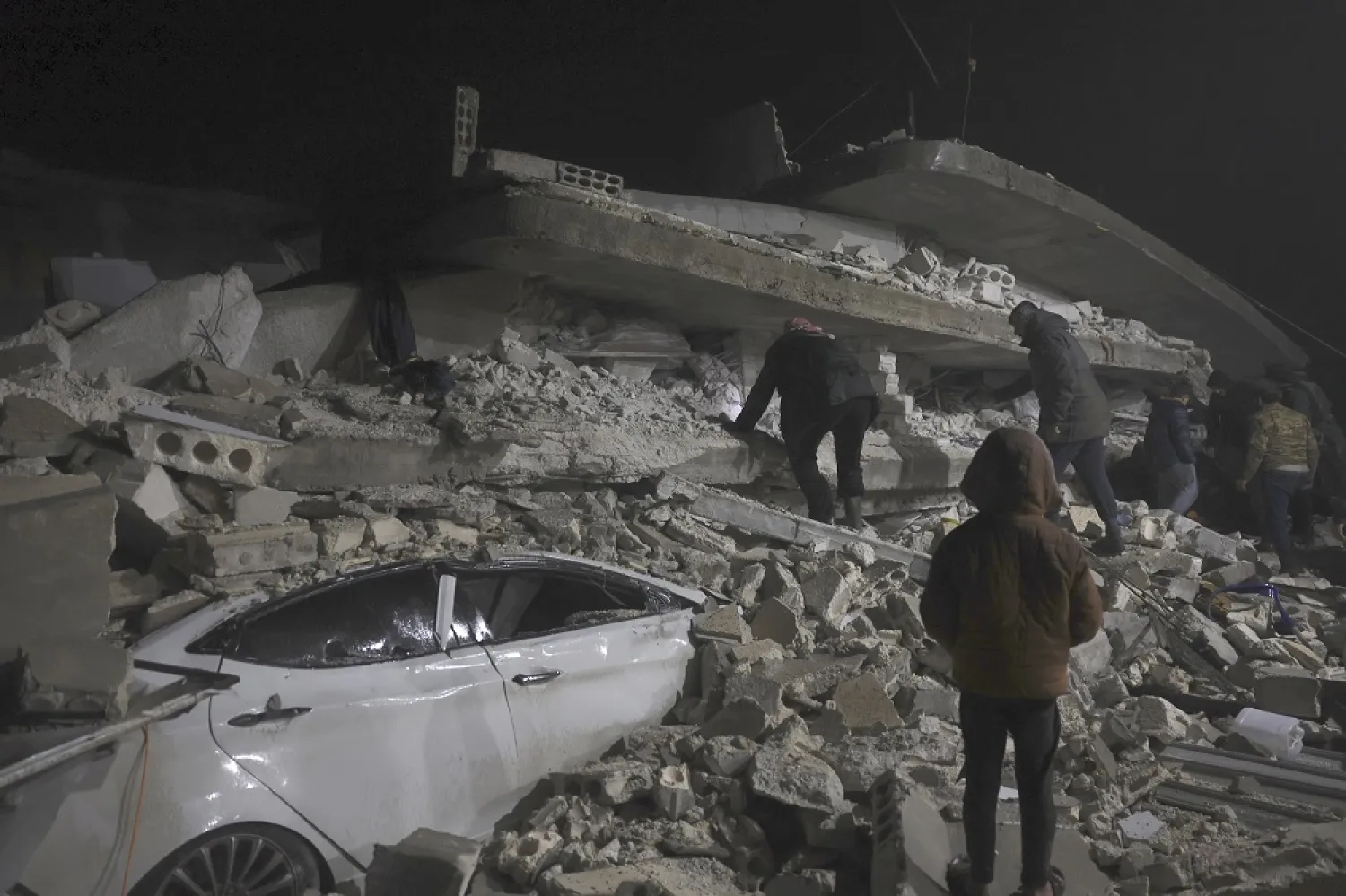
Syrian citizen search through the wreckage of a collapsed building, in Azmarin town, in Idlib province north Syria, Monday, Feb. 6, 2023. (AP)
TT

Powerful Quake Rocks Türkiye and Syria, Kills More than 2,300

Syrian citizen search through the wreckage of a collapsed building, in Azmarin town, in Idlib province north Syria, Monday, Feb. 6, 2023. (AP)

A powerful, 7.8 magnitude earthquake rocked wide swaths of Türkiye and neighboring Syria on Monday, killing more than 2,300 people and injuring thousands more as it toppled hundreds of buildings and trapped residents under mounds of rubble or pancaked floors.

Authorities feared the death toll would rise further as rescuers searched through tangles of metal and concrete for survivors in a region beset by more than a decade of Syria’s war and a refugee crisis.

Residents jolted out of sleep by the pre-dawn quake rushed outside in the rain and snow to escape falling debris, while those who were trapped cried for help. Major aftershocks, including one nearly as strong as the initial quake, continued to rattle the region.

“I don’t have the strength anymore,” one survivor could be heard calling out from beneath the rubble in the Turkish city of Adana, as rescue workers tried to reach him, said a resident, journalism student Muhammet Fatih Yavuz. He said three buildings near his home were toppled.

The quake, which was centered on Türkiye’s southeastern province of Kahramanmaras, sent residents of Damascus rushing into the street and was felt as far away as Cairo and Beirut.

“Because the debris removal efforts are continuing in many buildings in the earthquake zone, we do not know how high the number of dead and injured will rise,” Turkish President Recep Tayyip Erdogan said.

The quake piled more misery on a region that has seen tremendous suffering over the past decade. On the Syrian side, the area affected is divided between government-held territory and the country’s last opposition-held enclave, which is surrounded by Russian-backed government forces. Türkiye, meanwhile, is home to millions of refugees from the war.

In the opposition-held enclave, hundreds of families remained trapped in rubble, the opposition emergency organization, called the White Helmets, said in a statement. The area is packed with some 4 million people displaced from other parts of the country by the war. Many of them live in buildings that are already wrecked from past bombardments.

Strained health facilities and hospitals quickly filled with injured, rescue workers said. Others had to be emptied, including a maternity hospital, according to the SAMS medical organization.

The region sits on top of major fault lines and is frequently shaken by earthquakes. Some 18,000 were killed in similarly powerful earthquakes that hit northwest Türkiye in 1999.

The US Geological Survey measured Monday’s pre-dawn quake at 7.8, with a depth of 18 kilometers (11 miles). Hours later, a 7.5 magnitude one struck more than 100 kilometers (60 miles) away.

The second jolt in the afternoon caused a multistory apartment to topple face-forward onto the street in the Turkish city of Sanliurfa, smashing into rubble and raising a cloud of dust as bystanders screamed, according to video of the scene.

Orhan Tatar, an official from Türkiye’s disaster management agency, said it was a new earthquake, but Yaareb Altaweel, a seismologist with the USGS, said it was considered an aftershock because it took place on the same fault line as the first.

Thousands of buildings were reported collapsed in a wide area extending from Syria’s cities of Aleppo and Hama to Türkiye’s Diyarbakir, more than 330 kilometers (200 miles) to the northeast. A hospital came down in the Mediterranean coastal city of Iskenderun, but casualties were not immediately known, Turkish Vice President Fuat Oktay said.

Such severe damage typically leads to a significant death toll, but bitterly cold temperatures could make matters even worse, reducing the timeframe that rescuers have to save trapped survivors, said Dr. Steven Godby, an expert in natural hazards at Nottingham Trent University. He added that the difficulty of working in areas beset by civil war would only complicate rescue efforts.

Televisions stations in Türkiye aired screens split into four or five, showing live coverage from rescue efforts in the worst-hit provinces. In the city of Kahramanmaras, rescuers pulled two children alive from the rubble, and one could be seen lying on a stretcher on the snowy ground.

Offers of help — from search-and-rescue teams to medical supplies and money — poured in from dozens of countries, as well as the European Union and NATO. The vast majority were for Türkiye, with Russian and even an Israeli promise of help to the Syrian government, but it was not clear if any would go to the devastated opposition-held pocket in the northwest.

In Türkiye, people trying to leave the quake-stricken regions caused traffic jams, hampering efforts of emergency teams. Mosques around the region were opened to provide shelter for people unable to return to damaged homes amid temperatures that hovered around freezing.

In Diyarbakir, hundreds of rescue workers and civilians formed lines across a mountain of wreckage, passing down broken concrete pieces, household belongings and other debris as they searched for trapped survivors while excavators dug through the rubble below.

In northwest Syria, the quake added new woes to the opposition-held enclave centered on the province of Idlib, which has been under siege for years, with frequent Russian and government airstrikes. The territory depends on a flow of aid from nearby Türkiye for everything from food to medical supplies.

The opposition’s Syrian Civil Defense described the situation there as “disastrous.”

At a hospital in Idlib, Osama Abdel Hamid said most of his neighbors died. He said their shared four-story building collapsed just as he, his wife and three children ran toward the exit. A wooden door fell on them and acted as a shield.

“God gave me a new lease on life,” he said.

In the small Syrian opposition-held town of Azmarin in the mountains by the Turkish border, the bodies of several dead children, wrapped in blankets, were brought to a hospital.

The Directorate-General of Antiquities and Museums in Syria said the earthquake has caused some damage to the Crusader-built Marqab, or Watchtower Castle, on a hill overlooking the Mediterranean. Part of a tower and parts of some walls collapsed.

In Türkiye, meanwhile, the quake damaged a historic castle perched atop a hill in the center of the provincial capital of Gaziantep, about 33 kilometers (20 miles) from the epicenter. Parts of the fortresses’ walls and watch towers were leveled and other parts heavily damaged, images from the city showed.

More than 1,500 people were killed in 10 Turkish provinces, with some 9,700 injured, according to Turkish authorities. The death toll in government-held areas of Syria climbed to over 460 people, with some 1,300 injured, according to the Health Ministry. In the country’s opposition-held northwest, groups that operate there said the death toll was at least 380, with many hundreds injured.

Huseyin Yayman, a legislator from Türkiye’s Hatay province, said several of his family members were stuck under the rubble of their collapsed homes.

“There are so many other people who are also trapped,” he told HaberTurk television by telephone. “There are so many buildings that have been damaged. People are on the streets. It’s raining, it’s winter.”



Türkiye Holds Military Funeral for Libyan Officers Killed in Plane Crash

The Libyan national flag flies at half-mast in Tripoli on December 24, 2025, after the head of Libya's armed forces and his four aides died in a plane crash in Türkiye. (AFP)
TT

Türkiye Holds Military Funeral for Libyan Officers Killed in Plane Crash

The Libyan national flag flies at half-mast in Tripoli on December 24, 2025, after the head of Libya's armed forces and his four aides died in a plane crash in Türkiye. (AFP)

Türkiye held a military funeral ceremony Saturday morning for five Libyan officers, including western Libya’s military chief, who died in a plane crash earlier this week.

The private jet with Gen. Muhammad Ali Ahmad al-Haddad, four other military officers and three crew members crashed on Tuesday after taking off from Ankara, Türkiye’s capital, killing everyone on board. Libyan officials said the cause of the crash was a technical malfunction on the plane.

Al-Hadad was the top military commander in western Libya and played a crucial role in the ongoing, UN-brokered efforts to unify Libya’s military.

The high-level Libyan delegation was on its way back to Tripoli, Libya’s capital, after holding defense talks in Ankara aimed at boosting military cooperation between the two countries.

Saturday's ceremony was held at 8:00 a.m. local time at the Murted Airfield base, near Ankara, and attended by the Turkish military chief and the defense minister. The five caskets, each wrapped in a Libyan national flag, were then loaded onto a plane to be returned to their home country.

Türkiye’s military chief, Selcuk Bayraktaroglu, was also on the plane headed to Libya, state-run news agency TRT reported.

The bodies recovered from the crash site were kept at the Ankara Forensic Medicine Institute for identification. Justice Minister Yilmaz Tunc told reporters their DNA was compared to family members who joined a 22-person delegation that arrived from Libya after the crash.

Tunc also said Germany was asked to help examine the jet's black boxes as an impartial third party.


Syrian Foreign Ministry: Talks with SDF Have Not Yielded Tangible Results

SDF fighters are seen at a military parade in Qamishli. (Reuters file)
TT

Syrian Foreign Ministry: Talks with SDF Have Not Yielded Tangible Results

SDF fighters are seen at a military parade in Qamishli. (Reuters file)

A source from the Syrian Foreign Ministry said on Friday that the talks with the Kurdish Syrian Democratic Forces (SDF) over their integration into state institutions “have not yielded tangible results.”

Discussions about merging the northeastern institutions into the state remain “hypothetical statements without execution,” it told Syria’s state news agency SANA.

Repeated assertions over Syria’s unity are being contradicted by the reality on the ground in the northeast, where the Kurds hold sway and where administrative, security and military institutions continue to be run separately from the state, it added.

The situation “consolidates the division” instead of addressing it, it warned.

It noted that despite the SDF’s continued highlighting of its dialogue with the Syrian state, these discussions have not led to tangible results.

It seems that the SDF is using this approach to absorb the political pressure on it, said the source. The truth is that there is little actual will to move from discussion to application of the March 10 agreement.

This raises doubts over the SDF’s commitment to the deal, it stressed.

Talk about rapprochement between the state and SDF remains meaningless if the agreement is not implemented on the ground within a specific timeframe, the source remarked.

Furthermore, the continued deployment of armed formations on the ground that are not affiliated with the Syrian army are evidence that progress is not being made.

The persistence of the situation undermines Syria’s sovereignty and hampers efforts to restore stability, it warned.


Terrorist Attack on Mosque in Syria’s Homs Draws Wide Condemnation

 A view shows an interior of a damaged mosque after several people were killed in an explosion in Homs, Syria December 26, 2025. (Reuters)
A view shows an interior of a damaged mosque after several people were killed in an explosion in Homs, Syria December 26, 2025. (Reuters)
TT

Terrorist Attack on Mosque in Syria’s Homs Draws Wide Condemnation

 A view shows an interior of a damaged mosque after several people were killed in an explosion in Homs, Syria December 26, 2025. (Reuters)
A view shows an interior of a damaged mosque after several people were killed in an explosion in Homs, Syria December 26, 2025. (Reuters)

Condemnations poured in across the Arab world and international community of the terrorist attack that targeted a mosque in Syria’s Homs city on Friday.

An explosion killed at least eight worshippers with the extremist group Saraya Ansar al-Sunna claiming responsibility.

In a statement on Telegram, the group said its fighters “detonated a number of explosive devices” in the Imam Ali Bin Abi Talib Mosque in the central Syrian city.

Syria's interior ministry said in a statement that “a terrorist explosion” targeted the mosque and that authorities had “begun investigating and collecting evidence to pursue the perpetrators of this criminal act.”

The Saudi Ministry of Foreign Affairs condemned the attack, stressing the Kingdom’s “categorical rejection of terrorism and extremism in all their forms, including attacks on mosques and places of worship and the targeting of innocent civilians.”

It expressed the Kingdom’s “solidarity with Syria in this tragic incident and its support for the Syrian government’s efforts to uphold security and stability.”

Türkiye slammed the attack, saying it stands by Syria and its efforts to support stability, security and unity “despite all the provocations.”

The Iraqi Foreign Ministry strongly condemned the “heinous terrorist attack,” saying Baghdad rejects all forms of terrorism, violence and extremism regardless of their motives.

It slammed the attack against civilians and places of worship, saying they aim to create instability and sow strife in society.

The ministry underlined Iraq’s support for regional and international efforts aimed at eliminating terrorism and drying up its sources of funding.

The United Arab Emirates condemned the attack, saying it rejects all forms of violence and terrorism that aim to undermine security and stability.

Jordan’s Foreign Ministry slammed the attack, voicing its full support to Syria in its reconstruction process “based on principles that ensure its territorial unity, sovereignty, security and stability.”

In Beirut, President Joseph Aoun slammed the Homs attack, saying Lebanon stands by Syria in its war on terrorism. He offered his condolences to the Syrian people.

Qatar slammed the attack, saying it fully stands by the Syrian government and all the measures it takes to preserve security.

France said the blast was an “act of terrorism” designed to destabilize the country, while United Nations Secretary General Antonio Guterres condemned the “unacceptable” attack and said the perpetrators should be brought to justice.