


Powerful Quake Rocks Türkiye and Syria, Kills More than 2,300

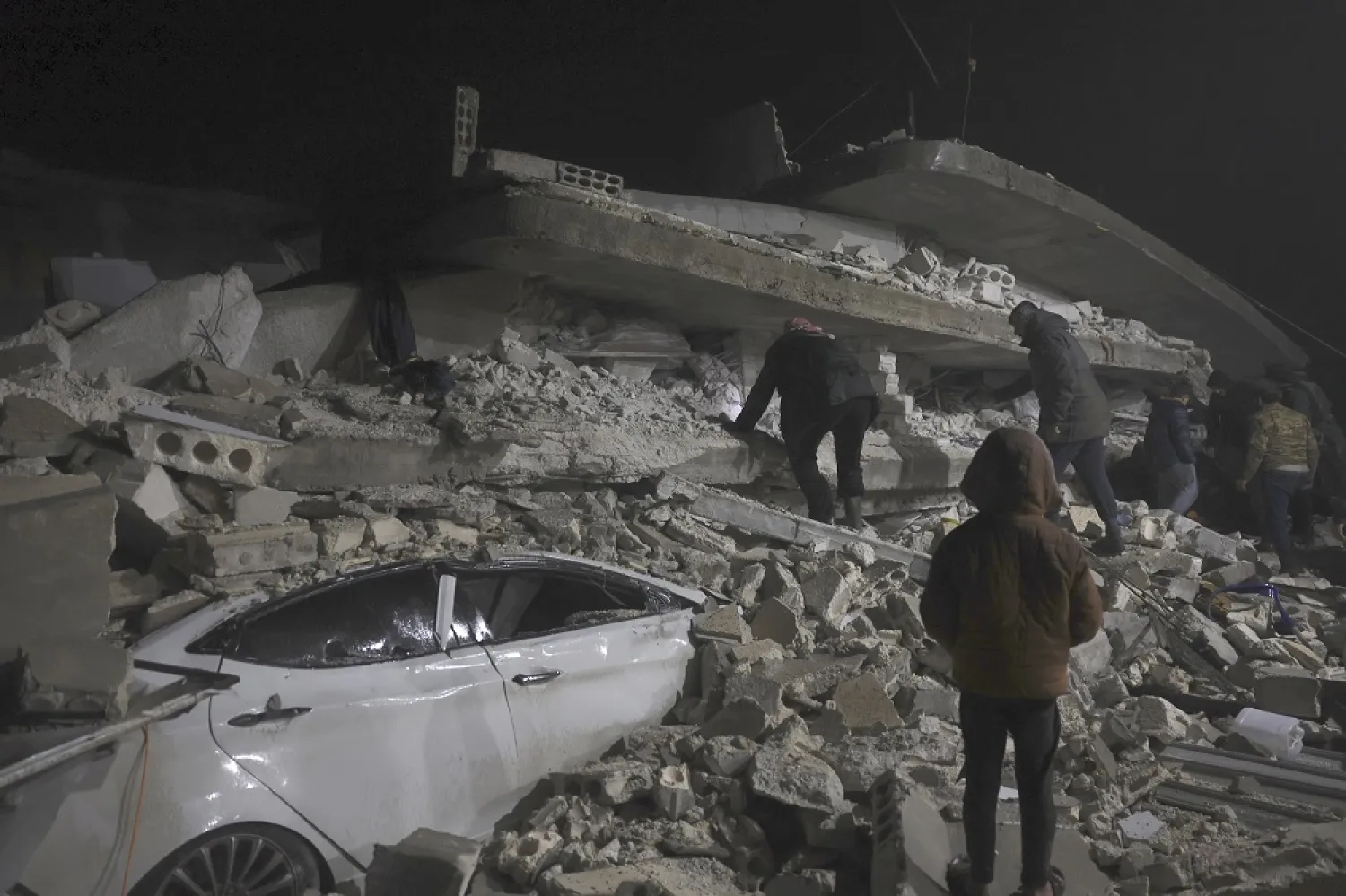
Syrian citizen search through the wreckage of a collapsed building, in Azmarin town, in Idlib province north Syria, Monday, Feb. 6, 2023. (AP)
TT

Powerful Quake Rocks Türkiye and Syria, Kills More than 2,300

Syrian citizen search through the wreckage of a collapsed building, in Azmarin town, in Idlib province north Syria, Monday, Feb. 6, 2023. (AP)

A powerful, 7.8 magnitude earthquake rocked wide swaths of Türkiye and neighboring Syria on Monday, killing more than 2,300 people and injuring thousands more as it toppled hundreds of buildings and trapped residents under mounds of rubble or pancaked floors.

Authorities feared the death toll would rise further as rescuers searched through tangles of metal and concrete for survivors in a region beset by more than a decade of Syria’s war and a refugee crisis.

Residents jolted out of sleep by the pre-dawn quake rushed outside in the rain and snow to escape falling debris, while those who were trapped cried for help. Major aftershocks, including one nearly as strong as the initial quake, continued to rattle the region.

“I don’t have the strength anymore,” one survivor could be heard calling out from beneath the rubble in the Turkish city of Adana, as rescue workers tried to reach him, said a resident, journalism student Muhammet Fatih Yavuz. He said three buildings near his home were toppled.

The quake, which was centered on Türkiye’s southeastern province of Kahramanmaras, sent residents of Damascus rushing into the street and was felt as far away as Cairo and Beirut.

“Because the debris removal efforts are continuing in many buildings in the earthquake zone, we do not know how high the number of dead and injured will rise,” Turkish President Recep Tayyip Erdogan said.

The quake piled more misery on a region that has seen tremendous suffering over the past decade. On the Syrian side, the area affected is divided between government-held territory and the country’s last opposition-held enclave, which is surrounded by Russian-backed government forces. Türkiye, meanwhile, is home to millions of refugees from the war.

In the opposition-held enclave, hundreds of families remained trapped in rubble, the opposition emergency organization, called the White Helmets, said in a statement. The area is packed with some 4 million people displaced from other parts of the country by the war. Many of them live in buildings that are already wrecked from past bombardments.

Strained health facilities and hospitals quickly filled with injured, rescue workers said. Others had to be emptied, including a maternity hospital, according to the SAMS medical organization.

The region sits on top of major fault lines and is frequently shaken by earthquakes. Some 18,000 were killed in similarly powerful earthquakes that hit northwest Türkiye in 1999.

The US Geological Survey measured Monday’s pre-dawn quake at 7.8, with a depth of 18 kilometers (11 miles). Hours later, a 7.5 magnitude one struck more than 100 kilometers (60 miles) away.

The second jolt in the afternoon caused a multistory apartment to topple face-forward onto the street in the Turkish city of Sanliurfa, smashing into rubble and raising a cloud of dust as bystanders screamed, according to video of the scene.

Orhan Tatar, an official from Türkiye’s disaster management agency, said it was a new earthquake, but Yaareb Altaweel, a seismologist with the USGS, said it was considered an aftershock because it took place on the same fault line as the first.

Thousands of buildings were reported collapsed in a wide area extending from Syria’s cities of Aleppo and Hama to Türkiye’s Diyarbakir, more than 330 kilometers (200 miles) to the northeast. A hospital came down in the Mediterranean coastal city of Iskenderun, but casualties were not immediately known, Turkish Vice President Fuat Oktay said.

Such severe damage typically leads to a significant death toll, but bitterly cold temperatures could make matters even worse, reducing the timeframe that rescuers have to save trapped survivors, said Dr. Steven Godby, an expert in natural hazards at Nottingham Trent University. He added that the difficulty of working in areas beset by civil war would only complicate rescue efforts.

Televisions stations in Türkiye aired screens split into four or five, showing live coverage from rescue efforts in the worst-hit provinces. In the city of Kahramanmaras, rescuers pulled two children alive from the rubble, and one could be seen lying on a stretcher on the snowy ground.

Offers of help — from search-and-rescue teams to medical supplies and money — poured in from dozens of countries, as well as the European Union and NATO. The vast majority were for Türkiye, with Russian and even an Israeli promise of help to the Syrian government, but it was not clear if any would go to the devastated opposition-held pocket in the northwest.

In Türkiye, people trying to leave the quake-stricken regions caused traffic jams, hampering efforts of emergency teams. Mosques around the region were opened to provide shelter for people unable to return to damaged homes amid temperatures that hovered around freezing.

In Diyarbakir, hundreds of rescue workers and civilians formed lines across a mountain of wreckage, passing down broken concrete pieces, household belongings and other debris as they searched for trapped survivors while excavators dug through the rubble below.

In northwest Syria, the quake added new woes to the opposition-held enclave centered on the province of Idlib, which has been under siege for years, with frequent Russian and government airstrikes. The territory depends on a flow of aid from nearby Türkiye for everything from food to medical supplies.

The opposition’s Syrian Civil Defense described the situation there as “disastrous.”

At a hospital in Idlib, Osama Abdel Hamid said most of his neighbors died. He said their shared four-story building collapsed just as he, his wife and three children ran toward the exit. A wooden door fell on them and acted as a shield.

“God gave me a new lease on life,” he said.

In the small Syrian opposition-held town of Azmarin in the mountains by the Turkish border, the bodies of several dead children, wrapped in blankets, were brought to a hospital.

The Directorate-General of Antiquities and Museums in Syria said the earthquake has caused some damage to the Crusader-built Marqab, or Watchtower Castle, on a hill overlooking the Mediterranean. Part of a tower and parts of some walls collapsed.

In Türkiye, meanwhile, the quake damaged a historic castle perched atop a hill in the center of the provincial capital of Gaziantep, about 33 kilometers (20 miles) from the epicenter. Parts of the fortresses’ walls and watch towers were leveled and other parts heavily damaged, images from the city showed.

More than 1,500 people were killed in 10 Turkish provinces, with some 9,700 injured, according to Turkish authorities. The death toll in government-held areas of Syria climbed to over 460 people, with some 1,300 injured, according to the Health Ministry. In the country’s opposition-held northwest, groups that operate there said the death toll was at least 380, with many hundreds injured.

Huseyin Yayman, a legislator from Türkiye’s Hatay province, said several of his family members were stuck under the rubble of their collapsed homes.

“There are so many other people who are also trapped,” he told HaberTurk television by telephone. “There are so many buildings that have been damaged. People are on the streets. It’s raining, it’s winter.”



Hamas Says Path for Gaza Must Begin with End to ‘Aggression’ 

Makeshift tents of displaced Palestinian families among the ruins of their homes at sunset during the holy month of Ramadan in Jabaliya northern Gaza Strip on, 19 February 2026. (EPA)
TT

Hamas Says Path for Gaza Must Begin with End to ‘Aggression’ 

Makeshift tents of displaced Palestinian families among the ruins of their homes at sunset during the holy month of Ramadan in Jabaliya northern Gaza Strip on, 19 February 2026. (EPA)

Discussions on Gaza's future must begin with a total halt to Israeli "aggression", the Palestinian movement Hamas said after US President Donald Trump's Board of Peace met for the first time.

"Any political process or any arrangement under discussion concerning the Gaza Strip and the future of our Palestinian people must start with the total halt of aggression, the lifting of the blockade, and the guarantee of our people's legitimate national rights, first and foremost their right to freedom and self-determination," Hamas said in a statement Thursday.

Trump's board met for its inaugural session in Washington on Thursday, with a number of countries pledging money and personnel to rebuild the Palestinian territory, more than four months into a fragile ceasefire between Israel and Hamas.

Israeli Prime Minister Benjamin Netanyahu has insisted however that Hamas must disarm before any reconstruction begins.

"We agreed with our ally the US that there will be no reconstruction of Gaza before the demilitarization of Gaza," Netanyahu said.

The Israeli leader did not attend the Washington meeting but was represented by his foreign minister Gideon Saar.

Trump said several countries had pledged more than seven billion dollars to rebuild the territory.

Muslim-majority Indonesia will take a deputy commander role in a nascent International Stabilization Force, the unit's American chief Major General Jasper Jeffers said.

Trump, whose plan for Gaza was endorsed by the UN Security Council in November, also said five countries had committed to providing troops, including Morocco, Kazakhstan, Kosovo and Albania.


Official Contacts Aim to Keep Lebanon out of War on Iran as Israel Raises Readiness on Northern Front 

This photograph shows a memorial for slain Lebanese Hezbollah longtime leader Hassan Nasrallah at the entrance of the southern village of Qannarit on February 16, 2026. (AFP)
TT

Official Contacts Aim to Keep Lebanon out of War on Iran as Israel Raises Readiness on Northern Front 

This photograph shows a memorial for slain Lebanese Hezbollah longtime leader Hassan Nasrallah at the entrance of the southern village of Qannarit on February 16, 2026. (AFP)

Israel has raised the alert level of its military along the border with Lebanon, raising questions that Lebanon’s south may again be involved in a regional confrontation should the US attack Iran.

Given the heightened tensions between the US and Iran, questions have been asked over whether Hezbollah will become involved in a new war. Its Secretary-General Sheikh Naim Qassem had recently announced that the party will not remain on the side if Iran is attacked.

On the ground, Israel blew up houses in southern Lebanon border towns and carried out air strikes in the south. Israeli military spokesman Avichay Adraee said the raids targeted “Hezbollah infrastructure,” including arms caches and rocket launchers.

Their presence in the south is a violation of current agreements, he added.

Amid the high regional tensions, Israel’s Maariv quoted a military source as saying that the army has come up with plans, including a preemptive strike against Hezbollah, which would drag the south and the whole of Lebanon into a new war.

Ministerial sources told Asharq Al-Awsat that the presidency has been carrying out internal and foreign contacts since Thursday morning to keep Lebanon out of any escalation.

Hezbollah had launched a “support front” war against Israel a day after Hamas’ October 7, 2023 attack. In 2024, the war spiraled into an all-out conflict, with Israel decimating the Hezbollah leadership and severely weakening the party.

Israel believes that Hezbollah has been rebuilding its capabilities since the ceasefire that was struck in November 2024.

Kassim Kassir, a political analyst who is close to Hezbollah, told Asharq Al-Awsat: “No one knows what Hezbollah will do because the situation is tied the extent of the attack, should it happen.”

He noted that Qassem was ambiguous when he said the party will decide what to do when the time is right, but at any rate, he stressed that the party will not remain on the sidelines or abandon Iran.

“No one knows what Hezbollah’s abilities are, so everything is possible,” Kassir said.

Riad Kahwaji, a security and defense affairs expert, said he does not rule out the possibility that Hezbollah would join the war should the US attack Iran.

Speaking to Asharq Al-Awsat, he stressed that Iran is now the United States’ main target, when previously it used to confront its proxies.

It has now taken the fight directly to the heart of the problem, which is the Iranian regime, he remarked.

The extent of the military mobilization in the region and the frequent American statements about regime change all indicate that a major military operation may be imminent, he added.

Israel’s military also favors preemptive operations, so it is watching Hezbollah, which remains Iran’s most powerful regional proxy despite the blows it received in 2024 war, Kahwaji said.

Hezbollah still possesses a rocket arsenal that can threaten Israel, he remarked.

Israel’s high level of alert on the border with Lebanon could be in readiness for any development. Should Tel Aviv receive word from Washington that it intends to attack Iran, then it could launch operations against Hezbollah as part of preemptive strikes aimed at preventing the party from launching attacks against it, Kahwaji said.

“As long as Hezbollah possesses heavy weapons, such as rockets, and drones, that it has not handed over to the army, then Lebanon will continue to be vulnerable to attacks in the next confrontation. It will be exposed to Israeli strikes as long as this issue remains unresolved,” he added.


Israel Keen to Attack Iran’s Regional Proxies before they Can Join the War

Two Israeli soldiers launch a drone. (Israeli Army)
TT

Israel Keen to Attack Iran’s Regional Proxies before they Can Join the War

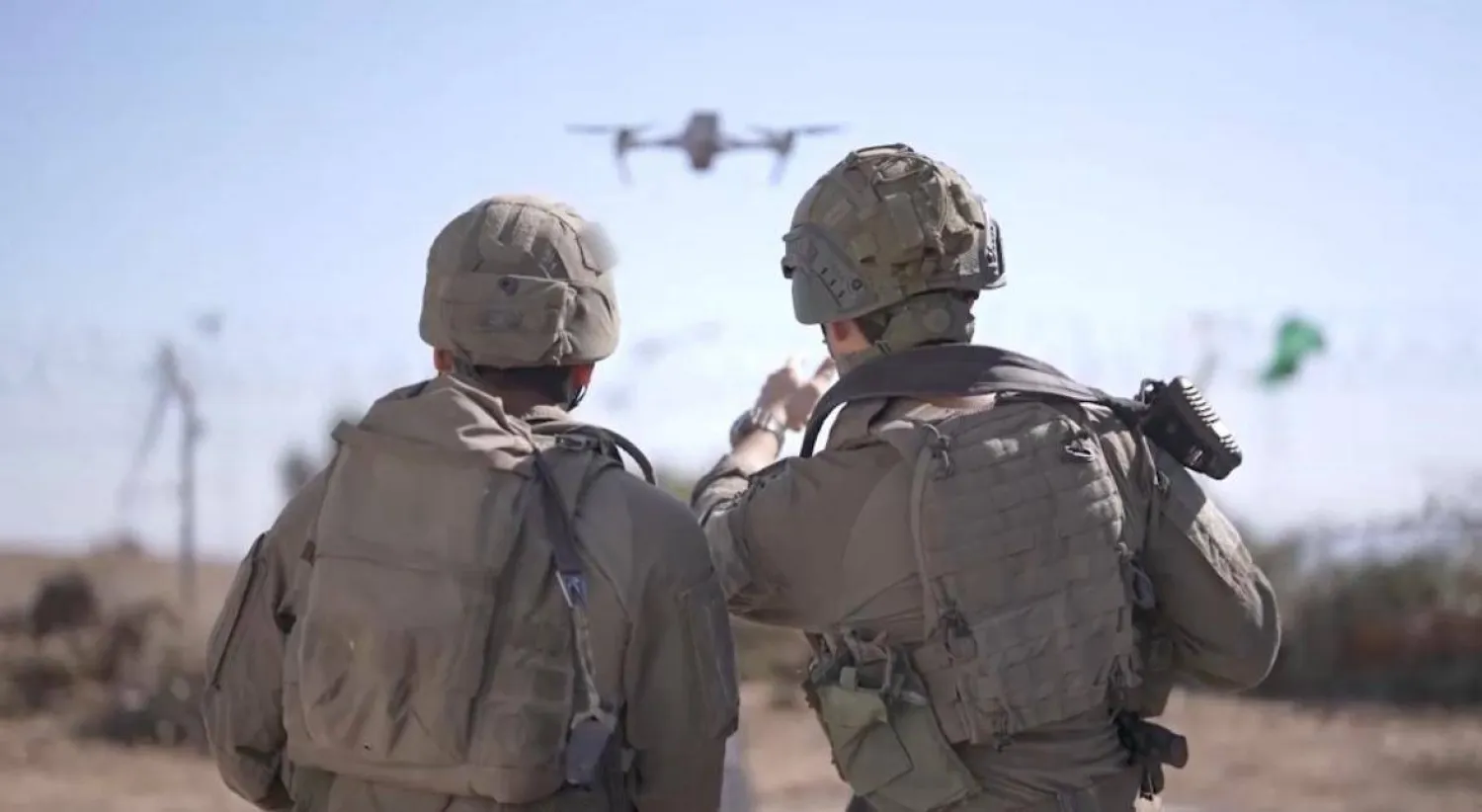
Two Israeli soldiers launch a drone. (Israeli Army)

The Israeli army is preparing to carry out “massive and unprecedented” strikes against groups backed by Iran, including the Houthis in Yemen, Hezbollah in Lebanon and armed factions in Iraq, should they join a potential war in the region, revealed Israeli military sources.

Iran is applying great pressure on these groups to take part in any upcoming conflict because the regime in Tehran concluded that their staying on the sidelines during the 12-day June war in 2025 was a strategic error, the sources said according to Israeli estimates.

Israeli Prime Minister Benjamin Netanyahu had on Thursday warned Iran that his country is making its own preparations for possible Iranian missile strikes in response to any US action.

“We are prepared for any scenario,” he said, adding that if Iran attacks Israel, “they will experience a response they cannot even imagine.”

A military source said the Houthis pose a “direct threat not just to Israel, but to the whole world.” He accused the Houthis of impeding international trade in the Red Sea.

Even though the Houthis are not firing at all ships, they are still a threat to everyone, added the source. The militants are producing weapons and possess advanced technology, he warned, comparing them to a “dangerous ticking timebomb that must be swiftly neutralized.”

Israeli and foreign experts revealed that Iran is providing large financial support to its allied armed groups in the region in order for them to join a war should US President Donald Trump act on his threat to strike Iran.

In 2025, Iran allotted a billion dollars to these groups so that they can carry out rocket attacks against Israel.

It remains to be seen if these groups will respond to Iran’s pressure. Israeli estimates believe that the Kataib Hezbollah in Iraq are unlikely to join a war, while Hezbollah and the Houthis are more prepared to do so.

Israel has turned to mediators to warn these parties that any attack against it will be met with a “massive and unprecedented response.”

In Lebanon, the sources said that the military operations Israel is carrying out against Hezbollah and other armed groups are aimed at undermining the party’s efforts to bolster its combat abilities.

They acknowledged, however, that the Israeli military establishment senses that Hezbollah is rebuilding its capabilities at a faster pace than Israel’s operations at reining it in.

The Houthis, meanwhile, have a relatively greater margin of independence, but they are always ready to take part in any regional war to shift attention away from the situation inside Yemen, said Israeli estimates.

The Houthis are receiving Iranian funds to boost their military capabilities and produce more weapons. They also continue to smuggle weapons to Hamas in Gaza. Israel also accuses them of extorting several countries, whereby they pledge not to attack their ships in exchange for money.

The Houthis are ultimately fully supportive of Iran’s goals despite the blows they have been dealt by Israel. The Houthis are suffering from a drop in combat abilities. The pace of their training of fighters has also dropped, while their airports have been damaged in Israeli attacks and the Houthis are facing difficulties in rebuilding them.

Despite the losses, the Houthis are still a threat. They possess heavy long-range missiles and drones and still have the ability to shut Israel’s southern Eilat port.