


Coronavirus Origins Still a Mystery 3 Years into Pandemic

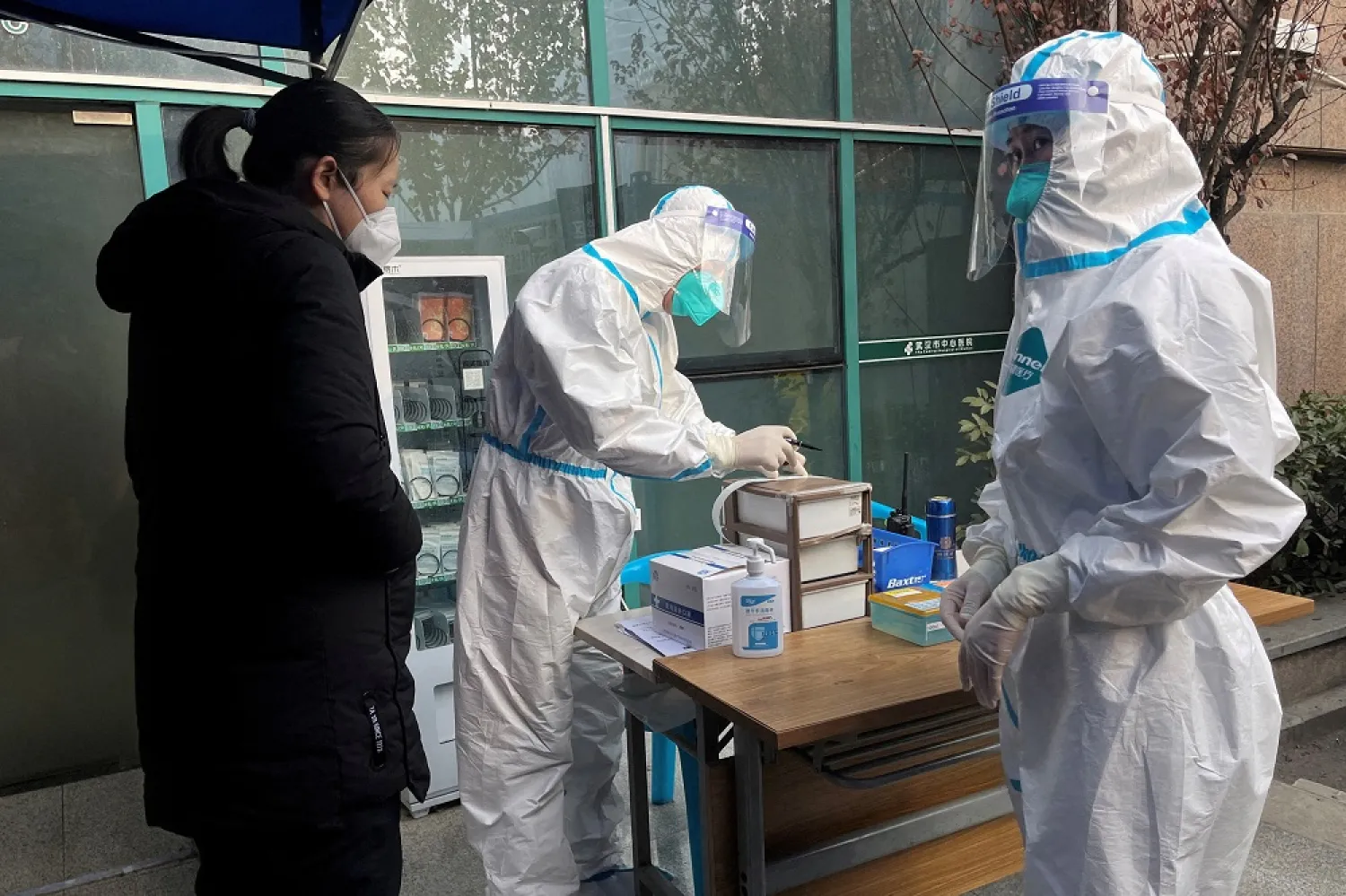
A medical worker in a protective suit registers information for a patient at the entrance to the fever clinic of the Central Hospital of Wuhan, amid of the coronavirus disease (COVID-19) outbreak, in Wuhan, Hubei province, China December 31, 2022. (Reuters)
TT

Coronavirus Origins Still a Mystery 3 Years into Pandemic

A medical worker in a protective suit registers information for a patient at the entrance to the fever clinic of the Central Hospital of Wuhan, amid of the coronavirus disease (COVID-19) outbreak, in Wuhan, Hubei province, China December 31, 2022. (Reuters)

A crucial question has eluded governments and health agencies around the world since the COVID-19 pandemic began: Did the virus originate in animals or leak from a Chinese lab?

Now, the US Department of Energy has assessed with “low confidence” in that it began with a lab leak, according to a person familiar with the report who wasn’t authorized to discuss it. The report has not been made public.

But others in the US intelligence community disagree.

“There is not a consensus right now in the US government about exactly how COVID started,” John Kirby, the spokesman for the National Security Council, said Monday. “There is just not an intelligence community consensus.”

The DOE's conclusion was first reported over the weekend in the Wall Street Journal, which said the classified report was based on new intelligence and noted in an update to a 2021 document. The DOE oversees a national network of labs.

White House officials on Monday declined to confirm press reports about the assessment.

In 2021, officials released an intelligence report summary that said four members of the US intelligence community believed with low confidence that the virus was first transmitted from an animal to a human, and a fifth believed with moderate confidence that the first human infection was linked to a lab.

While some scientists are open to the lab-leak theory, others continue to believe the virus came from animals, mutated, and jumped into people — as has happened in the past with viruses. Experts say the true origin of the pandemic may not be known for many years — if ever.

Calls for more investigation

The US Office of the Director of National Intelligence declined to comment on the report. All 18 offices of the US intelligence community had access to the information the DOE used in reaching its assessment.

Alina Chan, a molecular biologist at the Broad Institute of Massachusetts Institute of Technology and Harvard, said she isn’t sure what new intelligence the agencies had, but “it’s reasonable to infer” it relates to activities at the Wuhan Institute of Virology in China. She said a 2018 research proposal co-authored by scientists there and their US collaborators “essentially described a blueprint for COVID-like viruses.”

“Less than two years later, such a virus was causing an outbreak in the city,” she said.

The Wuhan institute had been studying coronaviruses for years, in part because of widespread concerns — tracing back to SARS — that coronaviruses could be the source of the next pandemic.

No intelligence agency has said they believe the coronavirus that caused COVID-19 was released intentionally. The unclassified 2021 summary was clear on this point, saying: “We judge the virus was not developed as a biological weapon.”

“Lab accidents happen at a surprising frequency. A lot of people don’t really hear about lab accidents because they're not talked about publicly,” said Chan, who co-authored a book about the search for COVID-19 origins. Such accidents “underscore a need to make work with highly dangerous pathogens more transparent and more accountable.”

Last year, the World Health Organization recommended a deeper probe into a possible lab accident. Chan said she hopes the latest report sparks more investigation in the United States.

China has called the suggestion that COVID-19 came from a Chinese laboratory “baseless.”

Support for animal theory

Many scientists believe the animal-to-human theory of the coronavirus remains much more plausible. They theorize it emerged in the wild and jumped from bats to humans, either directly or through another animal.

In a 2021 research paper in the journal Cell, scientists said the COVID-19 virus is the ninth documented coronavirus to infect humans — and all the previous ones originated in animals.

Two studies, published last year by the journal Science, bolstered the animal origin theory. That research found that the Huanan Seafood Wholesale Market in Wuhan was likely the early epicenter. Scientists concluded that the virus likely spilled from animals into people two separate times.

“The scientific literature contains essentially nothing but original research articles that support a natural origin of this virus pandemic,” said Michael Worobey, an evolutionary biologist at the University of Arizona who has extensively studied COVID-19's origins.

He said the fact that others in the intelligence community looked at the same information as the DOE and “it apparently didn't move the needle speaks volumes.” He said he takes such intelligence assessments with a grain of salt because he doesn't think the people making them “have the scientific expertise ... to really understand the most important evidence that they need to understand.”

The US should be more transparent and release the new intelligence that apparently swayed the DOE, Worobey said.

Reaction to the report

The DOE conclusion comes to light as House Republicans have been using their new majority power to investigate all aspects of the pandemic, including the origin, as well as what they contend were officials’ efforts to conceal the fact that it leaked from a lab in Wuhan. Earlier this month, Republicans sent letters to Dr. Anthony Fauci, National Intelligence Director Avril Haines, Health Secretary Xavier Beccera and others as part of their investigative efforts.

The now retired Fauci, who served as the country’s top infectious disease expert under both Republican and Democratic presidents, has called the GOP criticism nonsense.

Rep. Mike McCaul, R-Texas, chairman of the House Foreign Affairs Committee, has asked the Biden administration to provide Congress with “a full and thorough” briefing on the report and the evidence behind it.

Kirby, the National Security Council spokesman, emphasized that President Joe Biden believes it's important to know what happened “so we can better prevent future pandemics” but that such research “must be done in a safe and secure manner and as transparent as possible to the rest of the world.”



Heavy Snow in Poland Leaves Drivers Stranded in Tailbacks of up to 20 Km

Cars drive on a road during heavy snowfall in central Warsaw, Poland, 30 December 2025. (EPA)
TT

Heavy Snow in Poland Leaves Drivers Stranded in Tailbacks of up to 20 Km

Cars drive on a road during heavy snowfall in central Warsaw, Poland, 30 December 2025. (EPA)

Heavy snowfall in Poland caused tailbacks stretching as far as 20 km (12.43 miles) on a motorway between ​the capital Warsaw and the Baltic port city of Gdansk during the night, police said on Wednesday.

While the situation left hundreds of people trapped in their cars in freezing conditions, by the early hours of ‌Wednesday morning traffic ‌was moving again, ‌according ⁠to ​police.

"The ‌difficult situation began yesterday after 4 p.m., when the first trucks on the S7 route... began having trouble approaching the slopes," said Tomasz Markowski, a spokesperson for police in the northern city of ⁠Olsztyn.

"This led to a traffic jam stretching approximately ‌20 kilometers overnight." Deputy Infrastructure Minister ‍Stanislaw Bukowiec ‍told a press conference that nobody had ‍been hurt as a result of the difficult situation on the roads.

Anna Karczewska, a spokesperson for police in Ostroda, said officers had ​tried to help drivers who found themselves stuck. Ostroda lies on ⁠the highway about 40 km west of Olsztyn.

"We helped as much as we could, and we had coffee and hot tea for the drivers, which the Ostroda City Hall had prepared for us," she said.

State news agency PAP reported that there had also been some disruption to railways and airports, ‌but that services were returning to normal.


Infant Screen Exposure Shapes Long-Term Brain Changes and Teen Anxiety, Study Finds  

The study concluded that children exposed to high levels of screen time before age two are exposed to endure adolescent mental health. (The University of Queensland)
TT

Infant Screen Exposure Shapes Long-Term Brain Changes and Teen Anxiety, Study Finds  

The study concluded that children exposed to high levels of screen time before age two are exposed to endure adolescent mental health. (The University of Queensland)

Children exposed to high levels of screen time before age two showed changes in brain development that were linked to slower decision-making and increased anxiety by their teenage years, according to new study released by the Agency for Science, Technology and Research in Singapore.

Prepared in collaboration with the National University of Singapore (NUS) Yong Loo Lin School of Medicine, the study focuses on infancy, a period when brain development is most rapid and especially sensitive to environmental influences.

The amount and type of screen exposure in infancy are largely determined by parental and caregiver awareness and parenting practices, highlighting a critical window for early guidance and intervention, showed the study, published in eBioMedicine on Tuesday.

It said the researchers followed 168 children before age two and conducted brain scans at three time points (ages 4.5, 6, and 7.5), which allowed them to track how brain networks developed over time rather than relying on a single snapshot.

Children with higher infant screen time showed an accelerated maturation of brain networks responsible for visual processing and cognitive control.

The researchers suggest this may result from the intense sensory stimulation that screens provide. Notably, screen time measured at ages three and four did not show the same effects, underscoring why infancy is a particularly sensitive period.

The study showed that children with high screen exposure, the networks controlling vision and cognition specialized faster, before they had developed the efficient connections needed for complex thinking. This can limit flexibility and resilience, leaving the child less able to adapt later in life.

It said this premature specialization came at a cost: children with these altered brain networks took longer to make decisions during a cognitive task at age 8.5, suggesting reduced cognitive efficiency or flexibility.

Those with slower decision-making, in turn, reported higher anxiety symptoms at age 13. These findings suggest that screen exposure in infancy may have effects that extend well beyond early childhood, shaping brain development and behavior years later.

In a related study, the same team found that infant screen time is also associated with alterations in brain networks that govern emotional regulation — but that parent-child reading could counteract some of these brain changes.

Researchers found that their results give a biological explanation for why limiting screen time in the first two years is crucial.

“But it also highlights the importance of parental engagement, showing that parent-child activities, like reading together, can make a real difference,” said Asst Prof Tan Ai Peng, Clinician-Scientist at NUS, and the study's senior author.

The study concluded that children exposed to high levels of screen time before age two are exposed to endure adolescent mental health, particularly on cognitive performance and anxiety levels.


Indonesia Raises Alert for Mount Bur Ni Telong Volcano after Spike of Activity

Explosive activity concentrates at the north-east crater of the Mount Etna, as an eruption started on Dec. 24 continues, in Sicily, Italy, Monday Dec. 29, 2025. (AP Photo/Salvatore Allegra)
TT

Indonesia Raises Alert for Mount Bur Ni Telong Volcano after Spike of Activity

Explosive activity concentrates at the north-east crater of the Mount Etna, as an eruption started on Dec. 24 continues, in Sicily, Italy, Monday Dec. 29, 2025. (AP Photo/Salvatore Allegra)

Indonesian authorities have raised the alert level for the Mount Bur Ni Telong volcano in the country’s westernmost province of Aceh to its second highest following a series of increased activity and volcanic earthquakes, official said Wednesday.

The 2,624-meter (8,600-foot) stratovolcano in Aceh's Bener Meriah regency recorded at least seven earthquakes on Tuesday evening that were felt about five kilometers (three miles) away, while seismographs also detected seven shallow volcanic earthquakes along with 14 deep quakes and two tectonic quakes, said Lana Saria, the acting head of the Geological Agency at Energy and Mineral Resources Ministry.

She said based on the results of visual and instrumental monitoring which show the occurrence of increased volcanic activity for Mount Bur Ni Telong, scientists raised the alert level from the third to the second highest level Tuesday evening.

“Aftershocks following local tectonic events indicate magma activity is easily triggered by tectonic disturbances,” Saria said, adding that the increase in seismic activity has been ongoing since July and became more intense and shallow in the past two months.

According to The Associated Press, the agency's visual monitoring showed the volcano clearly visible with no crater smoke. However, she warned of possible eruption, including phreatic blasts and hazardous volcanic gases near areas with fumaroles and solfataras, openings in the Earth’s crust that emit steam and gases.

Authorities urged residents and visitors to stay at least 4 kilometers (2.4 miles) from the crater and avoid fumarole and solfatara zones during cloudy or rainy weather because gas concentrations can be life-threatening.

The heightened alert came as the Bener Meriah area is still recovering from catastrophic floods and landslides earlier this month that struck 52 cities and regencies on Sumatra island, leaving 1,141 people dead with 163 residents still missing and more than 7,000 injured, the National Disaster Management Agency said. In Bener Meriah alone, 31 people died and 14 are still missing after the floods and landslides hit the regency, disrupting access to remote villages and displacing more than 2,100 residents.

Local media said people living in three villages within a 2-kilometer (1.2-mile) radius from the crater are being evacuated as officials fear that heavy rains combined with volcanic activity could worsen conditions and complicate evacuation efforts.

Indonesia, an archipelago of more than 280 million people, has over 120 active volcanoes. It is prone to volcanic activity because it sits along the “Ring of Fire,” a horseshoe-shaped series of seismic fault lines around the Pacific Ocean.