


EU Diplomat Demands Accountability Following Israeli Settler Rampage in West Bank

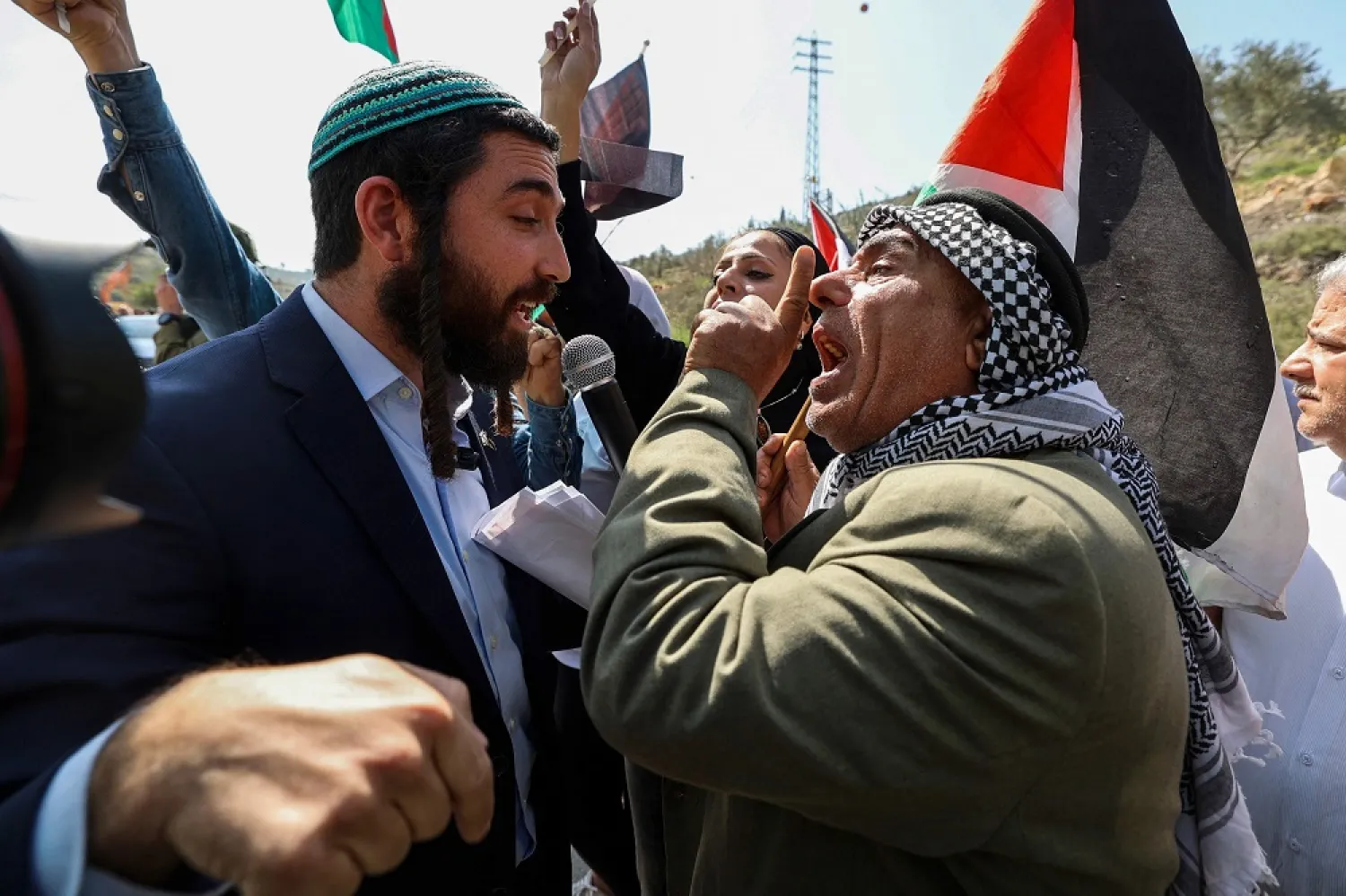
Knesset (Parliament) member for Israel's Religious Zionism party Tzvi Sukkot (L) is confronted as he tries to interrupt a rally by Palestinian and Israeli peace activists protesting at the entrance of Huwara in the occupied West Bank, on March 3, 2023, following deadly violence by Israeli settlers. (AFP)
TT

EU Diplomat Demands Accountability Following Israeli Settler Rampage in West Bank

Knesset (Parliament) member for Israel's Religious Zionism party Tzvi Sukkot (L) is confronted as he tries to interrupt a rally by Palestinian and Israeli peace activists protesting at the entrance of Huwara in the occupied West Bank, on March 3, 2023, following deadly violence by Israeli settlers. (AFP)

The European Union's envoy to the Palestinians called on Friday for accountability and for perpetrators to be brought to justice after a rampage by Israeli settlers this week in the occupied West Bank in which one Palestinian was killed and dozens of houses, shops and cars were torched.

Ambassador Sven Kuhn von Burgsdorff, heading one of the biggest EU delegations to visit the West Bank, said the officials wanted to see with their own eyes the damage left by Sunday's violence in and around the Palestinian village of Huwara. The rampage followed a Palestinian gun attack that killed two Israeli brothers.

"It is absolutely necessary for us that accountability is fully ensured, that the perpetrators be brought to justice, that those who lost property be compensated," Kuhn von Burgsdorff said.

Local media reported that, in a rare move, Israel's Defense Minister Yoav Gallant on Thursday signed administrative detention orders for two suspects over the rampage, after a Jerusalem court ordered police to release all seven people who had been detained in connection with the rampage.

Amnesty International condemned the release of the suspects in a statement on Friday. It also condemned the use of administrative detention, which it said was a practice that violated international law.

Israeli rights group Yesh Din found that 93% of investigations into settler attacks in the West Bank between 2005 and 2022 were closed without indictment.

Israeli Major General Yehuda Fuchs, who commands the Israeli military in the area, said on Tuesday that his forces had prepared for attempted settler retribution over the gun attack but had been surprised by the intensity of the violence, which he said was perpetrated by dozens of people. He called it a "pogrom carried out by outlaws".

Violence in the West Bank has surged over the past year with stepped-up Israeli military raids following a spate of Palestinian attacks. The United States, Jordan and Egypt have appealed for calm, concerned about an escalation ahead of the Muslim holy month of Ramadan and the Jewish Passover festival in late March and early April.

Washington’s call to Netanyahu

The United States has demanded that Israeli Prime Minister Benjamin Netanyahu disavow a call on Wednesday by far-right Finance Minister Bezalel Smotrich for the village of Huwara to be erased.

On the night of the rampage, Netanyahu urged people not to take the law into their own hands, but he has not publicly addressed Smotrich's statement or responded to the unusual criticism by Washington, a close ally.

The UN human rights chief on Friday criticized Smotrich for his remarks, describing them as "an unfathomable statement of incitement to violence and hostility".

Volker Turk was addressing the Geneva-based UN Human Rights Council, where he formally presented a report on the situation in the occupied Palestinian territories.

Late on Thursday, Palestinian officials said Israeli forces shot dead 15-year-old Mohammad Nidal Saleem in the back in the West Bank town of Azzoun.

Ahmad Enaya, the town's mayor, said an Israeli military vehicle drove into town and when teens hurled rocks at the car, soldiers responded with live fire.

The Israeli military said in a statement that soldiers shot at suspects who had hurled explosives at forces while they were conducting a search in the area for people who launched fireworks at Israeli vehicles passing near Azzoun.

It said it was aware of reports of people being wounded but did not confirm any Palestinian fatalities.

A statement by the public hospital in Qalqilya, near Azzoun, said two other people were treated for gunshot wounds.

"The terrorism waged by settlers, in cooperation with the occupation government, is unprecedented," said Walid Assaf, a former Palestinian Authority official who monitored Israeli settlements, speaking at Saleem's funeral in Azzoun on Friday.

At least 62 Palestinians, including gunmen and civilians, have been killed since the start of 2023, the Palestinian health ministry said. Thirteen Israelis and a Ukrainian tourist died in Palestinian attacks in the same period, according to official Israeli figures.

Palestinians seek to establish a state in the West Bank, East Jerusalem and Gaza, areas Israel captured in a 1967 war.

"We Palestinians will remain steadfast and we will defend our existence in the face of this occupation," said Assaf.



Sudanese Paramilitary Forces Kill at Least 28 People in an Attack in Darfur

FILE PHOTO: Displaced people ride a an animal-drawn cart, following Rapid Support Forces (RSF) attacks on Zamzam displacement camp, in the town of Tawila, North Darfur, Sudan April 15, 2025. REUTERS/Stringer/File Photo
TT

Sudanese Paramilitary Forces Kill at Least 28 People in an Attack in Darfur

FILE PHOTO: Displaced people ride a an animal-drawn cart, following Rapid Support Forces (RSF) attacks on Zamzam displacement camp, in the town of Tawila, North Darfur, Sudan April 15, 2025. REUTERS/Stringer/File Photo

An attack by the Sudanese paramilitary forces on a stronghold of a Darfur tribal leader left at least 28 people dead, a doctors group said on Tuesday.

The paramilitary Rapid Support Forces on Monday rampaged through the town of Misteriha in North Darfur province, according to the Sudan Doctors Network, which tracks the country’s ongoing war.

The town is a stronghold of tribal leader Musa Hilal who also hails from the Rizeigat tribe as the majority of the members of the paramilitary RSF.

At least 39 people, including 10 women, were wounded in the attack, the medical group said.

Sudan’s war erupted in 2023 after tensions between the Sudanese army and the rival RSF escalated into fighting that began in Khartoum and spread nationwide, killing thousands, triggering mass displacement, disease outbreaks, and severe food insecurity. Aid workers were frequently targeted.


Hamas Calls for Sanctions Against Israel Over New West Bank Moves 

A drone view shows Kedar Sheep farm, an Israeli outpost in the Israeli-occupied West Bank, January 20, 2026. (Reuters)
TT

Hamas Calls for Sanctions Against Israel Over New West Bank Moves 

A drone view shows Kedar Sheep farm, an Israeli outpost in the Israeli-occupied West Bank, January 20, 2026. (Reuters)

Hamas on Tuesday called for sanctions against Israel, welcoming a joint condemnation by nearly 20 countries of new Israeli measures aimed at tightening control over the occupied West Bank.

Israel has approved a series of initiatives this month backed by far-right ministers, including launching a process to register land in the West Bank as "state property" and allowing Israelis to purchase land there directly.

Late on Monday, 18 countries including Saudi Arabia, Egypt, and European powers France and Spain, slammed Israel over the recent moves.

They "are part of a clear trajectory that aims to change the reality on the ground and to advance unacceptable de facto annexation", the countries said.

"Such actions are a deliberate and direct attack on the viability of the Palestinian state and the implementation of the two-state solution."

Hamas hailed the condemnation as "a step in the right direction in confronting the occupation's expansionist plans, which flagrantly violate international law and relevant UN resolutions".

The group in a statement urged the countries involved "to impose deterrent sanctions and exert pressure on the fascist occupation government to halt its policies aimed at entrenching annexation, colonial settlement and forced displacement".

It said the Israeli measures were part of ongoing "aggression" against Palestinians in the West Bank and Gaza.

In addition to roughly three million Palestinians, more than 500,000 Israelis live in settlements and outposts in the West Bank, which are considered illegal under international law.

Israel's current government has accelerated settlement expansion, approving a record 54 settlements in 2025, according to activists.

The West Bank, which Israel has occupied since 1967, is envisioned as the core of a future Palestinian state, but many on Israel's religious right view it as part of Israel's historic homeland.


Israel Seeking Direct Military Coordination with Lebanon 

Lebanese soldiers and UNIFIL forces on patrol in Naqoura southern Lebanon. (Reuters file)
TT

Israel Seeking Direct Military Coordination with Lebanon 

Lebanese soldiers and UNIFIL forces on patrol in Naqoura southern Lebanon. (Reuters file)

Israel is seeking to alter the post-ceasefire coordination mechanism along the Lebanese border by establishing direct contact with the Lebanese army, bypassing the United Nations peacekeeping force deployed in the south, said Israeli media.

The proposal has reignited debate in Beirut over the future of UN Security Council Resolution 1701 and the role of international oversight in southern Lebanon, with Lebanese officials insisting that any modification must remain strictly within the United Nations framework.

Reports attributed to Israel’s security establishment say the United Nations Interim Force in Lebanon (UNIFIL) has recently adopted what Israeli officials describe as a “confrontational stance” toward the Israeli military.

Israeli media quoted officials as telling American counterparts that direct coordination between the Israeli military and the Lebanese army would be preferable to the current arrangement, which operates through UNIFIL. Some officials reportedly argued that the peacekeeping force now causes “more harm than benefit.”

The Israeli Public Broadcasting Corporation said Israel’s security establishment believes UNIFIL has grown increasingly “hostile” in recent weeks.

The force’s mandate in southern Lebanon is due to expire at the end of this year.

Lebanese officials have responded by underscoring that the country’s position remains anchored in international legality and UN authority.

Fadi Alame, head of the Foreign Affairs and Immigrants Committee in Lebanon’s parliament, said Israeli media discussions “do not bind Lebanon,” stressing that “Lebanon’s sole reference remains the international resolutions issued by the United Nations.”

Speaking to Asharq Al-Awsat, Alame reiterated Lebanon’s commitment to Resolution 1701 and expressed support for UNIFIL.

He said the force monitors implementation of the resolution and safeguards Lebanon’s rights and sovereignty within the UN framework.

“As long as there is a UN resolution in force, any amendment or termination must occur through the United Nations itself,” he stated. “International law requires an international monitoring body as long as the resolution remains in effect.”

Addressing speculation about replacing UNIFIL or shifting to direct coordination with the Lebanese army, Alame said Beirut’s official stance remains unchanged.

“Lebanon is committed to Resolution 1701 under a clear government decision,” he underlined. “For us, Resolution 1701 and other UN resolutions remain the foundation.”

He added that Lebanon is awaiting a report from the UN secretary-general in June that is expected to outline potential options. These could range from maintaining the current international force to introducing a European-led presence or increasing the number of international observers.

Any proposal, he stressed, would remain subject to UN approval.

Meanwhile, a Lebanese ministerial source told Asharq Al-Awsat that Israel’s proposal for direct coordination without UNIFIL “raises questions,” noting that the peacekeeping force is already embedded in the existing tripartite coordination mechanism.

Communication with Israel is conducted through UNIFIL under an established framework, the source explained, adding that Lebanon insists on maintaining an international sponsor and monitoring body as long as Resolution 1701 has not been fully implemented.

European proposals remain under discussion, including the possibility of a European-led force under French supervision or a mission focused on training and equipping the Lebanese army to assume expanded responsibilities. However, these ideas have yet to crystallize and remain tied to future political and security developments.

The debate follows a UN Security Council decision in August 2025 to extend UNIFIL’s mandate until December 31, 2026, with a coordinated drawdown planned to begin the following year.

UNIFIL has been deployed in southern Lebanon since 1978. It serves as a monitoring and buffer force, overseeing implementation of Resolution 1701 and supporting the Lebanese army’s deployment south of the Litani River.